
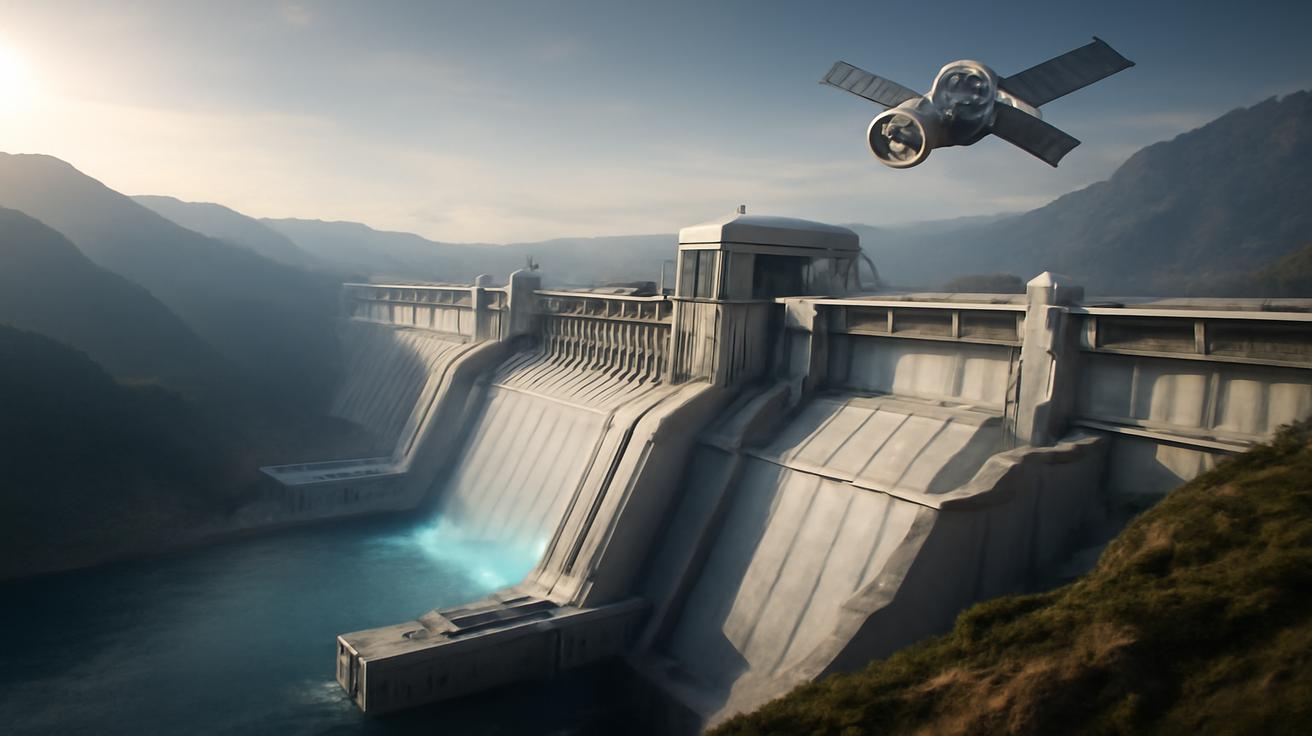
The rumor arrived, as these things often do, like a lightning bolt in a clear sky: NASA has confirmed it—China is about to slow down the rotation of the Earth with a titanic new project. You might have seen it in a headline, heard it in a breathless podcast, or watched it ripple across social media as if the planet itself had hiccuped. For a brief, dizzy moment, you probably imagined clocks stuttering, tides misbehaving, and sunrises arriving a little late, like trains on a foggy morning.
There is something deeply human about that spark of awe and unease. We live on a spinning stone we almost never feel, orbiting a star we mostly ignore until it burns too hot or disappears behind clouds. The idea that a single human project—no matter how grand—could reach up and lay a hand on that cosmic flywheel touches an ancient nerve. It feels like myth. It feels like hubris. It feels possible in the way that only modern technology does: obscure, technical, and just far enough beyond understanding that anything seems on the table.
So let’s stand on the shoreline of this story together, feel the pull of that rumor, and follow it outward—across physics, politics, engineering, and the quiet, steady heartbeat of the planet itself—toward what NASA actually says, what China is really building, and what it would truly take to slow the Earth.
The Whisper That Shook the World
The first time you hear it, you can almost picture the scene: a vast Chinese megaproject—perhaps a colossal dam, a planet-scale wind farm, or a gleaming orbital ring—so huge, so heavy, so mind-bending in scope that its mere existence drags on Earth’s spin. Maybe you imagine enormous turbines biting into the jet stream, or a network of artificial islands pushing against ocean currents like breaks on a cosmic wheel.
In this version of the tale, NASA lingers in the background like a sober parent in a disaster movie, grimly confirming what the public already fears: yes, this is real; yes, we’ve run the numbers; yes, the days are getting longer because of something we built.
It’s a compelling story because it lives at the intersection of everything we find most dramatic: rising global powers, cutting-edge technology, and the fragile, mysterious machinery of the planet. It plays on a suspicion that our inventions and ambitions, however brilliant, are starting to push against the walls of the cage we live in.
But stories can be magnetic without being true. To untangle this one, we first have to understand how stubborn Earth’s rotation actually is—and just how hard it is to nudge something that massive, that fast, and that old.
The Planet That Refuses to Budge
Let’s imagine, for a moment, that you could leave the atmosphere and watch the Earth from a quiet dark balcony in space. Below you, the planet turns once every 23 hours, 56 minutes, and 4 seconds—one full spin, a day in astronomical terms. At the equator, the surface is racing eastward at over 1,600 kilometers per hour, even though it feels to us like we’re standing still. That speed isn’t just motion; it’s momentum. It’s the memory of how the Earth was born.
More than four billion years ago, our planet coalesced from dust and rock and violent collisions. Whatever angular momentum those chaotic beginnings bestowed upon us is still what keeps the Earth turning today. To slow it down in any measurable way, you’d have to push against that ancient spin with unimaginable force or redistribute enough mass around the planet to alter how that spin is expressed.
Nature can do this—very slowly. The Moon, for instance, pulls on our oceans, raising tides that drag against the seafloor. That constant tug acts like a tiny brake. Over millions of years, it’s been lengthening our days, one imperceptible fraction of a second at a time. In the deep past, a day on Earth was much shorter. Now, thanks largely to tidal interactions, it has stretched out like a rubber band over geological ages.
We know this not because a giant cosmic stopwatch is hanging above our heads, but because humanity has become very, very good at keeping time. NASA and other institutions use networks of atomic clocks and laser measurements to track Earth’s rotation with astonishing precision. They can detect seasonal wobbles caused by shifting air masses, slight changes when glaciers melt, and offsets so minute they’re expressed in milliseconds.
When you’ve seen the planet with that level of clarity, you start to understand something crucial: if a human project were large enough to measurably slow Earth’s spin, it wouldn’t be a rumor. It would be the loudest, strangest engineering conversation in human history—and everyone from NASA to school science teachers would be talking about nothing else.
What NASA Actually Measures—and What It Says
Here is the quiet, grounded truth: NASA does indeed track the changes in Earth’s rotation. It publishes data, studies long-term trends, and collaborates with observatories and timing centers around the globe. Its scientists are deeply interested in why days lengthen or shorten by tiny amounts over time.
But those changes come from things like:
- Shifting air and water masses in the atmosphere and oceans.
- Melting ice sheets redistributing weight from polar caps to the seas.
- Earthquakes and tectonic rearrangements of rock deep beneath our feet.
- Tidal interactions with the Moon and the Sun.
When NASA’s researchers talk about millisecond variations in the length of day, they’re not pointing fingers at any single nation’s dam or bridge or skyscraper. They’re describing a planet that moves like a living thing, its spin subtly shaped by winds, currents, and internal flows that never quite repeat themselves.
So where does China enter the story? The answer says as much about our anxieties as it does about the facts on the ground—or in orbit.
The Scale of China’s “Titanic” Projects
China has been building big things. The Three Gorges Dam, completed on the Yangtze River, is among the largest hydroelectric projects on Earth. The country has thrown its weight behind vast high-speed rail networks, sprawling coastal cities, and deep-space exploration: lunar missions, Mars probes, satellite constellations, and ambitious blueprints for future space stations and beyond.
From a distance, these efforts blur together into a single, colossal silhouette. Phrases like “mega-project,” “titanic engineering,” and “planet-scale infrastructure” cling to them. If any nation today seems poised to attempt something that might reach into the machinery of the planet itself, the narrative often points to China.
Add to that a simple physical idea: if you move enough mass around on a spinning object, you can change how it spins. Figure skaters do it every time they pull in their arms to spin faster or extend them to slow down. So the thought creeps in: if a country rearranges enough water, rock, or metal—through dams, artificial islands, or even space structures—couldn’t it do the same to Earth?
In the realm of physics, the answer is yes, in principle. In the realm of practicality, the answer is an overwhelming, resounding no—at least for now.
Could Any Human Project Really Slow the Earth?
Let’s imagine the boldest version of the rumor. Suppose China—or any coalition of nations—decides to build an orbital ring: a massive, continuous structure encircling the planet, or an enormous constellation of satellites acting in coordinated fashion, each one exerting tiny forces over long periods. Or think of something closer to home: a mega-dam so immense it bottles up enough water to change how mass is distributed across the Earth’s surface.
In both cases, the underlying idea is the same: change the distribution of mass or apply a sustained torque, and you slightly alter the rotational characteristics. That’s real physics. But the crucial word is slightly—so slightly that the change would be almost impossibly hard to tease out from the natural noise of the planet’s constantly shifting systems.
To slow Earth’s rotation in a way you could notice without precision instruments—say, lengthening the day by even one second—you’d need to move around or otherwise influence an inconceivable amount of mass, or push continuously for an immense time with forces far beyond any propulsion system we currently wield.
Scientists have occasionally modeled the impact of large dams on Earth’s rotation and polar motion. Yes, the effect exists. No, it is not significant at the scale our senses inhabit. These projects tweak the planet’s rotation parameters by tiny, measurable but utterly harmless margins—comparable to what seasonal changes in the atmosphere or oceans do all the time.
In fact, if you were somehow able to tally up the collective influence of every skyscraper, every reservoir, every road, and every space station humanity has ever built, you’d still be talking about minuscule effects, buried beneath the natural variability already at play.
| Phenomenon / Project | Typical Effect on Length of Day | How It Compares |
|---|---|---|
| Tidal braking by the Moon | ~1.7 milliseconds per century | Dominant long-term natural slowdown |
| Large earthquakes | Fractions of a millisecond | Barely detectable, short-term |
| Seasonal atmosphere & ocean shifts | Up to ~1 millisecond | Normal, recurring fluctuations |
| Massive dams & reservoirs | Microseconds to tiny fractions of a ms | Within natural background “noise” |
| Hypothetical human mega-projects | Theoretical, but extremely small | Orders of magnitude too weak to notice |
Seen in that light, the NASA “confirmation” begins to dissolve. Scientists do see changes in Earth’s spin. They do track them obsessively. But the fingerprint of a single, human-made project—no matter how grand—would be vanishingly faint against the planet’s own deep, restless movements.
Why the Myth Sticks—And What It Reveals
Even when the math doesn’t hold, the story refuses to go away. It flares up in online debates, in speculative videos, in anxious late-night conversations. Why does the idea that China might slow the Earth resonate so strongly?
One reason is scale shock. We are living through an era where things that once qualified as science fiction routinely become technical white papers, crowdfunding campaigns, or government programs. Artificial suns in experimental fusion reactors. Gene editing. Reusable rockets. Climate interventions that talk casually about “geoengineering” the entire atmosphere.
Against that backdrop, the leap from “we can alter the climate” to “we can alter the planet’s spin” doesn’t feel as big as it should. The scale slips quietly in our minds. We forget that the leap from regional climate to global rotation isn’t one step; it’s a hundred orders of magnitude.
Another reason is trust—or the lack of it. Large-scale projects, whether dams or data centers or high-altitude experiments, often emerge behind closed doors and advance with speeds that outpace public understanding. When we don’t feel invited into the conversation, rumors rush in to fill the silence.
In this sense, the myth that NASA “confirmed” a Chinese rotation-slowing project tells us something not about astronomy, but about how small and out-of-the-loop many people feel when they look up at the machinery of modern civilization. The planet is huge. The powers that build upon it are larger than any one of us. The rumor becomes a kind of folk story, giving shape to a vague fear: that someone, somewhere, might flip a switch and tilt the world under our feet.
What It Would Take to Truly Slow the Earth
Let’s indulge the idea one last time—but this time, let’s go all in. Suppose a future civilization really wanted to noticeably slow Earth’s rotation. Not by microseconds, but enough that days lengthen by minutes or hours over a human lifetime. What would it take?
The answer belongs in the same drawer as terraforming Mars or moving stars: a realm of engineering that reads like myth. You’d either have to:
- Apply vast, sustained torques—perhaps with gigantic space-based engines or tethers anchored to the Moon or enormous asteroids.
- Or incrementally transfer angular momentum away from Earth through gravitational interactions, nudging massive bodies in carefully choreographed orbits.
Both ideas, while permissible on paper, live far beyond anything our current technology can sniff at. The energies involved dwarf our total global output. The timescales would stretch across thousands or millions of years. And the side effects—wildly altered climate patterns, chaos in ecosystems adapted to a 24-hour rhythm, reorganized tides—would be catastrophic for life as we know it.
In other words, by the time a species can seriously consider slowing its planet, it has become something that would be nearly unrecognizable to us: not a collection of nations bickering over territory, but a unified civilization with the ability to rewrite planetary fates and, presumably, the wisdom—or folly—to decide whether it should.
Against that backdrop, the notion that any single nation today, no matter how ambitious, is quietly tugging on Earth’s rotation with a dam, a satellite project, or a space station sounds suddenly small and faintly absurd. Not because our tools are insignificant—they aren’t—but because the planet is so stubbornly, gloriously large.
Listening Closer to the Planet We Already Have
So where does this leave us, standing on this spinning globe, caught between rumors and realities? Perhaps with an invitation to tune our attention differently.
We cannot slow Earth’s rotation in any dramatic way, not yet. But we are unquestionably, measurably altering other aspects of the planet’s behavior. We are thickening its atmosphere with greenhouse gases, brightening or darkening patches of surface with agriculture and urban sprawl, changing the reflectivity of ice and ocean, redrawing the map of where water lives and where it doesn’t.
These things don’t show up as dramatic shifts in day length, but they ring through climate, weather, habitats, and the rhythms of countless species—including our own. They’re subtler than the sci-fi imagery of a slowing world, but more immediate and more demanding of our attention.
NASA’s true warnings, and those of other scientific bodies, are not about Earth’s spin grinding down under the weight of some titanic Chinese project. They’re about temperatures creeping upward, sea levels following, and the finely tuned systems that have held steady for thousands of years beginning to wobble in ways that matter deeply to our crops, our coasts, our cities, and our sense of home.
In a way, the myth of the slowed Earth is a misdirected instinct. We feel, on some deep level, that we are starting to push against planetary limits. The instinct is correct. The story it chooses is just wrong. The real drama is not in our days becoming longer; it’s in our summers stretching hotter, our storms growing wilder, and our familiar seasons slipping out of their old, reliable grooves.
FAQ: NASA, China, and Earth’s Rotation
Did NASA actually confirm that China will slow Earth’s rotation?
No. NASA has not confirmed that any Chinese project will significantly slow Earth’s rotation. NASA and other scientific institutions do monitor tiny variations in the length of the day, but these changes are due to natural processes and subtle global effects, not a single engineered project.
Can large dams or mega-projects affect Earth’s rotation at all?
Yes, in principle—but only in extremely small ways. Projects like large dams can slightly redistribute mass on Earth’s surface, leading to tiny changes in rotation or polar motion. These effects are measured in microseconds or fractions of a millisecond and are dwarfed by natural changes from atmosphere and ocean dynamics.
Is China planning any project explicitly designed to change the length of the day?
There is no credible scientific or governmental evidence that China is planning a project to change Earth’s rotation. Most references to such a plan trace back to misunderstandings, speculation, or sensationalized online content, not official engineering proposals.
How does NASA measure small changes in Earth’s rotation?
NASA works with international partners using atomic clocks, radio telescopes, satellite tracking, and laser ranging systems. These tools allow scientists to detect millisecond-level variations in Earth’s rotation and tiny shifts in the position of the planet’s axis.
Is Earth’s rotation really changing over time?
Yes, but very slowly. Tidal forces from the Moon are gradually slowing Earth’s rotation, lengthening the day by about 1.7 milliseconds per century. Short-term variations, influenced by weather, ocean currents, and other factors, cause small fluctuations around this long-term trend.
Could humanity ever intentionally slow Earth’s rotation in a big way?
In theory, it’s possible within the laws of physics, but the energy and engineering required are far beyond our current abilities. Any deliberate attempt to significantly slow the planet would take unimaginable resources and could cause severe environmental consequences, making it a highly unlikely goal for any civilization at our stage.
So what should we actually be worried about?
Instead of fearing that a single mega-project will slow the Earth, scientific consensus points us toward more immediate concerns: climate change, biodiversity loss, pollution, and the long-term sustainability of our technologies and economies. These are the real ways we are already reshaping the world we live on.







Leave a Comment