
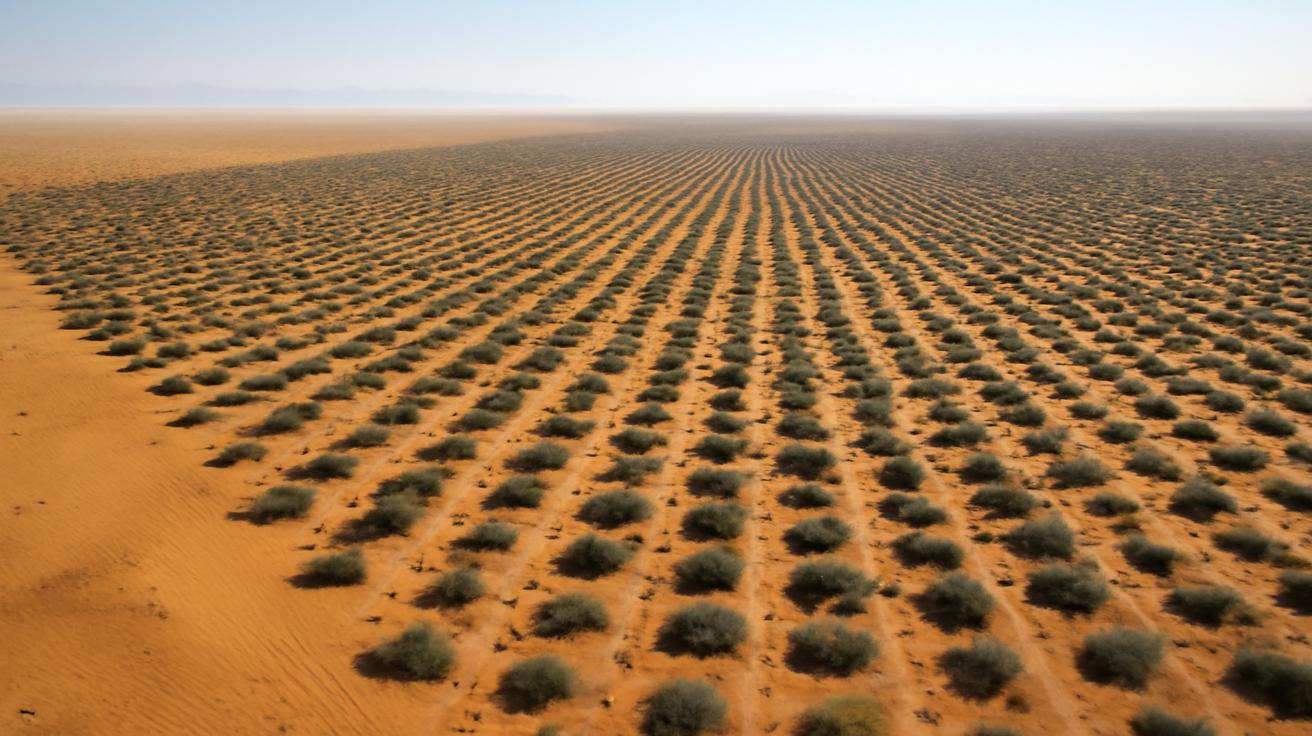
The first time I saw a desert come back to life, it was at dawn. The sky was still holding onto the last violet threads of night, and the air had that cold, metallic smell that only exists before the sun has fully made up its mind. What had been, just a few years earlier, a crusted, empty expanse of dust and stone now held a faint, improbable fuzz of green. Not much—just patches of low shrubs and seedlings, small shadows in the pale sand—but they changed everything. You could feel it in the way the ground held a touch more moisture, in the way beetles zigzagged over the soil, in the whisper of wings as a bird cut through the silence. This was not a miracle. It was math, sweat, seed, and something like stubborn hope. More than five million native plants had been reintroduced into deserts like this one across the world. And they were doing the quietly revolutionary work of slowing land degradation and rebooting arid ecosystems that once seemed lost.
The Quiet Crisis of Disappearing Deserts
We talk about melting ice caps, burning forests, and flooded cities. Deserts, by comparison, are often treated as static backdrops—already barren, already lost. But deserts are not empty. They are finely tuned, slow-burning ecosystems that depend on balance: between sparse rain and intense sun, between hardy plants and patient soils, between wind and the fragile crust that holds the land together.
When that balance breaks—through overgrazing, mining, off-road vehicles, poorly planned farming, or climate extremes—the desert doesn’t just “stay desert.” It degrades. The thin layer of life that protects the soil—roots, lichens, crusts, shrubs—gets stripped away. Wind lifts the topsoil and carries it off, sandstorms grow more violent, once-stable dunes begin to migrate, and drylands that once supported people and wildlife slip into something more like a planetary scar.
Across the world, from the Sahel’s shimmering horizons to the Mojave’s sun-cracked basins, this story has been repeating. By some estimates, billions of hectares of drylands are now degraded or at risk. But in the middle of that slow emergency, a counter-story has been taking shape: one seedling at a time, people are stitching the fabric of these landscapes back together.
Five Million Plants, One Big Experiment in Hope
Five million is an almost meaningless number until you stand among a few hundred of those plants and imagine them multiplied over valleys, dunes, and stony plains. In pilot projects from North Africa to the Arabian Peninsula, from Australia’s outback to South America’s dry corridors, restoration teams have been putting native plants back where they once thrived—and measuring what happens next.
It starts humbly. In a shaded nursery, rows of tiny seedlings—desert acacias, saltbush, sagebrush, tamarisk, wild grasses, spiny shrubs with names that catch in your throat—wait in trays. Many come from seeds collected by local communities, elders who still remember which plants once covered the hills, or by botanists combing dry riverbeds and rocky slopes for surviving pockets of diversity. Some seeds must be scarified, smoked, chilled, or soaked to coax them out of dormancy. Others wait patiently, as if timing their future with a storm they somehow sense coming.
Then come the teams: farmers who can read soil like a book, young technicians with data tablets, herders who know where livestock roam, and restoration ecologists tracking every step. They plant in furrows shaped to catch the rare rainfall, in crescent-shaped pits that slow runoff, in lines that break the wind’s ferocity. They use drip irrigation only when absolutely needed, sometimes only for the first season, sometimes not at all if the species is tough enough. Every sapling or clump of grass is a small wager that the desert is not done yet.
Once enough of these projects launched, the pattern started emerging. Where more than five million native plants have gone into the ground across multiple desert restoration initiatives, scientists tracking the land have begun to see a subtle but unmistakable shift.
How Native Plants Slow the March of Degradation
In a degraded desert, bare soil is the enemy. Exposed to sun and wind, it loses what little moisture falls. It erodes. It bakes into a hard crust that new life can’t penetrate. Each native plant is like a small barricade against that process.
Roots anchor the soil, turning loose dust into a more cohesive structure. When the wind rises—and it always does—it now hits stems and leaves that disrupt its speed near the surface. Sand drops out of the air, collecting in small drifts around plants instead of scouring the landscape bare. Over months and years, these plants become living windbreaks.
Leaves, even tiny desert leaves, shade the soil beneath them. In that narrow ring of shade, temperatures drop slightly, evaporation slows, and the next rare rain lingers a little longer in the ground. Dead leaves, fallen twigs, and even insect droppings collect around the base of the plant, starting the slow work of rebuilding organic matter. In the microscopic universe of soil, that organic matter is currency. It feeds microbes, which in turn improve the soil’s ability to absorb and store water.
Satellite images from test sites show measurable differences. Areas reintroduced with native shrubs and grasses have darker, rougher surfaces compared with adjacent bare land. Instruments record wind speeds closer to the ground dropping by small but significant amounts. Soil samples taken year after year reveal increases in carbon content, better structure, and reduced erosion.
On maps, these changes look like patches of slightly darker pixels. On the ground, they feel like this: the wind still stings your face, but the sand it carries hits your ankles a little less hard. The soil dust that used to hang in the air after every gust now often settles faster. Where vehicles once left deep scars, their tracks soften and disappear more quickly under new growth. Desert degradation hasn’t stopped, but in these zones, it’s losing its momentum.
Rebooting an Ecosystem, One Microclimate at a Time
The real magic begins when those scattered plants stop behaving like individuals and start acting like a community. Once enough native vegetation has taken hold—sometimes as little as 15–25 percent ground cover in arid systems—the desert’s internal feedback loops begin to shift.
Small islands of shade and moisture form at the base of plants. In these pockets, seeds that would have dried out on open ground now have a chance to germinate. Some drift in on the wind, some arrive in the guts of birds, or clinging to fur and feathers, or hidden in the cracks of hoofprints. In time, second-generation seedlings appear not just where humans planted them, but in the spaces in between.
Insects are often the first to respond. Ants, beetles, and solitary bees show up, drawn by nectar, shelter, or the simple complexity of the new vegetation. Their burrowing further aerates the soil. Lizards follow the insects. Small mammals follow the seeds and cover. Snakes follow the small mammals. Raptors follow the snakes. Such is the patient choreography of recovery.
Listen closely as you walk through one of these recovering zones and the difference from a fully degraded site is subtle but profound. There is the dry clink of beetles knocking against plant stems, the faint ticking of lizards moving over gravel, the occasional wingbeat or chirp that punctures the silence. You notice that not every footprint collapses into dust anymore. Under your boot, some of the soil has structure, like cake instead of powder.
Scientists speak of “functional diversity” and “trophic webs,” but what it really feels like is this: the desert, which once seemed brittle and one-dimensional, begins to acquire layers again. Layers of shade, layers of sound, layers of life that interact and reinforce each other.
People of the Drylands: Co‑Creators in Recovery
No story about restoring deserts is complete without the people whose lives braid through these landscapes. Many of the most successful projects are not grand, top‑down engineering feats but community‑rooted efforts that borrow from both tradition and modern science.
Pastoralists who once had to drive their herds farther every year in search of forage are now involved in planning grazing rotations that allow newly planted zones to rest. Farmers are experimenting with agroforestry on the desert’s edge—planting native shrubs and trees alongside drought‑tolerant crops, using the taller plants to shield the soil and reduce evaporation.
Women’s cooperatives in some regions manage nurseries, propagating native species for sale to restoration projects and local households. Youth groups track plant survival with smartphone apps, feeding data back to researchers who tweak planting strategies in near real time: different spacing here, slight changes to micro‑catchments there, a switch to deeper‑rooted species on that slope where winds are fiercer.
This collaboration doesn’t just improve the survival of those five million plants; it builds something harder to measure: a sense that the desert is not a doomed place but a living system worth tending. Knowledge flows both ways. Ecologists learn which plants goats will absolutely eat no matter how many fences you build. Elders point out shrubs with medicinal or cultural importance that never made it into academic species lists.
Lessons From Five Million Plants: What the Numbers Say
Strip away the poetry for a moment, and what’s left are measurable outcomes. Across multiple desert restoration projects that collectively count more than five million native plants reintroduced, monitoring teams are finding patterns that repeat, despite differences in culture, climate, and soil.
| Change Observed | Typical Range After 5–10 Years | What It Means on the Ground |
|---|---|---|
| Reduction in wind erosion | 10–40% decrease in soil loss | Fewer dust storms, more stable dunes and fields |
| Increase in vegetation cover | +15–35% ground cover | More shade, better water retention, cooler soil |
| Soil organic matter | +5–20% compared to baseline | Healthier soils, improved fertility, higher resilience |
| Biodiversity indicators | 2–3× more plant and insect species | Rebuilt food webs, return of pollinators and predators |
| Water infiltration | 10–30% higher infiltration rates | Less runoff, more water stored in the ground |
These are average ranges, and in nature, averages never tell the whole story. Some years are brutally dry. Some planting seasons fail. Sometimes grazing pressures, political instability, or sheer bad luck wipe out months of effort. Yet in enough places, over enough years, the overall curve bends toward recovery.
Perhaps most striking is how quickly some indicators respond once a critical mass of vegetation returns. In several projects, dust storm frequency over restored areas dropped noticeably within a decade. Farmers living downwind reported less grit in their water, fewer respiratory complaints during the windiest months, and a new willingness to invest in their land because it no longer felt like the wind could erase it all overnight.
Why Native Plants Matter More Than Just “Planting Trees”
It would be tempting to look at all this and conclude that the solution is simple: just plant as many trees as possible in deserts and wait for the magic. But deserts are not broken forests waiting to happen, and the word “native” in the phrase “five million native plants” is doing a lot of heavy lifting.
Many deserts do have trees, but they are specialists: deep‑rooted acacias, hardy palms, junipers clinging to slopes, scattered savanna trees. Around them weave shrubs, perennial grasses, bulbs, and herbs adapted to a harsh rhythm of feast and famine. Introduce the wrong species—fast‑growing exotics that demand more water than the land can spare, or trees that outcompete local shrubs—and you can tip the system into a new kind of imbalance.
Native plants have spent millennia learning the language of their landscapes. Their roots know how to chase water deep into fractured rock or spread widely to harvest every drop of a fleeting storm. Their leaves angle themselves to reflect or absorb sun in just the right way. Some go dormant underground for years, then burst into life after a rare deluge. Others host fungi and bacteria that unlock nutrients bound in the soil.
By using native species, restoration teams are not imposing a new system but mending an old one. They are giving the desert back its original vocabulary so it can once again tell the story it evolved to tell. Those five million plants are not five million identical “solutions”—they are a chorus of characters, each with a role in stabilizing slopes, cooling soil, feeding insects, or nursing more delicate species back into existence.
The Scale of What Comes Next
Five million plants, spread across multiple projects, are proof of concept more than a finish line. The world’s drylands are vast, and climate change is stretching and stressing them further every year. Yet the success of these efforts changes what feels possible.
We now know that even heavily degraded deserts can be nudged back from the brink when native plants are given a foothold and human pressure is managed carefully. We know this works best when local people are partners, not spectators. We know that restoration is not about freezing a landscape in time but about restarting its ability to adapt, to regenerate, to surprise us.
It also raises deeper questions: How do we balance restoration with the needs of communities who depend on grazing and agriculture today? How do we avoid turning deserts into the latest canvas for simplistic “green” campaigns that ignore local knowledge and ecological nuance? How do we ensure that water used to establish seedlings does not harm downstream users or fragile aquifers?
There are no easy answers, but there are guiding principles that these projects are helping to crystallize: restore with, not onto, the land; favor native diversity over monocultures; think in decades, not election cycles; listen to those who walk the land daily; measure, adjust, and measure again.
Back in that dawn‑lit desert, the sun finally clears the low hills, and color drains quickly from the sky. The young shrubs throw thin shadows over the sand. A small bird lands on a branch that, a few years ago, did not exist. It flicks its tail, scans the horizon, and calls once, twice. The sound seems out of proportion with the size of the creature—like a declaration from something much larger.
Maybe that’s what recovery looks like in the drylands: not a sudden transformation, not a forest where there should be none, but small, insistent acts of resilience that add up. Five million native plants anchoring five million patches of soil. Five million tiny microclimates where seeds can dare to germinate. Five million reminders that even the harshest landscapes are not finished stories, but drafts still being revised by wind, water, root, and human hand.
Frequently Asked Questions
Why focus on native plants instead of any drought‑tolerant species?
Native plants are adapted to the exact climate, soils, and rhythms of their home deserts. They support local insects, birds, and mammals, use water more efficiently in that specific environment, and fit into existing soil and nutrient cycles. Non‑native species can become invasive, overuse scarce water, or disrupt delicate food webs.
Can deserts really be “restored,” or are we just changing them?
Desert restoration is less about turning deserts into something else and more about reviving their original functions: stabilizing soil, supporting biodiversity, and sustaining people. Healthy deserts are still dry and open, but they are more resilient, less prone to erosion, and richer in life than degraded ones.
How long does it take for restoration to show visible results?
Early signs—like reduced dust and higher seedling survival—can appear within a few years. More noticeable vegetation cover and wildlife return typically take 5–10 years. Full ecosystem recovery, where natural regeneration can largely sustain itself, may require decades, especially in extremely arid regions.
Do these projects require constant irrigation?
Most well‑designed desert restoration projects use minimal, temporary water support, often only during establishment. Techniques like water‑harvesting pits, mulching, careful timing with seasonal rains, and selecting deeply adapted native species reduce or eliminate long‑term irrigation needs.
How do local communities benefit from desert restoration?
Communities can gain more stable grazing lands, reduced dust storms, improved soil fertility at the margins of fields, and new income from nursery work, seed collection, or sustainable harvesting of native plants. Perhaps most importantly, restored lands give people more options—and more security—in the face of a changing climate.







Leave a Comment