
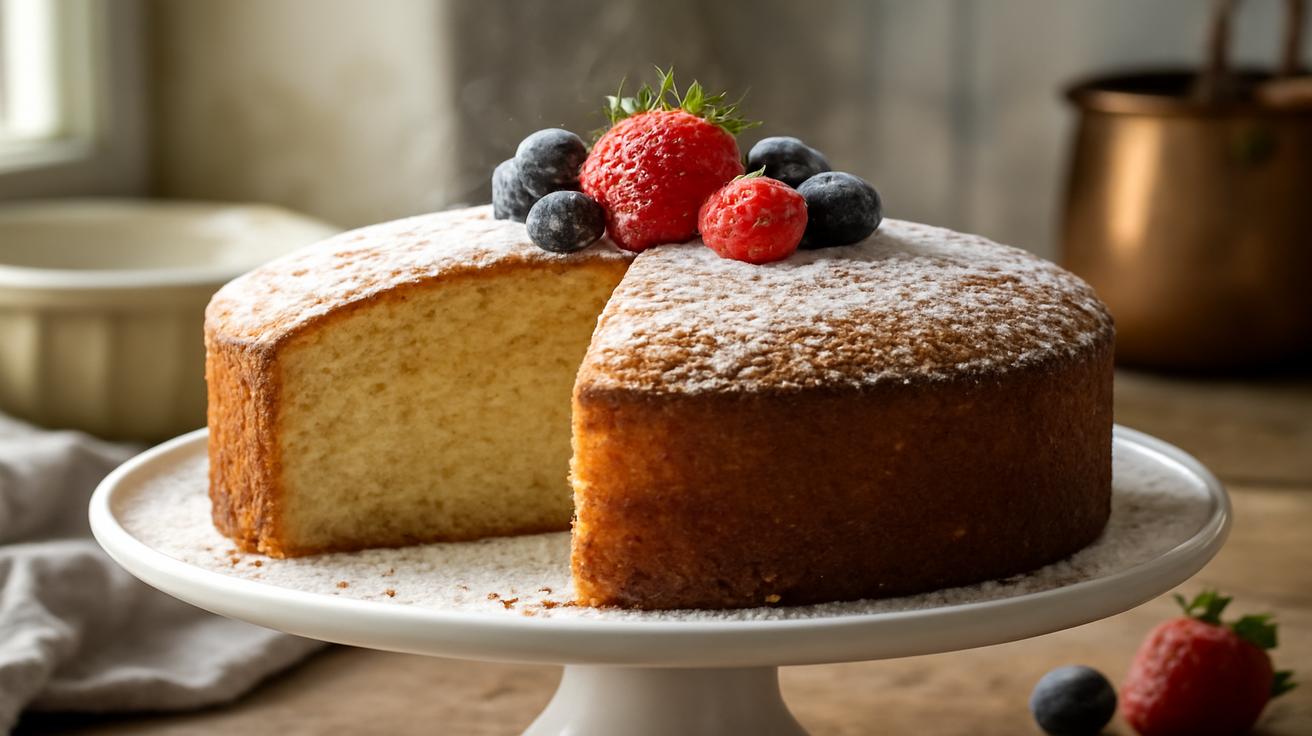
The first time I tasted it, the world around the plate seemed to blur. A small, unassuming slice of pale-gold cake rested on a white ceramic dish, a dusting of powdered sugar catching the afternoon light that slanted through the café window. Paris traffic murmured outside, a low growl under the clink of cups and quiet conversation. I took a forkful without expectation—just another gâteau, I thought—and then it happened. The crumb yielded with a sigh, almost collapsing in on itself, moist and tender and fragrant with lemon and something deeper, rounder, tangier. Yogurt. But not the chalky tang I knew from breakfast bowls. This was different—softly acidic, like a whisper, binding sweetness and richness together so each bite felt lighter than it had any right to be.
The waiter, balancing a tray of tiny espresso cups, noticed me pause mid-bite, fork hovering in the air. He smiled like someone who’d seen this exact expression a hundred times before. “Le gâteau au yaourt,” he said. “But…revisité.” Reinvented.
The Humble French Yogurt Cake That Started It All
In France, yogurt cake is one of those recipes that almost no one needs to write down. It’s whispered more than taught, handed over in gestures rather than measurements. The story usually begins with a small glass jar—the yogurt container itself—used as the measuring cup. One jar of yogurt, two jars of sugar, three jars of flour, and so on. Children learn it before they learn fractions. Grandmothers riff on it like jazz musicians, swapping oils and add-ins, swirling in fruit, shaving in chocolate.
It is, at heart, a cake of simplicity. No stand mixer. No specialty pan. Just a bowl, a whisk, a yogurt pot, and a little confidence. It’s the kind of cake you bake for an unexpected afternoon visit, for a neighbor recovering from surgery, for a picnic where the ants will inevitably show up before the second slice is cut.
That’s why, sitting in that café, I didn’t expect anything extraordinary. Familiarity doesn’t usually make our hearts race. But this particular version—moist but not heavy, indulgent yet airy—felt like someone had written poetry with flour and eggs. When I finally met the chef responsible, he laughed when I described it that way.
“It’s just yogurt cake,” he said. Then, after a beat, he added, “But yogurt cake deserves respect.”
The Famous Chef Who Couldn’t Leave Well Enough Alone
The chef—let’s call him Jean, though that’s not his real name—grew up in a small town in the south of France, where yogurt cake appeared at every school party and Sunday family lunch. For years, he ignored it professionally, considering it too ordinary for the menus of his refined Paris restaurant. Then, one slow afternoon, he tasted the version his pastry chef had made for the staff meal. It brought him back, in an instant, to the tiled kitchen of his childhood, his mother’s elbow brushing his as she reached for the sugar jar.
“I realized,” he told me, “that the most powerful flavors in our memories are often the simplest. But when we try to reproduce them as adults, we complicate everything. We make them fussy. I wanted to go in the opposite direction: refine, but not fuss.”
So he started with the most basic yogurt cake formula and questioned every part of it. Why this flour? Why this oil? Why this sugar, in this quantity, added at this time? He approached it as if it were a notoriously tricky dessert—like macarons or puff pastry—rather than the humble afternoon treat it was.
And somewhere in that meticulous tinkering, he discovered a way to treat yogurt cake like a quiet little luxury: moist, tender, deeply aromatic, but never cloying or dense. He kept the soul of the original but dressed it in a new, subtler elegance.
The Science of Moist and Tender: What Yogurt Really Does
There’s a kind of magic that happens when yogurt meets flour, eggs, and heat. It’s not magic, of course; it’s chemistry. But the result feels enchanted all the same.
First, there’s moisture. Yogurt, especially full-fat yogurt, brings water and fat together in a perfectly emulsified partnership. Inside the oven, that gentle moisture produces a soft crumb that stays tender for days. While butter cakes can turn dry quickly and oil-based cakes can feel slick or heavy, a yogurt cake finds a middle path: velvety, plush, and deceptively light.
Then there’s the tang. The natural acidity in yogurt interacts with baking powder (and sometimes baking soda, in certain recipes), helping the cake rise a little higher and set with a fine, even crumb. That same acidity sharpens flavors—lemon zest tastes more lemony; vanilla feels deeper; even a modest amount of sugar tastes more vibrant instead of flat and cloying.
Jean explained it like this: “Yogurt is the friend that introduces everyone else at the party and makes them all more interesting.” He swaps out part of the fat—traditionally oil—for yogurt, not just as a substitute, but as a flavor conductor. The yogurt doesn’t shout its presence; it lowers its voice so everything else can sing.
Finally, there’s tenderness. The acidity in yogurt slightly weakens gluten formation in the flour, but in a good way, softening the crumb without making it collapse. That’s what gives you a cake that slices cleanly yet melts as soon as it hits your tongue.
The Chef’s Reinvention: Small Tweaks, Big Payoff
What, then, did this French chef actually change? Not as much as you’d think—and that’s the beauty of it. He worked in whispers, not shouts. A different oil here, a precise amount of sugar there, a small rest before baking.
- Oil over butter: He stayed loyal to oil, but chose a neutral, high-quality one instead of a harsh, heavily flavored oil. This preserved the yogurt’s gentle tang and kept the crumb beautifully moist.
- Full-fat yogurt: No cutting corners. Full-fat, thick yogurt for body and richness, avoiding the chalkiness of nonfat options.
- Sugar, slightly reduced: Just enough to create a satisfying sweetness without masking the citrus and yogurt.
- Lemon in two forms: Both zest and a whisper of juice, to build a layered brightness rather than a blunt lemon punch.
- A brief batter rest: Letting the batter sit just a few minutes before baking for a calmer crumb and more even rise.
The result is not a cake that screams “chef-y” innovation. There’s no dramatic garnish, no bizarre ingredient to prove its pedigree. It looks like your grandmother’s cake. It just tastes…like her cake on its best possible day.
Inside the Reinvented Yogurt Cake: A Closer Look
Imagine slicing into this cake. The knife glides through a pale golden crust that’s barely crisp at the edges, releasing a puff of warm aroma: lemon, vanilla, and that hard-to-name comfort scent of freshly baked cake. The crumb inside is tight but not dense, with tiny, even bubbles—a sign that the leavening and acidity have worked in tandem.
Run your fingertip along the cut edge and it comes away slightly moist, not greasy. When you take a bite, the texture is almost custard-adjacent at the center, firmer toward the edges, each mouthful dissolving with just a few easy chews. There’s sweetness, certainly, but it’s never heavy. A small slice feels complete, yet you can understand why the person across from you keeps cutting “just another sliver.”
What makes this reinvention so special is how adaptable it remains. It’s a cake you can bake in a loaf pan for easy slicing, or in a round pan to serve at the center of a table, or even as small squares for a picnic. It plays well with every season: topped with strawberries in June, figs in September, candied citrus in January. It’s still the modest yogurt cake that welcomes whatever fruit you have…just more gracious, more refined, more quietly sure of itself.
A Simple Blueprint: The Yogurt Cake, Chef-Style
You don’t need a professional kitchen to get close to Jean’s version. What you need is intention—choosing ingredients that taste good on their own, and treating the steps like they matter. Here’s a close approximation of his approach, laid out as a flexible template rather than rigid law:
| Component | Typical Choice | Chef’s Refinement |
|---|---|---|
| Yogurt | Plain, low-fat | Full-fat, thick, unsweetened, room temperature |
| Fat | Any neutral oil | High-quality neutral oil with soft flavor; precise measurement |
| Sweetness | Granulated sugar, generous amount | Slightly reduced sugar; very fine or caster sugar for better texture |
| Flour | All-purpose, packed in cup | Lightly spooned flour, possibly with a small portion of almond flour for tenderness |
| Flavoring | Vanilla or lemon, sometimes both | Fresh lemon zest, a little juice, high-quality vanilla; optional orange blossom water |
| Method | Mix, bake immediately | Gentle mixing, brief batter rest, accurate oven temperature |
This isn’t about perfection. It’s about attention. When you treat each simple ingredient as if it matters, the whole cake begins to feel like something far more sophisticated than the sum of its parts.
From French Kitchen to Your Oven: The Experience of Baking It
Baking this reinvented yogurt cake at home is as much about the experience as the result. It’s a low-pressure ritual, forgiving and friendly, the sort of thing you can begin in a quiet kitchen with morning light slanting in, or late at night after the dishes are done and the house has gone still.
You crack the eggs into a bowl, their yolks a deep yellow if you’ve chosen well. Sugar follows, and as you whisk, the mixture thickens slightly, turning paler. You stir in the yogurt and oil, and the batter loosens into a glossy ribbon. When you add the flour, you do it with restraint, folding rather than beating, stopping while you can still trace soft streaks that disappear with a final gentle turn of the spoon.
While the cake bakes, your kitchen changes character. The scent creeps outward, down hallways, under doors, coaxing people from their rooms. Even if you live alone, the smell feels like company, like a roomful of people are about to walk in. The surface domes slightly, then settles into an even, gentle swell as it cools, the crust tightening and crackling almost imperceptibly as it releases heat.
Jean told me that in his restaurant kitchen, there’s a moment every afternoon when the yogurt cake is in the oven and the pastry team goes silent for a few seconds. “We all breathe in,” he said. “Even after all these years.” In that shared inhalation lies the power of this cake: not extravagant, not theatrical, but quietly irresistible.
Simple Variations, Infinite Stories
Part of the yogurt cake’s charm is its readiness to adapt—to your pantry, your seasons, your memories. The chef’s reinvented version isn’t meant to be rigid; it’s a base note, a starting place. Once you’ve baked it once or twice, you start to imagine your own twists.
- Summer afternoons: Fold in a handful of fresh berries at the end, or top the cooled cake with sliced peaches and a thin veil of warmed apricot jam.
- Autumn evenings: Add cinnamon, cardamom, or grated apple. A dusting of powdered sugar over a still-warm slice becomes its own small ceremony.
- Winter comfort: Infuse the yogurt beforehand with orange zest, or add a spoonful of marmalade to the wet ingredients, deepening the citrus and adding a subtle bitterness.
- Spring brightness: Stir in finely chopped herbs like thyme or rosemary with lemon, for a cake that smells like a sun-warmed garden.
None of these ideas disturb the cake’s essential character. They merely tilt it toward a particular mood, a particular day. The base remains what it has always been: yogurt, flour, eggs, sugar, oil—a recipe whose spirit has traveled from French childhood kitchens to professional pastry counters and, perhaps, to your own oven.
Why This Cake Matters More Than It Looks
In an age of towering layer cakes and elaborate desserts engineered for social media, the yogurt cake can appear almost shy. It doesn’t sparkle. It doesn’t ooze. It doesn’t beg to be photographed. It invites you, instead, to sit down, pour a cup of coffee or tea, and stay a while.
That’s part of why Jean chose to put it on his restaurant menu, even though it raised a few eyebrows. Guests who came expecting grand flourishes were served a modest slice of cake on a simple plate, perhaps with a spoonful of lightly whipped cream and a few seasonal fruits. Yet the feedback was immediate and intense. People recognized something in it—something from their own childhoods, or vacations, or a friend’s kitchen long ago.
“They would say, ‘It tastes like the cake my grandmother made, but…better,’” he recalled, a little sheepishly. “And I thought, if I can give them that memory and that ‘but better’ in the same bite, that’s all I want.”
At home, this cake becomes more than dessert, too. It’s what you bring to a new neighbor to say welcome, what you bake for yourself on lonely days as a small act of kindness, what you tuck into a container to share at work or school. It slices cleanly, travels well, and doesn’t demand to be served warm or cold or with a particular sauce. It is flexible, generous, and decidedly unpretentious.
Yet in its moist, tender crumb, there’s a quiet sophistication—a reminder that the line between everyday and exquisite can be very thin indeed. Sometimes, all it takes is a chef somewhere who refuses to take a simple cake for granted, who looks at a yogurt pot and sees not just a measuring cup, but a path back to everything that made them fall in love with baking in the first place.
FAQs About the Reinvented Yogurt Cake
Can I use Greek yogurt instead of regular yogurt?
Yes, you can use Greek yogurt, but it’s thicker and more concentrated. For best results, you may want to loosen it with a tablespoon or two of milk or water so it mixes smoothly and doesn’t make the batter too stiff. Full-fat Greek yogurt will give you a very rich, tender crumb.
What kind of oil works best in yogurt cake?
A neutral-tasting oil such as sunflower, grapeseed, or a very light olive oil works beautifully. Avoid oils with strong flavors that could overpower the delicate tang of the yogurt and citrus. The chef’s approach favors a clean, gentle oil that supports the cake without announcing itself.
Why is my yogurt cake dry instead of moist?
Dryness usually comes from one of three things: overbaking, using too much flour, or cutting back too much on the oil or yogurt. Bake just until a toothpick comes out with a few moist crumbs, measure the flour lightly rather than packing it in, and stick fairly close to the original ratios of wet to dry ingredients.
Can I make this cake ahead of time?
Yes, and in fact, yogurt cake often tastes even better the next day. The moisture redistributes, and the flavors settle and deepen. Once cooled, wrap it well and keep it at room temperature for up to two or three days. The crumb stays remarkably tender.
Is it possible to make a citrus-free version?
Absolutely. Simply omit the zest and juice, and lean into vanilla or another gentle flavor like almond extract. Without citrus, the yogurt’s tang becomes a bit more noticeable on its own, resulting in a subtle, comforting cake that pairs well with fruit, chocolate, or a dollop of cream.
Can I adapt the recipe for gluten-free baking?
Yes, you can use a good-quality gluten-free flour blend designed for baking. Because yogurt already helps keep the crumb tender, this cake can transition to gluten-free more gracefully than some recipes. Just be sure to follow the blend’s substitution instructions and avoid overmixing the batter.
Do I need any special equipment to make this cake?
No special equipment is required. One bowl, a whisk or spatula, and a standard loaf or round cake pan are all you need. That simplicity is part of the cake’s charm: it feels accessible on a busy weekday, yet the results taste like something far more elaborate.








Leave a Comment