
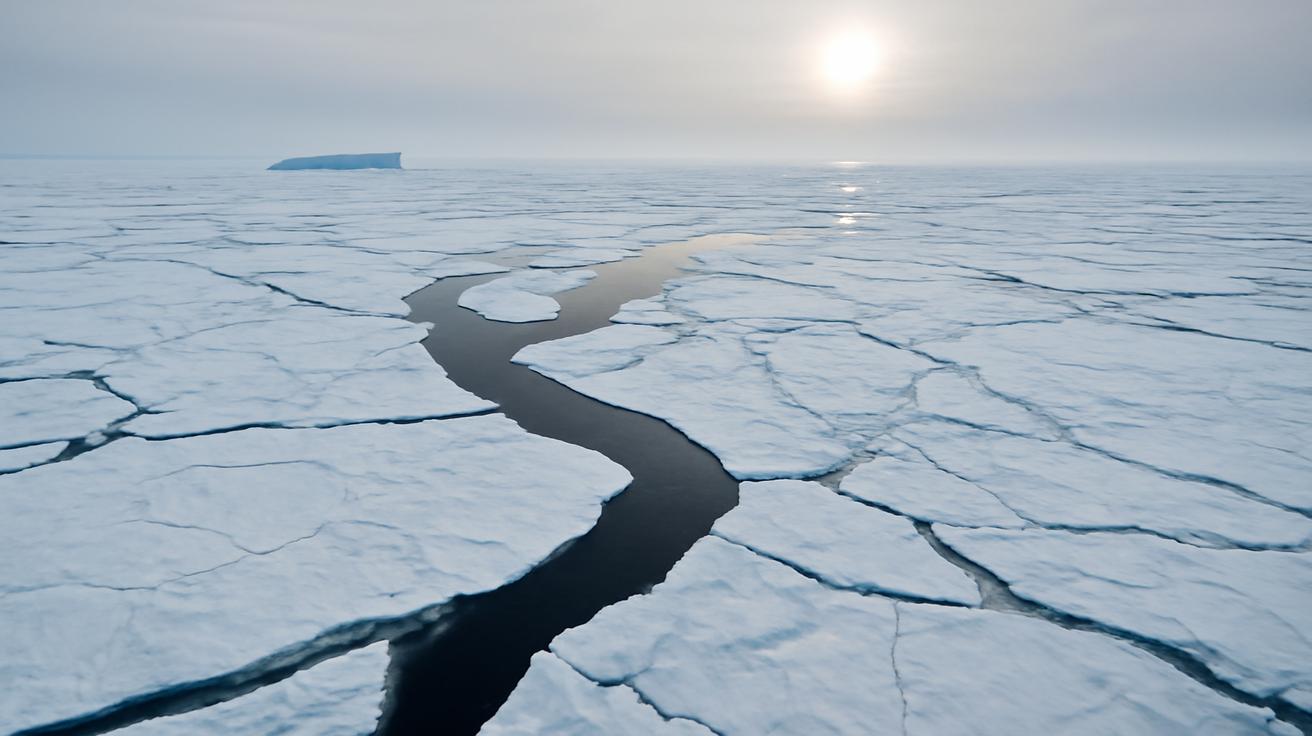
The sky over the Arctic in early March looks deceptively calm from far away—a white crown of cloud and ice circling the top of the planet, lit by a low, silvery sun. But the meteorologists who watch that sky from screens and satellites say this calm is an illusion. Somewhere above the polar night, the atmosphere is shifting, lines on graphs are bending, and the delicate balance that has kept the Arctic’s weather more or less predictable for generations may be entering a new and unstable phase.
The Moment the Models Began to Disagree
In a softly lit operations room, thousands of miles from the ice, a meteorologist named Lara watches her screens. It’s late February moving into early March, that strange hinge of the year when winter is still locked in place for much of the Northern Hemisphere, but the sun has begun its slow climb back over the Arctic horizon.
“This is where it gets interesting,” she murmurs to a colleague, eyes tracing a cluster of colorful lines across the screen. Each line is a different model run, a mathematical imagination of how the atmosphere might behave in the coming weeks. Usually, around this time, the models follow a tight path—small disagreements, minor squiggles. But this year, the lines have begun to fan out dramatically, like a river delta of uncertainty.
At the center of that divergence sits the Arctic. Winds in the polar stratosphere, temperatures high above the ice, pressure systems spinning like invisible gears—it all looks just a bit off. Stable patterns are wobbling. Storm tracks appear to be experimenting with new routes. “It’s not just noise,” Lara says. “The baseline is shifting.”
Meteorologists have a term for this kind of structural change: a turning point. And increasingly, their eyes are drawn to early March as the time when the Arctic atmosphere may be crossing one.
The Fragile Machine Above the Ice
To understand why early March matters, you have to picture the Arctic atmosphere not as a blank, cold void, but as a fragile machine made of circling winds and layered temperatures. For most of the winter, this machine is dominated by the polar vortex: a tight ring of strong westerly winds high in the stratosphere, tens of kilometers above the surface. When the vortex is strong and symmetrical, the Arctic acts a bit like a sealed freezer, keeping its cold air mostly locked in place.
Down below, closer to the surface where storms live and people feel the weather, another pattern is at work: the polar jet stream. It snakes around the hemisphere, steered in part by the cold contrast between the Arctic and mid-latitudes. Over decades, meteorologists have come to rely on certain recurring behaviors—how the vortex tends to strengthen in early winter, how it often weakens toward spring, how the jet usually sets up its meanders and loops.
But what happens when the freezer door doesn’t quite shut anymore?
The Arctic has been warming four times faster than the global average. Sea ice that once acted like a solid, reflective shield is thinning, retreating, and in some places vanishing seasonally. Dark, open water is absorbing more sunlight, warming the air directly above it. That warmth can ripple upward, disrupting the layers of the atmosphere, nudging the polar vortex from below like a persistent finger on a spinning top.
By the time Earth tips toward March, the sun’s return to the Arctic adds another ingredient. The upper atmosphere starts to feel that distant heat, even while the surface is still choked in ice. Historically, this is the beginning of a slow, graceful unwinding of winter’s machinery. Now, meteorologists suspect we’re watching something more abrupt—a new pattern of breakdown, one that carries echoes into weather systems far from the pole.
Why Early March Has Meteorologists Nervous
The concern is not about a single storm or cold snap, but about the timing and character of the transition itself. Early March used to be a relatively predictable period in the Arctic’s atmospheric cycle. But in recent years, scientists have begun to notice that strange events are clustering around this window: sudden stratospheric warmings, unusual reversals in wind direction, odd pressure anomalies over key regions like the Barents Sea and the Greenland Sea.
Think of it like a car that always used to shift gears smoothly at the same point on a familiar road. Lately, that gear change has started to shudder and grind, sometimes happening too early, sometimes too late, occasionally skipping altogether. The car still moves, but something deep in the transmission is changing.
For meteorologists, that deep transmission is the coupling between the Arctic stratosphere and the troposphere below—the way disturbances high up can “talk” to weather patterns nearer the surface. Early March is when communication between those layers has historically begun to relax, as winter’s grip weakens. But now, that conversation is getting louder, sharper, and more chaotic.
When Arctic Instability Spills South
Atmospheric instability in the Arctic doesn’t stay in the Arctic. The sky is not divided into neat country-sized boxes; it’s a flowing, interwoven system, like ocean currents swirling in three dimensions. When the polar vortex weakens or gets displaced, or when the jet stream becomes more wildly wavy, the effects tend to ripple outward—sometimes dramatically.
We’ve already seen hints of what a less stable Arctic atmosphere can do:
- Deep dips in the jet stream that drag frigid air into lower latitudes, triggering “polar vortex” headlines and brutal cold snaps in places unprepared for them.
- Stalled weather patterns that lock heat domes, heavy rain, or drought over regions for days or weeks longer than normal.
- Unusual storm paths, bringing intense storms to coasts and regions not used to dealing with them in that season.
As the Arctic loses its reliable temperature contrast with the mid-latitudes, the jet stream can slow and twist, like a river hitting flatter ground and beginning to braid and meander. Early March appears to be emerging as a pressure point in this new climate—an inflection period when the jet is especially sensitive to nudges from the changing polar regions.
For communities far from the ice—farmers in Europe planning early planting, city planners in North America bracing for late-season snow, power grid managers in Asia watching demand curves—this evolving instability matters. A March that yo-yos between unseasonal warmth and piercing cold isn’t just uncomfortable; it stresses infrastructures built around the old rhythms.
Reading the Signs in a Warming Arctic
What meteorologists are picking up now is not solely about extreme events, but about the background pattern that makes extremes more or less likely. They look at pressure maps, jet streaks, stratospheric temperatures, and something more intangible: the “feel” of the data compared to the climate they learned as students.
Some of the changes they’re tracking include:
- Frequent disruptions of the polar vortex: More sudden stratospheric warming events, where air high above the pole rapidly heats and circulations flip, can cascade downward into weeks of altered surface weather.
- Shifts in the Arctic Oscillation (AO): The AO, which describes pressure patterns over the Arctic and mid-latitudes, appears to be flirting more often with extreme phases—both strongly positive and strongly negative—when historically it spent more time in neutral territory.
- Unusual pressure “domes” over key seas: Persistent highs over areas of reduced sea ice can redirect the usual storms and jets like rocks diverting a stream.
Individually, these might be written off as quirks. Taken together, and mapped across the last few decades, they begin to form a story: the Arctic’s atmosphere, long a stabilizing anchor of Northern Hemisphere weather, is becoming more erratic. Early March, under the new regime of thinner ice and warmer seas, has become the stage where that erratic behavior is increasingly visible.
On the Ice, the Changes Feel Immediate
While the language of models and oscillations can feel abstract, the people who live and work under the Arctic sky feel these shifts in their bones. Hunters from northern coastal villages speak of sea ice that breaks up weeks earlier than it used to, of travel routes across frozen bays that have become unreliable, of storms that seem to swing in on less predictable paths. Research crews who set instruments onto what they expect to be stable ice floes find themselves scrambling to evacuate as unseasonal cracks open and plates grind apart.
Imagine standing on that ice on a March morning: the air so crisp it almost rings, a low wind nosing between your layers, snow squeaking under your boots. The sun, after its long absence, climbs just a little higher each day, throwing stubborn, pale light across pressure ridges and open leads of black water. For much of the twentieth century, this scene was the emblem of frozen stability. Now, beneath that same quiet sky, the atmosphere can be reorganizing itself in ways that send ripples of instability around the globe.
Meteorologists talk to pilots flying over the pole, shipping captains navigating newly open Arctic passages, and communities worrying about coastal erosion enhanced by the loss of shore-fast ice. The feedbacks are not just vertical—between surface and sky—but horizontal, connecting local livelihoods with planetary patterns.
| Arctic Signal | What Meteorologists See | Potential Impact Further South |
|---|---|---|
| Rapid sea-ice loss near spring | Warmer surface air, altered pressure fields | Shifted storm tracks; unusual March rainfall or snow |
| Disrupted polar vortex | Sudden stratospheric warming, wind reversals | Cold outbreaks in mid-latitudes; prolonged blocking patterns |
| Wavier jet stream | Larger north–south meanders in jet position | Stalled heat waves, extended wet or dry spells |
| Early March atmospheric anomalies | Model divergence, increased forecast uncertainty | Less reliable seasonal planning; surprise weather swings |
The Science of a “Turning Point”
When meteorologists and climate scientists talk about a major turning point in Arctic atmospheric stability, they are not announcing a single date on the calendar when everything suddenly breaks. What they are pointing to is a threshold—a point beyond which the statistics of the atmosphere change meaningfully.
In practical terms, a turning point might look like this:
- Forecast skill, which used to be quite high for early March, begins to erode, as past patterns become less reliable guides.
- Events that were once considered rare—say, a certain kind of jet stream configuration—start to show up more often around this time of year.
- Model ensembles that used to cluster tightly around one expected outcome now fan out, suggesting higher inherent chaos in the system.
Scientists use decades of reanalysis data—a kind of time machine built from observations and models—to see how the Arctic’s atmosphere behaved in the past. Against that backdrop, the last ten to fifteen years stand out. The shift is subtle but persistent: the old “rules” of March are being rewritten.
The phrase “atmospheric stability” in this context doesn’t mean stillness. The Arctic has always had storms, waves, oscillations. It means something closer to reliability—the tendency of patterns to behave within certain bounds, to revert to a mean. A less stable Arctic may be one in which those bounds expand, and the mean itself begins to drift.
Living With an Unsettled Sky
So what does it mean, in human terms, if early March is now a more volatile hinge between seasons in the Arctic?
For weather services, it means investing in better monitoring—more stratospheric balloons, more satellite products, improved sea-ice observations—to feed hungry forecasting models that now have to navigate a less familiar atmosphere. It means clearer communication about uncertainty: not only whether a late-season storm might hit, but how confident the science is that patterns themselves are shifting.
For communities everywhere, it means recognizing that complexity in one of the planet’s most remote regions can echo into very ordinary decisions: when to plant, when to travel, how to manage water resources, how much stress an energy grid can bear. The calm blue line of “average March weather” on old charts is no longer a trustworthy guide.
And for those who care about the broader climate story, it means treating the Arctic not as a distant backdrop but as an early warning system. A major turning point in its atmospheric stability is not just a scientific milestone; it’s a message about the pace and reach of planetary change.
Listening to the Arctic’s New Language
Walk outside on a breezy early March day, thousands of kilometers from the pole, and you might not feel any different kind of wind on your face. The clouds roll by, the sun tilts in that familiar late-winter arc, neighbors talk about whether it’s time to put the snow shovels away or dust off the garden tools. Weather is always experienced locally, intimately.
Yet overhead, the patterns that shape those small choices may already bear the signature of a changing Arctic. A jet stream loop that holds your town in an unexpected cold snap or warms it with oddly early spring air may partly be the result of ice vanishing on a distant sea, or stratospheric winds faltering above the pole.
Meteorologists, with their graphs and models, are learning to read this new language—a vocabulary of shifts and thresholds and feedback loops. Early March, once a familiar chapter in that language, has started to add surprising new words.
The warnings are not apocalyptic declarations, but carefully phrased concerns: that the top of the planet, long a kind of atmospheric metronome, is losing its steady beat. That a new rhythm is emerging—faster in some places, slower in others, syncopated in ways our infrastructure and expectations are not yet tuned to.
As we move into each new March, with the Arctic bathed in returning light and the rest of the Northern Hemisphere teetering between seasons, the question will hover in the background: what kind of turning point are we living through, and how quickly can we learn to navigate an atmosphere that is rearranging itself above our heads?
FAQ
What do meteorologists mean by “Arctic atmospheric stability”?
They’re referring to how predictable and consistent the Arctic’s large-scale wind, temperature, and pressure patterns are over time. A stable atmosphere follows recognizable rhythms; a less stable one shows more frequent or stronger deviations from those patterns.
Why is early March such an important time in the Arctic?
Early March sits at the seasonal tipping point: the polar night is ending, sunlight is returning, and the polar vortex and jet stream are beginning their late-winter transitions. It’s a sensitive period when small changes in sea ice, temperature, or winds can have an outsized effect on how the atmosphere reorganizes for spring.
How does instability in the Arctic affect weather where I live?
Changes in Arctic patterns can alter the jet stream and polar vortex, which help steer storms and air masses around the Northern Hemisphere. That can mean unusual cold snaps, warm spells, heavy precipitation, or stagnant weather systems far from the pole, especially in North America, Europe, and parts of Asia.
Is this turning point caused by climate change?
While no single event has a single cause, the broader shift toward less stable Arctic behavior is strongly linked to human-driven warming. Rapid sea-ice loss, warmer Arctic waters, and altered energy flows between surface and atmosphere all stem from the changing climate and contribute to the new patterns scientists are seeing.
Can better forecasting tools fix the problem?
Improved models, observations, and computing power can help meteorologists understand and predict the new patterns more accurately, but they don’t remove the underlying instability. Forecasts may get better at describing a more chaotic system, but the system itself is still changing as the Arctic warms.
Should people outside the Arctic be worried about this?
Concerned, yes; panicked, no. A less stable Arctic atmosphere means more uncertainty and more potential for disruptive weather, but it’s also something we can prepare for through better planning, infrastructure design, and climate action. Recognizing early March as a key transition period is part of that preparation.
Is there anything individuals can do in response?
On a direct level, staying informed about seasonal forecasts, supporting resilient local infrastructure, and adjusting expectations about “normal” weather all help. On a broader level, actions that reduce greenhouse gas emissions—personal, community, and political—address the root cause of the Arctic’s rapid warming and the atmospheric turning point we’re beginning to witness.








Leave a Comment