
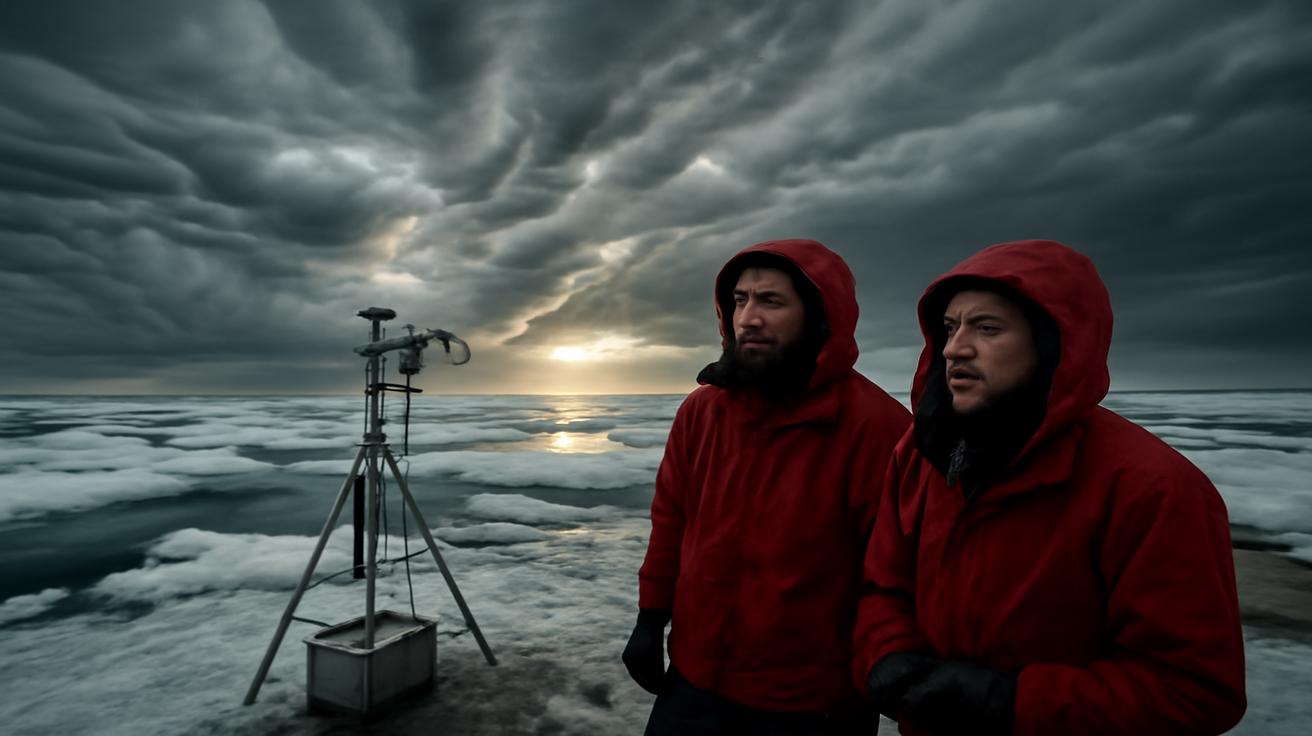
The night the sky turned the wrong color over the Arctic, nobody was there to see it—at least, not with their own eyes. Yet hundreds of people all over the world watched it happen in real time, blinking at their glowing screens as satellites streamed back data that should not have been possible, not in early February, not this far north, not in a world that still pretends winter has rules.
On those screens, the upper atmosphere above the North Pole rippled and twisted like a slow-motion bruise. Temperature lines bent out of shape; pressure fields wobbled; the familiar, tight ring of winds that usually circles the Arctic in winter began to fray. A meteorologist in Oslo quietly muttered, “Oh no.” A climate scientist in Colorado rubbed sleep from her eyes and refreshed the charts twice. In Tokyo, someone reached for a pen and wrote in the margin of a printed graph: This might be the turning point.
By morning, the emails had started. Subject lines carried the same uneasy rhythm: “Early February anomalies,” “Polar vortex weakening,” “We need to talk about this.” The data wasn’t just strange—it was the kind of strange that suggested something deeper was shifting, something that might not fully shift back.
A Winter That Doesn’t Feel Like Winter Anymore
If you step outside in early February in much of the Northern Hemisphere, you expect the air to have a kind of weight to it. This is the month of bitter sidewalks and chapped lips, of snowbanks and pale breath. Yet more and more, February is behaving like it misplaced the script. Rivers run too freely where ice should still clench them. Trees hold smears of budding green that belong to April. Birds arrive early, confused but hungry, following signals they barely recognize.
Ask a meteorologist what underpins that winter feeling, and they’ll tell you about the Arctic’s quiet authority. For decades, the polar region has acted like a cold, stable anchor for the atmosphere—especially in late January and early February, when the Northern Hemisphere’s winter should be at its peak strength. Above it, circling the pole like a ghostly crown, spins the polar vortex: a vast whirl of frigid air, trapped in the stratosphere, tens of kilometers above our heads.
Most years, the story is simple. The Arctic stays fiercely cold. The polar vortex spins fast and tight, like a well-wound top. Winds race west to east high above us, sealing in the most bitter air near the pole. Down at ground level, winter follows something like a familiar pattern. Storms and cold waves still come, but the general structure is recognizable—a winter you could point to and say, “Yes, this is normal.”
But the February now unfolding above us is edging away from that story. In the data, that tight, spinning top starts to wobble. The seal between Arctic and mid-latitudes loses some of its strength. The word that keeps appearing in the short, tense messages traded between meteorologists is “stability”—and whether we might be watching it unravel.
What Meteorologists Are Seeing Above the Arctic
On a monitor in a dim room, the Arctic looks like a swirling collage of numbers and colors. Wind speeds arc around the pole. Temperature gradients paint bands of blue and red. Pressure lines curl and knot. It is, in its own way, beautiful—if you can ignore what it implies.
The key to this early February, meteorologists say, is how the Arctic atmosphere is not behaving. Usually, deep winter over the pole is locked into a kind of stable cold. The polar vortex, high in the stratosphere, is strong and symmetrical, keeping Arctic air mostly where it belongs. This year, the vortex appears weakened and distorted. Warm air, driven by waves from lower latitudes, presses upward and northward like an unwelcome guest at the edge of a crowded room.
That warm intrusion matters. When warmer air rises into the upper atmosphere and displaces the cold, it can disrupt the polar vortex from above. In some years, this leads to what’s called a sudden stratospheric warming event—a dramatic, rapid heating of the stratosphere over the Arctic that can shatter the vortex like spun glass. Even when it doesn’t fully break, a weakened or off-center vortex starts leaking its cold southward in unpredictable ways.
In this early February, the models are suggesting that the Arctic’s atmospheric structure is increasingly prone to these disruptions. Sea ice is thinner and patchier than it used to be. Open water, which absorbs and releases heat more readily than ice, has turned parts of the Arctic Ocean into meteorological wild cards. That absorbed warmth doesn’t stay politely at the surface. It communicates upward—through storms, through waves in the jet stream, through an intricate ladder of energy—until it reaches the heights where the polar vortex lives.
This is how the abstract language of “Arctic amplification” translates into the felt world: the polar atmosphere loses some of its winter discipline. Early February, which once stood for deep, stable cold, now looks increasingly like a hinge point, a time when the Arctic decides whether it will hold fast or slip into something wilder.
The Polar Vortex, Unraveled for the Rest of Us
The phrase “polar vortex” has become media shorthand for any miserable cold spell, but what meteorologists are watching isn’t a headline—it’s the core machinery of winter itself.
Think of the polar vortex as a whirl of trapped cold air, spinning 20 to 50 kilometers above the Earth. As long as it stays strong and relatively round, the world below tends to keep its familiar climates more or less in place. Weather can be severe, but it’s framed within a recognizable pattern. Early February, for much of the Northern Hemisphere, is ruled by that high-altitude spin.
Now imagine what happens when the vortex weakens, warps, or even splits. Some of that normally contained polar air spills southward in weird, lopsided tongues. Regions unprepared for deep cold—southern Europe, the central U.S., parts of East Asia—can suddenly find themselves under a blast of Arctic air. At the same time, the Arctic itself can experience strange warmth, as if winter has abandoned its own birthplace.
When meteorologists warn that early February may become a turning point in Arctic atmospheric stability, they’re not just talking about one odd year. They’re talking about a creeping pattern: warming seas, shrinking ice, a more excitable jet stream, a polar vortex that seems easier to jostle, easier to break. The February of the past was a month that told you, “The system is still robust.” Increasingly, the February of the present whispers, “The system is growing fragile.”
This fragility doesn’t mean every winter will be mild. In fact, it can mean the opposite. Climate models and real-world observations both show that a disrupted Arctic can deliver more extreme cold snaps to places that aren’t used to them, and more stretches of weirdly warm winter weather elsewhere. What changes is not simply the temperature line—it’s the rhythm, the predictability, the sense that seasons have boundaries you can trust.
A Subtle but Stark Shift in the Data
For those watching carefully, early February’s Arctic behavior isn’t just intuition. It’s written in numbers—numbers that, over the past few decades, have traced a subtle but insistent curve away from what used to be normal.
| Indicator | Approx. 1980s Typical | Recent Early February | What It Implies |
|---|---|---|---|
| Arctic sea-ice extent | High, thick multi-year ice | Lower, thinner, younger ice | More heat released to the atmosphere |
| Near-surface Arctic temps | Well below 0°C across vast areas | Several °C warmer on average | Weaker thermal contrast with mid-latitudes |
| Polar vortex strength | Generally strong, stable | More frequent weakening episodes | Greater risk of erratic winter extremes |
| Jet stream pattern | Straighter, more zonal flow | Wavier, prone to blocking | Longer-lasting cold or warm spells |
Numbers like these help explain why a date on the calendar—early February—is attracting so much attention. It’s the moment when, historically, the Arctic atmosphere was at its most locked-in and stable. Now, that lock seems to slip more easily, opening the door to a hallway of shifting, unpredictable winters.
From Frozen North to Front Door: Why This Matters to You
To stand on a city street in late winter and feel a dry, lukewarm breeze instead of a clean, sharp cold is a small, almost private disorientation. It’s easy to dismiss. So what if this February is a little strange? Weather is variable. Seasons are flexible. Haven’t there always been odd winters?
This is the part where meteorologists have to be careful, because both things are true. Yes, there have always been unusual seasons. And yes, what we’re watching now is different.
That difference shows up in how often extremes are happening and how they cluster. A wavier jet stream, nudged out of its usual path by a disrupted Arctic, can stall storms over one region for days, dumping historic snow in some places while leaving others parched and mild. Bitter cold can lock in over a mid-latitude city unused to such intensity, stressing power grids and water systems. Warmer winters can erode mountain snowpack, starving rivers and reservoirs that depend on meltwater to sustain millions of people through the summer.
Farmers feel it when planting dates and frost risks no longer line up with inherited wisdom. Energy planners feel it when heating demand whipsaws between low and high in a single month. Migratory animals feel it when their ancient timing for food and nesting meets a world that has shifted its cues by weeks.
These are not just curiosities of the weather. They are tremors radiating outward from a pole that is losing its old balance. Early February’s instability is like finding cracks in the foundation of a house you live in but don’t remember building. You may not notice the cracks every day. But when the next storm comes, they matter a great deal.
The Growing Drumbeat of Climate Anxiety
Spend time with people who track these changes for a living, and you’ll notice a particular kind of worry. It’s not the theatrical panic often portrayed in headlines, but something quieter and more enduring—a kind of weathered grief mixed with stubborn resolve.
Many of them have spent their careers studying patterns. They know how wide the natural range of variability can be. They also know when a pattern breaks from its own history. The Arctic’s atmosphere, once the most reliable cold engine on Earth, is clearly stepping outside its old rules. Every early February that arrives lukewarm, wobbly, or fractured adds weight to that realization.
This is why talk of an “early February turning point” resonates beyond the community of forecasters and climate scientists. It offers a concrete image of what climate change looks like as it emerges from the sea of abstract numbers: winters that don’t quite know how to be winter, poles that leak their cold, weather that stretches further toward the edges of what we thought was possible.
For many, this realization sparks anxiety—about future storms, about food security, about financial systems tied to a stable climate. For others, it prompts a quiet mourning for the loss of things we never thought could vanish: predictable seasons, familiar snow, the comfort of knowing what the sky should look like at this time of year.
Yet threaded through that worry is something else: a sense of urgency that is finally catching up with the physics. If the Arctic atmosphere is entering a new era of instability, then the timelines we imagine for adaptation and mitigation cannot stay leisurely. The changes are not waiting politely for us to be ready.
Listening to the North While There’s Still Time
In the high Arctic, winter sound travels strangely. A footstep on snow can sound too loud, too close. The creak of ice carries across open distances. The atmosphere, so dry and thin with cold, turns the world into a listening chamber.
In a sense, that is what the Arctic is becoming for the rest of the planet: a vast, echoing warning system, amplifying the signals of a climate pushed out of balance. Early February, once a quiet, deep-blue stretch of the calendar, is now one of those signals.
When meteorologists warn that this month may mark a major turning point in Arctic atmospheric stability, they are not saying the sky will fall next week. They are saying that one of the main stabilizing gears of our climate machine is slipping. They are pointing to a time of year when the Arctic used to be most firmly locked into place and showing us how that lock is loosening instead.
We have choices about how to respond to that knowledge. We can turn away, let February blur by in a rush of errands and indoor heat. Or we can treat these warnings as the precise, data-rich, deeply human messages they are: notes from people who have spent their lives listening to wind and temperature and ice, now telling us in careful, measured voices that the story is changing faster than we thought.
Outside, whatever February feels like where you are, the air is strung with invisible paths that connect your sky to the Arctic’s: jet streams, pressure waves, subtle flows of heat. You breathe under the same shared atmosphere that twists over the pole. What happens there will not stay there, not anymore.
Somewhere tonight, another meteorologist will refresh another map of the Arctic, watching the swirling colors hesitate and distort, looking for signs of resilience or further unraveling. The rest of us may never see those maps, but we will live inside their consequences. That is what this early February means: the distant North, once an isolated stage for silent winters, has become a central character in all our futures.
FAQ
What does it mean for Arctic atmospheric stability to change?
Arctic atmospheric stability refers to how consistently cold and structurally “locked in” the polar atmosphere remains during winter. When stability declines, the polar vortex and jet stream become easier to disrupt, leading to more erratic and extreme weather in both the Arctic and mid-latitudes.
Is a weaker polar vortex the same thing as climate change?
No, a weaker polar vortex is not the same as climate change, but it is one of the ways climate change can express itself. Warming oceans, loss of sea ice, and rising global temperatures alter the energy balance of the atmosphere, which in turn can destabilize the polar vortex.
Does a disrupted Arctic mean we will always have colder winters?
Not always. A disrupted Arctic can bring both unusual cold snaps to some regions and unusually warm winter conditions to others. Overall, the long-term trend is warming, but the path there can be jagged, with intense cold events mixed into a generally warmer climate.
Why is early February such an important time for the Arctic?
Early February has historically been when the Arctic atmosphere is at its coldest and most stable, with a strong polar vortex. Changes at this time reveal whether the system is still behaving like its past self or slipping into a new, less stable regime.
How could this affect everyday life far from the Arctic?
Shifts in Arctic stability influence the jet stream and storm tracks, which shape local weather. This can impact heating and cooling demands, agriculture, transportation, infrastructure resilience, and even insurance and food prices, as extreme events become more frequent or more severe.
Is there anything that can be done to reduce these risks?
Reducing greenhouse gas emissions is the most direct way to lessen long-term Arctic disruption. In the near term, improving forecasting, strengthening infrastructure, updating building codes, and planning for more variable extremes can help communities adapt to the changing behavior of winter.
Are scientists certain that this is a permanent turning point?
Scientists are cautious with the word “permanent,” but many agree that the Arctic has already entered a new, warmer era compared to past decades. Whether this specific early February becomes a clear historical turning point will only be obvious in hindsight, but the broader trend toward reduced stability is well documented.






Leave a Comment