
The first hint arrives as a taste in the air. You step outside one late January evening expecting the familiar winter cool, but instead there’s a different sharpness, like the edge of metal pressed lightly against your skin. The wind is strangely quiet, the sky a dull, heavy gray that seems to be holding its breath. Somewhere far to the north, the Arctic is stirring—reshaping its icy lungs—and the atmosphere over your head is beginning to listen.
The Day the Forecast Starts to Wobble
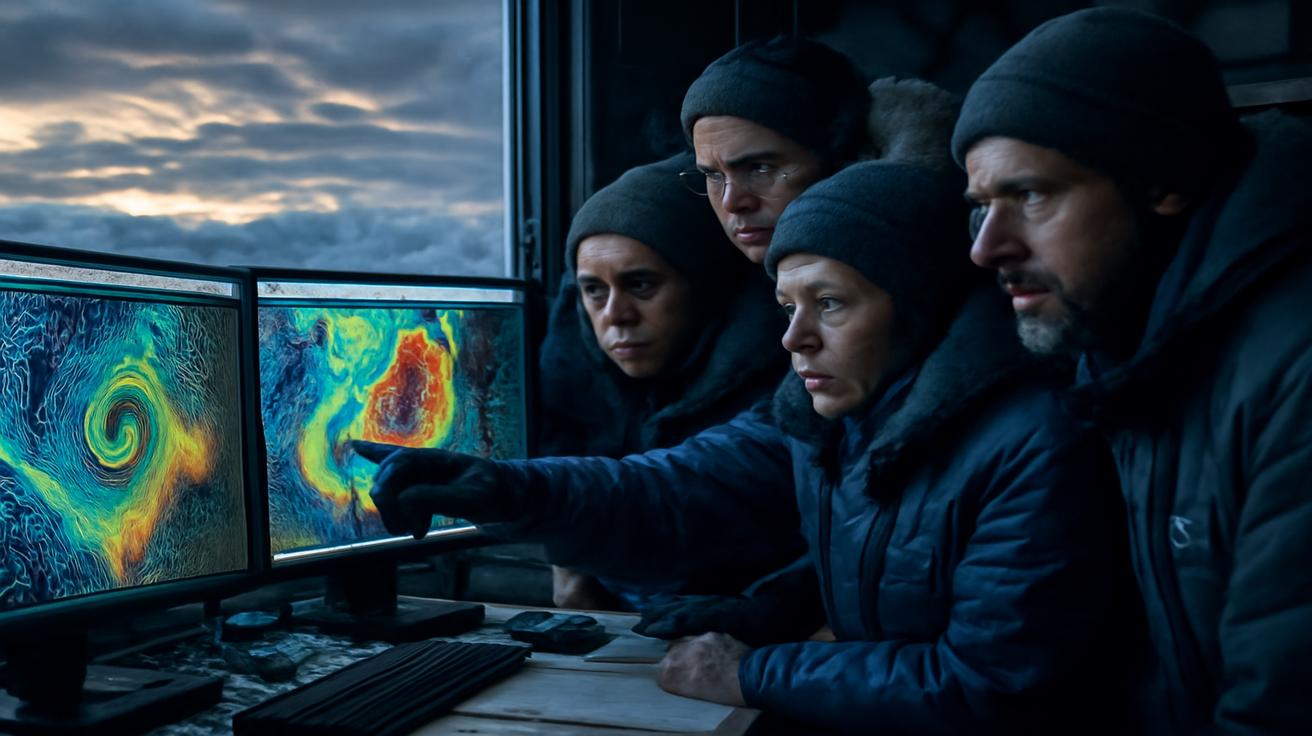
In a dim, humming operations room full of monitors and soft whirring fans, a meteorologist leans closer to the screen. The colors—bands of swirling purples, blues, and violent reds—aren’t behaving. A set of computer models, usually in broad agreement by this point in the season, have begun to diverge like startled birds. The timeline they’re staring at isn’t months away. It’s February. Just days ahead.
“It’s like the atmosphere is trying something new,” one forecaster mutters, half to themselves.
For years now, meteorologists have been warning about a changing Arctic: warmer seas, thinner ice, odd pulses of heat that thrust northward in winter, as if the tropics occasionally forget their place. But the pattern showing up this time is different—not exactly unprecedented, yet stubbornly slippery. It suggests that early February may open with an abrupt Arctic shift, a sudden pivot from relative winter normalcy toward something more extreme, more chaotic, more difficult to describe in neat graphics on the evening news.
Forecast offices around the Northern Hemisphere are watching the upper atmosphere like hawks. Above the jet stream, tens of kilometers overhead, the polar vortex—an enormous band of icy, high-altitude winds that circles the Arctic—might be gearing up for a stumble. When it stumbles, everything beneath it feels the shock.
When the Arctic Takes a Deep Breath
To understand what could be coming, you have to imagine the Arctic not just as a faraway place of snow and polar bears, but as a restless engine that powers much of the world’s winter weather. At the heart of that engine is a temperature contrast: bitter cold over the pole, less cold air to the south. The jet stream, a river of fast-moving air high above, snakes along that boundary. Where it flows smoothly, the weather below tends to behave. Where it kinks and bends, trouble brews.
Right now, scientists are watching for a trigger: a burst of energy that might punch its way upward from the troposphere—the layer we live in—into the stratosphere, where the polar vortex spins. If that punch lands just right, it can slow, warp, or even temporarily tear the vortex apart. Meteorologists call one version of this a sudden stratospheric warming, a bland name for a dramatic event in which the upper atmosphere over the Arctic heats by tens of degrees in only a few days.
Down below, that disruption doesn’t feel warm at all. The damaged vortex can spill dense, frigid air southward, like ice water sloshing over the rim of a tilted bowl. The jet stream, instead of zipping around the hemisphere in a tidy loop, buckles into huge waves—one cresting northward, drawing warmth into Alaska or northern Europe, another plunging south over the central United States or East Asia, dragging Arctic cold in its wake.
From the ground, it looks like winter going sideways: snowstorms where there should be drizzle, bone-deep cold following a week that felt almost like spring, freezing rain in places that were never built to handle it.
The New Shape of Winter
It’s not that these patterns have never existed before. History is full of late-winter cold snaps and freak snowstorms. But meteorologists are noticing two uncomfortable realities. First, the Arctic itself is warming at more than twice the global average rate, thinning the ice that once acted as a kind of planetary thermostat. Second, as that thermostat weakens, the old rules for how and when cold air moves south don’t always apply.
Some years, the polar vortex stays strong and symmetrical and winter remains oddly subdued in mid-latitudes—more rain than snow, more muddy fields than sparkling drifts. Other years, the vortex falters, and winter lashes out wildly, but in patterns that are hard to anticipate even a few weeks in advance. That’s the part that keeps forecasters awake at night.
Inside the Models: When the Future Won’t Sit Still
If you imagine a weather model as a crystal ball, it’s a very scientific, brutally honest crystal ball—one that constantly whispers, “I might be wrong.” Inside it are millions of equations, feeding on rivers of data: satellite readings, balloon launches, ocean buoys, aircraft sensors, ground stations scattered from city rooftops to lonely Arctic outposts. Every few hours, supercomputers chew through all of it, spitting out new maps of the atmosphere’s future.
During stable periods, those models tend to line up. There’s a comforting convergence: perhaps a storm in five days, a warming trend after that, a cold snap trailing behind. But when the atmosphere is poised on a knife-edge—like it may be heading into early February—small uncertainties explode. One model shows the jet stream buckling into a deep southward dive. Another keeps it high and flat. A third splits the difference in a way that convinces precisely nobody.
At the core of this February puzzle is the delicate interaction between the troposphere and the stratosphere, the handshake between the weather we feel and the winds we cannot see. That handshake is infamously hard to model. A tiny shift in tropical thunderstorm patterns, a subtle warming in the North Pacific, a patch of open water where sea ice used to be—each tweak can ripple upward and outward, altering the odds of a polar vortex disruption.
Scientists call this a “highly nonlinear system,” which is another way of saying: change one small thing, and the whole future may rearrange itself. The Arctic shift that forecasters are now warning about lives right in this realm of discomfort. It’s not guaranteed. It’s not fully predictable. But it’s increasingly likely.
What the Early Signals Are Saying
Amid the chaos, there are clues. Ensembles of model runs—dozens or hundreds of simulations with slightly different starting points—are beginning to show a growing cluster of outcomes where Arctic air pushes south more aggressively as February begins. The signals aren’t clean, but they’re loud enough that meteorologists are no longer shrugging them off as noise.
Patterns in the North Atlantic are hinting at a slowdown of the usual west-to-east flow, the kind of setup that can lock cold air in place over Europe or eastern North America. Meanwhile, over the Pacific, strange warmth persists over broad stretches of ocean, nudging storm tracks and feeding energy into the atmosphere in unpredictable ways.
It’s like watching a row of dominoes tip in slow motion. You know that somewhere down the line a bigger tile might fall, but the exact path is a blur. The forecasts can see the first few tiles, and they’re enough to raise an eyebrow.
How an Arctic Shift Feels in Everyday Life
Forecast maps can be hypnotic with their loops and swirls of color, but for most people an “Arctic shift” only becomes real when it spills into the rhythm of a week.
Picture it: You’ve just settled into the idea that winter might be fading. The last snowbank on the corner is shrinking to a dingy, tired lump. The kids have already asked where you stored the bicycles. Maybe you’ve gone out with just a light jacket once or twice, feeling that dangerous, hopeful lift in your chest: Maybe that’s it. Maybe the worst is over.
Then the new forecast comes in, and the language changes. Highs slide down from comfortable to marginal: 5°C, 2°C, then negative numbers, creeping lower day by day. Meteorologists start talking about “modified Arctic air,” then “a direct Arctic intrusion.” Suddenly, there are phrases like “dangerous wind chills,” “flash freeze potential,” “snow-to-ice transitions.” The tone on the radio shifts from casual to careful.
You notice it first in the sky. Clouds sharpen, edges defined, the blue between them deeper and almost brittle. When the wind picks up, it feels like it’s reaching through your clothes, through your skin. Sidewalk puddles from the last thaw turn to glass overnight, and the world begins to move more cautiously—drivers braking sooner, pedestrians testing each step with a subtle, practiced hesitation.
Even indoors, the shift makes itself known. Radiators clang to life more often. The air in your home grows dry enough that static sparks jump from your fingers when you touch a doorknob. Grocery lists start to include extra shelf-stable items, just in case. Somewhere down the block, a neighbor drags a snow shovel back up from the basement with a resigned scrape against the stairs.
The Uneven Geography of Cold
One of the strangest qualities of these Arctic disruptions is their unfairness. While one region may be gripped by bitter, relentless cold, another—sometimes just a few time zones away—experiences the opposite: an eerie, mid-winter warmth that sends buds swelling on branches and has insects waking up too soon.
During a warped-jet-stream event, the atmosphere stops behaving like a clean belt around the pole and looks more like a tangled rope. A lobe of cold might plunge deep into central North America while the West Coast basks in anomalous warmth. Europe can swing from rain and wind to deep freeze in days, depending on where those meanders set up. East Asia might get battered by back-to-back cold waves while the Arctic itself, paradoxically, registers temperatures far above its seasonal norm.
This unevenness is one reason communities struggle to prepare. A region that just endured a brutal Arctic blast might relax when the pattern shifts away—only to find the jet stream wobble brings another wave a week later, or shifts the worst cold to a city that hasn’t seen such temperatures in decades and lacks the infrastructure to cope.
Why Scientists Are Struggling to Model This
If you ask a climatologist or atmospheric scientist why this February’s potential Arctic shift is so hard to nail down, you’ll hear a confession: our models are powerful, but they weren’t built for a planet changing this quickly.
Many of the climate and weather models used today grew up in a world where Arctic sea ice was thicker, steadier, and more predictable. The ocean beneath that ice was locked away from the atmosphere for much of the year. Now, with more open water and thinner ice, the Arctic is breathing more freely—exchanging heat and moisture with the air above in ways that the old rules don’t fully capture.
The result is a kind of mismatch between the atmosphere we have and the atmosphere our equations expect. The physics are the same, of course, but the boundary conditions have shifted. New feedback loops are emerging: warm ocean, thin ice, moist air, altered cloud cover, re-routed storms. Those loops affect the jet stream and the polar vortex, which in turn shape the winter you experience on your street.
Adding to this is the sheer complexity of the vertical coupling between the troposphere and stratosphere. Even small errors in measuring or simulating stratospheric temperatures and winds can cascade into big uncertainties in surface forecasts. That’s why some model runs right now are hinting at a severe cold blast in early February, while others show only a glancing blow.
Learning From Each Wild Winter
Yet this struggle is not a failure; it’s an evolving conversation between humans, machines, and the sky. After each season of strange behavior, meteorologists go back and perform autopsies on the atmosphere: Where did the models go wrong? Which early signals were real but overlooked? How did the oceans, ice, and stratosphere conspire to build the pattern we just lived through?
Year by year, new data gets folded into better representations of Arctic processes. Observatories in remote locations, improved satellite sensors, and even citizen scientists snapping photos of halo clouds or reporting backyard snowfall totals—all contribute to a growing picture. The models are learning, but the atmosphere is improvising just as fast.
Preparing for an Uncertain February
What does all of this mean for you as February approaches with its rumored Arctic shift? On one level, it’s simple: be ready for a winter that might not follow the script you’ve grown accustomed to. On another, it’s an invitation to pay closer attention—to the sky, to forecasts, and to the quiet way a season can turn.
Instead of a single, clean forecast, imagine a set of possibilities, each with its own texture:
| Possible Scenario | What It Might Feel Like | How to Respond |
|---|---|---|
| Deep Arctic Outbreak | Days or weeks of intense cold, dangerous wind chills, frequent snow or ice. | Check heating systems, protect pipes, stock up on essentials, plan for school or work disruptions. |
| Back-and-Forth Swings | Rapid flips between mild spells and sharp cold snaps. | Stay alert to short-range forecasts, watch for icy roads after thaws, layer clothing. |
| Localized Extremes | One region frozen, another oddly warm and stormy. | Avoid assuming nearby regions share your risk; follow local alerts closely. |
| Near-Miss Scenario | Noticeable chill, but no prolonged or extreme impact. | Use the time to refine winter plans and emergency kits for future events. |
None of these paths is guaranteed. But thinking in terms of ranges rather than single outcomes can soften the shock when the atmosphere chooses its route.
Living With a Restless Sky
Standing in your doorway on an early February morning, you may feel that Arctic breath on your face or you may feel only a muted, uncertain cool. A layer of frost might have crept back overnight, or perhaps a soft, wet snow has settled on branches that were bare and black the evening before.
Somewhere overhead, the jet stream is tracing out its restless course. Far above that, invisible to you, the polar vortex is either holding together or coming apart at the seams. And inside a distant forecasting center, a meteorologist is adjusting a map, updating a discussion, trying to put human language around a planet that is learning new tricks.
We live now in a world where the Arctic is no longer a silent partner in our seasons. Its pulse is quicker, its responses sharper, its influence more erratic. The February ahead may bring a reminder of that, in howling winds and cracking ice, or merely in a faint, unsettling sense that winter no longer knows exactly what it wants to be.
Either way, when you step outside and taste that metallic edge in the air, you’ll know: somewhere, the models are still running, still struggling to keep pace with a sky that refuses to stand still.
Frequently Asked Questions
What do meteorologists mean by an “Arctic shift” in February?
An “Arctic shift” refers to a significant change in the atmospheric pattern that allows colder, denser air from the Arctic to move south into mid-latitudes. Instead of remaining bottled up near the pole, this air can spill into regions that are usually milder, leading to sharp temperature drops, increased chances of snow or ice, and longer-lasting cold spells.
Is this the same as a polar vortex event?
They are closely related. The polar vortex is a large, fast-spinning band of cold air high in the stratosphere over the Arctic. When the vortex is strong and stable, cold air tends to stay near the pole. When it weakens or becomes distorted, lobes of cold air can slide southward. An “Arctic shift” often involves some change in the polar vortex, but the exact impacts depend on how the jet stream and surface weather patterns respond.
Why are scientists struggling to model this year’s pattern?
The difficulty comes from the complex interaction between different layers of the atmosphere and a rapidly changing Arctic. Small differences in sea-ice cover, ocean temperatures, and tropical weather can have big effects on the polar vortex and jet stream. Our models are powerful, but they were largely developed in a more stable climate. As the Arctic warms and its ice thins, new feedbacks and patterns are emerging that are harder to predict weeks in advance.
Could this Arctic shift miss my region entirely?
Yes. Even if a major Arctic disruption occurs, its effects are not evenly spread. One area may see extreme cold and heavy snow while another region experiences only a modest chill or even unusual warmth. That’s why it’s important to follow local forecasts and updates rather than assuming a global headline will apply the same way where you live.
How can I practically prepare for a possible Arctic outbreak?
Focus on resilience: make sure your home’s heating system is working well, insulate or protect exposed pipes, and keep a small stock of nonperishable food, water, and basic supplies. Charge devices ahead of major storms, check on neighbors who might be vulnerable, and plan alternatives for commuting or childcare if conditions become hazardous. Staying tuned to short-range forecasts—over the next 3 to 5 days—will help you adjust as the pattern becomes clearer.
Is climate change making these Arctic shifts more common?
Scientists are still debating the exact relationship, but many studies suggest that rapid Arctic warming and sea-ice loss are linked to more frequent and persistent jet stream distortions. Those distortions can increase the odds of both prolonged cold spells and unusual winter warmth in different regions. While not every Arctic shift is directly caused by climate change, the background conditions that shape these events are undeniably changing.
Will forecasting of these events improve in the future?
Almost certainly. Each unusual winter event gives scientists new data and case studies to improve models. Better satellite coverage, more observations from the Arctic, and refined representations of ice, oceans, and clouds are steadily increasing our skill in predicting stratospheric disturbances and their surface impacts. We may never be able to forecast every detail weeks in advance, but the window of reliable warning is gradually widening.





Leave a Comment