
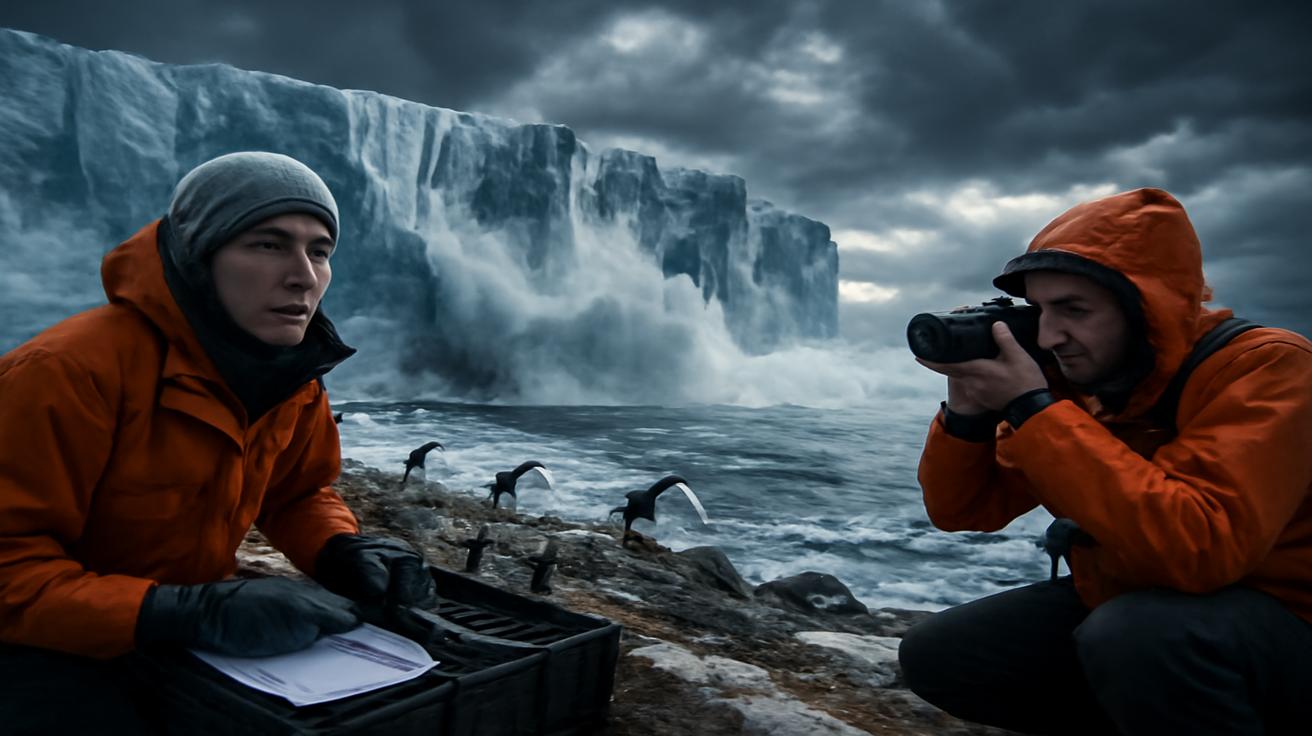
The forecast first arrived not as a thunderclap, but as a murmur. A few lines in a technical bulletin. A strange kink in a polar wind pattern. A quiet note from one meteorologist to another: “You should see what the Arctic jet is doing.” Within days, that murmur grew into a chorus of concern, and by late January, weather desks around the world were buzzing with the same uneasy phrase: an Arctic collapse could be coming, and February might not open gently.
The day the polar air began to wobble
Imagine waking up on the first morning of February and feeling that the air is somehow wrong. Not just cold, but sharp and electric, as if the atmosphere has been tilted a few degrees off center. On city sidewalks, people pull scarves a little tighter, sensing something they can’t quite name. Across the countryside, fields sit under a strange, muffled silence, the kind that comes before a storm decides what it wants to be.
In the upper reaches of the atmosphere, far above that quiet morning, something invisible is shifting. This is where meteorologists have been staring for weeks—into a turbulent, looping river of wind called the polar vortex. Ordinarily, that vortex keeps the Arctic’s deepest cold bottled up at the top of the world like a lid on a freezer. But this winter, the lid is rattling.
Computer models have been painting the same alarming picture: the vortex wobbling, stretching, even tearing in places as powerful waves of warmth surge upwards from the lower atmosphere, colliding with it like unseen tides. To scientists, these are not just pretty colors on a screen. They are signatures of an atmosphere under stress. The term they keep reaching for is “Arctic collapse”—a dramatic weakening and possible fragmentation of that cold-holding system, with the potential to unleash intense winter weather far to the south.
What an “Arctic collapse” really feels like
Arctic collapse sounds like an abstract phrase until you step outside into it. It is, quite literally, the feeling of the Arctic arriving uninvited on your doorstep.
In practical terms, an Arctic collapse means the polar vortex—usually a tight, well-contained ring of strong winds—loses its structure. Chunks of frigid air spill out, sliding down into North America, Europe, and Asia like slow-motion avalanches of cold. Barometers dip. Skies take on that bruised, metallic tone that makes daylight feel thinner, weaker.
During past events, sidewalks in temperate cities glazed over overnight. Breath plumed in dense, shimmering clouds. In some places, train tracks warped under the thermal shock of sudden, brutal chill. In others, farms that were greening early under an unseasonable thaw found themselves locked under ice, buds sacrificed to a cold they were never meant to face.
This time, the warnings are loud early. February might open not just with “wintry weather,” that vague phrase we’ve grown accustomed to, but with teeth—deep cold, fierce wind chills, and wild pressure swings as the high-altitude pattern shifts. Meteorologists are careful not to promise disaster, but they speak in probabilities that bend heavily toward disruption.
The invisible machinery above our heads
It can be hard to imagine how something so distant—tangles of wind tens of kilometers above our heads—can dictate how our front yards look next week. Yet the atmosphere is a single, continuous machine, with moving parts that whisper to each other across great heights and distances.
High above us, the polar vortex is a sprawling wheel of westerly winds circling the Arctic. It’s anchored by stark temperature contrasts: the extreme cold near the pole, the much milder air to the south. In a “normal” winter, this wheel is fast, strong, and reasonably symmetric, keeping cold air mostly corralled in the high latitudes.
But nothing in the atmosphere is truly static. Waves of energy—generated by mountain ranges, storm systems, and land-ocean temperature contrasts—pulse upward from the lower atmosphere. Sometimes, they crash into the vortex with unusual force, like swells slamming into a cliff. When they do, they push and stretch the vortex, slowing its winds. In especially strong events, they can send a surge of warmth into the upper layers over the pole, dramatically heating the stratosphere and upending the usual order of cold-above-warm.
Meteorologists call these episodes “sudden stratospheric warmings” (SSWs), a clinical term for what can lead to some of winter’s most dramatic weather. The warmth high above doesn’t reach the ground directly. Instead, it scrambles the jet stream—those lower, faster ribbons of air that guide storms and separate cold from warm at the surface. A once-straight jet can buckle into great loops, allowing the Arctic air to plunge south and, conversely, mild air to surge north into places that might usually be frozen solid.
Signals from a restless sky
As this February approaches, weather centers are watching a familiar pattern re-emerge—but with a twist. The stratosphere over the Arctic has shown strong signs of agitation: warming temperatures aloft, weakening winds, and persistent planetary waves crashing against the vortex. These are the fingerprints of an atmosphere leaning toward another major rearrangement.
At the same time, surface conditions are not typical either. Oceans in many regions remain anomalously warm, especially in the North Atlantic and North Pacific. Snow cover patterns across Eurasia and North America are patchier than usual in some areas, deeper in others, disrupting the delicate feedbacks that shape winter circulation. Add to that the lingering fingerprints of recent El Niño conditions, and the result is an atmospheric jigsaw puzzle where the pieces don’t fit the way old textbooks say they should.
In forecast offices, forecasters watch as ensemble runs—dozens of model variations nudged with slightly different starting points—begin to cluster around the same storyline: a weakened polar vortex, jet streams ripe for contortions, and the strong potential for cold air outbreaks reaching much farther south than they have so far this winter. It is not a guarantee, but it is enough to trigger cautious phrases in official outlooks: “heightened risk of Arctic air intrusions,” “potential for significant cold anomalies,” “monitor forecasts closely.”
For those who live by the sky, such language is heavy. It means the atmosphere is loading the dice.
Weather, climate, and a changing baseline
Here is where the story of a single February begins to blur into something larger. Extreme atmospheric anomalies do not exist in a vacuum. They are built on trends that have been quietly reshaping our winters for decades.
The Arctic is warming at more than twice the global average rate. Its sea ice—once a thick, multi-year shield—has thinned and retreated. Darker waters absorb more sunlight, which in turn warms the region further, weakening the stark contrast between Arctic and mid-latitude temperatures. That contrast is a key ingredient for a strong, stable jet stream and polar vortex.
As that contrast erodes, some scientists argue, the jet becomes more prone to wild loops and stalls, like a river that meanders more when its banks are worn down. Not every researcher agrees on the strength of this connection, but the idea has gained attention: a wavier jet can lock in place extremes of both warmth and cold. Heat domes sit and cook. Arctic blasts linger and deepen.
So when meteorologists warn that this coming February could open with an Arctic collapse, they are not only flagging a single anomaly; they are pointing to a pattern: a world where the atmosphere’s mood swings are growing more dramatic against a warmer background. Cold extremes still occur, sometimes fiercely so—but they now exist in a climate that, on average, is shifting warmer, moister, and more energetic.
| Feature | Normal Winter Pattern | During Arctic Collapse |
|---|---|---|
| Polar Vortex | Strong, circular, cold air mostly contained over the Arctic | Weakened, distorted, sometimes split into multiple lobes |
| Jet Stream | Relatively straight west-to-east flow | Highly wavy, with deep north-south loops |
| Temperature Patterns | Gradual gradient from cold north to mild south | Sharp contrasts; pockets of extreme cold and unusual warmth |
| Storm Tracks | Predictable, common routes across continents | Shifted or stalled; storms can intensify or linger |
| Impacts on People | Seasonal cold snaps, typical winter hazards | Severe cold waves, infrastructure stress, higher energy demand |
Life under a tilted sky
Weather, in the end, is personal. It’s not just numbers on charts; it’s the sound of tree limbs cracking, the feel of dry air in your lungs, the way your plans dissolve when a storm chooses your town instead of the one 100 miles away.
Under an Arctic collapse pattern, daily life can change quickly. Roads that were wet at dusk can be treacherous by dawn. Schools weighed down by marginal heating systems feel the strain as temperatures plummet. Energy grids, already stressed by complex demands, may be pushed to their limits as furnaces surge on across vast regions at once.
Wildlife, too, navigates these abrupt shifts. Birds that gambled on an early migration might find their feeding grounds sealed beneath ice. Small mammals, relying on snow as insulation, can be caught between exposed cold and frozen, impenetrable crust. Trees that had begun to wake under mild spells may find tender tissues flash-frozen, damage that won’t fully reveal itself until spring leaf-out falters.
For those who venture outdoors, the atmosphere itself feels taut. The wind picks up a dry hiss around corners. Snow, if it comes, drifts differently in bitter air—finer, sharper, scouring across open spaces like sand in a desert. Sound carries farther on some nights, voices and distant traffic reaching with an eerie clarity across hard, frozen ground.
Learning to read the warnings
If the atmosphere is a story, meteorologists are its translators. They read its patterns not to predict with absolute certainty, but to offer a kind of informed foresight: a way for society to bend, a little, instead of break.
The warnings about early February are still couched in probabilities, ensembles, and ranges. Yet for individuals, communities, and planners, those warnings carry practical meaning. A heightened chance of an Arctic collapse might be the nudge a city needs to ensure its salt supplies are in place, its homeless shelters ready, its communication systems primed. For a farmer, it might mean delaying field work that had seemed possible during a mild spell. For an energy manager, it could mean revisiting load forecasts and contingency plans.
For the rest of us, there is quieter preparation: dig out the heavier coat, check the draft under the back door, find the gloves you misplaced during that warm spell in January when it almost felt like spring. Make sure neighbors, especially the elderly or those living alone, have what they need. These acts may feel small, but they are forms of resilience, rooted in heeding the sky’s early hints rather than its late demands.
Holding awe and anxiety at once
There is a strange tension in living through such atmospheric drama. On one hand, an Arctic collapse is a hazard, a potential source of danger and hardship. On the other, it is a raw display of planetary power—a reminder that the air above us is alive with motion and memory, weaving patterns that have been playing out long before forecasts, long before cities, long before human stories at all.
Standing outside on the edge of a cold wave, you can feel this duality. The same sky that threatens travel and tests our infrastructure also puts on a performance of crystalline clarity and winter light. Ice feathers along windows in fractal patterns; stars burn with fierce sharpness in polar-cooled nights. The air itself seems to ring.
But awe alone is no refuge. The challenge of our century is to hold that wonder while also recognizing that the baseline has shifted—that the extremes we experience now are being amplified, nudged, and reshaped by our own presence on this planet. Every anomalous winter, every broken record, every sudden flip from mild to brutal cold becomes another data point in a larger, unfolding narrative.
Meteorologists, by necessity, live at that intersection of science, risk, and reverence. They speak the language of anomalies and indices, but many of them also carry a quiet, personal love for clouds, for wind, for the way sunlight filters through snow-laden air. When they warn of an Arctic collapse driven by extreme atmospheric anomalies, it is not only as technicians of danger; it is as caretakers of a story that connects jet streams and kitchen windows, satellite loops and the frost on your mailbox.
Listening to February
So as February approaches, the question is not simply: Will it be cold? It is: What is the atmosphere trying to tell us this time?
Will the polar vortex fully unravel, sending a spear of Arctic air deep into the heart of continents? Will the jet stream kink into stubborn patterns, freezing one region solid while leaving another oddly, eerily mild? Or will the atmosphere pull back from the brink, keeping its most extreme possibilities in reserve for another year?
The answer will arrive not in a single moment, but in a slow reveal: the way isobars tighten on weather maps, the shift in wind direction, the first day when the high temperature never quite climbs the way the forecast said it might. We will read it in our bodies—the sting on cheeks, the crunch of snow, the hush of a city wrapped in deep cold.
In the meantime, we can prepare, not only in practical terms, but mentally: by understanding the forces at play, by recognizing that these swings are no longer rare outliers but part of a growing pattern of atmospheric unease. Awareness does not change the wind’s direction, but it can change how firmly we plant our feet when it arrives.
Frequently Asked Questions
What exactly is an Arctic collapse?
An Arctic collapse is an informal way of describing a dramatic weakening or disruption of the polar vortex that normally traps very cold air over the Arctic. When this system destabilizes, large portions of that frigid air can spill southward into mid-latitude regions, leading to intense cold waves and major shifts in typical winter weather patterns.
Does an Arctic collapse mean everyone will get extreme cold?
No. Even during a strong Arctic collapse, the impacts are uneven. Some regions may experience severe cold waves, while others might see little change or even warmer-than-normal conditions. This depends on how the jet stream reshapes itself—where its loops dip south and where they arch north.
Is this connected to climate change?
Many scientists see plausible links between a warming Arctic, reduced sea ice, and a more unstable jet stream and polar vortex. However, the exact connections are still an active area of research. Climate change does not prevent cold extremes; instead, it can alter their frequency, intensity, and distribution against an overall warmer global backdrop.
How far in advance can meteorologists predict an Arctic collapse?
Signs of a potential Arctic collapse often appear 1–3 weeks in advance in stratospheric and jet stream forecasts. However, the precise timing, strength, and location of resulting cold outbreaks closer to the surface are usually more predictable only within about 5–10 days.
What can individuals do to prepare if such an event is forecast?
Practical steps include checking home insulation, ensuring heating systems are working well, stocking basic supplies, preparing vehicles for extreme cold, and staying informed through local forecasts and alerts. It’s also wise to look out for vulnerable neighbors, pets, and livestock, as sudden severe cold can be dangerous for those without adequate shelter or resources.







Leave a Comment