
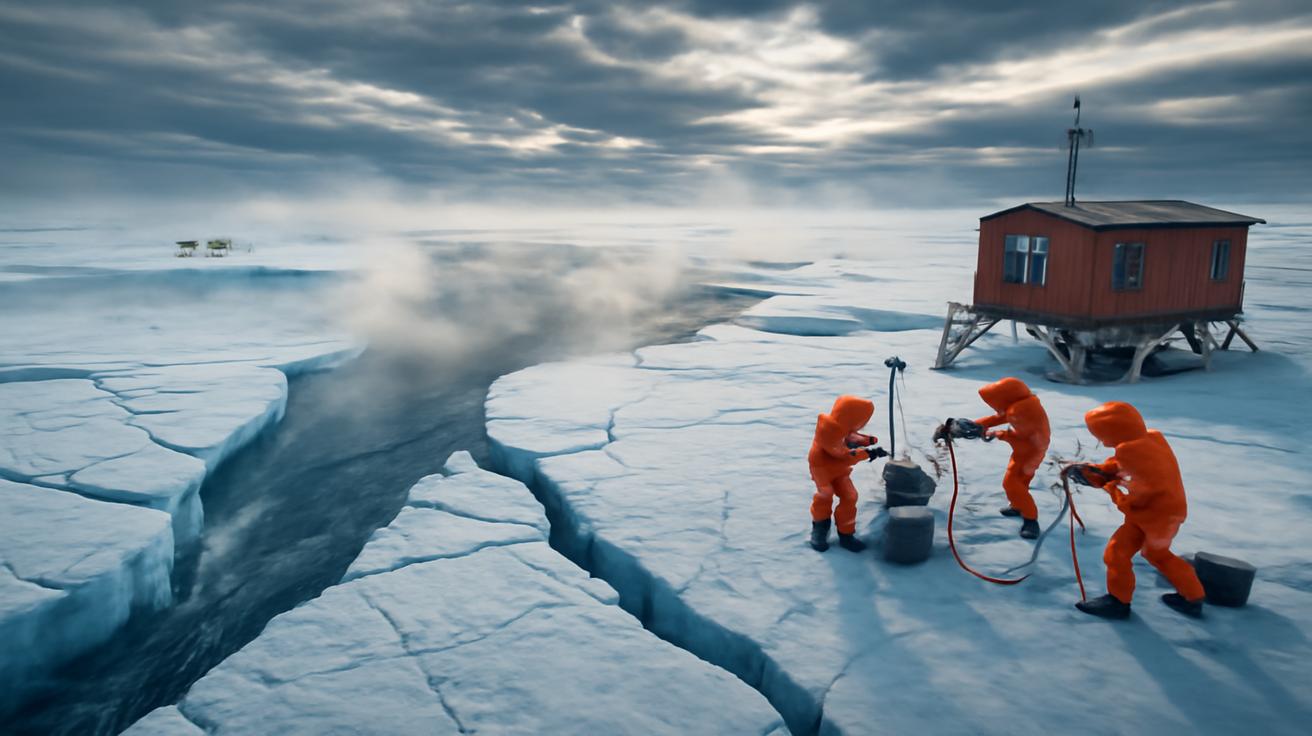
The snow started falling just after dark, soft and tentative, like it was unsure if it really belonged here. It dusted the mailboxes, softened the edges of parked cars, and laid a delicate veil over the last stubborn leaves still clinging to the trees. But if you stood still on that quiet street and really listened, there was something off about the silence. The air felt heavy, watchful. The wind kept changing direction. And far to the north—far beyond the glow of porch lights and grocery store parking lots—something enormous was stirring.
The Sky Above the North Is Coming Unraveled
High over the Arctic, fifty thousand feet above the sea ice and polar bears and shifting pack ice, there is a river of wind that behaves like the world’s great silent guardian. Meteorologists call it the polar vortex—a spinning crown of frigid air locked around the pole, normally tight and self-contained, like a whirlpool that knows its place.
In early February, that crown is showing signs of cracking.
On satellite imagery, it doesn’t look like much at first: a swirl softening at the edges, the smooth, cold circle beginning to warp and twist, like a coin of ice melting in slow motion. But for the scientists watching their screens in dim forecast offices and university labs, it might as well be a fire alarm.
“We’re seeing signals of destabilization,” one atmospheric scientist explains over a video call, her background a cluster of color-coded maps. The reds, blues, and deep purples ripple like heat mirages. “If this pattern continues, early February may be the opening act of a full-blown Arctic disruption event.”
In plain language: the Arctic’s cold air, long held in a kind of invisible bowl at the top of the world, could begin to spill south.
When the Arctic Lets Go
To understand what meteorologists are warning about, picture the Arctic as a giant freezer. For most of the winter, the door stays closed—cold locked inside, temperatures dropping to unimaginable lows over the polar night. The polar vortex, that spinning, high-altitude ring of wind, is like the seal around the door, keeping the cold in and the warmer air out.
But the atmosphere is not a perfect machine. Sometimes waves of energy rise up from lower in the atmosphere—driven by mountains, storm systems, or ocean temperature contrasts—and crash into the vortex from below like invisible tsunamis. When they’re strong enough, they can loosen that seal, tilt the freezer door, or even wrench it partially open.
This is what meteorologists are watching for in early February: a combination of those waves and a sudden spike of warmth high in the stratosphere, an event they call “sudden stratospheric warming.” In just a few days, temperatures about 30 kilometers up can soar by 30 or 40 degrees Celsius. The vortex weakens, wobbles, sometimes splits like a cracked plate.
When that happens, cold air no longer stays politely in the Arctic. It leaks out in lobe-like tendrils, pouring into eastern North America, Europe, or Asia, depending on how the atmosphere rearranges itself. The result on the ground: bone-deep cold, blizzards in places unprepared for them, strange warmth in others, and weather maps that look like they’ve been turned upside down.
Why Early February Matters
Timing is everything. Early February sits right in the heart of the Northern Hemisphere winter, when the Arctic has already had months to build up its cold reservoir. If a destabilization event takes shape now, there’s still plenty of winter left for that cold to roam.
Quiet phrases in technical briefings—“heightened risk of persistent anomalies,” “enhanced probability of high-impact events”—translate into the language of daily life as canceled flights, strained power grids, icy highways, and brittle, dangerous cold for people without adequate shelter.
The scientists are careful. That’s their training. They talk in probabilities and ensemble models—dozens, sometimes hundreds of forecast simulations run side by side. But when you listen closely, there is a tremor just below the surface: we are watching the rules of winter shift in real time, and we are not entirely sure how far they will bend.
The Shape of a Destabilized Winter
You might think Arctic disruption is simply “more cold.” In truth, it is more chaos.
Imagine walking through your city in early February under a pewter sky. One week, you pull your scarf tighter against a wind that feels like broken glass. The next, your boots sink into slush as rain drums on piles of dirty snow. Ice forms, melts, re-forms. Gutters gush and then freeze over. Sidewalks become obstacle courses of half-thawed ruts and treacherous black ice.
That uneasy back-and-forth is a hallmark of a destabilized Arctic. As the jet stream—the fast-moving river of air that guides storm systems—begins to buckle and meander, it can lock in stubborn patterns. Extended cold snaps. Repeated storms tracking the same corridor. Or, on the other side of the world, unseasonable warmth stretching on and on while somewhere else shivers.
Farmers watch the sky warily, wondering if a midwinter thaw will coax buds to swell too soon, only to be blasted by a late freeze. Migratory birds pause, confused, on their way north. Ice fishermen test and retest the thickness of lake ice that doesn’t quite behave like it used to.
For people whose lives are woven tightly with weather—the ranchers, the road crews, the line workers repairing power in the dark after an ice storm—these are not abstractions. They’re shifts you feel in your bones, changes that alter when you plant, how you move, what you trust.
A Quick Look at What May Happen
Meteorologists can’t give exact dates and cities—nature is never that neat—but they can sketch the kind of pattern early February may invite if Arctic destabilization unfolds:
| Region | Potential Impacts | Notes |
|---|---|---|
| Eastern North America | Outbreaks of Arctic air, heavy snow, ice storms | Higher heating demand and travel disruptions possible |
| Western Europe | Colder, stormier spells; increased coastal wind and rain | Localized flooding and transport issues |
| Central & Eastern Europe | Sharp cold snaps, snow, potential freezing rain | Risk to infrastructure and agriculture |
| Parts of Asia | Polar air intrusions, bitter wind chills | Stress on energy systems and vulnerable communities |
| Arctic Region | Paradoxical mild spells, shifting sea ice | Long-term implications for ice stability |
This is not a firm forecast; it’s a sketch of possibilities. But it is enough to make planners and emergency managers sharpen their pencils and, quietly, worry.
The Hidden Heat Beneath the Cold
There is a quiet irony in all of this: the story of an Arctic destabilization event is, ultimately, a story about a warming world.
For decades now, the Arctic has been heating up faster than the rest of the planet—nearly four times faster by some estimates. Sea ice that once held its ground through brutal winters now retreats earlier in spring, returns later in fall, and grows thinner and more fragile with each passing year. Dark ocean water, exposed for longer, soaks up sunlight instead of reflecting it. Permafrost slumps and seeps, releasing carbon and methane that had been locked away like old secrets.
All of this matters to the polar vortex.
When you change the temperature difference between the Arctic and the equator, you change the atmosphere’s balance of power. Some researchers argue that a weaker, wobblier jet stream and more frequent polar vortex disruptions are tied to this amplified Arctic warming. Others caution that the links are complex and still under intense study. The science is very much alive, with new papers, new debates, new refinements appearing every year.
Yet even with the uncertainties, a pattern is emerging: the Arctic is no longer the steady, frozen anchor it used to be. It is restless. It is reacting. And our winters, thousands of miles away from the polar bears and ice floes, are beginning to carry the signature of those northern changes.
Weather, Meet Climate
People often ask whether a brutal cold snap “disproves” global warming. The answer lives in scale and in memory.
Weather is the mood of the atmosphere: jumpy, impulsive, quick to change. Climate is its personality: the long view, the tendencies that emerge when you watch for decades instead of days.
An Arctic destabilization event is weather—a dramatic mood swing. But its background conditions are being reshaped by climate: warmer oceans, thinner sea ice, a more humid atmosphere, landscapes drying or flooding in new patterns. These conditions influence how extremes form, where they go, what they break when they arrive.
You can think of it like a piano. Climate tunes the instrument. Weather is the song being played. As the tuning changes, some notes become easier to hit, others harder. In a warmer world, extremes—both heat and, paradoxically, some forms of cold—have new pathways to emerge.
Living Through the Unsettled Season
What does any of this mean when you’re standing at your window, coffee cooling in your hand, watching the sky for signs of what’s coming?
It means that this early February, more than in winters past, the forecast is not just background noise. It’s a kind of navigation chart. When meteorologists talk about “Arctic air outbreaks,” they are handing you warning flares: this is when the roads may glaze over in hours, when your aging furnace will work harder than it has in years, when the neighbor down the street who sleeps in his car is in real, immediate danger.
In cities where warmth has become the new winter default, there’s a creeping complacency. Snow tires feel optional. Heavy coats gather dust in closets. But destabilization punishes unpreparedness. A single night of unexpected, deeply subfreezing temperatures can burst pipes, stall cars, and leave entire apartment buildings without heat.
Communities that remember the last polar vortex shock—power lines thrumming with ice, transit systems paralyzed, grocery store shelves stripped bare—are already checking in with each other. Elderly neighbors. Friends with chronic illness. Families in drafty rentals. Conversation shifts from small talk about “this crazy weather” to a more practical kind of care: Do you have enough blankets? Do you know where the warming center is if the power goes out? Can I bring you something if the streets turn to glass?
How to Read the Coming Weeks
You don’t need to understand the stratosphere’s complex math to live more skillfully through an Arctic disruption. You just need to pay attention in a different way:
- Listen for phrases like “high-impact cold event,” “polar air outbreak,” or “significant pattern change” in local forecasts. These are code for: take this seriously.
- Watch the temperature trends over multiple days, not just a single-day high. It’s the long stretches of cold that stress infrastructure and people the most.
- Notice how often storms are forecast to “track along the same corridor.” Repeated hits in the same region can magnify damage.
- Share what you learn. Weather awareness is strangely contagious; once one person starts tuning in, others follow.
This is the quiet power we still hold: not to stop the Arctic from destabilizing this February, but to soften the edges of its impact where we live.
The North Is Not Separate From Us
On maps, the Arctic is a distant white cap on the globe, seemingly detached, a place of faraway research stations and vanishing ice. But the atmosphere does not recognize those cartographic boundaries. The air above your street is part of a continuous, restless system that flows from equator to pole and back again.
When meteorologists warn that early February could mark the beginning of an Arctic destabilization event, they’re not simply talking about a scientific curiosity. They’re describing a change in the pulse of the planet that will reach into cities, suburbs, and small towns thousands of miles away.
Maybe, in your corner of the world, this February will pass with only a glancing blow: a week of uncomfortable cold, a snowstorm that kids greet with squeals and sleds. Or maybe it will arrive as something sharper, something that etches itself into memory the way all true weather extremes do—the scramble for generators, the silence of empty highways, the star-sharp stillness of a night so cold your breath feels like it might freeze mid-air.
Whatever comes, the Arctic will be part of it. Not as a postcard from a remote frontier, but as an active player in the story unfolding over your home, your street, your morning walk.
When the snow falls this time—whether lightly, tentatively, or in fierce, sideways sheets—you might pause and feel, for a moment, the invisible threads stretching north. Up past the city lights and dark farm fields and frozen rivers. Past the forests and tundra. All the way to that spinning, shifting crown of air high over the pole, where the shape of winter itself is being redrawn.
Frequently Asked Questions
What exactly is an Arctic destabilization event?
An Arctic destabilization event is a period when the normally stable pool of cold air over the Arctic becomes disrupted. The polar vortex weakens or wobbles, allowing frigid Arctic air to spill southward into lower latitudes, often leading to extreme cold and unusual weather patterns across parts of North America, Europe, and Asia.
Does an Arctic cold outbreak mean global warming isn’t happening?
No. Cold outbreaks are weather events, while global warming refers to long-term climate trends. A warming Arctic can actually contribute to a weaker, more unstable polar vortex, which may increase the chances of extreme cold spells in some regions, even as the planet warms overall.
How long can the impacts of a destabilization event last?
The initial disruption in the stratosphere can unfold over days, but its effects on surface weather often emerge one to three weeks later and can persist for several weeks. In some cases, a single destabilization can influence regional weather patterns for much of the remaining winter.
Which regions are most at risk during these events?
Eastern North America, parts of Europe, and sections of Asia are often most affected by Arctic air outbreaks linked to polar vortex disruptions. However, the exact regions vary with each event, depending on how the jet stream and pressure systems realign.
What can individuals do to prepare for potential Arctic outbreaks?
Stay informed through reliable weather forecasts, insulate your home where possible, ensure heating systems are serviced, keep emergency supplies on hand (including blankets, non-perishable food, and medications), and check on vulnerable neighbors or family members during extreme cold. Small, practical steps can significantly reduce the risk during a severe cold spell.







Leave a Comment