
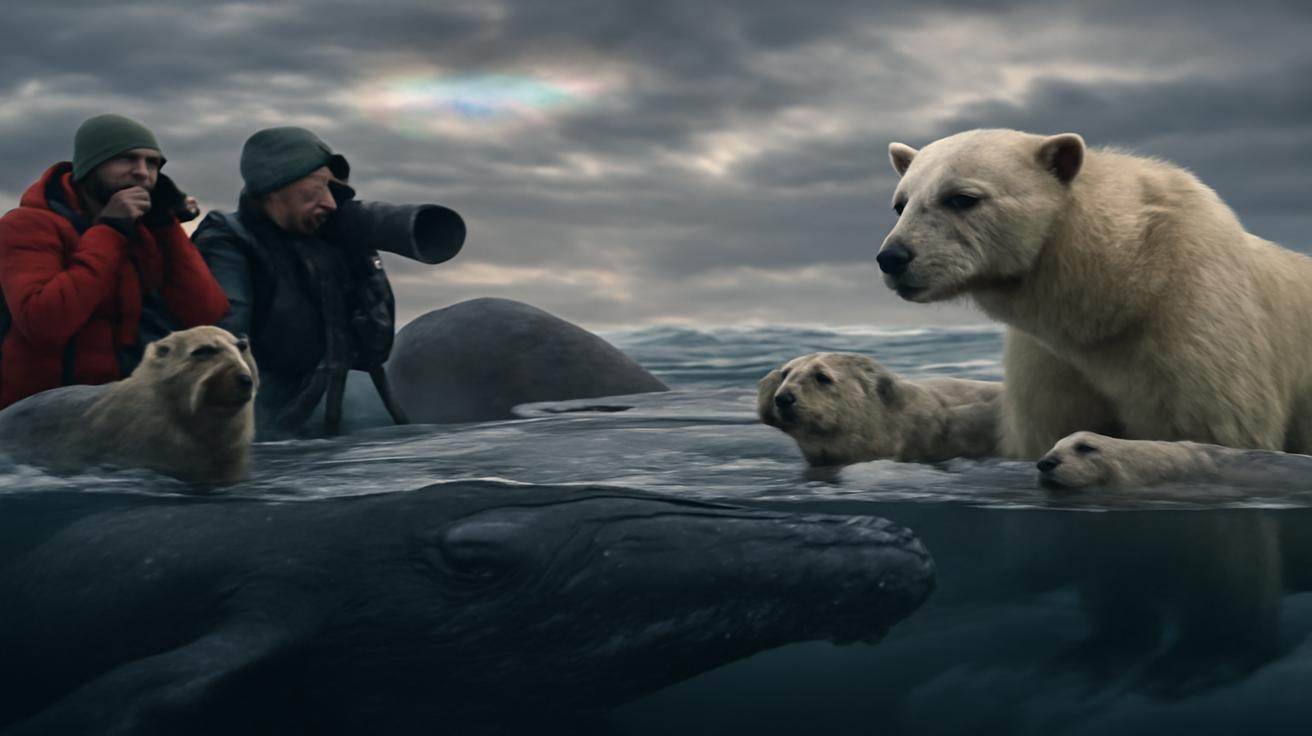
The first thing you notice is the silence. A white, breathless kind of quiet that seems to press against your eardrums, as if the world is holding itself very still. Somewhere beyond the edge of the sea ice, a bowhead whale exhales—a heavy, foggy plume that hangs in the dim Arctic air. It’s early February, the time of year when this world should be hard-frozen and predictable. But this winter, meteorologists are murmuring a different story, one written not in myth but in numbers, pressure charts, and satellite swirls. And that story has them worried for the animals that have long relied on winter to behave itself.
The Winter That Feels Wrong
Even in the high Arctic, where winter is more ritual than season, you can feel it: something is off. The ice doesn’t creak the way it used to. There are more stretches of open, inky water—black leads slicing the frozen sea into strange, shifting puzzle pieces. Hunters who grew up reading the ice the way others read books are pausing at the shore, eyebrows furrowed, trying to match memories with this new, unsettled reality.
In forecasting centers thousands of kilometers away, meteorologists are staring at their own uneasy landscape: looping jet streams, high-pressure domes, and ocean temperatures that refuse to come down. Early February is usually a stabilizing point for Arctic weather—an anchor moment when the atmosphere settles into a predictable, deeply cold pattern. But this year’s atmospheric signals are more like a warning light than a reassuring clockwork.
“We’re seeing anomalies on top of anomalies,” one forecaster explains during a late-night briefing. “The kind of patterns that tend to spell trouble for sea ice stability and, by extension, for the mammals that depend on it.”
Arctic marine mammals—walruses, ringed and bearded seals, narwhals, belugas, bowhead whales, even polar bears who hunt from the ice edge—have synchronized their lives to the rhythm of freeze and thaw. A few degrees warmer at the wrong time, a storm track shifted a few hundred kilometers off its usual path, and the rhythm fractures. Early February has always been part of their safety net: the assurance that by now, ice is thick, temperatures are low, storms are predictable. The new patterns tell meteorologists this safety net is fraying.
What the Atmosphere Is Whispering
The warnings start, as they often do, with a quiet change in the upper air. In early February, meteorologists notice the polar vortex—an immense, spinning crown of cold air that usually keeps Arctic chill contained—looking distorted, stretched like taffy. At the same time, the jet stream that circles the northern hemisphere bends into sharper, more dramatic waves.
In a room lit by glowing model outputs, these changes are not abstract. They show up as swirls of color, arrows of wind speed, pressure systems like massive, invisible mountains. What they’re hinting at is simple enough: the Arctic is too warm, the ice too thin, and storms are about to start using the polar seas as their playground.
Surface temperatures in some parts of the Arctic Ocean are running several degrees above normal, and open water—where there should be continuous ice—absorbs sunlight instead of reflecting it. That warmth seeps upward into the atmosphere, feeding the very patterns that keep the region unstable. It’s a feedback loop meteorologists have come to recognize all too well.
“When you see this configuration in early February,” a climate scientist notes, tapping an image of swirling red and orange anomalies near the ice edge, “you start thinking about what it means for the animals that need reliable ice platforms, quiet waters, and predictable breathing holes. The concern level goes way up.”
Atmospheric Patterns That Raise Red Flags
- Persistent high-pressure systems that trap mild air over key marine mammal habitats
- Frequent storms driving strong winds across fragile, newly formed ice
- Elevated sea surface temperatures near traditional feeding and breeding grounds
- Jet stream kinks that funnel warm, moist air north in sudden bursts
Each of these might seem like meteorological trivia. Together, in the vulnerable window of early February, they become a forecast not just for weather—but for stress, hunger, and risk for Arctic wildlife.
Life on the Edge of the Ice
Out on the real ice, far from model runs and climate jargon, a ringed seal surfaces through a narrow breathing hole. The seal’s world is built on assumptions: that the ice above its den will hold, that the snowpack will insulate its pups, that the ocean’s pantry below will be reachable. Those assumptions are suddenly unstable.
When winds strengthen and temperatures hover closer to freezing than they should, the ice can fracture unexpectedly. Leads of water open and close. A breathing hole the seal has used for weeks can be shoved dozens of meters away by shifting floes. For animals that navigate by memory and subtle cues, a reconfigured landscape is not just inconvenient; it can be deadly.
Walruses, hefting their bulky bodies onto the ice to rest between deep dives, depend on stable floes near rich feeding grounds. When early February storms churn the Chukchi or Barents Seas, those floes can break apart, forcing walruses to haul out on crowded shorelines instead. There, calves risk being crushed in panicked stampedes when spooked by noise or predators.
Then there are the whales—bowheads, narwhals, belugas—threading themselves along cracks in the ice, surfacing to breathe where open water or thin ice allows. If a sudden freeze follows an early thaw, or if wind compacts the ice after a storm, those leads can close like doors. Trapped whales, cut off from air, are not just tragic headlines; they’re a predictable outcome of fast, unstable weather swings.
| Species | Key Ice Need | Risk from Early Feb Anomalies |
|---|---|---|
| Ringed seal | Stable snow-covered ice for birth lairs | Ice collapse, rain-on-snow flooding lairs, pup exposure |
| Walrus | Floating ice near feeding grounds for haul-outs | Loss of resting platforms, crowded coastal haul-outs, stampede risk |
| Beluga & narwhal | Predictable leads and polynyas for breathing | Sudden ice closure, entrapment, disrupted migration routes |
| Bowhead whale | Seasonal ice edge zones rich in plankton | Shifts in prey distribution, longer travel to feeding areas |
| Polar bear | Sea ice platforms to hunt seals | Reduced hunting season, greater energy expenditure, starvation risk |
To these animals, the atmosphere’s “signals” don’t look like pressure anomalies or temperature charts. They look like extra miles swum, extra energy burned, extra risk taken for each meal.
Storms, Sound, and Stress Under the Ice
When meteorologists warn of a stormy pattern setting in for early February, they’re not only picturing waves battering the ice edge. They’re also imagining what happens beneath the surface. Strong winds can pile ice into thick ridges in some areas while tearing it apart in others, exposing open water to the sky’s full force. Waves then travel farther into regions that were once shielded by continuous ice cover.
Underwater, this chaos translates into a roar. Ice panels grind. Waves slam the underside of floes. Air pockets collapse. For animals like belugas and narwhals, who “see” with sound, a suddenly noisy seascape is like driving through a blizzard with your headlights flickering. Communication calls get masked. Echoes from prey and obstacles blur and blend. In a month when many whales are migrating, choosing routes, and staying close to familiar leads, that added confusion is more than mere discomfort.
On top of the natural storm noise comes another layer: ships. Warmer seas and patchier ice tempt more vessels northward, even in winter shoulder seasons that used to be effectively closed. When ice thins and breaks up earlier, shipping routes open sooner, bringing low-frequency engine sounds into waters where marine mammals are already straining to adapt.
Meteorologists, oceanographers, and biologists are starting to work together more closely to piece together these cascading effects. A pressure pattern here, a shift in wind field there, and the result might be a pod of narwhals pushed toward noisy, ice-clogged straits instead of quiet traditional passages. It’s a chain of events that begins in the high atmosphere and ends in the stressed heartbeat of a fleeing whale.
Hidden Costs of an Unstable February
- Increased energetic costs as mammals swim farther to find suitable ice or open water
- Higher calf and pup mortality when dens or haul-outs are disturbed by storms
- Disrupted migration timing as animals struggle to track moving ice edges
- Greater exposure to predators and human activities in newly open waters
The Arctic was never an easy place to live. But it used to be a reliable one. Early February used to draw a clear line of expectation—solid ice, deep cold, a quieter atmospheric mood. Now that line is smudged, and the animals are being asked to improvise in a play that once followed a dependable script.
Reading the Signals with Indigenous Knowledge
Long before satellite feeds and ensemble forecasts, Arctic communities were the meteorologists of this region. Inuit, Yupik, and other Indigenous hunters learned to read wind, cloud, snow, and even the tone of the ice itself—how it rang under a boot, how it flexed beneath a sled. Today, many of them say the same thing the models are hinting at: the timing is changing, and with it, the animals.
A hunter stands at the edge of a village, watching low clouds travel in from the south in early February. “These used to be March clouds,” he says quietly. “Now they come earlier. The ice isn’t as sure.” The words carry weight, backed by generations of knowledge passed from elder to youth in camps on the ice.
When meteorologists issue warnings about atmospheric signals, they’re increasingly cross-checking those warnings with what local people are seeing. Are seals hauling out in unusual places? Are whales arriving off schedule? Are hunters avoiding traditional trails because the ice has grown deceptive? In many cases, the answers are yes.
This fusion of satellite-era and story-era knowledge is reshaping how concerns are communicated. It’s no longer just a graph on a screen; it’s a shared narrative: the storms that come too soon, the rain that falls on snow and collapses seal dens, the wind that shifts just enough to break the ice in the wrong place at the wrong time.
And it’s not abstract sympathy. For many communities, marine mammals are food, culture, and identity. When the animals suffer, people suffer too. The early February signals, then, are warnings for livelihoods as much as for ecosystems.
What Can Be Done When the Sky Itself Is Changing?
Standing on the sea ice, staring at a vast and shifting horizon, the idea of doing anything about upper-level wind patterns can seem absurd. The Arctic atmosphere moves to scales far beyond local control. But that doesn’t mean there’s no agency in the story.
At the broadest scale, the root driver of these atmospheric anomalies is a warming climate—particularly the accelerated warming of the Arctic, which is heating roughly four times faster than the global average. The more the region warms, the more sea ice retreats and thins, and the more the atmosphere “notices,” adjusting storm tracks, jet streams, and temperature contrasts in response.
Reducing greenhouse gas emissions globally doesn’t immediately stop a February storm pattern. But it does shape the background against which those patterns form. Every fraction of a degree of avoided warming helps preserve some measure of winter’s old reliability for marine mammals. It’s a slow, cumulative defense rather than a quick fix, but it is a defense nonetheless.
Closer to the ice, there are more targeted levers:
- Dynamic marine protection: Using real-time ice and weather data to temporarily restrict shipping or industrial noise in key whale and seal habitats during high-risk periods.
- Ice and storm forecasting for communities: Translating complex atmospheric warnings into practical guidance for hunters and fishers, helping them avoid dangerous conditions while reducing pressure on stressed wildlife.
- Monitoring and rapid response: Coordinated teams ready to document and, when possible, assist in ice entrapment events or mass haul-outs, improving both rescue chances and scientific understanding.
- Respecting Indigenous leadership: Centering decision-making around those who live with these changes daily, blending data with deep local experience.
All of these rely on the same thing: listening carefully when meteorologists say, “The pattern this February is worrying.” Those warnings become a planning tool, a way to anticipate where and when marine mammals may be most vulnerable and to act—locally, politically, scientifically—while there is still time to soften the blow.
The Breathing Space We Still Have
Back in that vast Arctic twilight, a bowhead surfaces again, its breath briefly visible in the cold, blue-tinged air. It has no concept of a polar vortex, no language for “atmospheric anomalies.” What it knows is the feel of the water on its skin, the taste of plankton drifting in from the ice edge, the memory of routes its ancestors took in winters that were cold, steady, and slower to change.
We, however, do have the language. We have the instruments that can see storm systems before they form, the models that can sketch out possible futures weeks ahead, the statistics that trace a line from global emissions to regional instability. When meteorologists warn that early February atmospheric signals raise concerns for Arctic marine mammals, they are not predicting a single catastrophe so much as describing a tightening vise of risk—a season that leaves less room for error, less margin for survival.
There is still breathing space, for now. The ice still forms, even if it is thinner. The whales still find their leads, even if they travel farther. The seals still dig their dens, even if more of them fail. But every winter like this one, every February when the sky refuses to settle into its old, stable patterns, squeezes that space a little more.
In that narrowing gap between what the Arctic once was and what it is becoming, our role is being written too. We can treat the meteorological warnings as distant curiosities, or as dispatches from a frontier where animals are already paying for choices made far to the south. We can ignore the atmospheric whispers, or we can listen closely, translate them into action, and decide that the silence of the Arctic—the real, living quiet of breath through a blowhole, of paws on snow, of a seal surfacing into crisp air—is worth fighting to keep.
Frequently Asked Questions
Why are meteorologists especially concerned about early February conditions?
Early February is typically a stabilizing point in the Arctic winter, when sea ice is near its maximum extent and temperatures are deeply cold. When the atmosphere shows unusual patterns at this time—such as persistent warmth, strong storms, or distorted jet streams—it signals that ice may be weaker and more dynamic than normal right when marine mammals most depend on its reliability.
Which Arctic marine mammals are most affected by these atmospheric changes?
Ringed and bearded seals, walruses, narwhals, belugas, bowhead whales, and polar bears are all affected. Species that need stable ice platforms (like seals and walruses) or predictable breathing holes and migration routes (like whales) are particularly vulnerable to sudden shifts in ice and weather conditions.
How do storms and warm spells actually harm these animals?
Storms can break up ice, close breathing leads, flood seal birth lairs with rain-on-snow events, and force walruses into crowded shore haul-outs. Warm spells thin or delay ice formation, meaning less habitat for hunting, resting, and raising young. Together, they increase energy costs, reduce access to food, and raise mortality risks for pups and calves.
Is this just natural variability, or is climate change involved?
Natural variability still plays a role in year-to-year Arctic weather, but the overall backdrop is a rapidly warming climate. Loss of sea ice and warmer ocean temperatures are altering jet streams, storm tracks, and temperature gradients, making unusual atmospheric patterns more likely and more intense. Climate change is effectively loading the dice against stable winter conditions.
What can be done to protect Arctic marine mammals in the short term?
Short-term actions include limiting noise and shipping in sensitive areas during high-risk periods, improving ice and storm forecasting for local communities, protecting critical habitats, and supporting Indigenous-led monitoring and management. These strategies can reduce additional stress on animals that are already coping with rapidly changing ice and weather patterns.
How does this connect to what people do far from the Arctic?
Greenhouse gas emissions from around the world drive the warming that destabilizes Arctic weather and sea ice. Choices about energy use, transportation, and land management in distant cities and countries influence the conditions that marine mammals face in early February. Reducing emissions helps slow the changes that make each Arctic winter more precarious than the last.






Leave a Comment