
The first time the sky turned that strange, pewter color over the Arctic this February, no one had language for it. Weather satellites captured it in real time: a wide, swirling wound in the atmosphere, the polar vortex pulled apart like loose stitching. On the ground, the air felt wrong. Too warm. Too soft. Snow that should have squeaked like dry Styrofoam under boots slumped instead into a damp, muffled hush. Somewhere beneath that bruised sky, a ringed seal surfaced through thinning ice to breathe—and found not a solid roof of winter above, but slush and cracks and open water where stability should have been.
The Winter That Didn’t Act Like Winter
Meteorologists had seen the warning signs building for weeks—a sharp disruption in the polar vortex, the belt of very cold winds that normally circles the Arctic high above Earth’s surface. In early February, those winds buckled. Warm air surged north, slamming into the frozen ceiling of the world. Computer models glowed in frantic colors; temperature maps turned from deep blue to alarming yellow and red over places that, in any sane year, should have remained locked in polar night and bitter cold.
“It’s like the Arctic is having a fever,” one climate scientist put it during a rushed briefing. The phrase stuck, because it felt uncomfortably accurate. Fever isn’t just a number on a thermometer; it’s a signal that something deeper is malfunctioning. And what meteorologists were seeing wasn’t just another “weird weather event.” It was a shift in the operating system that everything up there—from microscopic plankton to polar bears—depends on.
In coastal villages along Alaska, northern Canada, and Greenland, the changes were not abstract. Hunters stepped onto ice that flexed with an ominous give, like a trampoline above dark water. Snowmobiles crossed routes that elders insisted had been safe for generations, only to find cracks as long as a river delta and as hidden as a trapdoor. The Arctic, once reliably frozen and fiercely predictable in its harshness, had become moody, hesitant, and dangerously inconsistent.
How a Broken Winter Breaks a Food Web
To understand why biologists and meteorologists are suddenly using the phrase “biological tipping point,” you have to follow the chain reaction from atmosphere to ice to animal. It starts high above, where sudden stratospheric warming events—rapid temperature spikes 30 kilometers up—knock the tight ring of polar winds off balance. That, in turn, lets milder air from lower latitudes push into the Arctic like an uninvited guest, raising ground-level temperatures by 10, 15, even 20 degrees Celsius above normal.
That might sound like a welcome reprieve from life-threatening cold, but in the Arctic, that cold is the scaffolding that holds the entire ecosystem together. Sea ice is more than frozen water; it’s a living platform. In its underside blooms algae that feed zooplankton that feed fish that feed seals that feed polar bears. When the ice forms late, thins early, or fractures unexpectedly, that entire vertical chain shudders.
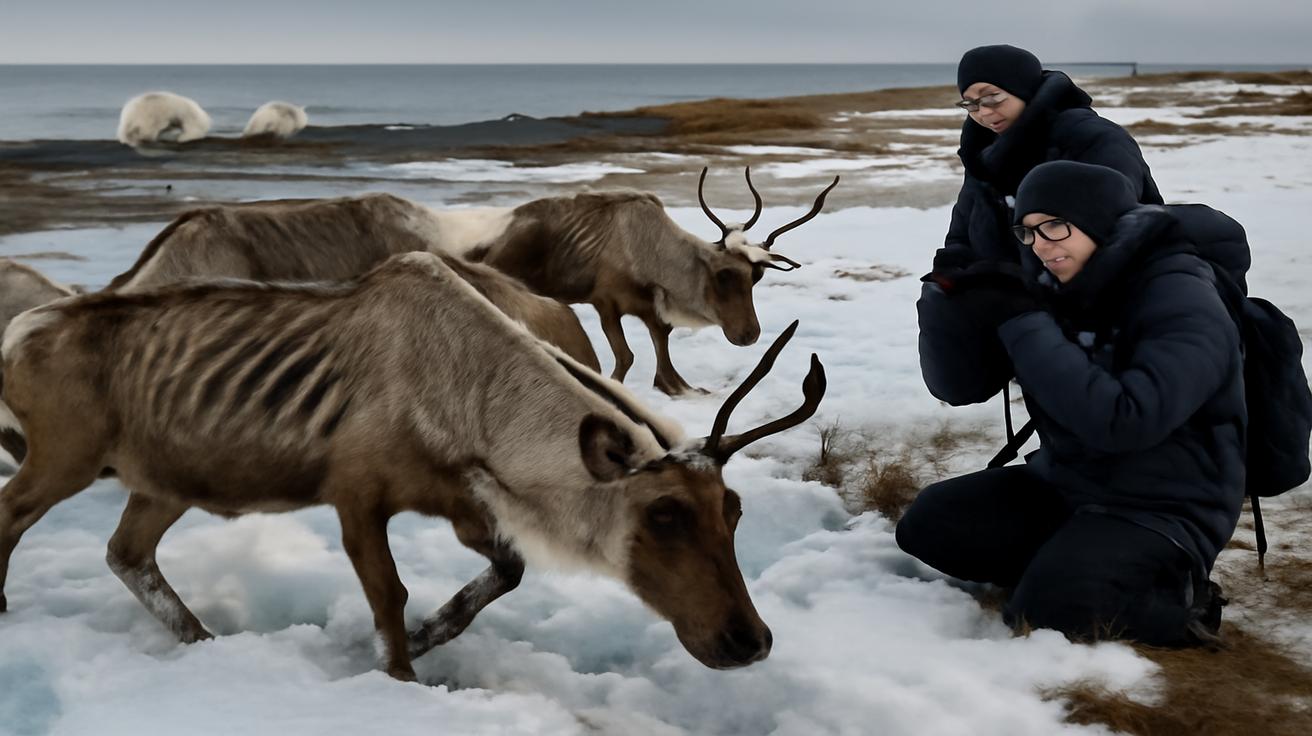
On the tundra, the script is just as delicate. Deep, reliable snow used to shelter small mammals like lemmings and voles, insulating them from extremes and predators. But rain-on-snow events—another hallmark of these February warm spells—create a different world. Rain falls onto cold ground, seeps through snow, and then freezes into a hard, glassy crust. Caribou and reindeer, which paw through powder to find lichen, slam their hooves against that icy armor and come up hungry. Lemmings once moved through fluffy tunnels; now they face concrete.
Every species up here has lived at the edge of enough for thousands of years. A late freeze or early thaw used to be a rare deviation. This February, it felt like the new normal—and that’s what has scientists alarmed. The system isn’t wobbling around an old balance anymore; it’s searching for a new one.
Signs that the System Is Crossing a Line
In laboratories and field camps, data are stacking up into an unsettling story. Wildlife biologists, oceanographers, and meteorologists are seeing parallel patterns, each one a different alarm bell ringing the same message: the Arctic’s living communities may be entering a state where they cannot simply “bounce back” when the weather stabilizes.
| Indicator | Recent Observation | What It Suggests |
|---|---|---|
| Sea-ice extent | Near-record lows in early February, with rapid midwinter melt episodes | Loss of stable habitat for seals, polar bears, and ice-dependent algae |
| Rain-on-snow events | Increased frequency, even above the Arctic Circle | Icy crusts blocking food access for reindeer, musk oxen, and small mammals |
| Thaw-freeze cycles | More frequent winter thaws followed by rapid refreezing | Structural stress on permafrost, den collapse, and vegetation damage |
| Migration timing | Birds and marine mammals increasingly “out of sync” with food peaks | Phenological mismatch, lower breeding success |
| Predator-prey interactions | New access routes for predators as sea ice fractures and refreezes | Higher mortality for ground-nesting birds and small mammals |
In isolation, any single one of these shifts might be survivable. Ecosystems are, by design, a bit elastic. But tipping points are what happen when multiple subtle shifts synchronize. Lemmings starve under ice crusts the same year snowy owls arrive earlier but find fewer nests to raid, the same year that meltwater seeps into fox dens, the same year that seal pups are born on ice that fractures under a mild February sun. The result isn’t a gentle decline; it’s often a sharp, stepped drop in populations.
Arctic Lives on Thin Ice
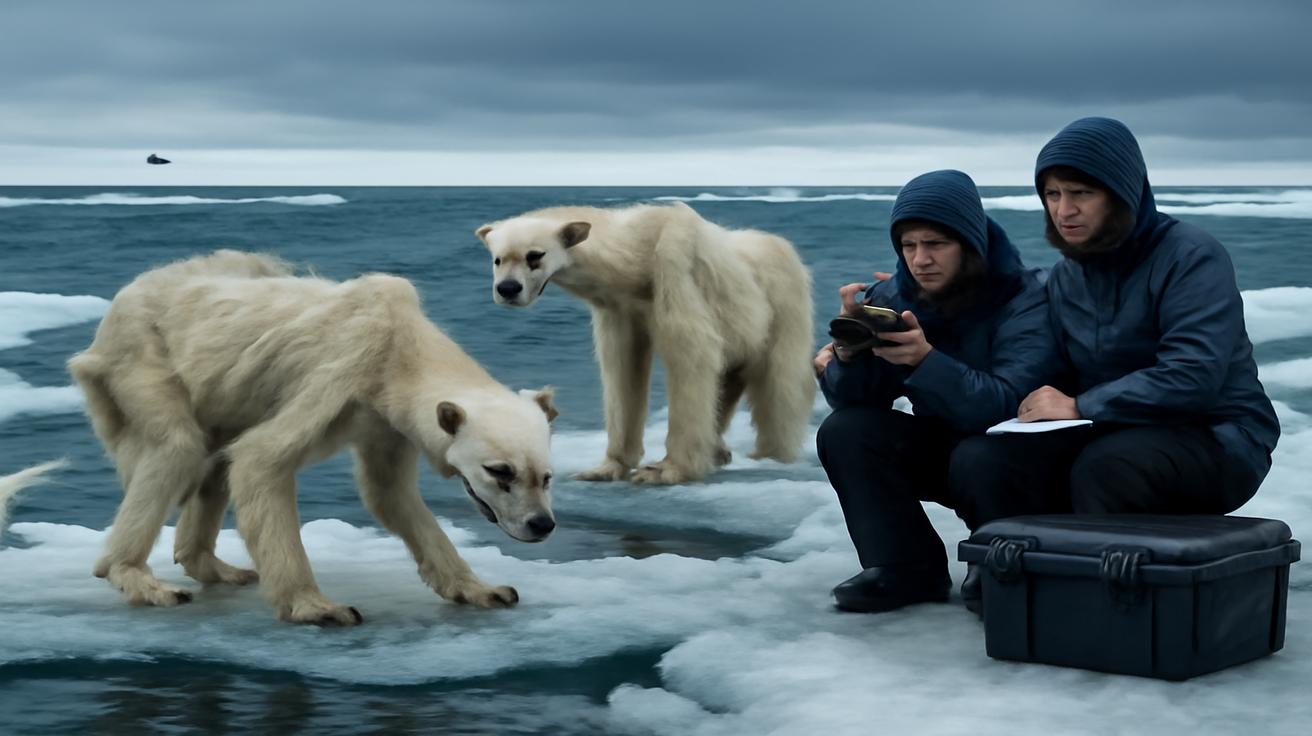
Imagine the life of a polar bear in a “normal” year, if there is still such a thing. Winter is hunting time. The bear roams the frozen ocean, nose twitching above breathing holes where seals surface to grab oxygen in the long polar night. Each successful hunt is a life-or-death bonus in a season that must fuel a long summer of scarcity.
When the February warm-ups hit, the physical world around that bear changes shape almost overnight. Leads of open water expand. The ice underfoot fractures into floes that drift apart, marooning bears on moving islands they did not choose. The stable ice edge—the bear’s main hunting ground—retreats farther from shore. Swimming longer distances in frigid water burns precious calories and drowns cubs that can’t keep pace.
Farther south on the tundra, herds of caribou face their own crisis. Their hooves are beautifully adapted snow tools, designed to dig down to the lichen fields that sustain them through winter. But they’re not built for the iron-hard ice crusts forged by rain-on-snow events. This past February, reports came in of caribou lingering longer in wind-scoured ridges, their ribs sharply visible even at a distance. In some regions in recent years, entire cohorts of calves have been lost after such winters. When scientists tally carcasses, they aren’t merely counting the dead. They are measuring the frayed edge of a population’s future.
And then there are the quiet casualties: tiny amphipods that feed under ice. Arctic cod that school in the dim water below. Algae that need just the right amount of sunlight filtering through snow-covered ice. Change the thickness, texture, and timing of that ice and you reorganize life from the bottom up. Some species may adapt or even briefly thrive in the chaos; generalists often do. But creatures finely tuned to a narrow band of conditions—like many Arctic specialists—have nowhere left to go.
Indigenous Knowledge and Scientific Alarm Converge
For Indigenous communities across the Arctic, every odd melt and strange storm carries more than scientific meaning—it is a lived disruption of culture, food systems, and identity. Hunters in northern Canada describe the sensation of traveling across “nervous ice,” a local phrase for surfaces that look solid but sound and feel wrong underfoot. Elders recall winters when wind direction, snow texture, and animal behavior offered dependable clues. Those clues are faltering now.
In meetings with researchers, Indigenous experts often arrive with their own datasets: stories, place names, detailed knowledge of when the first snow geese arrived each spring, or when the sea ice in a particular bay usually groaned and locked into place. That timeline is scrambled. Narwhals are appearing in routes where they were once rare. Sea ice that used to linger into late spring vanishes weeks earlier.
What’s striking in recent conversations is not just that Indigenous observers and satellite records now tell the same story; it’s that they converge on the same wordless unease. The word “tipping point” may sound clinical, but at its heart is a shared fear: that we are watching not a passing disturbance but a transition to a new, less life-supporting Arctic—one that will not easily shift back, even if global emissions fall.
The Physics of Irreversibility
Tipping points in nature are like the moment a chair teeters past balance. Up to a certain angle, it can still rock back to upright with a nudge. Beyond that, gravity takes over and the fall becomes inevitable. In the Arctic, several key physical systems behave that way.
Sea ice, for example, has a powerful feedback loop built in. Bright, white ice reflects most incoming sunlight back into space. Dark, open ocean absorbs it, warming the water, which then makes it harder for ice to form the next winter. As February warm events expand patches of open water in midwinter, they accelerate this feedback. At some point, a threshold is reached where the system “prefers” a low-ice state. Even if the air cools again, the ocean retains so much heat that the old ice regime never quite returns.
Permafrost—the frozen ground that underlies much of the Arctic—is another candidate. Repeated thaw-freeze cycles crack and destabilize it, creating sinkholes, slumps, and wetlands where solid ground once lay. This is not only a problem for infrastructure and human settlements; it reshapes habitats and releases stored greenhouse gases like carbon dioxide and methane. Those gases, in turn, intensify warming, feeding yet another loop.
When meteorologists warn that early February Arctic changes are pushing animal populations toward a biological tipping point, they are not simply tracking today’s storm. They are flagging the alignment of these feedbacks in a single direction—toward an Arctic that sheds ice, unlocks carbon, and asks every species to rewrite its survival strategies on the fly.
Life on the Edge of a New Arctic
Not all responses are stories of loss; some are stories of forced adaptation. Red foxes, for example, are increasingly pushing into territory once dominated by the smaller, better-insulated Arctic fox. As winters soften and snow cover dwindles, the red fox’s advantages—size, aggression, flexibility in diet—start to outweigh the Arctic fox’s finely tuned cold-weather traits. Bird species from farther south are showing up at northern breeding grounds, sometimes outcompeting local specialists.
Marine ecosystems, too, are reshuffling. With less ice, more light reaches the upper ocean earlier in the spring, altering the timing and composition of plankton blooms. Fish like capelin and cod follow those blooms, and their predators—seabirds, whales, seals—follow them. But timing is everything. If chicks hatch after the main fish pulse has passed, or if whale migrations are still synced to an older calendar, productivity plummets.
Scientists describe these shifts with words like “regime change” and “novel ecosystems,” which sound sterile until you imagine what they actually mean: a landscape where familiar anchors like the timing of snowmelt, the thickness of ice, the arrival of certain birds or whales, no longer hold. For animals at the razor-thin margins of energy and time, a slightly earlier melt or a week-long warm spell in February can spell the difference between a viable population and a cascading decline.
Why the Rest of the World Should Care
It might be tempting, from a temperate city far from sea ice and caribou, to file these February anomalies under “distant tragedies.” But the Arctic behaves like a planetary thermostat and a global mirror. When its ice thins, more heat is absorbed into the system we all share. When its jet stream is disrupted—pushed and pulled by unusual warmth aloft—the consequences ripple outward as extreme weather far to the south: winter heatwaves in one region, brutal cold snaps and storms in another.
The biological tipping points playing out in early February skies over the Arctic are not contained there. Migratory birds that breed in the north visit wetlands and shorelines on every continent. Shifts in Arctic fish populations alter global seafood markets. And the greenhouse gases released from thawing permafrost nudge the entire climate closer to thresholds of its own: coral bleaching, forest dieback, intensifying drought.
When scientists say they are alarmed, it’s because this February’s disrupted polar vortex and midwinter melt events are not isolated freak occurrences. They are the new, jagged edge of a long trend—one that binds human choices on fossil fuel use, land management, and conservation to the fate of animals breathing under fractured ice in the high latitudes.
Holding the Line Where We Still Can
There is a painful honesty required in talking about tipping points: some lines, once crossed, will not be easily uncrossed in any human time frame. Multi-year sea ice that took decades to grow cannot magically reappear in a few cold seasons. Animal populations that have crashed to a fraction of their former size may never reclaim their historic range, even if conditions partially improve.
But that does not mean the story is already written. Tipping points are not single cliffs; they are a series of thresholds. Avoiding the worst of them—preserving remnant cold refuges, safeguarding migration corridors, curbing further acceleration of warming—still lies within our collective reach, primarily by reducing greenhouse gas emissions and protecting intact habitats. For Arctic species, even a fraction of a degree less warming can be the margin between survival and collapse.
On the ground, this looks like tighter protections for key denning and breeding areas, real partnerships with Indigenous communities whose knowledge can guide smart adaptation, and global policies that pull back on the throttle of the warming that’s driving February’s strange weather in the first place. On the sea, it means carefully regulating new shipping lanes and fisheries that open as ice retreats, so that animals already stressed by climate disruption aren’t hammered by noise, pollution, and overharvest.
The Arctic is telling a story in the language of clouds, wind, and ice. This February, that story bent sharply toward danger. The question is not whether animals feel the shift—they do, in their empty bellies, failed litters, and lost migrations. The question is whether we, far away and insulated by geography and comfort, are willing to hear them in time to keep more of that living tapestry from unraveling.
FAQ
What do meteorologists mean by a “biological tipping point” in the Arctic?
They mean a threshold where environmental changes—such as repeated midwinter warm spells, sea-ice loss, and unusual rain-on-snow events—become so intense and frequent that many species can no longer cope. Instead of gradually adjusting, populations may suddenly crash or ecosystems may reorganize into a fundamentally different state.
How does a disrupted polar vortex affect animals?
When the polar vortex weakens or breaks apart, warm air can surge northward. This leads to sudden thaws, rain in midwinter, and rapid refreezing. Animals adapted to stable, deep cold—like seals, polar bears, caribou, and small mammals—find their habitats transformed: ice becomes unstable, food gets locked under icy crusts, and breeding or hunting seasons are thrown out of sync.
Why is early February such an important time in the Arctic?
Early February is usually deep winter in the Arctic—a period when sea ice should be thick, snow cover stable, and many species are relying on predictable conditions to hunt, migrate, or conserve energy. Disruptions during this time undermine the foundation of the entire year’s ecological cycles, from seal pupping to caribou calving.
Will Arctic animals simply adapt to the new conditions?
Some may adapt or shift their ranges, and generalist species often cope better. But many Arctic animals are extreme specialists, finely tuned to narrow temperature ranges, specific ice conditions, or tightly timed food peaks. The speed and unpredictability of current changes mean that many species are being pushed beyond the limits of their ability to adapt.
How does what happens in the Arctic affect people living elsewhere?
Changes in the Arctic influence global weather patterns, including the jet stream, which can lead to more extreme storms, heatwaves, or cold snaps in lower latitudes. Thawing permafrost releases greenhouse gases that intensify global warming. Migratory birds, fish, and marine mammals that depend on Arctic habitats also connect those ecosystems to food webs and economies around the world.





Leave a Comment