
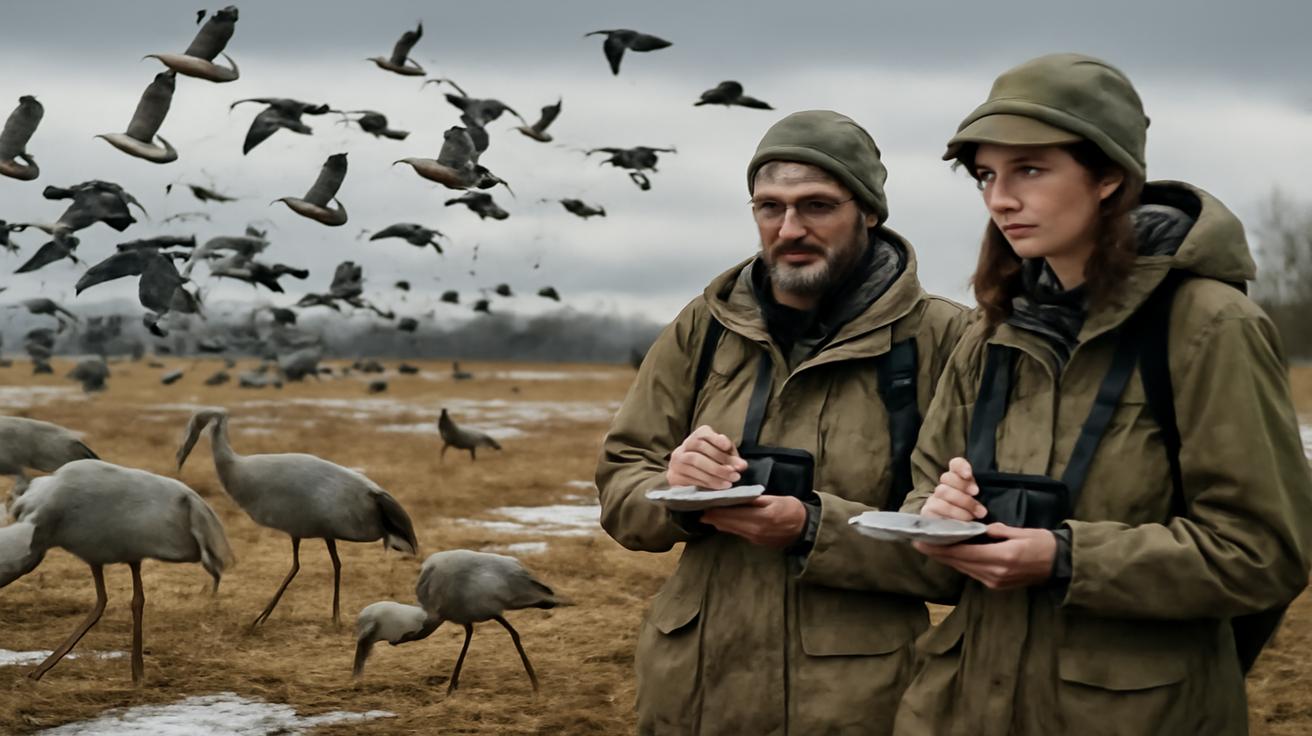
The first sign that something was off came not from a satellite map or a complex model, but from a narrow strip of sky where the geese should have been. In early February, on a morning that should have bitten with cold, the air felt strangely soft. Over a marsh that usually rang with the ragged calls of migrating birds, there was only the low hiss of wind over half-frozen water. It felt, in that unsettled quiet, as if the season itself had missed a cue.
The Winter That Refused to Behave
Meteorologists had seen it building for weeks: the Arctic, that white cap that steadies the planet’s seasons, was unraveling early—again. Sea ice that should have been locked tight was fracturing. Warm pulses from the south thinned the frozen shield, allowing heat to well up from the ocean below. In weather centers from Oslo to Tokyo, screens glowed with the same story: an early February Arctic breakdown was underway.
“We’re used to seeing the Arctic destabilize later, in late winter or early spring,” one climate scientist in Helsinki said during a video briefing, the glow of her model outputs reflecting off her glasses. “But this pattern—this early—ripples far beyond the polar circle. It changes everything we expect about seasonal timing.”
When she said “everything,” she wasn’t just talking about snowstorms and unseasonal rain. She was thinking of wings. Of journeys that cross hemispheres. Of birds whose internal calendars are tuned, with exquisite precision, to the subtle shifts in light, temperature, and wind—the very things the Arctic breakdown was now scrambling.
Outside those labs and offices, most people didn’t feel the change as an atmospheric event. They felt it in small puzzles: cherry trees budding too soon, a midwinter thunderstorm, a February afternoon that smelled faintly of mud and thawed leaves. But if you walked along wetlands and shorelines, or through city parks where starlings gather in dense murmurations, you could sense a deeper confusion. The sky itself seemed to be waiting.
How the Arctic Talks to the Rest of the World
The early February breakdown isn’t a single event. It’s more like a chain reaction, a quiet but powerful argument between air, ocean, and ice. High above the planet, the polar vortex—a swirl of cold, dense air in the stratosphere—begins to wobble. Sometimes it even splits. When that happens, the boundaries between Arctic cold and mid-latitude warmth blur and buckle.
The jet stream, that fast “river” of air that snakes around the Northern Hemisphere, responds like a loosened thread. Instead of flowing in a relatively straight line, it starts to kink and meander. Some regions are locked into weeks of unusual warmth; others find themselves repeatedly under cold, stormy air that once belonged much farther north.
This is more than a story about people swapping snow shovels for umbrellas. For migratory birds, the jet stream is a moving highway sign. It shapes prevailing winds, storms, and temperature gradients along their routes. The timing of that shift in early February now threatens to throw off a choreography that’s been rehearsed over thousands of years.
Many long-distance migrants haven’t even left their wintering grounds yet when the Arctic begins to unravel. A sandpiper probing mudflats in West Africa, a warbler flitting through mangroves in Central America, a goose grazing in a European pasture—none of them sees sea ice melting. Yet the cues they rely on for their departure are indirectly rooted in that polar drama: the way winds will line up over the Atlantic, the storms that will build over the Mediterranean, the stirring of spring in the breeding grounds they’ve never actually seen before, but somehow know to expect.
When the Calendar in the Sky Doesn’t Match the One in the Ground
Scientists talk about “phenological mismatch”—a gentle phrase for what is, to many species, a brutal misalignment in time. It happens when the seasonal timing of one part of an ecosystem shifts faster than another. Trees leaf out earlier, but the insects that depend on them hatch later—or the other way around. Snow melts before mountain flowers are ready. Rivers swell before fish are in place to spawn.
For migrating birds, whose survival depends on being in the right place at the right moment, phenological mismatch can be devastating. Many species time their northward journeys so that their arrival in breeding grounds coincides with a peak explosion of insects or seeds. That short window—often just a couple of weeks—is when parents must find enough food to feed their chicks in a frenzy of sunrise-to-sunset foraging.
Now imagine that the Arctic breakdown nudges spring conditions to arrive two weeks earlier in one region, but the birds’ departure cues in their wintering grounds haven’t yet caught up. A flycatcher that used to arrive just as caterpillars were plumping up on new leaves might now show up to a forest where the insect “buffet” has already come and gone. The forest will still be green, but nutritionally it will be quieter, poorer.
Or take the opposite case: if a short, sharp shot of cold follows an early warm spell, buds that opened too soon can be damaged or killed. A whole season’s supply of blossoms—and the insects that rely on them—might simply fail. Birds arriving at their traditional time find a landscape visually familiar but biologically thinned, a mirage of abundance where the calories are missing.
It’s not that all birds are helpless in the face of this shift. Some species show an astonishing flexibility, adjusting departure times or routes as conditions change. But the early February Arctic breakdown adds a layer of unpredictability: it shakes the foundation on which those adjustments have always been made. It’s no longer just spring that’s moving; the entire seasonal script is being revised year by year.
Listening to the Silence Where Birds Should Be
In recent years, field biologists and dedicated amateurs have begun to notice unsettling patterns. Cranes lingering longer in their winter grounds, as if reluctant to leave. Swallows arriving at old barns weeks earlier, skimming for insects over fields that still look like winter. Coastal wetlands falling eerily quiet in migration seasons that used to be deafening.
At a small ringing station along a European estuary, volunteers who have trapped and banded birds for decades keep careful notes in the margins of their logbooks. In one column: the dates when certain species first appeared each spring. Over time, those notes become a kind of testimony. “First chiffchaff: March 29 (early).” “Oddly late blackcap arrival this year.” “No snipe in the usual numbers.” And, increasingly: “Weather pattern strange.”
Meteorologists, too, are keeping new kinds of notes. They track not just temperature and storm tracks, but how often the Arctic breakdown intrudes earlier into the calendar. What used to be rare is becoming frequent. And while no single event can be blamed for a specific late robin or missing flock of shorebirds, the patterns are starting to line up: when the polar system wobbles early, the birds do too.
Species on Edge: Who’s Most at Risk?
Not all birds are equally sensitive to these shifts. Some, like generalist species that can feed on a wide variety of foods and nest across broad ranges, may cope relatively well. Others are more tightly bound to precise timings—of insect hatches, snowmelt, or plant flowering—and it’s these specialists that raise the most concern when meteorologists warn of an early February Arctic breakdown.
Long-distance migrants are especially vulnerable. A warbler flying from the Amazon basin to boreal forests in Canada or Scandinavia can’t easily “preview” conditions thousands of kilometers ahead. It relies on internal clocks synchronized with day length, and on historical patterns of wind and weather along the way. If those patterns break down, its entire schedule risks becoming misaligned.
Shorter-distance migrants—or partial migrants, where some of the population stays put while others travel—may have a bit more room to maneuver. They can respond more directly to local weather. But even they face challenges when the big atmospheric drivers shift. An unusually warm spell triggered by the Arctic breakdown might draw them north early, only to strand them when winter reasserts itself.
Conservation biologists are starting to map out which bird groups may be in the most immediate danger from these timing disruptions. They look at diet, migration distance, breeding latitude, and flexibility in behavior. The picture that’s emerging is complicated, but certain themes are clear: high-latitude breeders, insect-dependent species, and those with very short breeding windows are on the front line.
To bring some of these patterns into focus, it helps to see them side by side:
| Bird Group | Typical Migration Distance | Key Timing Cue | Main Risk from Arctic Breakdown |
|---|---|---|---|
| Arctic-breeding shorebirds (e.g., sandpipers, knots) | Very long (intercontinental) | Day length & wind patterns | Mismatched arrival with insect peaks on tundra; altered wind support on routes |
| Songbirds of temperate forests (e.g., warblers, flycatchers) | Long (continental to intercontinental) | Day length & plant phenology | Arriving after insect flush; food bottlenecks for chicks |
| Waterfowl (e.g., geese, ducks) | Short to medium | Local temperature & ice cover | Earlier departures, risk of late freezes damaging nesting and feeding grounds |
| Raptors (e.g., buzzards, kites) | Short to long | Thermal currents & prey movement | Unpredictable winds and prey timing; migration delays or detours |
| Urban-adapted species (e.g., starlings, pigeons) | Mostly short or partial migration | Local conditions & food availability | Relatively lower risk; but cascading effects if wider food webs shift |
Reading Feathers as Climate Diaries
For decades, much of what we knew about migration came from metal bands on tiny legs and the occasional recovery of a bird far from where it was tagged. Today, satellite transmitters, geolocators, and even chemical signatures in feathers give us a more intimate view of how birds respond to a changing climate.
In one recent multi-year study, researchers tracked a population of Arctic-breeding shorebirds as repeated early-season Arctic breakdowns reshaped snowmelt patterns on their breeding grounds. In years when the polar wobble was especially strong in February, snow cleared earlier from tundra, insects emerged sooner, and the tight window for raising chicks shifted forward. But the birds’ migration timing barely budged.
The result: chicks hatched into a world where the caterpillars they relied on were already declining. Survival rates dropped. The population, so far, persists—but its margin for error is shrinking.
Similar stories are emerging from forest birds. Feathers grown on nesting grounds carry the chemical “fingerprint” of the environment in which they formed. Analyzing these, scientists reconstruct changing diets and conditions over time. Layered onto meteorological data, the picture clarifies: in years marked by early Arctic destabilization, dietary stress in some species ticks up. It’s as if the birds are eating the same kinds of food, but scraping the bottom of the pantry earlier, more often.
What an Early February Forecast Really Means
When meteorologists now issue warnings that “an early February Arctic breakdown may affect bird migration timing worldwide,” they’re not engaging in dramatic speculation. They’re doing something newer and more difficult: reaching across disciplines. It’s an invitation for ecologists, ornithologists, and even local bird clubs to treat that weather alert as an ecological heads-up.
In practical terms, it might mean that a wildlife refuge adjusts its monitoring schedule, expecting birds to appear earlier—or, paradoxically, to stall farther south. It could prompt forest managers to think about how altered insect emergence might affect nest success. It might nudge citizen science projects to rally their volunteers: “This year, pay special attention in late March. Note first arrivals carefully. The sky’s calendar may have shifted.”
Because birds are so visible, and so widely loved, they also act as translators of an otherwise abstract climate story. People might not feel a weakened polar vortex, but they notice when the swallows are late to the eaves, or when autumn flocks of cranes pass overhead at strange times of day. These are not just sentimental losses. They are feedback messages from living systems, carried on wings.
What We Can Do from the Ground
There is a temptation, when faced with something as vast as the reorganization of Arctic air masses, to feel small and powerless. After all, no one can stand on a hill and hold the jet stream in place. Yet the levers that drive that breakdown—greenhouse gas emissions, land use, energy systems—are, ultimately, human choices accumulated over generations.
Acting on those big drivers matters, but it’s not the only place where people intersect with this unfolding story. We can’t recalibrate a bird’s internal compass, but we can shape the landscapes through which that bird must pass at the exact moment climate chaos makes its journey harder.
Protecting and restoring wetlands, maintaining hedgerows and native forests, reducing pesticide use, and preserving coastal stopover sites all help create a buffer. If timing becomes less predictable, birds will need more options along the way: more places where, should they arrive early or late, there is still enough food and shelter to survive.
Local efforts to limit light pollution can also reduce the risk that disoriented migrants collide with buildings during erratic, weather-driven detours. Urban parks managed with birds in mind—native plantings, messy corners left for insects, ponds with natural edges—become small but vital oases on journeys that climate change is making longer, rougher, more expensive in the currency of energy and risk.
At a more personal scale, something as simple as taking part in seasonal bird counts or logging first-arrival dates in a notebook or an app contributes data. When stitched together from thousands of observers, those notes form a global ledger of change: a way to see how much, and how fast, migration calendars are being rewritten.
Living with a Moving Season
On that unusually warm February morning by the marsh, the silence did not last forever. A week later, under a sky now bruised with cloud and the smell of oncoming rain, a ragged V of geese finally appeared, beating hard against a crosswind. Their formation wobbled, broke, reformed. They seemed almost too low, as if the air wasn’t holding them the way it used to.
Watching them go, it was impossible not to think of the invisible maps they carry—constellations and magnetic fields, ancestral memories of wind—and how those maps are being stretched by forces they cannot see. Far to the north, sea ice was continuing its early retreat. Jet streams were bending. Storm tracks were rearranging in loops and whorls that would reshape whole springs and summers to come.
Yet each bird in that V flew on, focused not on the grand geometry of the atmosphere, but on the next few wingbeats, the next field, the next patch of open water. For them, the world is always weather in the present tense.
For us, the challenge—and perhaps the responsibility—is to see both scales at once: the intimate drama of a single flock fighting a shifting wind, and the planetary script that now tilts the odds against them in subtle but relentless ways. Early February forecasts from the Arctic are no longer just technical bulletins for meteorologists; they are, increasingly, season-opening notes in a story written across continents and centuries.
Whether the skies in coming decades will still fill with the great migrations we know depends in part on what we do with that knowledge now: how seriously we take those warnings, how quickly we address their cause, and how carefully we tend the lands beneath the birds’ uncertain, determined paths.
Frequently Asked Questions
How does an Arctic breakdown actually affect bird migration timing?
An Arctic breakdown disrupts the polar vortex and jet stream, which in turn alters temperature patterns, wind directions, and storm tracks across the Northern Hemisphere. Migratory birds rely on consistent seasonal patterns for cues about when to depart, which routes to take, and when to arrive on breeding grounds. When those patterns shift or become erratic, birds may leave too early or too late, encounter unexpected headwinds or storms, and arrive out of sync with peak food availability.
Are all bird species affected equally by these changes?
No. Long-distance migrants, high-latitude breeders, and species that depend heavily on short-lived food peaks (like insect hatches) are generally more vulnerable. Short-distance migrants and generalist species that can use a variety of foods and habitats may be more flexible, though they are not immune to cascading ecosystem changes.
Can birds adapt quickly enough to keep up with these new patterns?
Some species show considerable flexibility in their migration timing and routes, adjusting departure dates or using new stopover sites. However, the pace and unpredictability of climate-related changes—like earlier and more frequent Arctic breakdowns—may outstrip the ability of many species to adapt. Evolutionary change typically takes many generations, while climate-driven timing shifts are occurring over decades.
How do scientists know that migration timing is changing?
Researchers combine long-term field observations, banding records, satellite and GPS tracking, and citizen science data to measure when birds arrive and depart from key locations. By comparing these records over multiple decades and aligning them with meteorological data, scientists can see clear trends in earlier or more variable migration, and link those patterns to climate phenomena such as Arctic destabilization.
What can individuals do to help migratory birds facing these challenges?
On a local level, people can support birds by creating or protecting habitat: planting native vegetation, reducing pesticide use, keeping cats indoors, and advocating for the conservation of wetlands, forests, and coastal areas. Reducing light pollution, especially during migration seasons, helps prevent disorientation and collisions. Participating in bird counts and logging observations also provides valuable data to scientists tracking how migration is changing in response to events like early Arctic breakdowns.





Leave a Comment