
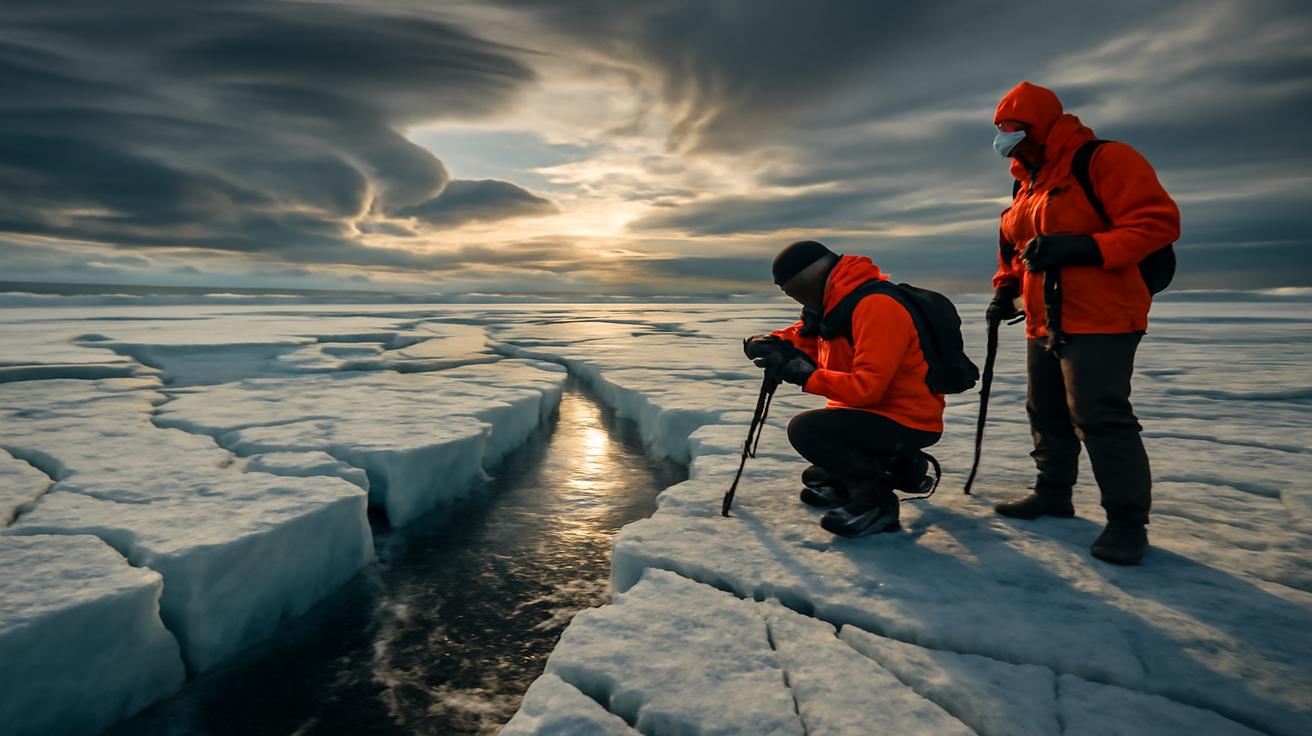
The first hint that something was wrong arrived not as a headline, but as a silence. In late January, above the Arctic Circle, there should have been the familiar groan of ice under pressure, sheets grinding and stacking like tectonic plates. Instead, there was an eerie stillness. Sea ice that should have been locked in place shifted like loose glass. Wind skated over open water where there should have been a frozen plain. Meteorologists watching the Arctic’s pulse from screens thousands of miles away leaned in, frowned, and started using words they do not use lightly: “unprecedented,” “off-the-charts,” “deeply concerning.”
By the time the first week of February forecasts began to roll in, those warnings had sharpened into something closer to alarm. The Arctic, the planet’s icy attic, wasn’t just changing—it was unraveling in real time.
The Winter That Never Quite Arrived
Picture a February dawn in the far north. The air should be knife-bright and brittle, each breath turning to crystals in your scarf. But this year, in places where -30°C (-22°F) used to be unremarkable, thermometers flirted with the freezing point. Ocean buoys bobbed in water that should have been locked under meters of ice. Snow that typically squeaked underfoot turned to heavy, wet slush that soaked through boots in minutes.
Meteorologists who specialize in polar weather have been tracking these anomalies for years, but the patterns now appearing on their charts look less like a slow trend and more like a series of sudden lurches. Instead of a stable, frigid dome of cold air, the polar region is behaving like a spinning top pushed off balance—cold air spilling south into Eurasia or North America, while tongues of warm, moist air surge north into the Arctic’s heart.
“We expect variability,” one researcher explained during a recent briefing. “What we’re seeing now is outside the bounds of what our models said was likely this soon.” Behind those cautious words is a simple reality: the Arctic’s winter engine—sea ice, snowpack, and stable cold—is sputtering.
The Ice Is Thinner, Younger, and Frighteningly Vulnerable
For much of human history, sea ice in the central Arctic Ocean was old—multi-year ice that survived one summer after another. It was thick, ridged, and resistant to storms. That ancient ice acted like the Arctic’s backbone. Today, that backbone is splintering.
Satellite records show a shrinking ice cap year after year, but this winter, meteorologists are less focused on how far the ice stretches and more on how fragile it is. The ice that now dominates the Arctic is seasonal, forming in autumn and melting almost entirely by late summer. It’s thinner, smoother, and much easier to break.
Consider what that means in practice: when a powerful winter storm barrels across the Arctic now, its winds and waves don’t push against a stiff, armored shield. They churn through ice that behaves more like frozen skin on a lake, cracking and shattering into floes. This movement opens up new patches of dark ocean—called “leads”—that absorb sunlight instead of reflecting it, warming the water and air above.
That warmth lingers. Even in the heart of winter, it can blunt the usual cold snap, leaving temperatures several degrees higher than historic norms. This is part of why meteorologists are issuing such stark warnings now. Thin ice isn’t just a summer problem; it is reshaping winter itself.
Why February Is So Critical
February is the Arctic’s moment of supposed maximum strength. By then, sea ice usually approaches its greatest extent, and the long polar night keeps temperatures brutally low. It’s the month when the Arctic should be locked down tight. Instead, meteorologists are reporting widespread cracks, polynyas (areas of open water within the ice), and temperatures that spike 10–20°C above what would have been expected a few decades ago.
That shift isn’t a curiosity—it’s a warning light. If ice can’t fully form and consolidate by February, it enters spring at a disadvantage. The melt season then starts earlier, lasts longer, and eats deeper into the Arctic’s remaining strongholds. The system becomes more fragile with each cycle.
| Indicator | Typical Historical February | Recent February Observations |
|---|---|---|
| Air Temperature Anomaly | Within ±1°C of 20th-century average | Often +4°C to +8°C, with extremes >+10°C |
| Sea Ice Thickness | Dominated by multi-year ice (2–4 m thick) | Dominated by first-year ice (1–2 m, highly variable) |
| Multi-year Ice Share | Large, continuous central pack | Shrunken, fragmented patches near northern Greenland & Canada |
| Open Water Within Ice Pack | Limited; mostly coastal or polynyas in known locations | Widespread new leads & polynyas in unusual regions |
| Atmospheric Patterns | Stable polar vortex, strong cold pool | Frequent polar vortex disturbances, warm air intrusions |
The Sky Above the Ice: A Disturbed Polar Vortex
Above the ice and water, high in the atmosphere, another crucial player is behaving strangely: the polar vortex. This swirling ring of cold air in the stratosphere usually acts as a kind of containment wall, keeping Arctic air penned up near the pole. When it’s strong, winter in mid-latitudes tends to be relatively stable. When it weakens or fractures, cold air can cascade south while warm air charges north.
This winter, meteorologists watching the stratosphere saw that containment wall fray earlier than expected. Sudden stratospheric warming events—where temperatures in the upper atmosphere over the Arctic skyrocket by 30–50°C in a matter of days—have become more frequent and more intense. Each event can ripple downward, reshaping weather patterns for weeks.
In practice, that has meant dramatic juxtapositions: blizzards in one part of Europe while Svalbard sees rain in the dead of winter; record snowfalls in parts of North America while the Arctic Ocean’s central pack experiences thawing air temperatures. These are not just weird coincidences on the weather map. They are signs of a system under stress.
Warm Rivers in a Frozen Sky
Meteorologists now talk a lot about “atmospheric rivers”—long plumes of moisture that stream through the sky, delivering torrents of rain and snow when they make landfall. Increasingly, these rivers are reaching higher latitudes, ferrying warm, wet air deep into the Arctic in winter.
When one of these atmospheric rivers curls northward, it can deliver what feels, to the Arctic, like a wintertime heat wave. Snow turns to rain, ice surfaces become slick and heavy, and wildlife that relies on predictably frozen ground is trapped in a layer cake of ice, unable to reach food. Each such event leaves a mark, softening snowpacks, stressing ice, and loading the atmosphere with additional heat and moisture that would have been unthinkable just a few decades back.
Life on Thin Ice: Wildlife at the Edge
Amid these shifting patterns, the Arctic’s creatures are the ones living the data in real time. The numbers that meteorologists feed into their models show up on the tundra as fraying threads in an ancient web of life.
Imagine a polar bear in late winter—a time that should be one of quiet strength. The sea ice should stretch unbroken, seals should be hauling out at breathing holes, and the bear should be steadily building the fat reserves it needs to survive the rest of the year. Instead, this bear encounters an erratic patchwork of ice and open water. Some hunting grounds are gone entirely, lost to unseasonal cracks or early melt. Other areas are coated in a glaze of thick ice formed when winter rain refroze, burying the smell and sound of prey.
Caribou and reindeer, too, are caught in the crossfire of thaw and freeze. These animals time their movements to snow conditions, digging through powder to reach lichen and other low-growing plants. But when winter warmth melts the surface and a sudden freeze follows, a concrete-like crust can form on top of the ground. Hooves slip, legs break, and entire herds can be walled off from food, even as it lies just centimeters beneath their feet.
For Arctic foxes, walruses, seabirds, and countless less visible creatures—from plankton under the ice to insects in the soil—the shifting seasons are rewriting the rules at dizzying speed. Breeding seasons are out of sync with peak food availability. Migration routes depend on ice bridges that no longer form reliably. Meteorologists see anomalies on temperature and ice charts; field biologists see them as empty nests, starving pups, and vanishing patterns.
Indigenous Knowledge in a Changing World
For Indigenous communities who have lived with the Arctic’s moods for millennia, the idea of unprecedented change carries a deep emotional charge. Hunters in northern Greenland, Alaska, Canada, and Siberia speak of trails that used to be safe for generations suddenly becoming dangerous. Ice that once “spoke” with clear warnings—cracks, pops, shudders—now fails with little notice.
The knowledge passed from elders to youth—how to read snowdrifts, predict storms by the horizon’s color, travel safely over sea ice—is still profoundly valuable, but it is being tested by a climate that no longer plays by familiar rules. Meteorologists, increasingly, are sitting at the same tables as Indigenous experts, comparing satellite data with lived experience, looking for a way to anticipate the next twist in a rapidly evolving story.
Beyond the Arctic: Why These Warnings Matter Everywhere
It’s tempting, from a temperate city far from drifting pack ice, to treat Arctic reports as distant dispatches from another world. But meteorologists are raising their voices precisely because what happens there does not stay there. The Arctic is the top of the planet’s spinning wheel. When its balance shifts, the wobble can be felt everywhere.
One of the clearest global signals comes from the jet stream—a high-altitude river of wind that steers storms across continents. As the Arctic warms faster than the rest of the globe, the temperature difference between the pole and the equator shrinks. This contrast is one of the jet stream’s main drivers. With less contrast, the jet doesn’t flow as smoothly; it meanders, buckles, and stalls.
Those stalls can leave one region locked under relentless rain while another endures a weeks-long drought or a brutal cold spell. Heat domes, persistent flooding patterns, and back-to-back storms are often linked to these wavy, slowed jet streams. In other words, the same forces loosening winter’s grip on Arctic sea ice can be part of what locks an inland city into a miserable, seemingly endless weather pattern.
More Water in the Air, More Extremes on the Ground
Then there’s moisture. A warmer world holds more of it, and the Arctic is no exception. As sea ice shrinks and open water expands, evaporation increases. That added moisture can be transported over huge distances, feeding extreme snow events in one place and overwhelming rainfall in another.
Downstream, coastal communities grapple with sea level rise that is partially driven by meltwater from the Greenland Ice Sheet and shrinking mountain glaciers feeding the Arctic Ocean. Warmer, fresher Arctic waters can alter ocean circulation patterns that influence everything from fisheries to hurricane formation. Those meteorological “anomalies” become the high tides that creep closer to front doors and the storms that redefine what “once in a century” really means.
Reading the Signs: How Meteorologists Know Things Are Deteriorating
The phrase “unprecedented ways” isn’t used casually. It’s earned through long hours spent reading the atmosphere’s handwriting across instruments and models. So what, exactly, are meteorologists seeing that justifies such language?
They watch satellite images of sea ice concentration not just at the end of summer, but week by week in mid-winter, checking for gaps that never used to appear. They compare present-day measurements of ice thickness from radar-equipped satellites and submarines to decades-old records. They track surface air temperatures, ocean heat content, and the trajectories of storms plowing across the Arctic Basin.
What stands out this year is not one single broken record, but the pileup:
- Multiple regions with winter temperatures soaring far above historical norms.
- Repeated intrusions of warm, moist air deep into the high Arctic at times that used to be reliably frigid.
- Persistent shortfalls in sea ice thickness and extent, even during the heart of winter, erasing the margin of safety that once buffered the system.
- Polar vortex disruptions coinciding with extreme weather events across the Northern Hemisphere, in patterns that align with a warming, less stable Arctic.
In meteorology, one oddity can be an outlier. A constant drumbeat of anomalies—across different types of measurements, over multiple seasons—is something else entirely. That’s when experts start searching for new language to describe a phase shift: an Arctic that is not just warmer, but fundamentally behaving differently.
Stories in the Data, Stories in the Snow
Ask a meteorologist what keeps them up at night and they may not talk first about numbers, but about trajectories. Not this year’s specific ice extent, but where the line has been heading for 40 years. Not a single storm, but the growing likelihood that old “rare” events become the new background noise.
On the ground, that trajectory is written intangibly: in how early the first meltwater trickles across sea ice, in how many times freezing rain coats coastal villages each winter now compared to a generation ago, in how often hunters are forced to turn back from routes they once knew by heart.
Standing at the Threshold
The warnings coming from meteorologists this winter are not predictions of an overnight tipping point, where the Arctic suddenly loses all its ice in a single season. Instead, they describe a cumulative unmooring—conditions deteriorating piece by piece as feedback loops strengthen, thresholds are crossed, and what once seemed solid becomes precarious.
For those of us far from the drifting floes and howling winds, there is an invitation in these warnings: to pay attention, not only when disaster strikes, but when systems creak and sag. The Arctic’s February is one such creaking hinge—a moment when we can watch, almost in real time, how the climate engine that has long governed our winters is being retooled by human-driven warming.
Step outside on your own February morning. Feel whatever your version of winter is—hard frost, warm drizzle, deep powder, or muddy fields. Somewhere far to the north, the same dawn is breaking over an ocean that should be solid but isn’t; over ice that should be old and thick but has grown thin and restless; over communities who know, in their bones, that their world is out of balance.
The meteorologists’ maps and models are one way of telling this story. The cracking of ice, the flight of birds that arrive too soon or too late, the silence where there should be the roar of pack ice—these are others. Together, they say the same thing: the Arctic’s conditions are deteriorating, and February, once the secure heart of winter, has become a fragile edge.
Frequently Asked Questions
Why are meteorologists especially worried about the Arctic this February?
They are seeing unusually high winter temperatures, thinner and less extensive sea ice, and repeated intrusions of warm, moist air into regions that used to remain reliably frigid all winter. These patterns are showing up together, across multiple data sources, in ways that go beyond normal year-to-year variability.
What does “unprecedented” really mean in this context?
“Unprecedented” means that within the span of reliable modern observations—roughly the last 40–50 years for many Arctic measurements—scientists have not previously documented conditions like these at this time of year. It signals that the climate system is moving into territory outside what past data would have led us to expect.
How does a warmer Arctic affect weather where I live?
A warming Arctic can weaken the temperature contrast that powers the jet stream, making it more wavy and prone to getting “stuck.” That can lock regions into prolonged cold spells, heat waves, droughts, or heavy rainfall. Changes in Arctic sea ice and ocean temperatures can also influence storm tracks and seasonal patterns far from the pole.
Is this year just a bad outlier, or part of a longer trend?
Current conditions sit on top of a clear multi-decade trend of warming Arctic air and oceans, shrinking and thinning sea ice, and more frequent extreme events such as midwinter rain-on-snow or warm air intrusions. This year’s anomalies are better understood as an escalation along that trend line rather than an isolated fluke.
Can anything still be done to slow or reverse these Arctic changes?
Some changes, like the loss of long-lived multi-year sea ice, will be difficult to reverse in the near term. But reducing global greenhouse gas emissions can still slow further warming, limit the severity of future impacts, and give Arctic ecosystems and communities more time to adapt. Local and regional adaptation efforts—such as improving forecasting, infrastructure, and safety for Arctic residents—can also reduce harm even as the climate continues to change.






Leave a Comment