
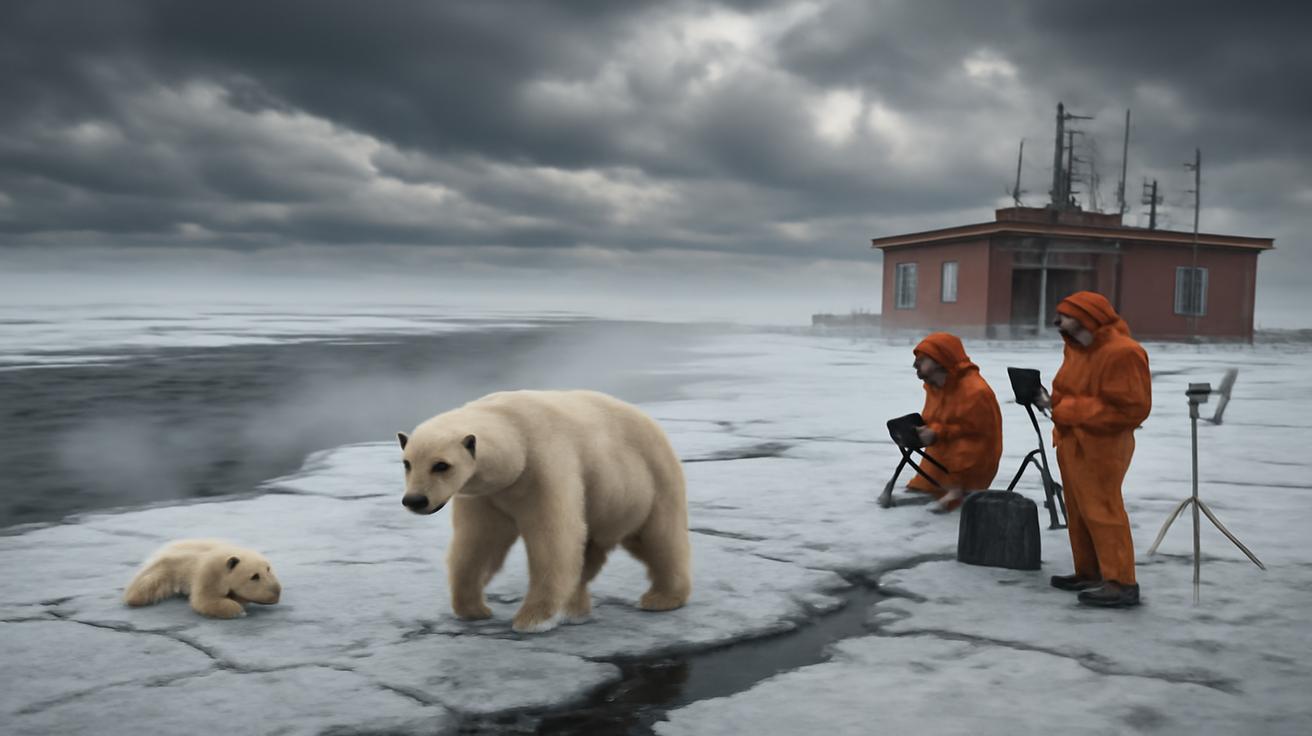
The warning doesn’t arrive with sirens or flashing banners. It lands in quiet places: in the glow of a laptop screen at 2 a.m., in the nervous taps of a meteorologist’s fingers on a mug of coffee gone cold, in the sudden flurry of emails titled “Update: Arctic breakdown scenario.” Somewhere over the North Pole, a river of icy air that usually circles in tight, disciplined loops is wobbling, stretching, and preparing, perhaps, to spill south. And on a mild winter afternoon that feels more like early spring, you might stand outside, coat unbuttoned, and have no idea that the atmosphere above you is already rearranging itself.
The Shape of the Sky Is Changing
Meteorologists have a phrase for what’s now showing up, again and again, in their models: an “early February Arctic breakdown.” It sounds dramatic, and in many ways it is. It refers to a disruption in the polar vortex—the vast, frigid whirl of air that usually stays parked over the Arctic, like a spinning top that keeps the cold air penned in. When that top starts to wobble, the cold can leak or even gush southward, draping itself over North America, Europe, and Asia in surges of Arctic air.
You can’t see the polar vortex from your window, of course. But you might notice its fingerprints: a strange instability to the season, swings from muddy rain to blinding snow, the odd feeling that winter doesn’t know what kind of winter it wants to be. In weather offices around the Northern Hemisphere, forecasters shuffle through runs of computer simulations that flicker with color: bands of purple, blue, and red representing temperature and pressure high above Earth’s surface. There, in the upper reaches of the atmosphere, they witness an unfolding drama that will likely decide whether early February feels like a normal winter hiccup—or like the kind of cold snap that earns its own name.
Right now, those models are leaning in one direction. Most of them agree: pressure patterns over the Arctic are beginning to favor a breakdown, a loosening of that cold-core circulation. It is not guaranteed, not yet. But the phrase “increasingly likely” has begun to appear in forecast discussions, and for atmospheric scientists, those two words carry a particular weight. They mean it’s time to start preparing, mentally and practically, for what could come next.
The Polar Vortex, Unmasked
To understand why this looming breakdown matters, you have to picture the polar vortex not as a single storm, but as a structure of wind and temperature that wraps around the Arctic like a moat. In calm years, it spins fast and tight, corralling the cold air into a relatively contained region. Planes fly beneath its influence, satellites watch it from above, and most of us go about our winters without ever hearing its name on the evening news.
But the polar vortex is sensitive. It listens to the waves rising from below—meanders in the jet stream, mountains forcing air to rise, vast contrasts between ocean and land temperatures. It listens, too, to the warming stratosphere above it, where pulses of energy can pour down like invisible hammers. When the right pattern of waves and warming lines up, the vortex can weaken, stretch, or even split into separate pieces. That’s when the Arctic cold, no longer corralled, can pour south.
Meteorologists watching the early February pattern see hints of this weakening. Stratospheric temperatures are nudging upward; high-pressure domes are building over parts of the Arctic, squeezing and deforming the cold pool like thumbs pressed into a ball of dough. None of it guarantees a dramatic collapse, but each sign nudges the odds. This is where the language of weather becomes the language of risk: “more likely,” “strong potential,” “heightened chance.”
Why February Matters
February is a curious month for the atmosphere. Near the surface, sunlight is slowly returning, especially at higher latitudes, but the legacy of deep winter still lingers. Snow cover can be extensive, sea ice is near its seasonal maximum, and the temperature difference between the Arctic and the mid-latitudes remains sharp and volatile. This boundary is like a loaded spring; if the polar vortex shifts at this time of year, that spring can snap in surprising ways.
A breakdown in early February doesn’t just mean “cold” in the abstract. It can mean intense, localized outbreaks: a city that has basked in an unusually warm, brown winter suddenly swallowed by a week of biting wind and squeaky-crunch snow; lakes that never fully froze-over suddenly capped in silvery ice; streets that go from bare pavement to treacherous glaze in a single afternoon. Patterns can lock in, too, with one region mired in frigid air while another rides an unseasonable thaw.
When the North Comes South
Try to imagine, for a moment, what it feels like when a piece of the Arctic visits your front yard. The air is sharp and oddly quiet. Sound travels differently when the temperature plunges; footsteps on snow sound more brittle, like breaking glass wrapped in blankets. Your breath arrives as a visible cloud and then another and another, each one hanging in the air a bit longer than seems natural. Metal stings to the touch. The world, so recently muddy or damp, suddenly takes on the crisp geometry of deep winter.
Now zoom out from that single yard. Imagine whole regions—plains, valleys, dense cities—waking up to the same shift. Buses struggle to start; the hum of heat pumps deepens into a roar; utility lines ping with the sudden burden of demand. For meteorologists, these aren’t romantic images; they are stress tests. An Arctic breakdown, especially one that arrives earlier than expected, can strain systems that have grown accustomed, in recent winters, to milder weather.
What makes the current situation especially intriguing—and unsettling—is the context in which it’s happening. Winters, on average, are warming. The baseline upon which these cold outbreaks occur is shifting upward. That makes the extremes of cold, when they do come, stand out even more starkly. An early February Arctic breakdown in the 1980s might have felt harsh but familiar. Today, after a string of muted winters in many places, the same level of cold can feel shocking, as though the climate has snapped back to a memory you thought it had misplaced.
The Strange Dance of Warmth and Cold
Climate change does not turn off the polar vortex; it distorts the stage on which it spins. Sea ice is thinner and more fragile, snow cover patterns have shifted, and the contrast between warmer oceans and cold landmasses is increasingly lopsided. Some scientists have argued that these changes may be making the vortex more prone to disruption; others are more cautious, pointing to the complexity of the atmosphere’s long-term dance. Still, what many agree on is that the “weirdness” of winter—the sudden flips from one regime to another—is becoming harder to ignore.
So as meteorologists flag the growing odds of an early February breakdown, they’re not just talking about one chilly spell. They’re talking about the way the planet is learning, in real time, how to have winter in a warming world. About the awkwardness of that learning, the mismatched signals, the shock of finding yourself in a biting wind only a few days after gardening in a light jacket.
| Scenario | What It Means | What You Might Notice |
|---|---|---|
| Minor Arctic wobble | Polar vortex weakens slightly, brief cold spell | A few days of sharp cold, then a quick return to milder weather |
| Displaced vortex | Core of cold air shifts off the Pole toward one continent | Persistent cold and snow in one region, unusual warmth in another |
| Split vortex | Vortex breaks into two or more lobes of intense cold | Multiple cold outbreaks in different areas over several weeks |
| No major breakdown | Vortex stays strong and centered over the Arctic | Generally milder, more stable winter conditions in mid-latitudes |
Inside the Forecast Rooms
Step, in your imagination, into a national weather center in late January. The light is the pale color of long fluorescent tubes; the walls are a mosaic of maps and radar loops and color-coded anomaly charts. Coffee cups cluster near keyboards. On one sequence of screens, you see the heights and winds at 10 millibars—a thin-skinned slice of atmosphere more than 30 kilometers above the ground. In those images, the polar vortex looks like a living thing: a swirl of cold that has started to elongate, the once-circular isobars now stretching like pulled taffy.
A forecaster scrolls through ensemble runs—dozens of slightly different simulations of the same atmospheric future. The members diverge and reconverge like a flock of birds. Some show the vortex holding together, bruised but intact. Others show it drifting, lopsided, toward Eurasia or North America. A few depict a dramatic split. The forecaster’s job is to interpret these possibilities, weigh them against current observations, and translate all that swirling uncertainty into the words that will eventually land on your phone: “Colder than average conditions likely,” “Potential for significant winter weather,” “Confidence increasing in Arctic air outbreak.”
This is not just guesswork dressed up in graphics. It is a kind of storytelling rooted in physics—an attempt to narrate what the sky is likely to do, based on how it is behaving now and how it has behaved in countless simulations before. The idea of an early February Arctic breakdown isn’t a hunch; it’s the plotline that most of the models, for the moment, agree on. But like any story still in progress, it has room to twist.
The Human Side of “Increased Likelihood”
For people whose lives hinge on weather, those two words—“increased likelihood”—are both warning and lifeline. Farmers watch them as they decide whether to risk an early planting under deceptively soft ground. City planners eye them while calculating how much road salt to stockpile and how many crews to have on call. School districts follow along as they weigh budgets against the chance of additional snow days.
Even if you’re not in one of those roles, the phrase can, and perhaps should, tug at your attention. It’s a reminder that weather is not just a background condition but a dynamic, living script in which you are a character. You don’t get to write the sky’s lines, but you do get to choose your response: the extra blanket on the bed, the check on a neighbor who lives alone, the quiet decision to insulate a pipe before it freezes instead of after.
Preparing for the Possible
There’s a temptation, on hearing about some looming atmospheric event, to lean either into panic or dismissal—to scoff that “they never get it right anyway” or to doom-scroll through endless threads of worst-case scenarios. But between those extremes is a steadier path: listening, learning, and using early warnings as an invitation to resilience rather than dread.
If meteorologists are right and early February does deliver an Arctic breakdown, it may arrive unevenly. One region might endure days of bone-deep cold while another receives only a glancing chill. Snow belts could flare in places that have been quiet all winter. Power grids in some areas might find themselves tested by a spike in electric heaters roaring to life. The exact pattern is impossible to know this far out, but the spectrum of what’s plausible is clear enough to justify simple, grounded actions.
Think in terms of layers—of clothing, but also of preparedness. A winter kit in the car: blanket, gloves, scraper, a small shovel, a flashlight. A plan for pets who usually linger outside but won’t fare well in single-digit nights. A glance at the places in your home most vulnerable to cold: that one pipe along an exterior wall, the draft that whistles in under an old door. None of these measures require certainty; they only require respect for probability.
Listening to the Quiet Signals
The beauty of the atmosphere’s warning system is that it speaks long before the first blast of cold air crosses your doorstep. It speaks through model ensembles and stratospheric temperature charts, yes—but also, more quietly, through the subtle ways your local forecasts begin to change. The mention of “pattern shift” in a regional outlook. The extension of the seven-day forecast to include phrases like “much colder late next week” or “increasing chance of wintry mix.”
By the time the cold fully arrives—if it does—the story will have been unfolding for weeks above your head. You get to decide at what point you want to start listening. In that sense, paying attention to an early February Arctic breakdown is a practice, almost, in tuning yourself to the Earth’s larger rhythms. It’s a way of aligning your small, day-to-day plans with the great, slow-turning gears of the atmosphere.
A Winter Out of Balance
Even if the coming breakdown turns out to be less dramatic than feared, the very fact that we watch for it so intently reveals something about where we are in this century’s climate story. Winters are increasingly unmoored from their old patterns. Snow that once came in predictable blankets now arrives in erratic bursts. Thaws carve strange windows of mud into months that, in our memory, were cleanly white.
An Arctic breakdown is, in some ways, winter remembering its power. But it is winter doing so on a planet whose baseline has shifted. That tension—the clash between ancient atmospheric processes and a newly warmed world—creates the strange, dissonant winters many of us now inhabit. Winters of green Christmases followed by Valentine’s Day blizzards; of lakes that never fully freeze and yet still host a night or two of dangerously thin ice under a sudden, bitter wind.
Meteorologists, with their careful caveats and probability charts, are not trying to scare us with talk of early February breakdowns. They are trying to name the shape of the season as it arrives, to give us a vocabulary for what we are living through. The language may sound technical—polar vortex, stratospheric warming, Arctic oscillation—but underneath is a simple message: the atmosphere is restless; pay attention.
So as the last days of January slip by and early February draws closer, pause for a moment the next time you step outside. Feel the air on your face, the direction of the breeze, the softness or bite of the cold. Somewhere high above, invisible rivers and gyres of air are turning, negotiating, deciding how much Arctic to share. You cannot change their course. But you can meet what comes with a kind of grounded curiosity—with gloves laid out by the door, with an eye on the forecast, with a quiet understanding that you are, always, living inside the weather’s unfolding story.
Frequently Asked Questions
What exactly is an Arctic breakdown?
An Arctic breakdown is a period when the normally strong, stable polar vortex weakens or becomes distorted, allowing very cold Arctic air to spill south into mid-latitude regions. It often leads to sharp drops in temperature and increased chances of snow and ice in areas that may have been relatively mild.
Does an Arctic breakdown mean the polar vortex is “coming to get us”?
Not literally. The polar vortex itself is a circulation high in the atmosphere over the Arctic. During a breakdown, parts of its cold air are displaced toward lower latitudes. You experience the effects at the surface as unusually cold weather, but the vortex itself remains a high-altitude feature.
How is this related to climate change?
Climate change is warming the planet overall, including the Arctic. This can alter patterns of sea ice, snow cover, and temperature contrasts that influence the polar vortex. There is ongoing scientific debate about whether these changes are making vortex disruptions more frequent, but many researchers agree that winter patterns are becoming more variable, with sharper swings between warm and cold.
Can meteorologists predict an Arctic breakdown with certainty?
No. They can estimate the likelihood based on models and observations, especially patterns in the stratosphere. When they say a breakdown is “increasingly likely,” it means many independent model runs and indicators are pointing in the same direction, but there is always some uncertainty in the exact timing, intensity, and location of impacts.
What can I do to prepare if a breakdown is forecast?
Preparation is mostly about basic winter readiness: checking home insulation, protecting exposed pipes, ensuring you have warm clothing and blankets, keeping an emergency kit in your car, and staying updated with local forecasts and advisories. Small steps taken early can prevent larger problems if a severe cold spell arrives.
Why does the cold sometimes hit one region hard and skip another?
When the polar vortex weakens or shifts, it doesn’t send cold evenly across the hemisphere. High and low pressure systems steer the Arctic air along specific paths. One continent or region might sit under persistent cold, while another, under a ridge of high pressure, can stay unusually mild, even during a major breakdown.
Is an early February Arctic breakdown unusual?
Breakdowns and disruptions of the polar vortex have occurred many times in the historical record, including in February. What feels unusual today is the backdrop: warmer average winters, more frequent odd swings in temperature, and the heightened attention these events receive because of their potential to strain infrastructure and daily life.






Leave a Comment