
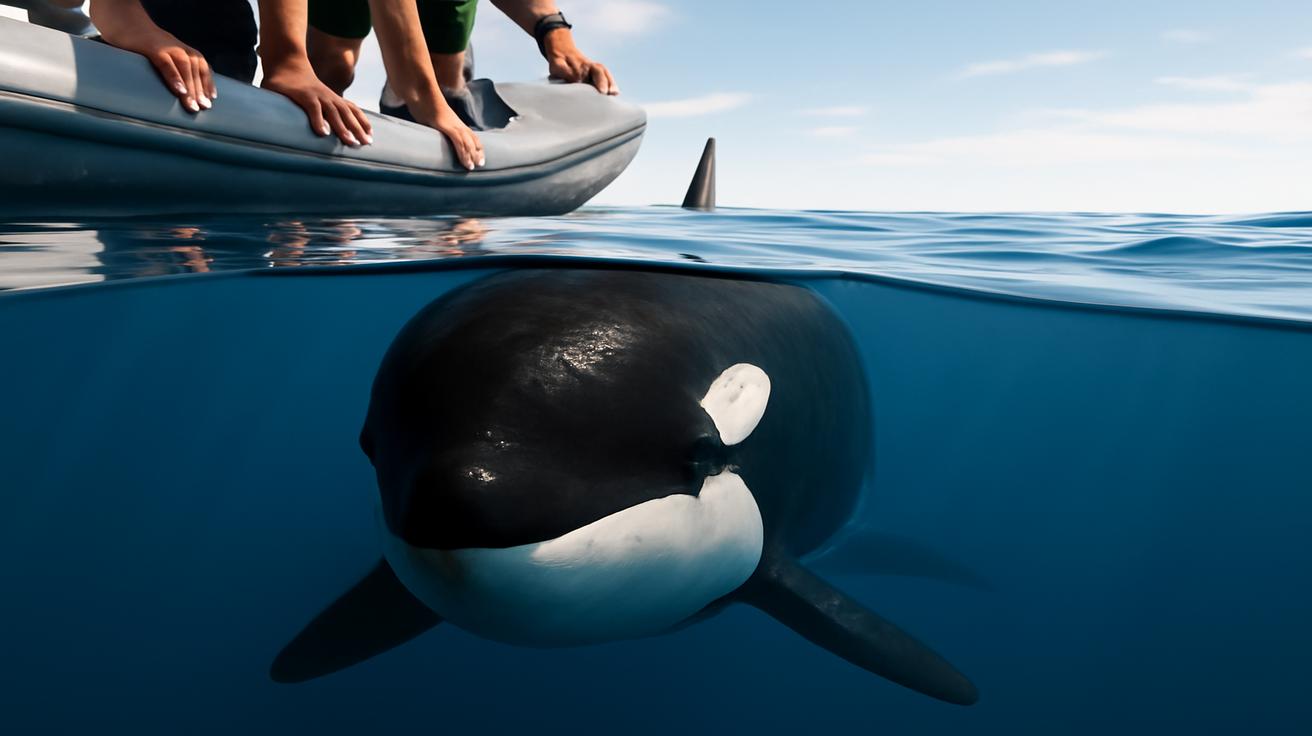
The first time you hear it, you don’t think much of it. Just another thud against the hull, you tell yourself, the kind that comes with rough seas or a drifting log. But then it happens again—sharper, deliberate, followed by the unmistakable shiver of metal under stress. Out on the open water, the sky low and pewter, an unsettling realization ripples through the crew: something out there has noticed you… and is testing your ship.
Moments later, black-and-white shapes rise out of the gray waves like punctuation marks in a sentence you don’t yet understand. Orcas—sleek, powerful, unnervingly precise in their movements—circle the vessel. One peels away and dives beneath the keel. Another surges toward the rudder. The water fizzes with their exhalations, their dorsal fins slicing the surface with an almost casual confidence. You are not just passing through their world. You are now the focus of it.
The New Stories Spreading Across the Water
In ports and harbors from the Iberian Peninsula to the Pacific Northwest, the stories are swapping hands faster than gear on a busy dock. Sailors, fishermen, and research crews lean in closer over steaming mugs and salt-crusted rails, retelling scenes that sound like fragments from a strange, evolving folklore.
There’s the couple whose sailboat shuddered as if it had hit a reef—only there was no reef, just a small group of orcas working in coordinated lunges at the rudder. A marine research team whose instruments recorded a series of short, sharp impacts on their vessel’s stern right before their steering went slack. A solo sailor who watched, stunned and frozen, as an orca rolled onto its side beside the boat, eye above the surface, clearly watching him while another juvenile nudged the underside of the keel.
To those who study orcas, these aren’t just dramatic sea stories. They’re data points in a pattern that’s growing harder to dismiss: a troubling and still-mysterious shift in how some orcas are interacting with human vessels.
Reports have emerged over the last few years of orcas approaching, following, and occasionally damaging boats—most famously in parts of the North Atlantic near Spain and Portugal, but with echoes of similar behavior noted elsewhere. It’s not constant, and it’s not every orca population. But it’s enough to make marine biologists uneasy, more curious than alarmist, but urgently alert.
What Exactly Is Happening Out There?
To understand what’s unfolding, you have to picture it scene by scene on the water. Many encounters begin quietly. A small group of orcas appears, often juveniles alongside adults, surfacing at a distance before closing in. They rarely charge in chaos. Instead, they move with the measured poise that has earned them their name: “killer whales,” apex predators known for coordinated hunting strategies that border on military precision.
Then the focus narrows. Rather than ignoring the boat or simply riding the pressure wave at its bow, some orcas zero in on the stern. They may bump or push at the rudder. In some cases, they seem to bite it. Sometimes they nudge the hull itself, rocking smaller vessels with surprising force. In more intense encounters, rudders have been shattered, disabled, or snapped clean off, leaving boats adrift and frightened crews calling for help.
Other times, the behavior is gentler but no less strange. Orcas have been observed shadowing vessels for extended periods, rolling and pivoting beneath them as though mapping every contour. One skipper described it as being “scanned” by the sea itself.
For scientists used to watching orcas stalk seals or corral fish, this new focus on boats feels like a story mid-sentence. It’s neither random nor easily explained by a single cause. Instead, it has the texture of something learned—passed on, perhaps, like a peculiar game, or a shared response to some invisible grievance.
Play, Protest, or Something In Between?
Ask a marine biologist what they think is going on, and you’ll see the answer forming first as a frown rather than a sentence. It’s not that they don’t know how to guess; it’s that they know how dangerous guesses can be when they turn into stories people want to believe.
One popular idea is that this is a form of play. Orcas are famously intelligent and curious. Young individuals often experiment with objects—bits of kelp, fish, floating debris—and sometimes with live animals in what looks like a chilling combination of practice and mischief. A boat’s rudder, spinning and hissing through the water, might present a tempting interactive “toy” in the vast monotony of the open sea.
But then there’s another possibility: that what looks like play might partially be something closer to protest, or at least a response to stress. Some researchers suggest that a specific event—perhaps an orca injured by a boat, or disturbed by repeated interactions—could have seeded a new behavior. Orcas are cultural animals; they teach and learn. A single influential individual can, in theory, introduce a behavior that propagates through a group and persists for years.
The truth might not fit cleanly into either box. It may be play shaped by frustration, exploration sparked by trauma, or a complex behavior with layers we haven’t yet learned how to peel away. What’s clear is that orcas are not acting randomly. They are choosing, repeatedly and with apparent intent, to interact with certain parts of certain vessels.
Orcas: Minds Built for Stories
To fully grasp why this shift matters, you need to know a little about who orcas are beneath the surface of their sleek skin and striking patterns. They are not just big, smart dolphins with fancy markings. They are, in many ways, carriers of culture.
Distinct orca populations around the globe have their own dialects—patterns of calls and clicks as recognizable to them as accents are to us. They pass down hunting strategies over generations: one group may specialize in fish, another in seals, another in sharks. Some techniques are dazzlingly inventive: creating waves to wash seals off ice floes, or even stranding themselves temporarily on beaches to ambush prey.
This kind of cultural inheritance means that new behaviors don’t just appear; they spread. A novel way of interacting with the environment—like, say, investigating rudders—can ripple through a pod if it’s repeated enough and especially if it’s picked up by younger orcas. Before long, what started as an isolated quirk can become a recognizable pattern.
When scientists look at these unsettling vessel interactions, they see not just individual animals making individual choices, but the possibility of a story passing among them: something that one orca discovered and others decided was worth repeating. Whether that story began in fear, curiosity, irritation, or fascination is still unknown.
How Scientists Are Trying to Read the Signs
Piecing together this puzzle demands equal parts field science and forensic patience. There’s no laboratory where you can ask an orca why it rammed a rudder. Instead, biologists rely on a slow accretion of evidence: videos from sailors, hull damage reports, acoustic recordings, GPS tracks, and direct observation where possible.
They catalog details: time of day, sea conditions, boat size, engine type, rudder style, presence of fishing gear, number and age of orcas. They look for correlations. Are certain boats more likely to be approached than others? Are the interactions more frequent in heavily trafficked waters, or near known feeding grounds? Do they spike seasonally?
At the same time, researchers are listening. Underwater microphones pick up layers of conversation invisible to human eyes. Each interaction is an opportunity to hear what kinds of calls and clicks the orcas use, whether they resemble hunting vocalizations, social chatter, or something new entirely.
All that data is painstakingly stitched together to produce something that looks, in the end, like a story written in numbers and noise. It won’t tell us everything. But it may narrow the range of possible explanations, allowing us to move from speculation to evidence-based understanding.
| Aspect | What Scientists Look For | Why It Matters |
|---|---|---|
| Location & timing | Where and when interactions occur | Reveals patterns tied to migration, feeding, or human traffic. |
| Type of vessel | Size, speed, engine, rudder style | Helps determine if orcas prefer or avoid certain designs. |
| Behavior of orcas | Bumps, bites, circling, vocalizations | Clarifies whether actions resemble play, aggression, or exploration. |
| Outcome of encounter | Damage, duration, retreat, persistence | Shows how serious and repeatable the behavior is. |
| Group composition | Adults vs. juveniles, known individuals | Reveals whether young orcas are learning from elders. |
How It Feels on the Water
For people who’ve spent their lives on the sea, orcas have long occupied a conceptual space somewhere between neighbor, legend, and fleeting miracle. A pod appearing off the bow can turn a routine crossing into a day you’ll talk about for decades. They’ve been seen as signs of good luck, guardians of coastlines, and occasionally as eerie, inscrutable presences that slip back into the deep just when you start to feel they might stay.
This new chapter, though, has stirred something more complicated: unease. Sailors talk about feeling watched, assessed. The ocean, already alive with enough unknowns, now contains an intelligence that is paying a different kind of attention. It’s one thing to know there are whales nearby; it’s another to feel like you’ve become an object in their experiment.
On a small yacht, the world shrinks to the few inches of fiberglass or steel between you and a depth you can’t imagine. When something powerful bumps that barrier, the human body responds in primal ways. Heart rates spike. Adrenaline hums. Rational awareness of statistics—how rare serious incidents are—evaporates in the visceral reality of a keel jolted from below.
Yet among the fear and tension, there’s another emotion that sailors quietly admit to: awe. Even in the midst of a nerve-jangling encounter, it’s hard to miss the raw grace of a 6-ton animal sliding beneath your boat with surgical accuracy, or the shimmering white patch of an orca eye as it tilts to regard you. It is unnerving, yes. But it is also a reminder that out here, the boundaries of who is observing whom are not as fixed as we like to believe.
Coexisting with a Question Mark
Marine authorities and conservation groups now face a delicate problem: how to keep people safe without turning orcas into villains, and without escalating a situation that is not yet fully understood. Some areas have issued guidelines urging vessels to slow down in known interaction hotspots, avoid sudden course changes, and refrain from trying to outrun or evade orcas aggressively.
There’s a growing emphasis on education: helping mariners recognize early signs of orca interest, encouraging them to power down engines when safe, and report encounters in detail. Every account, from mild to severe, feeds into the broader effort to map and interpret this shifting behavior.
What scientists and conservationists agree on, almost to a person, is this: retaliation is the worst possible path. Orcas have long memories and complex social structures. Responding with harm or harassment would not only be ethically fraught—it could also rewire the narrative further, transforming a puzzling behavior into a deeply rooted conflict.
For now, the priority is de-escalation, patience, and humility. This is their home, after all. We are the visitors whose noise, nets, and traffic have reshaped their underwater cities. If some orcas have decided to take a closer, more disruptive look at our machines, it may be a reflection of just how entangled our lives have become.
What the Future Might Hold
Nature rarely hands us clear-cut stories. Instead, we get fragments, half-legible, carried ashore by waves of data and anecdote. The emerging picture of orcas interacting more boldly—and sometimes destructively—with vessels feels like one of those incomplete messages. It carries urgency without a simple moral, drama without a neat ending.
The possibilities branch. One path leads to this behavior fading as abruptly as it emerged, just another strange fad in the long, rich cultural history of orcas—a “phase” that future scientists mention in passing, the way we speak of brief fashions or forgotten dances.
Another path sees the behavior entrenching, refining, and perhaps spreading to new groups. In that future, boat design might adapt, rudders reimagined, shipping lanes reconsidered, and guidelines formalized the same way we’ve learned to live alongside other large, unpredictable wildlife on land.
There is also the deeper question of what this story might say about the state of the oceans themselves. Orcas do not exist in isolation; they sit at the top of intricate food webs woven through waters increasingly strained by overfishing, warming temperatures, and noise. When apex predators start acting differently, it sometimes signals broader pressures still invisible to us.
Standing on the deck of a small vessel today, watching an orca surface a few meters away, you might feel all of these threads at once: the thrill of proximity to a magnificent being, the flicker of fear that it might ram your keel, the heavier awareness that whatever is happening here is bigger than any one boat or pod or coastline.
We are, perhaps, at the beginning of a new kind of relationship—one where the other party has the intelligence, memory, and agency to respond to us in ways we cannot fully anticipate. The ocean has always been a realm of mysteries, but this one looks back. It assesses. It learns.
For now, marine biologists urge us to pay attention, report what we see, and resist the urge to cast ourselves as either victims or heroes in this unfolding drama. The orcas are writing part of this story, too. If we listen carefully enough—in the shudder of hulls, the echoes of sonar, the soft exhale of breath at the surface—we may yet learn what they’re trying to tell us.
Frequently Asked Questions
Are orcas becoming more aggressive toward boats?
Some groups of orcas have shown an increase in direct interactions with vessels, particularly targeting rudders. While these behaviors can be damaging and frightening, scientists are cautious about labeling them as purely “aggressive.” They may involve elements of play, curiosity, learned behavior, or responses to earlier negative experiences with boats.
Are these interactions happening everywhere?
No. The behavior is concentrated in specific regions and among particular orca groups. Many orca populations around the world still show little to no interest in boats beyond occasional passing curiosity.
What should I do if orcas approach my vessel?
Guidance varies by region, but generally mariners are advised to slow down, avoid sudden maneuvers, keep engines in neutral when safe, and refrain from trying to chase away or harass the animals. Afterward, reporting the encounter to local marine authorities or research organizations helps scientists track and understand patterns.
Are humans causing this change in behavior?
It’s likely that human activity plays some role, whether through direct interactions, noise, pollution, or changes in prey availability. However, the exact trigger—or combination of triggers—behind the current wave of vessel-focused behavior is still under investigation.
Should we be afraid of orcas now?
Caution is reasonable, especially in regions where damaging interactions have occurred. But fear alone is not helpful. Orcas remain highly intelligent, socially complex animals that rarely harm humans directly. Respect, preparedness, and informed behavior on the water are far better responses than fear or hostility.
Can this behavior be stopped?
There’s no simple switch to turn it off. Over time, changes in vessel practices, better understanding of triggers, and non-invasive deterrence methods may reduce risky encounters. Because orcas learn culturally, behaviors can fade as well as spread—but whether that happens will depend on both their choices and ours.








Leave a Comment