
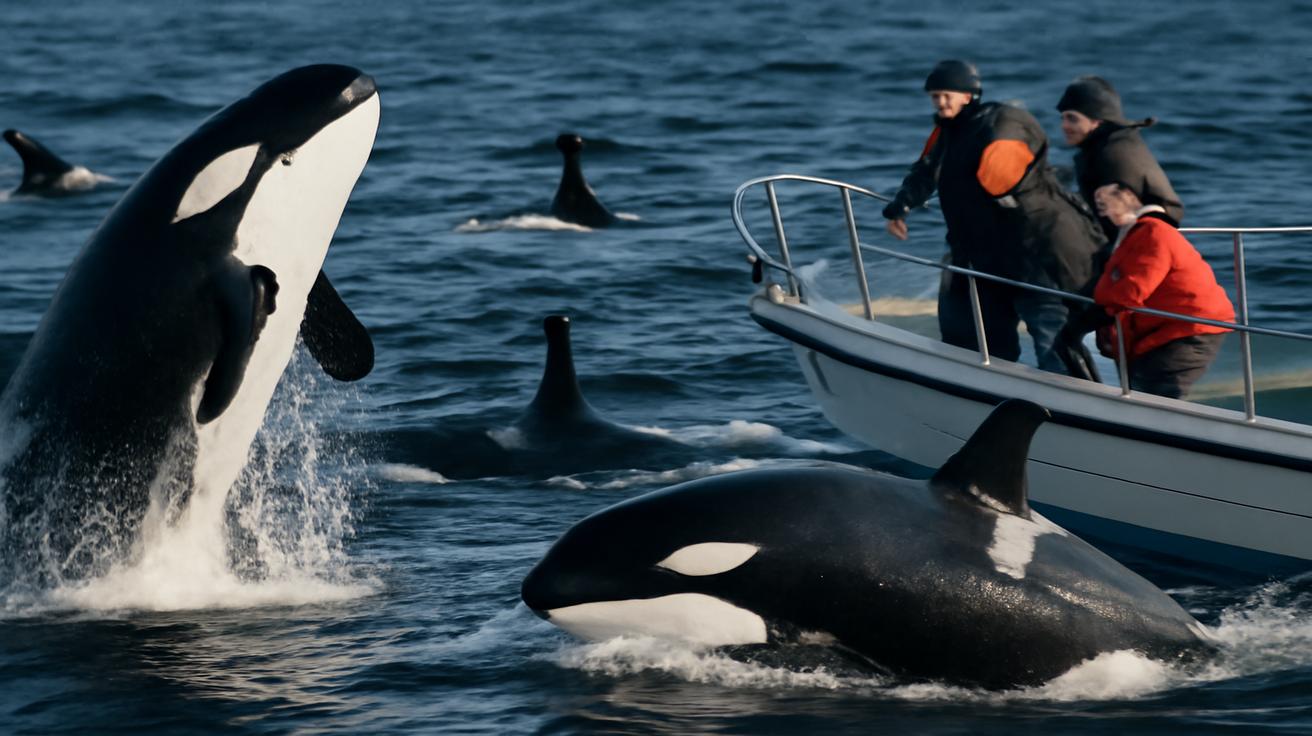
The first time a sailor hears the breath of an orca in the dark, it feels almost holy. It’s a sound that cuts right through the mechanical hum of an engine and the low crash of waves on a hull: a sudden, soft exhale, like the ocean itself taking a quick, secret breath. For generations, that sound has been a promise of wildness, of shared water, of distant, intelligent company moving beneath the keel. Lately, though, in pockets of ocean from the Iberian coast to the Pacific Northwest, that sound has begun to carry something new: unease. Because more and more often, the presence of orcas is followed by a jolt, a shudder of fiberglass or steel, and a spreading realization on deck—those whales are not just passing by. They are coming for the boat.
When the Ocean Turns and Looks Back
On a pale morning off the coast of Spain, a 38-foot sailboat rides a lazy swell. The crew is tired, salt-streaked, lulled by a long night of watch rotations. A breeze tugs at the sails. A kettle rattles on a gimbal stove below deck. Ordinary sea life, until the helm begins to twitch strangely under the skipper’s hands, as if the rudder has snagged something heavy.
Then comes the sound—a hollow bang from below, followed by another, sharper this time. The skipper peers over the stern. A black-and-white shape appears in the wake, impossibly close, an orca rolling sideways, eye above water, looking straight back at him. Before he has time to process, the boat lurches as another impact slams into the rudder. The fiberglass casing groans. Someone shouts. Someone else grabs a life jacket they swore they wouldn’t need today.
This scene, which might once have belonged purely to sailors’ yarns and rare, freak encounters, has become disturbingly common in some stretches of sea. Reports from mariners, charter captains, and scientists now describe groups of orcas that seem, by all appearances, to be deliberately interacting with passing vessels—nudging, ramming, spinning them, and in some cases, disabling them. Marine authorities, in turn, are issuing warnings and advisories that sound increasingly urgent, even as they try to keep one careful foot in the camp of measured science and the other in the reality of frightened boaters making distress calls.
The ocean has always looked back at us, of course. But lately, in these orca encounters, that gaze feels especially sharp and unsettling—as if a line we didn’t know existed has been brushed, or crossed.
What Exactly Are the Orcas Doing Out There?
In harbors and coast guard offices, on VHF channels and in yacht club bars, the stories echo with a kind of stunned disbelief: a pod of orcas approaches, often quietly, and focuses on the stern of the boat. Sometimes they circle first, almost politely, like curious neighbors. Then comes the contact—head-butts to the rudder, heavy pushes against the hull, or methodical nudges that spin the vessel. Sailboats are most often mentioned, their deep rudders apparently irresistible targets.
To turn a swirl of anxious anecdotes into something more useful, many marine authorities have begun gathering data. Crews are asked to report location, behavior, and damage. Scientists join the calls, listening for patterns in what, from the deck, feels like chaos.
| Reported Encounter Detail | Common Pattern |
|---|---|
| Vessel type | Primarily sailing yachts, 30–50 feet |
| Attack focus | Rudder and stern area |
| Typical duration | From a few minutes up to an hour |
| Orca group size | Small pods, often 2–10 individuals |
| Damage reported | From scraped hulls to snapped rudders and lost steering |
| Human injuries | Extremely rare; most reports involve damage to vessels only |
To a crew in the moment, it can feel like an attack. To a scientist watching from the surface or reviewing videos later, it often looks more like a forceful, focused game. Orcas push on the rudder as if testing the resistance. They seem fascinated by the way the boat responds—how it slews, slows, or shudders. In some videos, juveniles mimic the actions of older whales, repeating the same movements with near-comic determination.
Still, it is not playful from the human perspective when the steering fails 15 miles offshore and the boat starts drifting toward a lee shore. “Aggressive” is the word that appears most often in official advisories, because no matter the motive, the reality is simple: people are losing control of their boats, and some are having to abandon them entirely.
Warnings from the Shoreline
As reports climb, marine authorities walk a tightrope. Their messages need to be clear enough to protect people and vessels, but nuanced enough not to paint orcas as villains. Bulletins recommend slowing down, avoiding sudden course changes, and, if orcas appear, cutting the engine and staying calm. Crews are urged not to throw objects or attempt to “fight back,” both for legal reasons and for their own safety.
In some regions, official routes have been adjusted, and yachts are advised to hug certain coastlines or avoid specific hot spots during peak seasons of activity. Coast guards run training sessions on what to do if steering fails. Insurance companies quietly revise their policies to account for orca-related damage, turning a strange natural phenomenon into paperwork and premiums.
And still, beneath the practical measures, a deeper question hums like background static: why is this happening at all?
Theories in the Wake: Why Would Orcas Go After Boats?
Science, ever cautious, often bristles at the human urge to assign motives to animals. Yet orcas make it hard to resist. They have complex social structures, teach their young, and exhibit regional “cultures” of hunting style and vocal dialects. They are problem-solvers, innovators, and, sometimes, mischief-makers.
One idea circulating among researchers is that these interactions might have started with a single traumatic event—perhaps a collision with a boat or an entanglement in fishing gear—that led one orca to associate rudders with danger or pain. From there, in a species known to spread behaviors socially, it could have rippled outward as a kind of learned response, or even as a ritualized way of “fighting back” against an inscrutable enemy: vessels that roar through their world leaving noise, wake, and sometimes injury.
Another view is more playful, if that’s the word. Orcas are notorious for fads: one population was once observed carrying dead salmon on their heads like hats; others have been seen pushing ice floes like toys. To such animals, a moving rudder—a big, underwater fin that pushes back when you hit it—might be irresistible. A strange, human-made thing that behaves dynamically under pressure? For a bored or curious mind, that’s enrichment, a puzzle in motion.
There is also the possibility that the behavior began as exploration and escalated because of the reactions it produced. Boats that stop, engines that go quiet, people who shout and dash about the decks—all of this could be a strong form of feedback, reinforcing the behavior in ways we barely understand.
None of these theories cancel the others out. Marine biologists tend to speak in layers: trauma, curiosity, learned tradition, and environmental stress could all be braided together here. What is clear is that this is not random frenzy. It is patterned, repeated, and shared within particular orca groups, almost as if they are passing around a new, strange story about the creatures that move awkwardly on the sea’s surface.
Stress Lines in the Sea
Behind the behavior loom wider pressures. Overfishing reduces prey; shipping traffic increases underwater noise; climate change shifts currents and alters where and when food is available. In such a changing world, orcas must adapt or fail, and their adaptations may not always be comfortable for us.
In the low, booming world of underwater acoustics, the modern ocean is a loud place. Engines, propellers, seismic surveys, and sonar create an almost constant roar in many coastal regions. To an orca, who hunts and communicates by sound, this is not mere inconvenience; it is life-altering. When your world gets noisier, you push closer to quiet corners. You experiment. You push back.
At the Intersection of Awe and Fear
For people at sea, orcas have long occupied a special place: both omen and highlight reel. Sailors call their families on patchy satellite connections to say, “We saw them today,” voices tinged with something close to reverence. Whale-watching expeditions stake entire businesses on those moments when a black dorsal fin breaks the surface close enough to drip water on the bow.
Now, in the regions where aggressive behavior has been reported, that reverence has become tangled with apprehension. Offshore forums fill with questions: Should I reroute my voyage? Is it safe to take a smaller boat? What if I’m alone when it happens?
There is an emotional whiplash in being both enchanted by and afraid of the same animal. An orca surfacing beside a boat is big enough, powerful enough, to remind any person how small their vessel truly is. When that power is directed not just nearby, but at the boat itself, every human calculation of risk feels suddenly flimsy.
And yet, face to face, the encounter is complicated. More than one sailor has described making eye contact with an orca nudging the rudder and feeling a surge of something they struggle to name. Not malice, exactly. Not comfort, either. Just recognition—a sense that somewhere in that deep, dark pupil, a mind is at work. A mind that has noticed the boat, decided to act, and is now watching what happens.
How Authorities Want Boaters to Respond
In light of that uneasy dance, the guidance from marine authorities has taken on a tone that mixes practical seamanship with respect for wildlife. Among the most common recommendations:
- If orcas are sighted approaching, slow the vessel and, if safe, stop or disengage the engine.
- Avoid abrupt course changes or attempts to “outrun” the pod; high-speed maneuvers can increase risk of collision.
- Keep hands and objects out of the water; resist throwing gear or trying to hit the animals.
- Prepare safety gear—life jackets, radios, flares—without panic, in case the rudder or hull is compromised.
- As soon as practical, report the encounter to local coast guard or marine authorities, noting time, location, and pod behavior.
None of this, of course, solves the emotional riddle: how do you feel about an animal that could flip your boat and often chooses not to? How do you carry, in the same body, both gratitude for their restraint and anxiety about their next move?
Listening to a Species That Doesn’t Speak Our Language
Modern nature storytelling often tries to soften the wild, to make it accessible, even friendly. We like our dolphins grinning, our penguins comical, our whales soulful ambassadors of the deep. Orcas, long saddled with the misleading name “killer whale,” have been working their way out of that villain role in the public imagination for decades. Tales of complex family bonds and gentle interactions with kayakers have helped.
These new reports trouble that tidy redemption arc. They remind us that the ocean is not a theme park and that wild intelligence may not always align with human comfort. An orca that nudges your rudder until it breaks is not “evil,” but neither is it safe in the ways we might wish. It is something more bracing: a reminder that another powerful species shares this planet with us, on terms it did not agree to have altered.
In the quiet rooms where marine managers, biologists, and mariners meet, a consensus is slowly forming. The goal is not to demonize orcas, nor to romanticize them into misunderstood heroes. It is to accept that they are doing something we do not fully understand, that their reasons may never be translated neatly into human words, and that our duty is to reduce harm on both sides of the waterline.
This means stricter controls on noise and disturbance in key habitats. Better enforcement against reckless boating. Continued, careful research into specific pods involved in vessel interactions: their age structures, health, histories. And yes, continuing to teach sailors how to avoid becoming the next story in a spreading map of encounters.
Coexisting with a Powerful Neighbor
In some ways, our species is being invited—rather rudely, perhaps—to renegotiate its relationship with the sea. For centuries, we have treated the ocean as a road, a pantry, a dump, a stage. The orcas ramming rudders are not sending a polite email about zoning regulations. They are speaking in the language of force and interruption. They are, quite literally, taking hold of the steering.
Maybe, in time, this behavior will fade the way some fads do. Perhaps a new generation of orcas will find other puzzles to solve, ones that do not leave human sailors adrift. Or maybe this is the beginning of a longer-term adjustment, one more reminder that the age of consequence-free expansion across the world’s oceans is ending.
Out there, beyond the charts and the bulletins, beyond the tables and theories, it still comes down to a simple, sensory moment: the breath of a whale in the dark, the sudden jolt under your feet, and the realization that the sea is paying attention.
On some level, it always has been. We are only just beginning to understand what it means to be noticed in return.
Frequently Asked Questions
Are orcas intentionally trying to sink boats?
There is no clear scientific evidence that orcas are deliberately trying to sink vessels with the goal of harming humans. However, some groups of orcas are repeatedly targeting boat rudders and causing serious damage that can disable a vessel. Whether this stems from play, curiosity, learned behavior after a negative incident, or a mix of all three is still under study.
Is it safe to go sailing or boating in areas where orca interactions are reported?
Many people continue to sail and boat in these regions, but extra caution is advised. Check local marine authority advisories, follow recommended routes, and learn the current guidelines for responding to an orca encounter. Preparedness—both in seamanship and safety gear—makes a significant difference if steering or propulsion is lost.
Have there been human injuries from these orca encounters?
Most reported incidents involve damage to boats rather than injuries to people. While the risk to humans exists, especially if a vessel is disabled in rough conditions or near hazards, direct physical attacks on people by wild orcas remain extremely rare.
What should I do if orcas start interacting with my boat?
Authorities typically recommend slowing or stopping the vessel if safe, avoiding sudden maneuvers, keeping hands and objects out of the water, and preparing safety equipment. Once the situation is stable, report the encounter to local coast guard or marine authorities with as much detail as possible.
Does this aggressive behavior mean orcas are becoming more dangerous overall?
Not necessarily. Orcas have always been powerful, capable predators, but attacks on humans remain uncommon. The recent increase in aggressive interactions with boats seems to be localized to certain pods and areas. It does highlight, however, the need to treat orcas with respect, to minimize disturbance in their habitats, and to recognize that coexistence with such an intelligent marine species will always involve an element of unpredictability.







Leave a Comment