
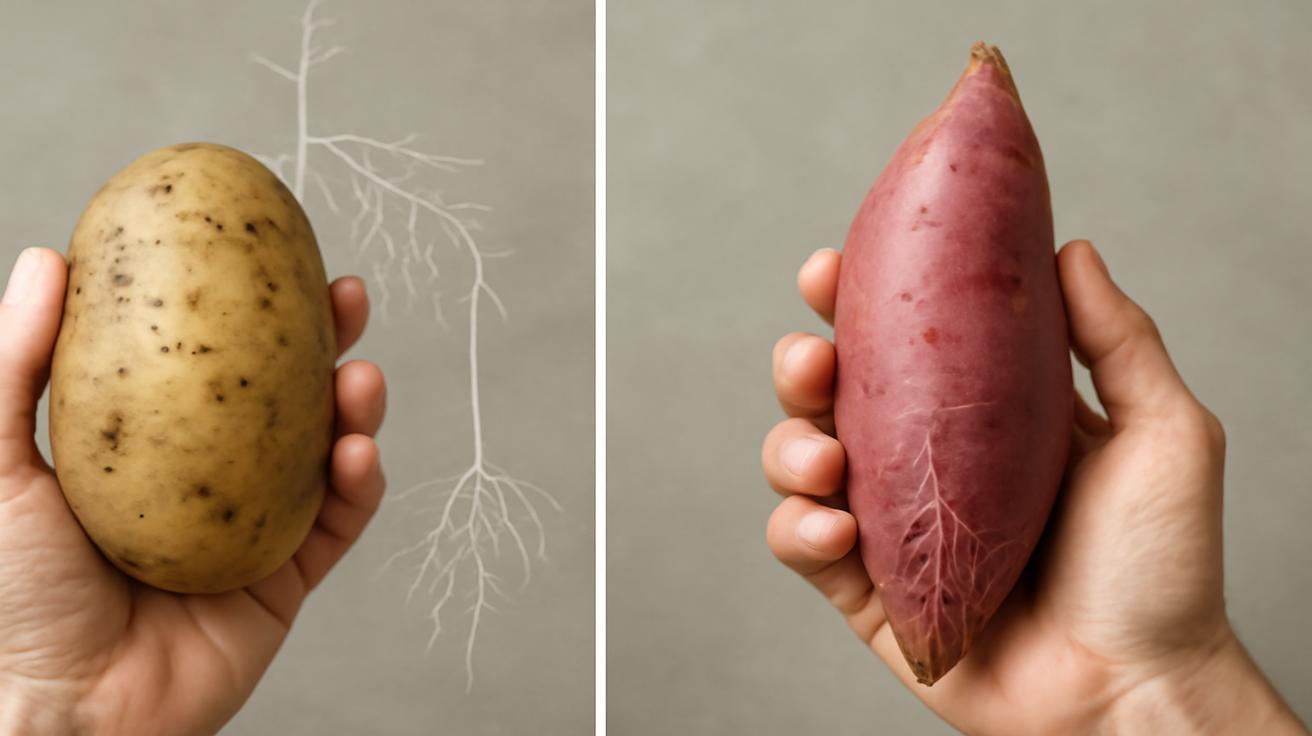
The first time you pull a sweet potato vine from the soil, it feels like unearthing treasure from another world. The air is thick with the smell of damp earth and green leaves; the vines tug back as if they’d rather stay buried. You brush away clumps of soil, and there, glowing a soft copper-orange in the fading light, is the unmistakable shape of a sweet potato—stubby, knobby, and almost comically shaped. A few feet away, in another bed, you might find the more familiar regular potatoes: smooth, oval, pale-skinned, cold to the touch, like they’ve been storing away the last chill of spring. Side by side in the harvest basket, they look like cousins. On the plate—mashed, roasted, or fried—they might as well be twins. But beneath the soil and beneath the skin, their stories peel in completely different directions.
Two Vegetables, Two Family Trees
Let’s start in a place we can all agree on: most of us grew up thinking sweet potatoes and “regular” potatoes were variations on the same theme. Grocery stores line them up next to each other. Recipes casually say you can “swap in sweet potatoes if you like.” Even language gets confused—people in some regions say “yam” when they mean “sweet potato,” yet what they’re really thinking about is a sweeter version of the thing you’d make into fries.
But if you walked into a botanical family reunion, sweet potatoes and regular potatoes would not only sit at different tables—they’d be in completely separate halls, under different last names, maybe even in different cities. The regular potato, the one you know from French fries and mashed potatoes, belongs to the Solanaceae family, also known as the nightshade family. Its scientific name: Solanum tuberosum. It shares a family tree with tomatoes, eggplants, and peppers.
The sweet potato, on the other hand, carries a different passport. Its name is Ipomoea batatas, and it’s part of the Convolvulaceae family—the morning glory family. Yes, that morning glory: the delicate, trumpet-shaped flower twining around fences and garden trellises. If that feels surprising, you’re not alone. The idea that the orange root on your Thanksgiving table is botanically closer to a vining ornamental flower than to a russet potato is the kind of odd truth that makes the plant world so deeply compelling.
If you zoom out far enough—to the level of “they’re both plants”—sure, they share a kingdom. But on the evolutionary tree, they branched away from each other tens of millions of years ago, heading off in two separate directions while quietly evolving their own survival tricks. We simply happened to domesticate both of them into something delicious.
The Nightshade vs. The Morning Glory
To really feel how different they are, imagine them not in the grocery aisle, but in the wild. The ancestor of the regular potato grew high in the cool, thin air of the Andes in South America. Picture steep stony slopes, mist clinging to jagged rock, thin soils that seem more suited to lichens than lush crops. This is nightshade country: tough, resilient, a bit suspicious. Many of its relatives protect themselves with bitter alkaloids—compounds that make unripe or green potatoes slightly toxic. The leaves and berries of potato plants are not something you snack on. They’re warning flags.
Now walk down the mountain, closer to the equator, and let the air grow warmer, heavier, more humid. In Central and northern South America—places once dominated by forests, river valleys, and rich tropical soils—you’d find the ancestral sweet potato making its way as a trailing vine, its leaves shaped like hearts or elongated fingers, its flowers unfolding in soft, fluted cups like its morning glory cousins. This is a world of twining through other plants, spreading across the ground, soaking up heat and rain.
The potato’s strategy is defensive toughness; the sweet potato’s is generosity of growth. Both form swollen storage organs underground, but even those organs are different things. Regular potatoes are tubers—swollen stems. Sweet potatoes form storage roots—roots that have thickened with starch and sugar. It’s like the difference between saving your resources in a bank account versus stuffing them into a safe hidden beneath the floorboards. Both hold value, but they aren’t built the same way.
The Science Under the Skin
To plant people, that difference matters. Tubers, like those in regular potatoes, are modified stems: they have “eyes” (buds) that can sprout new stems and leaves. When you cut a potato into pieces and plant them, each piece with an eye can grow into a new plant. Sweet potato storage roots behave differently. If you plant a chunk of sweet potato, what grows is a bit indirect. You don’t get a stem sprouting from an “eye” in the same way; instead, slips—small shoots—are usually started from the whole root and then transplanted. It’s a subtler, more root-centric system.
Genetically, the distance widens even more. Sweet potatoes are polyploid—many sets of chromosomes, tangled and multiplied over evolutionary time. Regular potatoes are also genetically complex, but belong to a completely separate lineage. Ask a plant geneticist, and they’ll tell you: these two crops have more in common with their respective families than with each other. A potato is closer to a tomato than to a sweet potato; a sweet potato is closer to a morning glory vine than to anything sitting in the “potato” bin at your local market.
Why They Taste—and Feel—So Different
Your tongue already knows they’re different, even if your mind was late to the party. A forkful of mashed russet potato feels dry and fluffy, eager to soak up butter and salt. A bite of roasted sweet potato comes off as dense, creamy, candy-sweet at the edges where it caramelizes. That isn’t just a matter of preference or cooking method; it’s chemistry written into the flesh of each plant.
Regular potatoes are mostly starch, and that starch is often made of long chains that cook up into that familiar fluffy texture. Sweet potatoes also have starch, but they balance it with sugars—sucrose, glucose, and fructose—that intensify with certain cooking methods. Slow roasting at a moderate temperature gives enzymes time to break down starches into sugars, which then caramelize at the edges. It’s why the kitchen smells like a bakery when sweet potatoes are in the oven.
Even their nutritional profiles tell separate stories. Consider the rough comparison below:
| Feature | Regular Potato (boiled, 100g) | Sweet Potato (boiled, 100g) |
|---|---|---|
| Calories | ~87 kcal | ~86 kcal |
| Carbohydrates | ~20 g | ~20 g |
| Fiber | ~1.8 g | ~3.0 g |
| Vitamin A | Very low | Extremely high (from beta-carotene) |
| Vitamin C | Moderate | Moderate |
| Potassium | High | High |
Calorie-wise, they’re surprisingly similar. But sweet potatoes are running a different race: more fiber, more antioxidants, especially beta-carotene, which paints them orange and fuels that famous Vitamin A content. Regular potatoes hold their own as a staple energy source, packed with potassium and vitamin C, but they don’t glow with that same internal sunset of antioxidants.
You can taste that difference. Sweet potatoes lean toward dessert even in savory dishes; potatoes lean toward comfort, their flavor quiet, waiting for garlic, butter, or herbs to dress them up. It’s almost as if sweet potatoes bring their own seasoning to the party, while potatoes show up with an empty plate and a big appetite.
How History Twisted Their Names
People have been confused about these two plants for centuries, and history did little to untangle the knot. Long before supermarkets and recipe blogs, there were sailors, traders, and colonizers moving plants across oceans and continents, giving them new names in new languages.
Regular potatoes were first domesticated in the Andes thousands of years ago, long before Europeans had any idea the Americas even existed. Indigenous farmers nurtured hundreds of varieties: blue-fleshed, finger-sized, knobbly, tiny, bitter, and sweet (in the sense of “less bitter,” not candy-sweet like today’s sweet potatoes). When the Spanish encountered them in the 1500s, they brought them back across the Atlantic, where European farmers slowly learned to trust a plant that grew underground and belonged to the same family as some fairly toxic wild species.
Sweet potatoes, meanwhile, were cultivated in tropical and subtropical Americas, likely even earlier. They were carried across the oceans as well, reaching Africa, Asia, and Europe via different trade routes than the regular potato. In many places, their local names evolved or were borrowed from languages along these routes.
The confusion really thickened in English-speaking regions, especially in North America. Orange-fleshed sweet potatoes became popular in the United States, and marketers wanted a way to distinguish them from the firmer, drier, paler varieties of sweet potato already in circulation. They borrowed the word “yam”—a name that originally belonged to a completely different starchy root grown in parts of Africa and Asia (from the Dioscorea genus).
So now we had three unrelated plants tangled in one linguistic net: true yams, sweet potatoes, and regular potatoes. In the produce aisle, “yam” often simply means “this is the sweeter orange thing,” even though it’s still just a sweet potato with a different costume. Behind the scenes, botanists wince and mutter family names under their breath. But language, like vines, tends to wander where it will.
Living Very Different Lives in the Garden
If you ever decide to grow both in your own backyard, the illusion that they’re closely related dissolves within a single season. Regular potatoes like cool weather and don’t appreciate heat waves. They go into the soil as chunks of tuber, each with an eye, and send up leafy, bushy plants topped with delicate star-shaped flowers, often white or purple.
Sweet potatoes, however, love heat. They want soil that warms your hands when you dig into it. Gardeners plant them as “slips”—little rooted cuttings with a few leaves—and they sprawl, sending vines tumbling over the edges of beds, rooting here and there along their length. Their flowers, if they appear, resemble morning glories: soft, funnel-shaped, elegant.
Their pest problems, their preferred soil types, even their harvest cues differ. Potatoes are dug once their foliage dies back and dries. Sweet potatoes are often lifted while their vines are still green, then cured in a warm, humid place for days or weeks to convert more starch into sugar and heal small cuts in the skin. That curing is part of why a supermarket sweet potato tastes sweeter—and keeps longer—than one you’d pull from the ground and eat the same day.
Standing in a garden with dirt on your knees and these plants at your fingertips, it becomes obvious: you’re dealing with two separate species with different needs and habits, not two variations of the same thing. The resemblance on your plate is a trick of culinary culture and human imagination.
Why It Matters That They Aren’t Related
At first glance, this might feel like a niche botanical detail, the kind of thing that delights plant nerds and leaves everyone else shrugging. But understanding that sweet potatoes and regular potatoes come from different lineages is more than trivia; it subtly shifts how we think about food, biodiversity, and even climate resilience.
For plant breeders, those family boundaries are hard walls. You can’t cross a sweet potato with a regular potato to get some hypothetical super-root that has the sweetness of one and the frost-hardiness of the other. They speak different genetic “languages.” Improvements—more nutrition, more disease resistance, better storage—have to come from within each family, through traditional breeding or genetic tools that work within their biological limits.
For farmers and gardeners, that difference helps plan more resilient fields. A disease that sweeps through potato crops doesn’t automatically spell doom for sweet potatoes, because the pathogens that attack one often can’t affect the other. Their separate lineages are like firebreaks in a forest of food. Growing both can be a kind of insurance against a bad year.
For anyone simply trying to eat well, the distinction nudges us away from one-size-fits-all thinking about carbohydrates. Neither sweet potatoes nor regular potatoes are “good” or “bad” in isolation; they’re tools you choose depending on your needs, tastes, and traditions. They carry different portfolios of nutrients, respond differently to cooking, and fit into different cultural roles. Knowing they’re not cousins in disguise reminds us to appreciate them for what they are, not what they’re mislabeled as.
Seeing Them Clearly on Your Plate
Next time you sit down to a meal, imagine all the invisible threads connecting the food on your plate to distant ecosystems and ancient decisions made by people whose names we’ll never know. A crisp roast potato carries the cool breath of Andean highlands and the caution of the nightshade family. A baked sweet potato, split open to reveal its molten orange center, carries the lush warmth of old tropical landscapes and the exuberance of a morning glory vine that refused to be just ornamental.
You can eat both with more awareness now. When you call one a “yam,” you’ll know you’re participating in a tangled history of trade and language. When a recipe says, “substitute sweet potatoes for regular potatoes,” you’ll understand that sometimes you can, but what you’re really doing is swapping the personality of one plant family for another. The stew or roast or salad that emerges will reflect that choice.
In a world where so much of our food is shaped and packaged to look interchangeable, it’s quietly radical to remember that each plant has its own lineage, its own story, its own way of being in the world. Sweet potatoes and regular potatoes may share the same basket, might even end up on the same fork. But under the skin, they’re strangers who took different paths through deep time and happened, by chance and by human curiosity, to arrive at the same table.
FAQ
Are sweet potatoes healthier than regular potatoes?
It depends on what you mean by “healthier.” Sweet potatoes are richer in beta-carotene (which the body converts to Vitamin A) and often have more fiber. Regular potatoes offer plenty of potassium and vitamin C. Both can be part of a healthy diet; preparation and portion size matter more than choosing one “winner.”
Are sweet potatoes and yams the same thing?
No. In most North American grocery stores, “yams” are actually sweet potatoes with a different label. True yams are starchy tubers from a completely different plant family (Dioscorea) and have a different texture and flavor.
Can you substitute sweet potatoes for regular potatoes in recipes?
Sometimes, but expect a different result. Sweet potatoes are sweeter, softer, and hold moisture differently, so they can change the texture and flavor of dishes like soups, stews, and fries. In recipes where structure and starch type matter (like gnocchi or certain bakes), substitution can be tricky.
Do sweet potatoes and regular potatoes grow in the same conditions?
Not ideally. Regular potatoes prefer cooler climates and are often grown in spring or early summer. Sweet potatoes thrive in warm, even hot, conditions and need a longer frost-free season. They also differ in how they’re planted and harvested.
Why belong sweet potatoes to the morning glory family?
Botanically, sweet potatoes share key characteristics—like flower structure and genetic traits—with morning glories. Their flowers resemble morning glory blossoms, and genetic studies confirm that they fit comfortably within the Convolvulaceae (morning glory) family, far from the nightshade lineage of regular potatoes.








Leave a Comment