
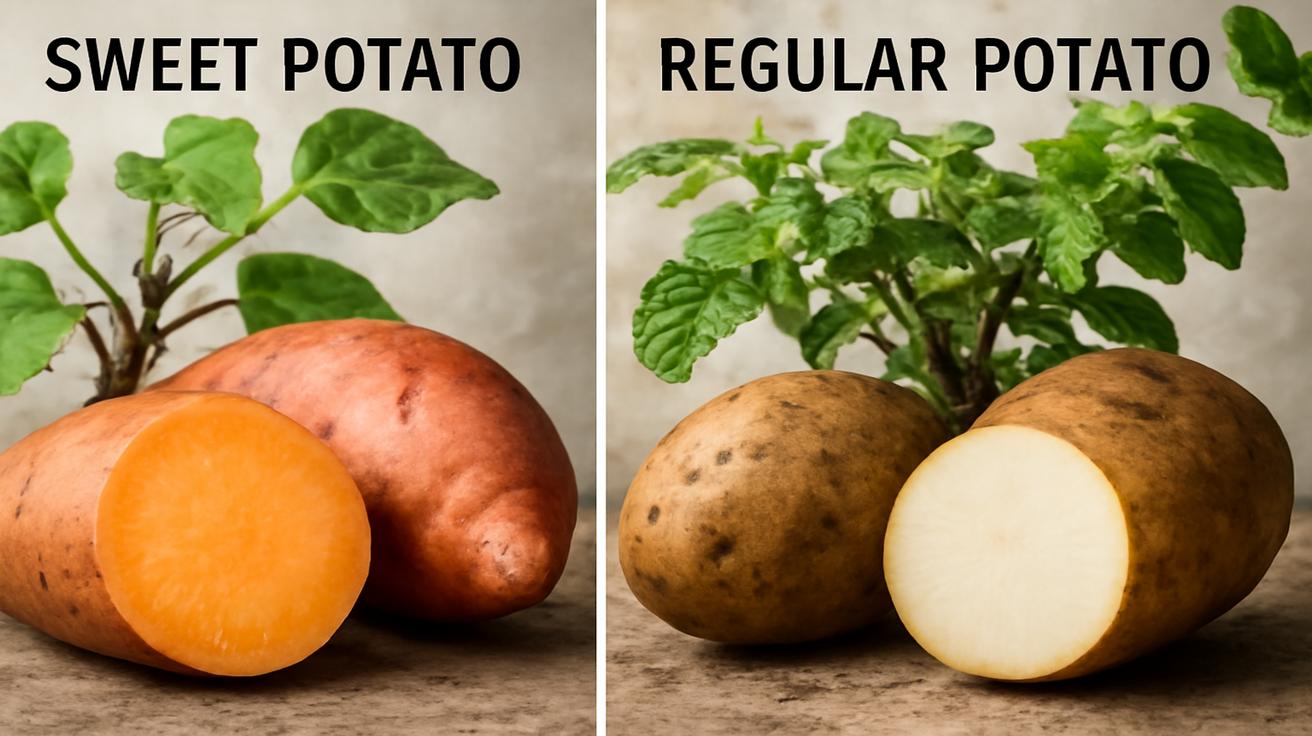
The first time you slice into a sweet potato and a regular potato side by side, it’s hard not to notice how different they feel beneath the knife. One bleeds a pale, starchy milk, the other glows a deep orange or soft yellow, wet and firm and almost squeaky on the cutting board. Yet in kitchens around the world, they sit together in pantry baskets and supermarket bins, sharing a name, sharing a place on our plates, and—if we’re honest—sharing a chunk of our confusion. Of course they’re related, we assume. Potatoes are potatoes, just some are sweet and some are not. How different could they be?
Walk through a farmer’s field at the right time of year, though, and the truth rises from the soil and curls through the air like a vine reaching for light: these two “potatoes” might as well be distant strangers that just happen to dress in similar clothes. Their shared name is a trick of history and habit. In the quiet work of roots and leaves, in the microscopic code of their DNA, science tells a very different story—one where the sweet potato is more in league with morning glories than with the humble, dirt-crusted spud we mash for dinner.
Two Plants, One Name: How We Got So Mixed Up
If you trace this confusion back in time, it doesn’t start in a lab or a textbook. It starts with sailors, traders, and a tangle of languages trying to catch up with unfamiliar foods.
Imagine the decks of ships hundreds of years ago, creaking across the Atlantic. In the holds are crates of strange tubers: some are knobbly and brown, others long and reddish, all pulled from soils half a world away. When Spanish explorers met Indigenous farmers in the Americas, they encountered a root the locals called something like “batata.” It was sweet, nourishing, and easy to store—everything a traveling sailor dreamed of.
European tongues, unaccustomed to the word, folded and reshaped it. “Batata” blurred into “patata,” and eventually into “potato.” At the same time, another root was being cultivated in the highlands of the Andes: the starchy, non-sweet tuber we now think of as the classic potato. Somewhere along the way, different plants got swept up under the same general term, like distant cousins mistakenly added to the same family portrait.
The English language did what it often does—it compromised. It called the Andean tuber “potato” and the sweeter batata “sweet potato.” The label stuck. And once a food name settles into the rhythms of daily speech, it’s remarkably hard to shake, no matter what botany has to say about it.
Not Even Close on the Family Tree
In the plant world, names are more than just habits and sounds; they’re coordinates on a vast family tree. That tree, carefully charted by botanists and sharpened by genetic studies, reveals that sweet potatoes and regular potatoes part ways far, far earlier than their shared name suggests.
The regular potato—the champion of fries, chips, and mashed piles on holiday plates—belongs to the Solanaceae family. This is the nightshade clan, a mix of the beloved and the dangerous. Tomatoes, eggplants, peppers, and tobacco all live here, along with some truly poisonous relatives. The potato’s scientific name, Solanum tuberosum, gives a hint of its position in this group.
The sweet potato, though? It’s not a nightshade at all. It lives across the botanical aisle in the Convolvulaceae family—the morning glory family. Its official name, Ipomoea batatas, places it among the vines with heart-shaped leaves and trumpet-shaped flowers you might see climbing fences and roadside railings, opening to the sun each morning and curling inward at dusk.
Botanically speaking, sweet potatoes are closer to those decorative morning glories than they are to the russet potato sitting in a grocery bag right now. That’s not a poetic exaggeration; it’s a hard fact of lineage. When scientists map their genes, the two “potatoes” show a distance that cannot be bridged by shared recipes or grocery store signage.
What Science Sees That We Don’t
From the supermarket aisle, the tuber section can look like a blended family of roots: red, white, purple, all dusty and dim under fluorescent lights. But to a plant biologist, the differences between these species flare like neon.
Start with their basic body plans. Regular potatoes grow on underground stems called stolons. These are horizontal, branching runners that thicken at the tips, swelling into the familiar tubers we store in dark cupboards. The potato plant above the ground—green stems, compound leaves, clusters of white or purple star-shaped flowers—looks very much like its nightshade cousins, such as tomatoes.
Sweet potatoes, by contrast, are storage roots, not swollen stems. They form deep, tapered, fleshy roots that dig into the soil like buried torpedoes. Above ground, the plant sends out trailing vines, adorned with simple, heart-shaped leaves and pale funnel-shaped flowers that look remarkably like morning glories because, genetically, they are close kin.
Even their chromosomes tell different stories. The two plants vary in chromosome number and structure. When scientists use modern genetic tools to compare their DNA, they find no close overlap that would suggest a near relationship. There is simply too much distance—like trying to cross a canyon with a single stepping stone.
Roots on Different Continents
To understand why these plants turned out so differently, you have to step back from the lab bench and look at a map of the world and a timeline stretching thousands of years into the past.
Regular potatoes first rose to importance high in the Andes, in what is now Peru and Bolivia. At those altitudes, nights are cold, days can be harsh, and the soil is often rocky and thin. Farmers there, long before any European ship appeared on the horizon, were quietly experimenting. Over centuries, they selected for tubers that were more nutritious, more frost-resistant, more reliable. Potatoes became an anchor of Andean diets, a living store of energy tucked into the earth.
Sweet potatoes likely found their earliest cultivation in Central or South America as well—but in much warmer, lower regions. They thrived in looser, well-drained soils and warmer climates. Where potatoes nestled into the cool highlands, sweet potatoes sprawled along the coasts and lowlands, their vines creeping and their roots swelling under tropical and subtropical suns.
Eventually, both crops took to the seas. Potatoes were carried to Europe, where they altered the course of history, fueling population growth and, in times of blight, devastating famine. Sweet potatoes traveled across the Pacific, took root in Polynesia and later in Asia and Africa, absorbing themselves into the textures of local cuisines.
By the time they met again in modern global markets—lined up together under one broad, misleading label—they had already spent millennia living separate lives, adapting to different climates, pests, and human preferences.
The Chemistry of Sweet and Savory
On the tongue, the story of their separation continues. Anyone who has mistakenly used sweet potatoes instead of regular potatoes in an old family recipe knows that they do not behave the same way in a pan.
Regular potatoes are starch powerhouses. Their white or yellow flesh is packed with complex carbohydrates and only a whisper of sugar. The type of starch matters too. Waxy potatoes like red or new potatoes hold their shape, making them perfect for salads and stews. Floury, high-starch varieties like russets break down and fluff up when cooked, ideal for mashing or baking.
Sweet potatoes carry more natural sugars—sucrose, glucose, fructose—and their starches interact differently with heat. Roast them, and their edges begin to caramelize, darkening and crisping with a sweetness that borders on dessert. That caramel note is not simply a trick of perception; it’s chemistry at work as their sugars and amino acids dance in the oven, creating new flavors and aromas.
Hidden beneath all this taste is another chemical twist: while “yams” are often used as a casual synonym for sweet potatoes in some countries, true yams belong to yet another plant family altogether, Dioscoreaceae. They are different again in anatomy, genetics, and chemistry. So the basket in your pantry may sometimes contain three unrelated plant groups disguised under two names, an identity mix-up that only deepens the mystery.
A Tale of Two Nutritional Profiles
If you laid out the nutrients of each plant like a set of cards on a table, you’d find similarities—carbohydrates, fiber, vitamins—but the suits and numbers wouldn’t quite line up.
| Nutrient (per 100 g, cooked) | Regular Potato | Sweet Potato |
|---|---|---|
| Calories | ~87 | ~90 |
| Total Carbohydrates | ~20 g | ~21 g |
| Sugars | ~1 g | ~6 g |
| Fiber | ~2 g | ~3 g |
| Vitamin A (as Beta-Carotene) | Trace | Very high |
| Vitamin C & Potassium | High | High |
Both plants are nourishing in their own right. Potatoes are an efficient delivery system for energy, vitamin C, potassium, and some B vitamins. They became a staple food for a reason: they pack a lot of nutrition into a durable, storable package.
Sweet potatoes, on the other hand, bring a dramatic burst of beta-carotene, especially in their orange-fleshed varieties, which the body converts into vitamin A. This is a vitamin deeply tied to eye health, immune function, and skin. Their gentle sweetness also changes how we use them: they wander into desserts, into breakfast hashes, into dishes that straddle the line between savory and sweet.
Look long enough at these differences, and a pattern emerges. These are not two versions of the same thing; they are two answers to the same question: how can a root help humans survive and thrive? Different lineages, different strategies, converging on the same solution—store energy underground.
Convergent Lives Beneath Our Feet
In nature, when unrelated organisms start to look alike, it’s often a clue that they’ve faced similar challenges. Fish and dolphins share sleek, finned bodies; cacti and some African succulents both wear spines and store water. They did not inherit these traits from a common ancestor; they built them independently, shaped by similar demands. This is convergent evolution in action.
Something similar whispers beneath the skins of potatoes and sweet potatoes. Both became staple crops in human societies. Both evolved thickened underground structures to store starches—living savings accounts for future seasons. Both lent themselves to propagation by planting pieces of the plant instead of seeds, allowing humans to clone their favorites, generation after generation.
Yet their choices differ in detail. Potatoes turned stems into storage organs, packing energy into nodal swellings that could sprout new plants from “eyes.” Sweet potatoes fattened their roots, extending deeper and anchoring more firmly. The path was different, but the destination was the same: survive dry spells, cold, and hungry months by keeping a reserve hidden in the soil.
From a distance, this convergence tricked us. We saw the shared shape—brown, knobbly, root-like—and assumed shared heritage. Science, zooming closer, saw the separate histories written in cells and chromosomes.
What This Changes in Our Kitchens and Our Minds
Knowing that sweet potatoes and regular potatoes are not close relatives doesn’t change how they taste. A crisped potato wedge dipped in salt and vinegar is as satisfying as ever; a roasted sweet potato, split open and steaming, still smells like comfort. But the knowledge has a way of subtly rearranging things in the mind.
In the kitchen, it invites respect for their differences. You start to understand why they behave differently in the pan, why one stays firm in a stew while the other melts into a soft sweetness, why swapping them in a recipe rarely yields the same dish. Instead of treating them as interchangeable, you begin treating them like distinct personalities: the potato as a starchy canvas for fats and seasonings; the sweet potato as a natural carrier of sweetness and earthy depth.
In the garden, the difference becomes even more tangible. Plant potatoes, and you bury chunks of tuber, each with at least one eye, and wait for leafy shoots to emerge. Plant sweet potatoes, and you tuck slips—small rooted vines—into the soil and watch them sprawl outward in green rivers. Dig up a harvest, and your hands meet two completely different architectures beneath the surface.
In the mind, something else shifts: a sense of humility in the face of everyday things we thought we understood. If two of the most common “potatoes” in our diets aren’t really kin, what else in our world have we lazily lumped together? How many hidden stories are buried, like roots, beneath the labels we casually use?
Frequently Asked Questions
Are sweet potatoes and regular potatoes from the same plant family?
No. Regular potatoes belong to the nightshade family (Solanaceae), while sweet potatoes are part of the morning glory family (Convolvulaceae). They are not closely related.
Why do sweet potatoes and regular potatoes both get called “potatoes”?
The name “potato” evolved from earlier words like “batata” used by Indigenous peoples for sweet potatoes. Over time, European languages merged and reshaped these terms, and both crops ended up sharing similar names despite their different origins.
Is a sweet potato just a healthier type of regular potato?
They are different foods with distinct nutrient profiles. Sweet potatoes tend to be higher in natural sugars and beta-carotene (vitamin A), while regular potatoes are excellent sources of starch, vitamin C, and potassium. One isn’t universally “better”; they simply offer different benefits.
Are sweet potatoes and yams the same thing?
In many stores, the terms are used interchangeably, but botanically they are not the same. True yams belong to yet another plant family (Dioscoreaceae) and are different from both sweet potatoes and regular potatoes.
Can sweet potatoes and regular potatoes cross-breed?
No. Because they are from different plant families with very different genetics, they cannot hybridize. Any “hybrid” you see is usually just a marketing name for a particular variety, not a true cross between the two species.
Do they grow the same way in the garden?
Not at all. Regular potatoes grow from tubers—swollen underground stems—with “eyes” that sprout. Sweet potatoes grow from slips—rooted vine cuttings—and produce enlarged storage roots, not tubers.
Which one came first in human agriculture?
Both have ancient roots, but in different places and contexts. Regular potatoes were first domesticated in the Andean highlands of South America, while sweet potatoes were domesticated in warmer regions of the Americas, likely Central or northern South America. They followed parallel, not shared, paths into human history.








Leave a Comment