
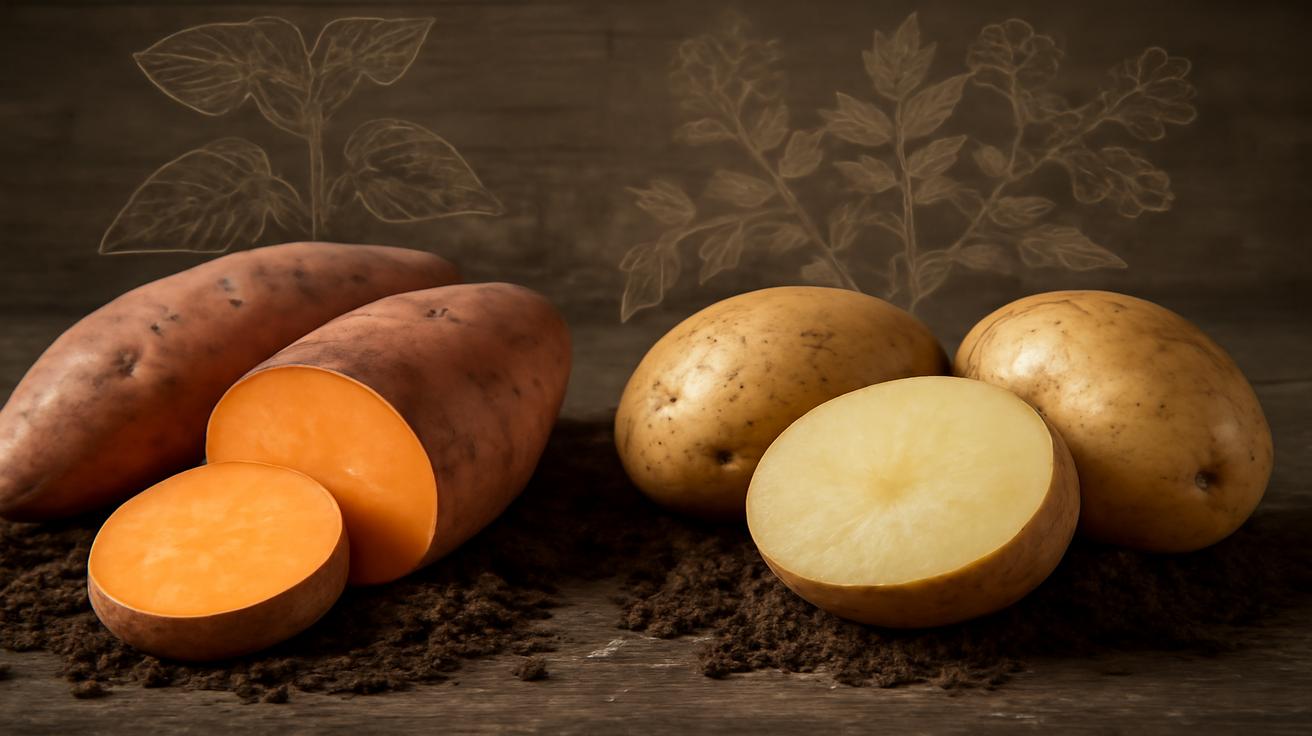
Their skins sat touching in the grocery bin, a tumble of earthy browns and sunset oranges. Under the fluorescent lights, they looked like cousins waiting to be picked for the same family dinner: the familiar rough russet potato and the glowing, smooth sweet potato. A shopper reached in, grabbed one of each, and slid them into the same paper bag—as if that were the most natural thing in the world. Mashed, roasted, baked, or fried, many of us treat them as simple variations on a theme. One is “regular,” the other is “sweet,” and that’s that. Yet the moment you slice into them—the chalky white of the potato, the jewel-toned orange or purple of the sweet potato, the different scent rising from the cutting board—you’re already brushing up against a deeper truth: these two vegetables are, in botanical terms, barely related at all.
The Twin Impostors of the Root Vegetable Aisle
Walk through any supermarket and you’ll find them stacked side by side like twins who chose wildly different wardrobes. The potato, Solanum tuberosum, wears dusty, utilitarian work clothes: browns, tans, thin reds, sometimes a muted purple. The sweet potato, Ipomoea batatas, looks like it just came back from a tropical vacation—sleek, stretched, sun-kissed in copper or flame-orange skin.
They’re both called “tubers” in everyday conversation, both pulled from the earth, both roasted into wedges and bathed in oil and salt. Many people assume sweet potatoes are just a sugary variety of the same plant, sort of how green apples and red apples share a family tree. But potatoes and sweet potatoes are more like two strangers who just happen to have shown up at the same party wearing vaguely similar outfits.
In the hidden language of plant classification, they don’t even share a plant family. Potatoes belong to the nightshade family, Solanaceae, which includes tomatoes, eggplants, and peppers—as well as some of the most infamous poisons known to humanity. Sweet potatoes live in a different botanical neighborhood entirely: the morning glory family, Convolvulaceae, better known for ornamental vines that unfurl trumpet-shaped flowers at sunrise.
Yet because they store energy underground in fleshy roots or tubers, farmers, cooks, and shoppers grouped them together long before science began carefully sorting and naming them. Our senses trick us: what we see, smell, and taste in the kitchen can feel more “real” than the invisible branching of evolutionary family trees. To understand how misleading appearances can be, you have to follow these two vegetables back into deep time—long before supermarkets, recipes, or even humans existed.
The Family Secret Hidden in Their Flowers
If you want to know who plants are really related to, you don’t look at what’s on your plate. You look at their flowers. Roots, leaves, and stems can be shaped by climate, soil, or survival strategy, but flowers are about reproduction—passing genes onward—and evolution guards their basic blueprint more jealously.
Potato flowers look like tiny white or lavender stars with bright yellow centers—if you’ve ever seen a tomato or eggplant bloom, you’ll recognize the family resemblance. Five petals fuse into a star, and the yellow anthers bunch together in a tight cone. It’s the same pattern across the nightshades, from the tomato vines in your garden to the wild relatives in South American highlands.
Sweet potatoes, when given the chance to flower, quietly tell a different story. Their blooms resemble morning glories: funnel-shaped, often with a lilac or pinkish tint, delicate and almost ornamental. If the potato is a tough mountain farmer, the sweet potato moves more like a vine that might climb your fence and greet the sunrise.
Botanists in the 18th and 19th centuries used these floral signatures to sort plants into families, long before DNA tests made it official. The flowers whispered: We are not the same. Later, when scientists began comparing their genes, the evidence shouted it.
DNA: The Quiet Proof Beneath the Skin
Modern biology lets researchers read the letters in a plant’s DNA like a long, ancient story. When they compared the genetic “books” of potatoes and sweet potatoes, they found entirely different volumes shelved in distant corners of the plant library. Both belonged to the broader bookcase of flowering plants, sure, but their family chapters were separated by tens of millions of years of evolution.
In other words, these two starchy staples did not gradually split from a common potato-like ancestor. Instead, they represent independent solutions to the same problem: how to store energy safely underground in an unpredictable world of droughts, fires, and hungry animals. Evolution is a master of what scientists call “convergent evolution”—very different creatures arriving at a similar shape or strategy because it works well.
A whale and a shark both glide through water with streamlined bodies and powerful tails; one is a mammal, the other a fish. A cactus in Mexico and a spiny euphorbia in Africa both hoard water behind sharp defenses; they evolved on separate continents, unrelated but uncannily similar. Potatoes and sweet potatoes followed a similar script, each in its own time and place, ending up in the same stewpot for reasons that have little to do with kinship.
Same Kitchen, Different Body Plans
To the cook’s hand, they feel like variations on a theme: solid, dense, rustling faintly when you rub the skin. But inside, the architecture of these plants tells a story of deep divergence.
A potato’s “potato” is a true tuber—a swollen part of an underground stem. You can see its stem origins in the so-called “eyes,” each a dormant bud capable of sprouting a new plant. Plant a chunk of potato with an eye, and you’ll grow more potatoes, because you are reanimating a bit of stem that carries the plant’s blueprint.
A sweet potato is different. The edible part is a “storage root,” technically a modified root that has thickened to hold reserves. Cut across it and you won’t find true eyes—no buds that mimic the stem’s habit. It’s as if one plant chose to stash its savings in a bank account labeled “stems,” while the other chose the “roots” branch across town.
This difference might seem academic, but it ripples into how they grow, how they respond to pests, and how we propagate them. Farmers plant potatoes from pieces of the tuber itself, eyes and all. Sweet potatoes usually begin as “slips”—small rooted cuttings grown from a mature root, like green clones reaching into new soil.
And then there’s the chemistry. Potatoes and sweet potatoes do both trade in starch, but the details change how they taste, cook, and nourish us. Here’s a simplified comparison that captures some of those differences:
| Feature | Potato (White/Yellow) | Sweet Potato (Orange) |
|---|---|---|
| Botanical family | Solanaceae (nightshade) | Convolvulaceae (morning glory) |
| Edible part type | Stem tuber | Storage root |
| Typical taste | Mild, earthy, neutral | Sweet, caramel-like when roasted |
| Signature pigment | Varies: white, yellow, purple (anthocyanins in purple types) | Beta-carotene (orange), anthocyanins (purple varieties) |
| Notable relatives | Tomato, eggplant, pepper, tobacco | Ornamental morning glories |
On the plate, those invisible differences turn into sensation. Potatoes, with their particular starch structure, can go fluffy when baked, crisp when fried, and gluey if overworked. Sweet potatoes hold moisture, collapsing into soft, almost custardy interiors that caramelize along their edges under high heat. When you bite into each, you’re tasting not just sugar and starch, but two entirely different survival strategies encoded across millions of years.
Poison, Light, and the Nightshade Legacy
Being a nightshade carries a curious baggage. The same family that feeds us potatoes and tomatoes also harbors deadly poisons like belladonna. It’s not that potatoes themselves are secret villains—at least, not the part we eat in moderation—but their wild relatives evolved chemical defenses that still echo in the cultivated plants.
That faint greenish tinge you sometimes see on a potato that’s been sitting too close to the window? It’s chlorophyll, produced when the tuber is exposed to light and begins to behave more like an aboveground plant. Along with the green, the potato ramps up production of glycoalkaloids, including a compound called solanine. In large enough doses, solanine can cause nausea, headaches, even neurological symptoms.
This doesn’t mean you should panic over every potato. But it does hint at the nightshade’s evolutionary strategy: living in a tough world by becoming chemically unappetizing to herbivores. For wild potatoes, bitter and toxic tubers were an insurance policy against being eaten into extinction. Humans, drawn by the caloric treasure buried inside, slowly nudged potatoes toward less bitterness and greater yield—but the genes for defense never fully disappeared.
Sweet potatoes, coming from the morning glory family, took a gentler path. They have their own defenses against insects and disease, but not the same nightshade cocktail. Their sweetness is no coincidence, either. In their native tropical and subtropical climates, attracting certain animals that might dig them up and help spread their offspring wasn’t necessarily a bad strategy. To some hungry creatures—including humans—sweetness reads like an invitation.
Different Homelands, Different Histories
Their geographical stories underscore how separate their journeys have been. Potatoes trace their domestication back to the Andes in South America, where Indigenous farmers were patiently selecting and improving them at least 7,000–8,000 years ago. High-altitude cold, thin soils, and challenging seasons shaped the potato into the hardy staple that would later feed industrializing Europe.
Sweet potatoes tell a different tale, rooted in lowland warmth. Most evidence points to Central or South America as their earliest cradle of cultivation, but they spread early and far, especially into the Pacific. Long before European ships stitched the world’s maps together, Polynesian navigators were already carrying sweet potatoes—kumara—across vast ocean distances, tucking them into new volcanic soils on distant islands. Their shared word for it with some South American groups is a linguistic fossil of those daring journeys.
So when you line a potato and a sweet potato side by side on your kitchen counter, you’re not just holding two vegetables. You’re touching two entire civilizations, two sets of farmers, two ecological theaters that never met until global trade tossed everyone’s seeds into the same pot.
Why Our Brains Keep Insisting They’re Related
Knowing all this, why do we still lump them together instinctively? Part of it is simple: our senses. Both live underground. Both are starchy. Both can anchor a meal. For a hungry human—or a cook thinking about what to serve—they answer similar questions: What will fill me up? What keeps well? What grows here?
Our language also blurs them. In some regions, sweet potatoes are called “yams,” even though true yams belong to yet another family entirely (Dioscoreaceae). In the United States especially, the orange-fleshed sweet potatoes we bake for holidays are often labeled as yams for marketing reasons, while white-fleshed varieties keep the “sweet potato” name. That triple confusion—potato, sweet potato, yam—turns the produce aisle into a quiet taxonomic comedy.
But the deeper reason might be this: humans are pattern seekers. We notice shapes, uses, and flavors long before we care about Latin names or evolutionary distances. To a villager a thousand years ago, plants that grew underground and yielded filling, starchy flesh were the same tribe, however distant their botanical lineage. If it behaves, cooks, and nourishes like a potato, the mind files it in the potato drawer.
Science doesn’t erase those intuitive categories; it adds another layer. It lets us understand that what feels like family can, in fact, be a coincidence of function. In a way, potatoes and sweet potatoes are less like siblings and more like two inventors on opposite sides of the planet who independently dreamed up the same clever tool.
The Wonder Hiding in Ordinary Food
Next time you cook them side by side—slices of russet crisping into fries, sweet potatoes collapsing into sticky orange crescents—pause for a moment. Notice how the potatoes exhale a mild, earthy aroma, while the sweet potatoes send caramel notes curling through the oven. Listen to the different sounds your knife makes against each: the chalky crunch of the potato, the denser, almost squeaky slide through sweet potato flesh.
In that everyday choreography of kitchen work, the distance between these two plants stays invisible. Yet once you know their stories, the meal transforms a little. You’re not just mixing textures and flavors—you’re hosting an ancient reunion, inviting two far-flung branches of the plant kingdom to share a tray.
Science sometimes seems like it lives in labs and journals, but here it’s whispering from your cutting board: things that look alike may have walked very different paths. You can appreciate the comforting sameness they bring to your table while honoring the wild, divergent journeys hidden beneath their skins.
After all, it’s not every night that a nightshade and a morning glory, products of poison and perfume, mountains and tropics, find themselves baked together, dusted with salt, and passed around a crowded table as if they were always one and the same.
FAQ
Are sweet potatoes and regular potatoes the same species?
No. Regular potatoes are Solanum tuberosum (nightshade family), while sweet potatoes are Ipomoea batatas (morning glory family). They are distantly related flowering plants but not close relatives at all.
Why do sweet potatoes sometimes get called yams?
In some markets, especially in the United States, orange-fleshed sweet potatoes have been labeled “yams” for historical and marketing reasons. True yams belong to a completely different plant family (Dioscoreaceae), so the name is technically inaccurate.
Is one healthier than the other: sweet potatoes or regular potatoes?
Both can be part of a healthy diet. Sweet potatoes are rich in beta-carotene (vitamin A precursor) and often have a slightly lower glycemic impact. Regular potatoes provide vitamin C, potassium, and resistant starch, especially when cooked and cooled. Healthiness depends more on preparation (baked versus deep-fried) than on which one you choose.
Why do potatoes sometimes turn green, and are they safe to eat?
The green color comes from chlorophyll forming when potatoes are exposed to light. Along with greening, levels of natural toxins called glycoalkaloids (like solanine) can increase. Small areas can be trimmed away, but very green or bitter-tasting potatoes are best avoided.
Can you grow new plants from both potatoes and sweet potatoes the same way?
Not exactly. Potatoes are usually grown from “seed potatoes”—chunks of tuber containing eyes (buds). Sweet potatoes are commonly grown from “slips,” which are rooted sprouts taken from a mature sweet potato root. The edible organs look similar but come from different parts of the plant, so their propagation methods differ.







Leave a Comment