
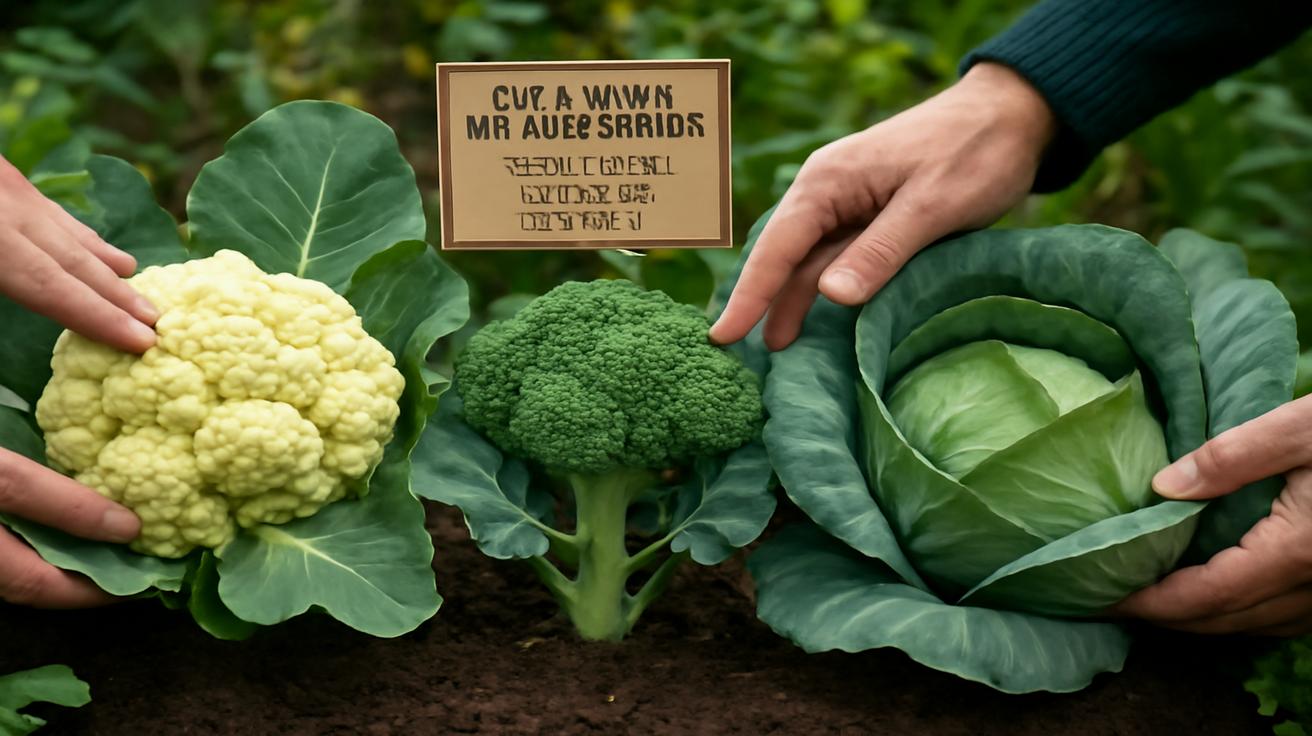
On a soft October morning, when the air smells faintly of woodsmoke and damp soil, you walk into a small-town farmers’ market and pause in front of a stall practically glowing green and white. Broccoli crowns, bumpy and tight. Snowy heads of cauliflower, wrapped in leaves like gifts. Purple and crinkled cabbage, stacked like planets. They seem like cousins at a family gathering—familiar, related, but clearly not the same. The farmer bags your vegetables, nods toward the pile, and says casually, “You know they’re all the same plant, right?” You smile politely, half sure he’s joking. The same plant? They look nothing alike.
The Plant With a Thousand Faces
The idea sounds absurd at first: cauliflower, broccoli, and cabbage as different faces of a single species. Yet in the slow, meticulous world of plants, this is exactly what happened. All three—along with kale, Brussels sprouts, kohlrabi, and more—belong to Brassica oleracea, a humble coastal wild plant once found clinging to salty cliffs along parts of Europe’s Atlantic edge. Picture it there: wind-gnarled, sea-sprayed, hardly remarkable. No big flower heads, no tight cabbages, no neat grocery-store shapes. Just a rangy, waxy-leaved thing surviving where other plants gave up.
Human hands, eyes, and appetites did the rest. Over thousands of years, farmers saved seeds from plants that had slightly bigger leaves, or thicker stems, or fuller flower buds. They did this not with laboratories, but with baskets, seasons, and patience. Each seed chosen, year after year, tugged the plant in a new direction, until the wild coastal plant fractured into a chorus of forms. One species, many bodies.
It’s a bit like watching one character actor play a dozen roles: the same underlying talent, wearing wildly different costumes. Cauliflower and broccoli are not distant relatives—they are just intensely specialized versions of that original cliff-dweller. Cabbage is another. They are not just related by family; they are, biologically, still the same species.
How Humans Sculpted a Single Species Into Many
Imagine a farmer, centuries ago, walking a rough field at dusk. He runs his hands over the plants, pausing at one whose leaves curl more tightly than the rest. It’s nothing dramatic—just a bit denser, like it’s trying to fold in on itself. Maybe he notices that this one stays sweeter in the cold, or seems less nibbled by insects. For reasons practical or intuitive, he saves its seeds.
Next year, some of those seeds produce plants that curl their leaves even more. He saves those seeds, too. Over and over, without ever using the term “selective breeding,” he is shaping a future cabbage. No one generation sees the leap from wild plant to tidy green orb. But over hundreds of years, across many lives, the plant bends to human desire.
Some farmers, in other regions, are drawn to different quirks. One favors plants whose flowers form especially tight clusters—the early beginnings of broccoli. Another saves from plants with thick central stems and extravagant leaves—the origins of kale and kohlrabi. These preferences, scattered across time and geography, accumulate like brushstrokes. The result: an explosion of vegetables that today feel distinct, almost unrelated.
Yet in a botanical sense, these differences are like regional dialects. The language—Brassica oleracea—remains the same. What changed is which part of the plant we pushed into the spotlight: leaves, stems, buds, or flower heads. Each vegetable you know is not a separate story, but a chapter in the same long relationship between humans and one adaptable species.
The Body Parts We Eat
You can almost read a plant’s history by asking a simple question: which part do people eat? For Brassica oleracea, the answer varies wildly, even though the DNA is shared.
| Vegetable | Plant Part We Eat | What Was Selected For |
|---|---|---|
| Cabbage | Leaves | Tight, layered heads and cold hardiness |
| Broccoli | Immature flower buds and stems | Large, clustered flower heads |
| Cauliflower | Immature, modified flower structure | Dense, white curd-like heads |
| Kale | Leaves | Loose, tender, often curly foliage |
| Brussels Sprouts | Leaf buds along the stem | Tight little “mini cabbages” on a stalk |
| Kohlrabi | Swollen stem | Bulb-like, crisp, mild stem base |
Look at broccoli with that in mind. Those green “trees” you fork into your mouth are actually clusters of unopened flower buds on a thickened stem. Wait long enough and they will burst into yellow blossoms, the whole head loosening into a firework of petals. Cauliflower, with its tight white curd, is also a mass of immature floral tissue—so crowded and altered that it forms that brainy, cloud-like dome instead of obvious buds.
Cabbage went another way. Rather than dramatizing its flowers, it curled its leaves inward, layer upon layer, protecting a dense, crunchy heart. All these forms are just different architectural experiments performed on the same blueprint. It’s as though one plant kept rearranging its furniture while we walked around saying, “Oh, look, a new house.”
The Secret Chemistry Behind Their Familiar Smell
Anyone who has ever overcooked cabbage or boiled broccoli too long knows there’s a particular smell that fills the kitchen—sulfurous, sharp, hard to forget. That scent is yet another reminder that these vegetables are siblings. They share not only a species name, but a chemistry set.
Inside their cells, compounds called glucosinolates sit quietly, waiting. On their own, they don’t smell like much. But cut, chew, or cook the plant, and you break cells open. Enzymes meet glucosinolates, and suddenly a rush of new chemicals forms—mustardy, peppery, sometimes pungent. Some of these compounds help the plant defend itself against insects and disease. Some give you that distinctive brassica taste that can be faint in a young cabbage leaf or bold in a bite of raw broccoli.
The same chemistry that makes a forgotten pot of boiled cauliflower fill the house with a funky cloud is also responsible for some of the health benefits that keep nutrition scientists interested. You can smell the kinship between these vegetables. That whiff is a quiet chorus: same plant, different shapes, same underlying tricks.
One Species, Many Cultures
Walk through a busy market in any food-loving city and you’ll see how different cultures have taken this plant’s versatility and spun it into a thousand dishes. In one corner, cabbage is being shredded into slaw, dressed with vinegar, salt, and a hint of sugar. A few steps away, it’s being transformed into kimchi, bright red and bubbling with fermentation, garlic, and chili. The same leaves, wildly different lives.
Cauliflower might be roasted whole until its edges char and crackle, smelling nutty and sweet, or broken into florets and simmered in golden curry. In another kitchen, it’s grated into a faux “rice,” or smashed into taco filling, or hidden in a creamy soup. Meanwhile, broccoli is sizzling in a wok with ginger and soy, or folded into pasta with lemon and olive oil, or charred on a grill until its tips turn inky and crisp.
What makes all of this possible is not just culinary creativity but botanical plasticity. Brassica oleracea is a plant that said yes, over and over again, to the experiments of farmers and cooks. Its genome seems to tolerate, even invite, mutation and variation. That mutability gave ancient farmers something to work with, and it gives modern chefs a playground.
Seeing the Family Resemblance in Your Kitchen
Back home from the market, you unload your bag onto a wooden counter. A cabbage thumps softly. A head of cauliflower settles beside it, speckled with a hint of soil. Broccoli crowns tumble out, their stems still cool from the morning. Suddenly that offhand comment from the farmer—“They’re all the same plant”—doesn’t sound so far-fetched. You start to look for clues.
There’s the leaf shape: though smaller and tighter on your cabbage, the veining and texture echoes the bigger leaves that once wrapped the cauliflower. The main stem of the broccoli, if you strip away the florets, looks not unlike a young cabbage stem, simply repurposed and made proud. Slice them all open and you’ll find pale, juicy interiors, tightly grained and faintly peppery in scent.
You notice, too, how similarly they respond to heat. Give broccoli and cauliflower a drizzle of oil and a blast of high oven temperature, and they both caramelize at the edges, their sweetness coming forward, their bitterness tamed. Shred cabbage and toss it in a pan with garlic, and its stiffness melts into silk in just a few minutes. Roast it in thick wedges, and suddenly it behaves like a cousin of roasted cauliflower—charred edges, tender core, deepened sweetness.
Once you start noticing, it becomes hard to unsee. The vegetables in your kitchen, separated into neat piles, are more like a series of mirrors, each reflecting a different possibility inside a single seed.
From Wild Cliffs to Home Gardens
It’s tempting to think of this as a story locked in the past, something that happened centuries ago in fields none of us will ever walk. But the domestication of Brassica oleracea is not over. Gardeners still play a quiet role in the ongoing evolution of this plant. Each time someone saves seeds from the broccoli plant that handled summer heat better, or from the cabbage that stayed crisp in storage the longest, they are adding a tiny new line to the story.
In home gardens, you can see the spectrum of possibilities. Purple sprouting broccoli, with its loose, elegant stems. Romanesco, that psychedelic chartreuse cauliflower whose spirals look like an alien architect designed them. Savoy cabbages, their leaves crinkled and blistered like handmade paper. All of them are the same species, stretched and twisted into different art forms.
If you have ever grown one of them, you know the quiet thrill of watching a plant decide what to be. At first, the seedlings all look alike: two simple leaves, then a few more, green and ordinary. Only later does the plant declare its intention—to curl into a head, to thicken a stem, to assemble a constellation of buds. In those weeks, you’re watching a version of history replay in miniature.
What This One Plant Can Teach Us
There’s a gentle humility in learning that the vegetables we’ve sorted into separate mental boxes—broccoli here, cauliflower there, cabbage somewhere else—are all varieties of the same being. It nudges us to loosen our categories, to see nature as a continuum rather than a series of hard lines. The plant never cared what label we gave it; it simply responded to the pressures and preferences around it.
It also makes your dinner plate unexpectedly profound. A bowl of roasted vegetables is not just a random mix; it’s a reunion. Broccoli florets nestled against slivers of cabbage and chunks of cauliflower are, in a sense, siblings bumping shoulders again, after centuries of being pushed into different roles. The diversity on the plate is, at its root, the story of one plant’s capacity to take on many shapes.
For anyone who has ever wondered how much change is possible within a single life—or a single family, or a single culture—this plant offers a quiet metaphor. You can begin with one shared origin and still unfold into many expressions, each molded by environment, by attention, by choice. The core remains, even as the form diverges.
Next time you stand in the produce aisle, your hand hovering between a head of broccoli and a firm green cabbage, you might pause a moment longer. You might picture the salt spray on old stone cliffs, the hands of unnamed farmers, the patient ticking of seasons. You might feel, in that familiar sulfurous whiff as you chop, not just the promise of dinner, but the echo of a long, shared history.
Many people don’t realize it, but cauliflower, broccoli, and cabbage are all different varieties of the very same plant. Now that you do, the simple act of cooking them can feel like joining in a story that’s still being written—one seed, one leaf, one steaming bowl at a time.
Frequently Asked Questions
Are broccoli, cauliflower, and cabbage really the same species?
Yes. All three belong to the species Brassica oleracea. They look and taste different because humans selectively bred them over many generations to emphasize different plant parts and traits.
If they’re the same species, can they cross-pollinate?
They can, especially if they flower at the same time and are grown close together. Gardeners sometimes see surprising hybrids when seed is saved from plants that were allowed to bloom near other varieties of Brassica oleracea.
Do they have similar nutritional benefits?
They share a broadly similar nutritional profile: rich in vitamin C, fiber, and various beneficial plant compounds such as glucosinolates. Exact amounts vary—broccoli, for instance, is often higher in certain vitamins, while cabbage is frequently used for its fermenting qualities.
Why does cooking them too long make them smell strong?
Prolonged cooking breaks down sulfur-containing compounds in the vegetables. As these compounds degrade, they release pungent, sulfurous aromas. Shorter cooking times or roasting at high heat can reduce that intensity and bring out sweetness instead.
Is one of them “healthier” than the others?
Not in any simple, universal way. Each offers a slightly different mix of vitamins, minerals, and phytochemicals. The best approach is variety—eating broccoli, cauliflower, and cabbage (and their cousins) regularly to enjoy the full spectrum of benefits this one remarkable species can offer.






Leave a Comment