
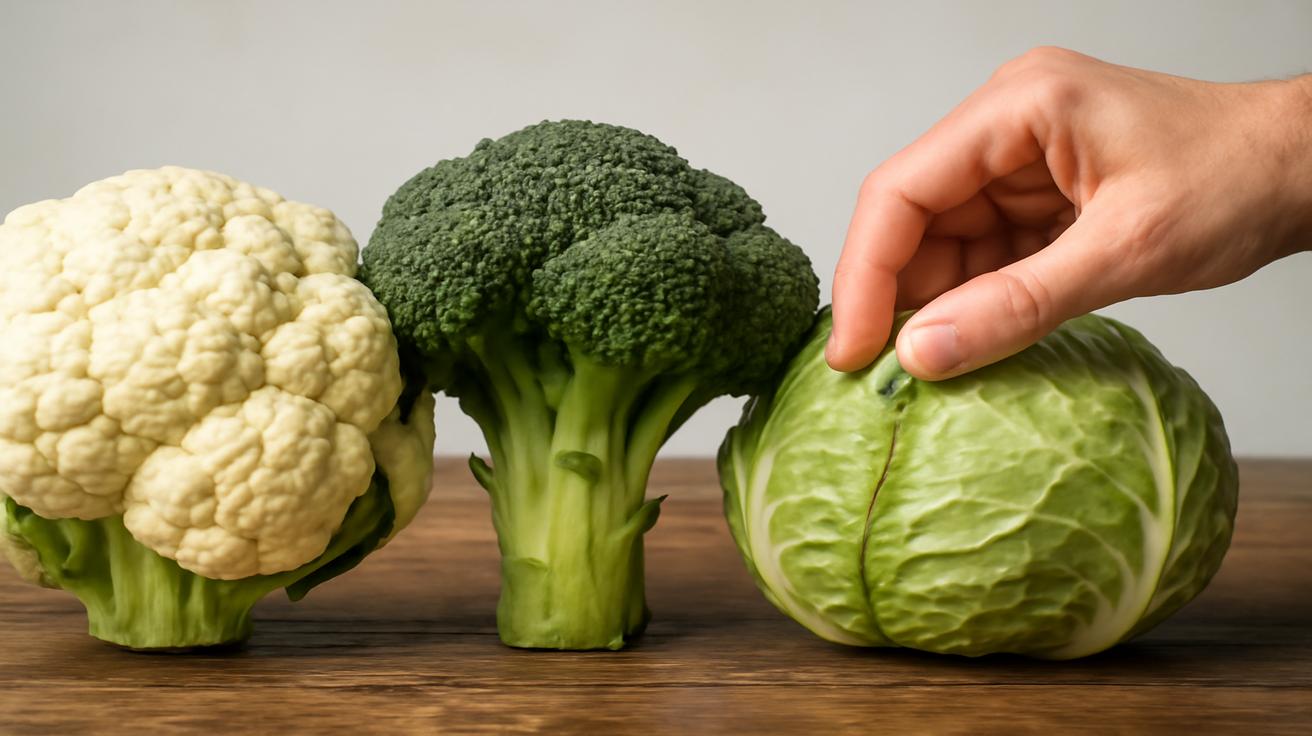
The woman in the farmers’ market stall doesn’t hesitate for a second. “I’ll take broccoli, but not cauliflower,” she says, wrinkling her nose at the pale, bumpy heads on the crate. “And no cabbage, please. Too boring.” The farmer, a sunburned man with earth still under his nails, just smiles and starts filling her bag. He doesn’t correct her. Maybe he’s done it too many times before. Maybe he’s tired of telling people that the broccoli, the cauliflower, the neat green cannonballs of cabbage stacked beside them are, in a very real sense, the same creature wearing different costumes.
Many people never hear this strange little truth: cauliflower, broccoli, cabbage, kale, Brussels sprouts, and even kohlrabi are all versions of one species—Brassica oleracea. To stand in front of a produce aisle and imagine that the tight cabbage head and the branching broccoli floret share a genetic core is like being told your goldfish, your Great Dane, and a wolf are all close cousins. Your eyes insist they’re different. The plant quietly insists otherwise.
A Wild Plant on a Windy Cliff
If you could go back far enough, before supermarkets and seed catalogs, you’d find the ancestor of all these vegetables clinging to harsh, salt-sprayed cliffs along the Atlantic coast of Europe. It wouldn’t look like a neat garden plant. It would look like a scruffy survivor. Tough, waxy leaves. A squat, unassuming stalk. Nothing like a tight cabbage or a branching broccoli head. Just wild cabbage—scraggly, resilient, and unremarkable to anyone except a hungry traveler with a cooking pot.
Imagine the wind there: sharp and insistent, pushing at your coat, tugging your hair sideways, rattling the plants until they bow in submission. Wild cabbage thrives in that kind of place, its thick, bluish leaves coated with a waxy bloom that sheds salt spray and wind alike. It doesn’t need rich soil or gentle weather. It simply needs a foothold and a little light. It is not glamorous. It is not delicate. It is the kind of plant that doesn’t apologize for existing.
Early people along those coasts didn’t have the luxury of ignoring a plant that stayed green when other things withered. They chewed on those leaves, maybe grimacing at the bitterness at first, and soon enough they noticed: some plants had sweeter leaves, some thicker stems, some larger flower buds. And with that simple observation, a slow, world-changing experiment began—one that would eventually give us the brassica parade marching through our kitchens today.
The Quiet Magic of Selective Breeding
There’s a kind of understated romance in the way humans and plants evolve together, not through sudden drama but through countless small choices. A farmer in a stone-age village, watching her small patch of wild cabbage, saves seeds from the plants whose leaves are thick and tender. Her children do the same, and their children after them. Generations of hands moving through the same patch of ground, choosing, favoring, encouraging.
Selective breeding is, at its heart, a simple conversation between human desire and plant possibility. You take seeds from the individuals that have the traits you like, and you plant them. Repeat that process for hundreds of years, and the plant will start to lean hard in the direction you’ve been gently pushing.
With Brassica oleracea, we didn’t settle for just one direction. We pulled in many directions at once—toward leaves, stems, buds, flowers. From one wild, scraggly ancestor, we coaxed an entire cast of characters.
| Vegetable | Plant Part Emphasized | Key Trait Selected |
|---|---|---|
| Cabbage | Leaves | Tight, layered head of tender leaves |
| Broccoli | Flower buds & stems | Large clusters of unopened flower buds |
| Cauliflower | Flower structure | Dense, compact “curd” of aborted flower buds |
| Kale | Leaves | Large, open, often curly foliage |
| Brussels sprouts | Lateral buds | Multiple mini cabbage heads along the stem |
| Kohlrabi | Stem | Swollen, bulb-like stem base |
To look at that table is to see a family tree where every cousin has been shaped by a slightly different wish: “What if this part were bigger? Sweeter? Denser?” It’s less like creating new species and more like sculpting different statues from the same block of stone.
Broccoli: Forest of Frozen Blossoms
Pick up a head of broccoli and look at it a little too long, the way you might study a seashell or an unfamiliar insect. The thick, pale green stalk rises and splits into smaller stems, each tipped with a mass of tiny beads. Those beads are tightly packed flower buds—baby blossoms that have been arrested mid-dream. If you let a broccoli plant keep going in the garden, it will prove this to you: its compact green domes loosen, stretch, and burst into showers of yellow flowers that tremble with bees.
Broccoli is what happens when people fall in love with flower buds and refuse to let the plant move on to the next stage of its life cycle. Over centuries, farmers favored the cabbages whose flower clusters were larger, denser, and more satisfying to eat. The plant obliged. It poured more of its energy into those immature flowers, making them thick and meaty. When you bite into a steamed broccoli floret, you’re crunching down on a whole bouquet that never quite got the chance to open.
There’s a sensual pleasure to broccoli that’s easy to overlook if you only ever meet it boiled into a limp green memory. Roasted, the florets puff slightly at the edges, crisping where the oil has kissed them. The stems, when peeled and sliced, are almost sweet, with a juicy crunch that feels more like biting into an apple than a leaf. Somewhere in there, beneath the caramelized edges and the garlic and lemon, you can sense the wild plant—the sturdy stalk, the urgent drive to flower—still humming inside this domesticated form.
Cauliflower: A Cloud Made of Fractals
Cauliflower is stranger still. Set one on your counter and really let yourself stare at it. It doesn’t look like a flower. Not exactly. It looks like someone compressed a whole universe of tiny, chalky domes into one dense, startlingly tidy mass. Running your fingers across it, you feel the firm give of the curd, the oddly velvety surface. Cut into it, and it breaks along branching lines that mimic trees and river systems—fractal patterns repeating in miniature, over and over again.
Where broccoli is a pause button on the flower buds, cauliflower is more like a glitch. In botanical terms, it’s a “proliferation of the inflorescence meristem”: the part of the plant that should be organizing itself into a normal flower structure instead just keeps dividing and piling on more of itself, never quite committing to full blossom. Humans saw this botanical mistake and thought, Yes. That. More of that.
So we bred for curds that were denser, whiter, more cohesive. Farmers used the plant’s own outer leaves to shield the heads from sunlight, preserving that pale, almost luminous color. Green and purple and orange cauliflowers came later, each a new twist on the same core idea: an arrested bloom, looping back on itself, thick with potential.
On the plate, cauliflower is an actor of almost alarming range. Raw, it snaps and squeaks between your teeth, all clean, faintly nutty crunch. Roasted, its edges brown and curl, and suddenly it tastes like something much richer than it has any right to be, something buttered and toasted and faintly sweet. Puréed, it masquerades as cream. Riced, it imitates grain. It’s one plant part, endlessly reimagined, just as the species itself has been.
Cabbage: The Tight-Fisted Heart
Cabbage feels almost old-fashioned now, like a relative who still writes letters on paper and folds them carefully into envelopes. But hold a head of cabbage in your hands and there is a satisfying solidity to it, like a stone that somehow became plant. The outer leaves are tougher, sometimes rattling with a faint papery sound when you thumb them. Peel them away and the head reveals itself: layer upon tighter layer of leaves wrapped around a pale inner core, all the plant’s energy folded inward.
Cabbage is what Brassica oleracea becomes when generations of humans fall in love with leaves and with density. When early farmers saved seeds from plants whose leaves formed tighter rosettes, whose centers started to close in on themselves, they were quietly rewriting the plant’s architecture. Instead of reaching outward, the plant’s growth tipped inward, spiraling into a compact heart that stores well and slices into ribbons of green crunch.
There’s an intimacy to cutting into a cabbage. The knife moves through the first layers with some resistance, then slides more easily as you enter the paler, more tender heart. There, the leaf ribs are crisp but not tough; the scent that rises is sharp, green, faintly sulfurous. Cook it gently and you coax out sweetness. Ferment it with salt and time and it transforms again, taking on a lactic tang that echoes back to coastal caves lined with clay jars, to winter cellars where people reached for something still alive in the dead of January.
Same Plant, Different Personalities
This is the part that startles people most: you can walk through a garden where cabbage, broccoli, and cauliflower are all growing, and if you catch them at the right stage, they look uncannily alike. Same bluish-green leaves, broad and waxy. Same sturdy stems. The differences that loom so large in the grocery store—this one tight and round, that one branching, the other bumpy and pale—begin to feel like variations on a theme instead of entirely different songs.
Their shared origin shows up elsewhere, too. That almost peppery edge when you bite into a raw brassica? It’s from compounds called glucosinolates, part of the plant’s defense system. When damaged—say, by your chopping knife—they break apart into pungent molecules that smell a bit like mustard or horseradish. Same chemistry, different intensities, different balances, depending on whether you’re dealing with a cabbage leaf or a broccoli stem or a cauliflower floret.
Once you know they’re all Brassica oleracea, your kitchen starts to feel like a small laboratory of applied evolution. You begin to notice family resemblances in the way they cook: how each one responds to heat by softening and sweetening, how each can flip from delicious to overcooked sulfur bomb if pushed too far. You see how roasting brings out their shared earthiness, how vinegar and lemon seem to flatter them all.
The Human Imagination in a Grocery Aisle
Stand in front of the cruciferous section of a supermarket now and it’s easy to feel you’re looking at a quiet gallery of human imagination carved in plant form. We don’t tend to think of farmers as artists, but what else would you call the slow crafting of a cauliflower curd, the coaxing of dozens of miniature cabbages along a Brussels sprout stalk?
From a distance, the display is simply color and shape: the glossy dark green of kale leaves, the pale moon of a cauliflower, the forested dome of broccoli, the round solidity of cabbage. Up close, each tells a story about what people in different times and places wanted from their land and their plants. In regions where winter was long and harsh, a tight cabbage head that stored well could be the difference between thin soup and something substantial. In places where fresh eating was prized, tender florets and fast-cooking greens took precedence.
Even now, we’re still at it, still nudging Brassica oleracea into new forms. Broccolini, Romanesco, rainbow cauliflowers—these are just the latest chapter in an ongoing collaboration. Romanesco in particular, with its neon-green, spiraling towers of perfect fractals, feels like nature and mathematics and human curiosity all got together and decided to show off.
A Different Way to See What’s on Your Plate
Knowing that cauliflower, broccoli, and cabbage are all varieties of the same plant adds an almost secret layer to everyday meals. The next time there’s a sheet pan of roasted cauliflower on your table, you can imagine its cousins out there in the field—cabbage heads tightening, broccoli florets swelling, all growing from the same ancestral blueprint.
It can also change how you cook. If they’re all variations of one plant, why not treat them like interchangeable puzzle pieces sometimes? Shred broccoli stems into a slaw with cabbage. Roast cauliflower and Brussels sprouts together and see how their shared sweetness plays off each other. Use cabbage leaves where you might once have reached for kale, or toss cauliflower leaves and stems into the pan instead of throwing them away, recognizing them as simply another part of an old friend.
There’s something humbling in this, too. So often we divide the world into neat categories—this plant, that plant; this vegetable, that one—as if nature itself came pre-labeled. But here is one species quietly wearing a dozen disguises, reminding us that our boundaries are often just stories we tell ourselves. Underneath, the living world is messier, more fluid, more inventive than our tidy labels allow.
Listening to the Plant Behind the Produce
If you have the chance to grow any of these in a garden, the “same plant, different variety” idea stops being an odd fact and becomes a daily, physical experience. You tuck seeds into soil: one packet labeled “cabbage,” one “broccoli,” one “cauliflower.” A week later, their seedlings emerge, and you’d be hard-pressed to tell them apart. As they grow, those familiar blue-green leaves spread out, waxy and strong. Only as weeks pass does each plant slowly reveal its specialization: a ball forming tight and secretive at the center, a branching crown rising, or a pale, hidden mass swelling under a hood of leaves.
In those weeks, you learn the shared language of brassicas. You learn the smell of their crushed leaves, that unmistakable spicy-green scent. You learn how cabbage moths find them with eerie precision, how flea beetles stipple their leaves, how rain beads and rolls off their surfaces. You see how quickly broccoli bolts in sudden heat, how cabbage splits if it gets too much water too fast, how cauliflower can surprise you overnight, suddenly ready, suddenly perfect, suddenly demanding to be cut.
And when you harvest them—when your knife slides through a cabbage core or under a cauliflower head or below a broccoli crown—you feel, for a moment, that you’re not just growing vegetables. You’re participating in an old, ongoing conversation with a single species that has, over millennia, been willing to become so many things for us.
Frequently Asked Questions
Are cauliflower, broccoli, and cabbage really the same species?
Yes. Cauliflower, broccoli, cabbage, kale, Brussels sprouts, and kohlrabi are all cultivated varieties of one species: Brassica oleracea. They differ because humans selectively bred them for specific traits over many generations.
If they’re the same species, why do they look so different?
Selective breeding focused on different plant parts. Cabbage was bred for tight leafy heads, broccoli for large flower buds and thick stems, and cauliflower for its dense, abnormal flower structure (the curd). Over time, these traits became very pronounced, creating distinct-looking vegetables.
Do they taste similar because they’re related?
They share a family resemblance in flavor—especially that slightly mustardy, peppery note—because they contain similar sulfur-rich compounds. But differences in sugar levels, fiber, and specific aroma compounds make their flavors and textures distinct.
Can they cross-pollinate with each other in the garden?
Yes. Because they’re the same species, different varieties of Brassica oleracea can cross-pollinate if they flower at the same time and are grown close together. The resulting seeds may produce plants with mixed traits.
Are the leaves and stems of broccoli and cauliflower edible like cabbage?
They are. Broccoli stems are tender and sweet when peeled, and cauliflower leaves and outer stems can be cooked much like cabbage or kale. All are simply different expressions of the same plant’s leaves and stems.
Why do some people dislike the smell when these vegetables are cooked?
Overcooking releases sulfur compounds that can smell strong or unpleasant. Gentle cooking—like quick sautéing, steaming until just tender, or roasting—keeps their flavors sweeter and their aroma milder.
Is one of them healthier than the others?
All three—broccoli, cauliflower, and cabbage—are nutrient-dense, providing fiber, vitamin C, vitamin K, and beneficial plant compounds. Broccoli tends to be especially high in certain antioxidants, but they each offer a slightly different nutritional profile and are all excellent additions to a varied diet.







Leave a Comment