
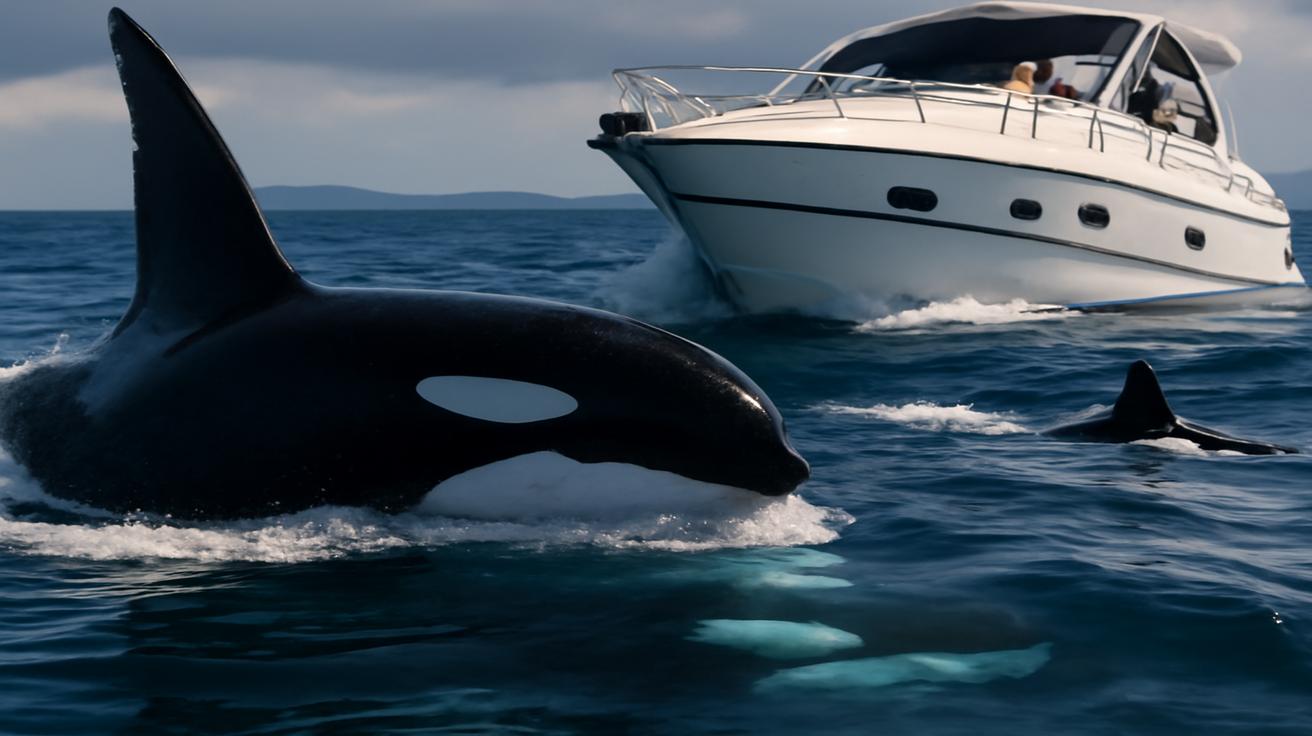
The first impact sounded like a freight train hitting the side of the world.
Stainless-steel coffee mugs rattled in their holders. The wine glasses—stemless, crystal, imported—leapt and chimed against each other in the galley. Above deck, under a sky the color of polished aluminum, the 60-foot yacht shuddered as if some giant hand had reached from the deep and given it a contemptuous shove.
“What the hell was that?” someone shouted.
They all knew, even before the second hit came. By now, everybody who sails these waters knows. The captain dropped his sunglasses to get a clearer look at the dark water off the stern. A shadow slid beneath the surface, impossibly smooth, impossibly fast. Then another. Black and white, unmistakable. Orcas.
There was a clatter of feet on teak. A phone rose, already recording. Another thud—this time lower, booming through the hull like the heart of the ocean itself, followed by a sharp crack somewhere deep inside the yacht’s expensive bones.
“They’re ramming us,” someone said, half-disbelieving, half-thrilled.
Not everyone was thrilled. The owner, hair blown back by the sharp Atlantic wind, watched the navigation instruments flicker, listened to the unfamiliar groans of fiberglass and carbon fiber under strain, and felt his throat tighten. This boat cost more than most houses in the nearby fishing town. It was supposed to be freedom, prestige, sanctuary. Lately, it felt like a target.
Another impact. This time, people grabbed railings. Someone screamed. Somewhere behind the fear there was also wonder—because the orcas moved with a deliberate intention that felt uncomfortably like strategy.
When the Sea Fights Back
Out here, off the coasts of Spain and Portugal, and in pockets of the Mediterranean and Northeast Atlantic, the story repeats in different variations: a sleek hull, a confident crew, and a pod of orcas that seem to have added “ram a yacht” to their list of daily activities. Sometimes they snap rudders clean off. Sometimes they circle and bump for an hour, ignoring shouted pleas and blaring horns. Occasionally, boats are left drifting, injured and helpless, broadcasting emergency calls as the orcas melt back into the swell.
“They’re doing it on purpose,” people say, and the sentence hangs in the salty air a little too long.
Marine biologists, cautious by profession, prefer the quieter word: behavior. A new behavior, spreading among a subset of orcas like a strange fashion or a dangerous game. Perhaps it began with one injured matriarch, they say—maybe struck by a vessel—and spread through imitation. Perhaps it’s novel play. Perhaps it’s stress. Perhaps it’s something we don’t even have language for yet.
What’s not in doubt is that these encounters have changed how it feels to be rich and floating above the deep. For years, yacht marketing promised transcendence: escape from the crowded coasts, from traffic, from politics, from the messy problems of life on land. But the ocean has problems of its own, and they are arriving—sometimes at 25 knots, nose-first, aimed straight at the rudder.
On shore, two truths rub up against each other like tectonic plates. Yacht owners are furious, afraid, and counting the costs. Coastal communities—fishers, ferry crews, harbor workers—watch with a mix of concern, resignation, and, just below the surface, something that looks suspiciously like “Now you know how it feels.”
The Price of Being Rammed
Talk to a luxury yacht owner or captain who’s lived through an orca encounter, and you’ll hear the same vocabulary of shock. They use words like “attack,” “terror,” “siege.” The sound of an orca’s skull slamming into a rudder blade is not something you forget easily. Nor is the sight of your steering wheel spinning uselessly as the boat veers with the whims of the swell.
There are insurance claims, surveyor reports, shipyard estimates. A high-end composite rudder can cost tens of thousands of euros to repair or replace. Factor in tow fees, lost charter revenue, hotel stays for guests who’d paid to sleep under the stars, and the numbers climb quickly. Some owners quietly reroute their summer plans altogether, skipping known orca hotspots for safer—but often less appealing—waters.
Yet the most corrosive cost is psychological. Pleasure boating depends heavily on an illusion: that money and technology can insulate you from the unpredictable moods of wind, tide, and creature. You buy the best radar, the best hull form, the best insurance. You hire a captain with 20 years at sea. You expect control. When a 5,000-kilogram orca decides otherwise, control feels suddenly fictional.
Skippers share grainy videos in tight-knit online groups: dorsal fins cutting the surface like black scythes; glossy backs rolling, white eye patches gleaming; the sudden shudder and roar as another head-on collision shakes aluminum ladders and stainless rails. Beneath the fear, there’s outrage—a sense that the rules have been broken.
“We’re just passing through,” one owner insists over coffee in a harbor café, the wake of fishing boats slapping the pilings outside. “We respect the ocean. We obey the speed limits. And we’re the ones getting punished?”
The word “punished” is doing a lot of work in that sentence. It implies intent, judgment, maybe even revenge. It imagines the orcas not as animals in a fluctuating environment, but as conscious agents with a grievance. That’s a leap, scientifically. It’s also a deeply human way of framing a story—especially when you’re the one holding the repair bill.
“Live With It”: The Authorities’ Line in the Sand
On harbor notice boards and in official bulletins, the tone is very different. Short, clipped sentences advise boaters to reduce speed if orcas appear, to avoid sudden course changes, to shut down engines if safe. Do not, they repeat, attempt to scare, chase, or injure the animals. Do not drop fireworks or flares. Do not strike them with poles. Do not treat this like a war you can win.
In meetings and press conferences, marine authorities sound weary. They’ve fielded the calls: shaken skippers, angry owners, marine tourism companies watching their bookings wobble. They’ve studied the damage reports, plotted the sightings on digital charts, invited scientists to explain, again and again, how protected status works and why lethal responses are off the table.
Publicly, their message condenses into something that infuriates many yacht owners: you’re going to have to live with it.
Not in the flippant way it sometimes gets quoted in the tabloids, but in a sobering, ecological sense. These are protected apex predators in their home territory. Their populations are fragile, their lifespans long, their social structures intricate. No one wants to be the country that responds to strange new behavior from a vulnerable species by reaching for the harpoon.
Behind closed doors, officials worry about escalation—from both sides. There are already whispered stories of crews keeping heavy tools close at hand, of “accidental” blows from boat hooks, of engines revved aggressively when an orca gets too close. Retaliation, even small-scale, risks injury, death, and nearly inevitable public backlash. One dead orca photographed with propeller wounds could ignite an international firestorm.
So the law holds: do not harm them. Adapt. Wait. Study. Hope the behavior evolves into something less destructive—like the time a group of orcas in the Pacific got briefly obsessed with wearing dead salmon on their heads like hats and then moved on.
Of course, hoping orcas “get bored” is not much comfort to someone watching their million-euro yacht drift rudderless toward a rocky shoreline.
A Sea Divided: Luxury Hulls and Working Boats
In the small towns along these coasts, in bars that smell of diesel and fried fish, the conversation sounds different again.
“Now they’re worried,” a fisherman says, leaning back on a plastic chair, hands still faintly smelling of bait. He nods toward a sleek white yacht tied up two slips away, her chrome fittings gleaming. “They didn’t care when the dolphins disappeared from our bay. They didn’t care when we said the tuna went deeper. But now the orcas touch their toys…” He shrugs, a gesture part bitterness, part weary amusement.
The working relationship between coastal communities and wealthy yacht owners has always been complicated. There’s money, of course: marinas, provisioning, repairs, restaurants. Some villages now depend heavily on the seasonal migration of floating luxury. Yet there’s also resentment—about rising dock fees, waterfront bars priced beyond locals’ reach, shorelines reshaped not for those who fish, but for those who cruise.
Orcas, crashing headlong into composite rudders, have become unlikely symbols in this tension. For some coastal residents, they represent the ocean’s refusal to stay picturesque and compliant. A reminder that sea is not scenery; it’s system, power, risk.
Still, fishermen are not cheering from the breakwaters. Many of them know orcas as competitors and companions. They’ve watched pods cruise along the edge of their nets, clever eyes tracking every move. Some have lost catches when a pod learned exactly when and where the fish would appear. Others swear they’ve seen orcas gently escort lost calves back to their mothers, or linger, circling, when a boat was in trouble.
“They’re not saints,” a retired trawler captain says. “They’re hunters. Smart hunters. If you’ve been cutting up the ocean for years, they’re going to notice. Maybe this is just them… reacting.” He spreads his hands. The word hangs between us: reacting. Not plotting. Not revolting. But not passive either.
What We Think We Know About Orca “Attacks”
Science, moving slower than headlines, is trying to keep up. Researchers track individual orcas by the nicks on their dorsal fins and the unique white patches at their tails. In some of these boat-ramming hotspots, a specific subgroup—often led by a few known individuals—seems to be driving the trend.
They catalog behaviors: an orca approaching quietly from behind, tilting sideways as if to examine the spinning propeller; another lifting a rudder with its head like a careless child flipping a toy; coordinated pushes that feel remarkably like teamwork. The language in the scientific papers remains careful, but between the lines, you can sense the astonishment.
We already knew that orcas share culture. Different pods have different dialects, hunting techniques, even preferences for certain prey. Off the coast of Patagonia, they surge onto beaches to grab seals. In other regions, they herd fish into tight balls with shocking precision. They learn from each other. They teach their young. Sometimes they innovate in ways no one expects.
This is where the neat lines we draw between “wildlife” and “us” blur. We like to imagine that we observe nature from outside, as tourists in someone else’s drama. Orcas ramming boats disrupt that fantasy. They notice us. They interact in ways that feel unnervingly pointed. Not random collision, not indifferent passing, but focused engagement with the very technology that lets us roam their world.
Are they angry? Avenging some injury, some trauma? Maybe. Maybe not. Maybe frustration and curiosity and learned behavior are colliding in ways we can’t yet parse. Maybe what feels like a moral confrontation is just a new pattern in a changing sea.
But on board a shuddering yacht, high-minded nuance is hard to maintain. The brain rushes toward old, primal scripts: threat, attack, enemy. That’s how conflicts—between nations, between neighbors, between species—so often begin.
Who Owns the Water, Really?
Strip away the fiberglass and the fur of marine law, and you find an older question: who gets to claim space in the sea?
Luxury yachts arrive with charts, permits, and the implicit authority of money. They fly flags of nations, follow corridors, pay marina fees that sometimes exceed local monthly wages. They embody a human conviction: that if you can afford a vessel, the water it rests upon becomes, in some diffuse way, yours to enjoy.
Orcas do not recognize boating regulations or seasonal cruising guides. Their routes are carved into ancestral memory, etched by the movement of currents and prey. The underwater canyons where yachts now linger for sunset cocktails may also be the corridors where orcas have hunted for generations.
When a pod slams into a hull, it exposes a quiet arrogance at the heart of marine recreation: the unspoken assumption that non-human life will accommodate itself to our desires. That whales will breach at a safe, photogenic distance. That dolphins will race our bow waves but never collide. That sharks will glide beneath us, fearsome but far enough away to remain abstract.
The orcas, it seems, have not read the script.
In the face of this, the authorities’ call to “live with it” is more radical than it sounds. It asks a group used to customizing their environment—to setting temperature, playlist, destination—to accept an element they cannot control. To acknowledge that, for all their wealth and varnished teak, they are guests where others are native.
Some yacht owners quietly accept this. They adjust their routes, travel in convoy when possible, learn to read the shifting reports: pods spotted here at dawn, there at dusk. They talk in low, fascinated voices about “my orca incident,” turning fear into story, story into identity.
Others bristle. In their frustration, a few drift toward fantasies of culling, relocating, disciplining the creatures that have damaged what they worked so hard to acquire. Those fantasies hit a wall of biology, ethics, and public opinion, but they still reveal something about how we rank our priorities when human convenience collides with wild autonomy.
Learning to Sail in a Stranger Sea
Stand on the deck of a yacht at dusk after an orca encounter, and the ocean feels different. The light goes soft and gray; the wind carries a tang of diesel and salt. Somewhere, deep below, the pod moves on—maybe uninterested, maybe satisfied, maybe simply drawn onward by hunger and habit.
Up here, people whisper. They replay the hits, the way the boat lurched off course, the eerie intelligence in the orcas’ timing. They exaggerate—because that’s what we do with fear—and then downplay, because no one wants to admit how helpless they felt.
But in the hours afterward, something else often settles in: a recognition that this is what wildness looks like when it’s not framed in a documentary or a glossy calendar. Wildness is inconvenient. Unnerving. Indifferent to our timetables and insurance policies. Occasionally, it’s destructive.
The question is not whether we can eliminate that wildness—we can’t, not without losing something essential—but how we choose to live alongside it. How we share water with animals smart enough to recognize our machines, and bold enough to test them.
For coastal communities, this isn’t an abstract philosophical exercise. It’s daily life. The sea takes and gives, wrecks and feeds. Fishers mend nets after storms, recalibrate routes when currents shift, accept risk as part of the only home they’ve ever really known. In their eyes, pleasure boaters are just now discovering a truth that’s always been obvious: the ocean does not care what you paid to be here.
That doesn’t mean your fear is silly, or your boat expendable. It means you’ve been invited—aggressively, perhaps violently—into a more honest relationship with the water.
| Perspective | Main Concern | Typical Response |
|---|---|---|
| Luxury yacht owners | Safety, financial loss, disruption of leisure and charter plans | Calls for stronger protections, route changes, and sometimes more aggressive deterrents |
| Marine authorities | Species protection, legal obligations, public safety, avoiding escalation | Guidelines to coexist, speed limits, monitoring, research support |
| Coastal communities | Economic stability, traditional livelihoods, fair use of coastal waters | Mixed feelings: concern for safety, some empathy for orcas, skepticism toward luxury complaints |
| Orcas | Unknown: possibly play, stress, learned behavior linked to vessels | Targeted interactions with rudders and hulls, spreading socially within pods |
Somewhere between rage and resignation lies a fragile middle ground: acknowledgment. A captain watches the horizon a little more closely. A harbor installs clearer information boards. A charter company briefs guests not just on life vests and champagne, but on what to do if a black fin slices the surface beside them.
And in the quiet after the last wave of panic recedes, someone on deck might look out at the steel-blue water and, just for a moment, feel something strange threading through the fear: not dominance, not ownership, but a raw, humming awareness of being one vulnerable body among many in a vast, contested space.
The sea was never ours alone. The orcas are making sure we remember.
Frequently Asked Questions
Are orcas intentionally attacking yachts?
We don’t know their intentions in a human sense. What we do know is that some orcas are repeatedly targeting rudders and hulls in specific regions. Scientists describe this as a new behavior that may be linked to play, stress, or learned responses—possibly starting with one influential individual and spreading socially within the pod.
Is it dangerous for people on board?
So far, most incidents have damaged boats rather than people. The main risks are loss of steering, collision with other vessels or shore, and panic on board. Authorities advise wearing life jackets, staying calm, and calling for assistance if steering or propulsion is lost.
Why don’t authorities remove or harm the orcas?
Orcas are protected marine mammals. Their populations are relatively small and vulnerable, and many countries have strict laws preventing harm. Beyond ethics, any lethal response would likely trigger major public and scientific backlash and could destabilize local ecosystems.
What can yacht owners do to reduce the risk?
Recommendations include avoiding known hotspot areas when possible, reducing speed if orcas are sighted, not attempting to outrun or harass them, and following the latest guidance from local marine authorities. Some skippers travel in company and keep emergency tow options in mind.
How do coastal communities feel about this conflict?
Feelings are mixed. Many locals worry about safety and economic impacts on tourism, but there is also frustration at how quickly luxury concerns dominate headlines compared to long-standing issues like overfishing or habitat loss. For some, orca encounters highlight long-ignored tensions over who the coastal waters are really for.






Leave a Comment