
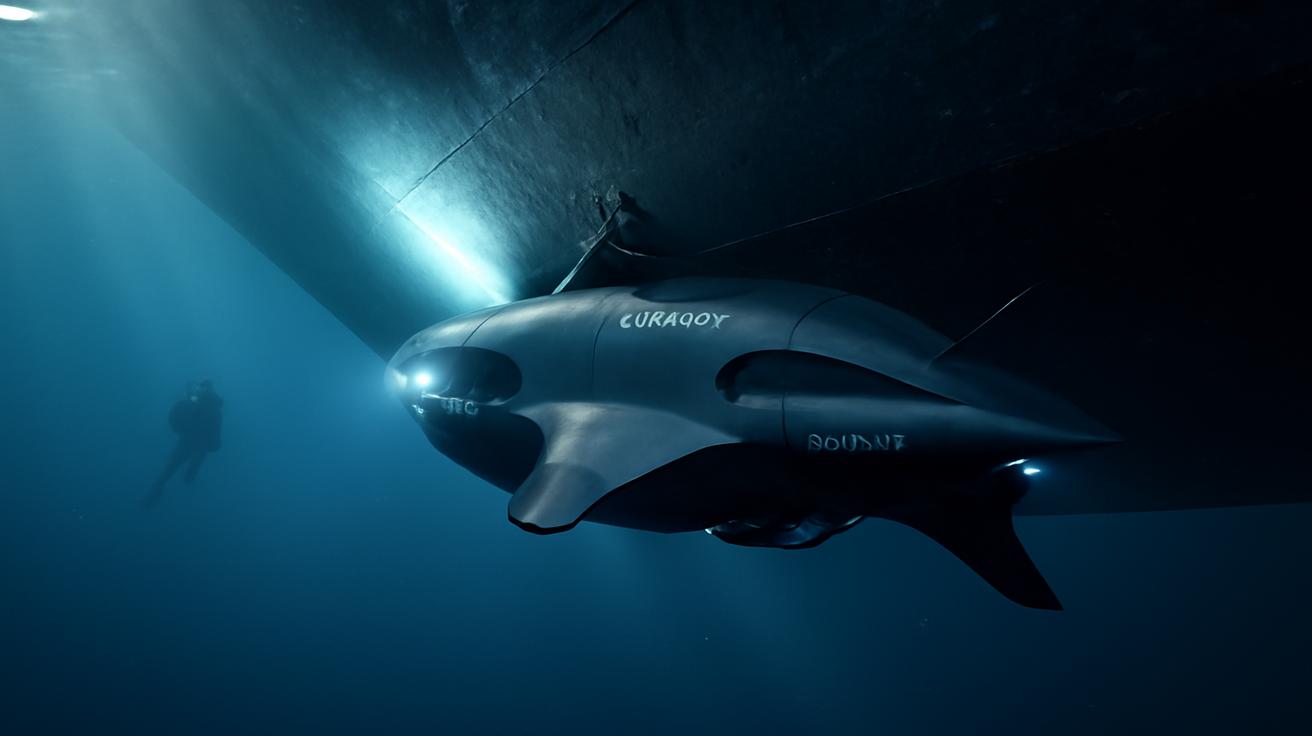
The ocean at night looks calm from the shore—a black mirror, a hush of waves, a slow breathing in the dark. But a few miles out, beneath that sleek surface, something new is learning how to move like a creature and think like a machine. It isn’t a fish, though it glides as quietly as one. It isn’t a submarine, though it can cling to a hull like a barnacle. It is called Lamprey, and Lockheed Martin has just pulled back the curtain on this unsettlingly organic underwater drone that can slip through the sea, latch onto ships, and vanish into the deep again without leaving more than a shiver on the sonar.
A machine named after a mouth full of teeth
Somewhere in a chilly test basin, under white industrial lights, the Lamprey sits on a crane hook, dripping. It doesn’t look quite like the sharp-edged submarines of Cold War movies. It looks…sleeker. Softer, almost. The engineers named it after the lamprey eel—those pale, jawless fish that cling to larger animals with a ring of teeth and quietly feed, a living reminder that the ocean doesn’t always play fair.
The real lamprey moves with a slow, coiling precision. It senses tiny electrical fields, locks on, and holds fast to its host. Lockheed’s Lamprey borrows the metaphor more than the biology, but the echoes are intentional. This is an underwater vehicle designed to approach ships, attach to their hulls, and ride along or work in secret. No big splash, no flurry of bubbles, no obvious trail. Just a quiet meeting of steel on steel, hidden under layers of saltwater and noise.
For sailors topside, the sea is a surface—weather, waves, the color of the sky reflected back. For an underwater drone like Lamprey, the sea is architecture. It is currents and thermoclines, pressure gradients and sound corridors. It must read this invisible landscape, navigate it, and then do something wholly unnatural to most ocean life: cling, precisely and deliberately, to a moving ship.
How do you teach a robot to cling to a ship?
Imagine a vessel the size of a city block moving through a chilly gray sea. Its hull pushes water aside in a complex pattern of vortices and turbulence, throwing off noise, wake, and cavitation. Now imagine trying to steer a compact, unmanned vehicle into that chaos—and then asking it to hold on.
The Lamprey’s body, from what Lockheed has revealed, seems designed with this brutal fluid dynamics problem in mind. It likely carries a blend of thrusters and control surfaces that can pivot and trim, letting the drone sidestep eddies and ride pressure waves like a surfer hunting for the cleanest line. In the final seconds of approach, it must match the ship’s speed, stabilize itself against the hull, and extend a mechanism that locks it in place.
We’re used to thinking of drones as airborne—whirring rotors, buzzing cameras, something you can hear coming. Underwater, everything changes. Sound carries far, light dies quickly, and water presses in from every side. So Lamprey leans into stealth by default: quiet propulsion, streamlined design, and an operating depth that hides it from casual detection. It may use sonar sparingly, relying as much as possible on passive listening, mapping the acoustic “fingerprint” of its target ship long before it makes contact.
Then there’s the gripping itself, the act that gives Lamprey its name. No one outside the labs will see the exact engineering for now, but the possibilities are evocative: magnetic pads locking onto the hull, vacuum or suction-based clamps, or some hybrid that can adapt to different surfaces. However it works, the connection must be strong enough to survive a swell or a sharp maneuver, but subtle enough not to announce itself to the crew or rattle the hull like an unwelcome guest.
The quiet mathematics of attachment
Inside the Lamprey’s core is a brain tuned not to poetry, but to probability. It has to model how the water will buffet it, how the ship might turn, how its own energy reserves will drain if it hangs on too long. Each approach is a gamble: Does it close in now while the sea is calm, or wait, knowing that another vessel, another chance, might never appear?
If you could see its decision tree, it might read like a strange form of marine intuition: If noise rises above this threshold, retreat. If hull geometry looks like this, attach with these points first. If battery dips below that percentage, break away and return to base. Cool logic mapped onto the wild physics of the ocean.
Shadows, signals, and silent missions
Once attached, Lamprey is no longer a prowling hunter but a hitchhiker with a mission. The obvious uses are military: monitoring the vibrations of a ship’s engines, listening to onboard systems, watching for changes in course or speed. But even beyond spying, there’s a ghostly versatility to what an underwater drone can do when it’s pressed up close to the steel skin of a vessel.
It might inspect for cracks, corrosion, or signs of tampering. It could leave behind or retrieve sensor packages, like an underwater courier meeting a ship in transit. In theory, it could even use the hull as a shield to move through contested waters, sliding beneath the noise umbrella of the larger vessel like a fish sheltering under a whale.
Picture this: a merchant ship moving along a busy trade route at dawn. Container stacks loom overhead, seagulls wheel and dive. The captain watches radar, weather reports, port schedules. No one feels the small tug below the waterline as a compact, autonomous vehicle quietly lets go and sinks back into the darkness, its mission complete. The ship steams on, oblivious. Somewhere, far away, a screen lights up with the data Lamprey brought home.
Potential uses beyond the battlefield
It’s easy—almost automatic—to imagine an underwater drone as a tool solely for conflict. But the ocean doesn’t belong only to navies, and the same capabilities that make Lamprey intriguing for military planners could, in time, be repurposed for more peaceful work.
Attaching to ships could let drones conduct real-time structural health checks on critical vessels—tankers, ferries, research ships—without sending human divers into often dangerous, murky environments. They could monitor invasive species hitchhiking on hulls in the form of biofouling, scanning for organisms that don’t belong and tracking how they spread from one port to another.
Imagine a future in which fleets of Lamprey-like drones quietly patrol busy shipping lanes, not to threaten, but to study: measuring noise pollution, sampling water quality in the ship’s wake, mapping the pressure waves and turbulence each hull leaves behind. Each mission would begin in secrecy, but end in shared data that could help scientists understand and protect the stressed arteries of global trade.
The eerie intimacy of machines and whales
To understand how strange Lamprey really is, it helps to zoom out and listen—not to the echo of sonar, but to the long, bending songs of whales that share this underwater soundscape. They, too, read the sea by ear. They, too, follow invisible paths stitched together by currents and temperature and noise. Where a humpback sings across dozens of miles, a ship roars, and a drone like Lamprey must sneak through the overlapping thunder.
There is an eerie intimacy in imagining this encounter: a metal body, smooth and engineered, slipping past a living one whose species has evolved over tens of millions of years. Whales have already learned to navigate around shipping lanes, to adjust their calls to cut through the low-frequency roar of propellers. What will it mean when more and more of the ocean’s hidden life consists not of animals, but of machines that can lurk, listen, and cling?
We’ve already filled the airspace over cities with aircraft and satellites. Now, steadily, we are doing the same to the water. The Lamprey is not the first underwater drone, nor will it be the last. But its ability to attach—to form a temporary, secret relationship with passing ships—gives it an oddly biological flavor, a reminder that so much of the natural world’s brilliance comes from the simple trick of holding on.
Where nature ends and design begins
Engineers often talk about “bio-inspired design,” and Lamprey is a textbook example of that phrase given teeth. For millions of years, real lampreys and remoras and other hitchhiking creatures have turned bigger animals into transportation. They use suction, hooks, and adaptive muscles. They’ve learned how to ride without killing the host—at least not quickly.
Technologists watch these relationships and see opportunity. If a fish can cling to a shark without being scraped off in the first wild twist, surely a drone can be made to attach to an armored hull buffeted by heavy seas. Nature, unwillingly, becomes a tutor. But where animals evolved slowly, guided by the random walk of mutation and selection, machines like Lamprey are pushed rapidly into existence by budgets, doctrines, and the race to own the next layer of the ocean.
The ethics of unseen machines in shared seas
Strip away the technical wonder and a harder question surfaces: what does it mean to hide machines on the bodies of ships that cross shared waters? The sea, after all, is one of the last places on Earth where borders blur and shift with the tide. Fishing boats from one nation work alongside tankers from another, research vessels map seamounts no one owns.
With a system like Lamprey, the quiet becomes crowded with intentions. A ship passing through international waters may now carry hidden passengers, unnoticed even by its own crew. That fact alone could deepen mistrust on already tense sea lanes, where miscalculations have enormous consequences.
Environmentalists might ask a different question: every new machine introduced beneath the waves adds another thread of sound, another potential disturbance to animals that are already dodging nets, plastic, and climate-driven changes in their food. Will a drone attached to a hull make the vessel louder, more confusing to a pod of dolphins trying to interpret the underwater chaos? Or could such systems be designed to track and mitigate their own footprint—shutting down active sensors when whales are near, slipping into a quieter posture in sensitive habitats?
As Lamprey moves from prototype to deployment, the answers to those questions will matter as much as the specifications. The ocean has taught us, again and again, that there is no such thing as a perfectly concealed footprint in its depths. Oil sheens on the surface, submarine noise on hydrophones, plastic found in deep-sea trenches—what we put into the water echoes back to us, sooner or later.
Public imagination and private technology
Most of what Lamprey can and cannot do will remain behind closed doors and silent testing grounds. That is the nature of defense technology. But that doesn’t mean the public imagination will stay quiet. Filmmakers, novelists, and game designers are already fluent in the aesthetics of drones in the sky. Underwater, there is even more room to speculate, to build stories around machines that slip past sensors and latch onto the great metal whales of 21st-century trade.
The narratives we create about such devices will, in turn, influence how we see them in the real world: as necessary guardians, as invasive parasites, as tools that can either sharpen or soften our relationship with the sea. Somewhere between those extremes lies the truth: Lamprey is a tool born of human curiosity and fear, shaped by natural models, destined to swim in the same water that cradles plankton blooms and coral reefs.
A future written in bubbles and quiet wakes
If you were to dive, one moonless night, into a busy shipping lane, you’d first feel it before you saw it: the low, continuous tremor that big ships trail behind them like invisible tails. You’d see their hulls loom out of the dark, black silhouettes blotting out the faint light from the surface. Between those shadows, in the cold, green-black space, might move smaller shapes—unmanned, controlled from far away, or left to their own decision-making schemes.
The Lamprey is a signpost: a marker that we are stepping into an era where the sea is not just crossed but colonized by robotics. We have gliders that drift for months, profiling water temperature and salinity. We have small submersibles that map shipwrecks in high definition. Now we also have a machine built to intimately, almost invisibly, attach itself to the infrastructure that keeps our world moving.
What will the ocean feel like when these vehicles are no longer experimental, but ordinary? Maybe little will seem different at first, from a beach or a ferry deck. The sunset will still burn orange on the horizon. The tide will still drag foam back from the sand. But beneath, there will be new stories unfolding: sensors seeing where eyes cannot, data whispering to satellites, algorithms tracking the motion of steel and salt and life.
Like its namesake, the Lamprey occupies a strange moral gray zone—neither fully predator nor simple passenger. It is a reminder that our technology is growing more capable of weaving itself quietly into the fabric of the natural world. Whether that weaving becomes a patch to protect, a net that entangles, or a pattern we can live with will depend on choices made far from the waves, in meeting rooms and design labs that may never smell like saltwater.
But the ocean will respond, as it always does—not with arguments, but with consequences. Soundscapes will shift. Animal behavior will adjust. Shipping patterns will warp around new doctrines and old fears. And somewhere out there, a machine that borrowed its name from a ghostly fish will cling to a hull in the dark, waiting for its moment to let go and slip, unseen, back into the endless, listening sea.
At a glance: Lamprey’s emerging place in the underwater world
While the full specifications of Lockheed’s Lamprey are closely held, we can sketch its emerging role in our evolving relationship with the deep.
| Aspect | What It Represents |
|---|---|
| Design Inspiration | Bio-inspired robotics echoing lamprey eels and hitchhiking fish, optimized for stealth and attachment. |
| Core Capability | Autonomous approach and secure attachment to ship hulls for data collection, inspection, or covert tasks. |
| Likely Uses | Military surveillance, hull inspection, sensor delivery and retrieval, long-duration covert monitoring. |
| Civilian Potential | Maritime safety checks, environmental monitoring, tracking of hull biofouling and invasive species. |
| Key Questions | Impact on marine life, legal and ethical use in shared waters, long-term noise and ecological footprint. |
FAQ
Is Lamprey an actual living robot modeled exactly on the fish?
No. Lamprey is an unmanned underwater vehicle developed by Lockheed Martin. Its name and some of its design concepts are inspired by the lamprey eel’s ability to attach to other animals, but it is a conventional machine built from metals, composites, electronics, and software—not a living organism.
Can Lamprey damage the ships it attaches to?
The goal of a system like Lamprey is generally to remain undetected, which discourages overt damage to a hull that might alert a crew. Its attachment mechanisms are expected to be engineered to hold firmly without compromising structural integrity. However, specific capabilities and any offensive roles remain undisclosed.
Is this technology only for military use?
At present, Lamprey is primarily framed as a defense technology, designed for tasks such as surveillance, reconnaissance, and specialized naval missions. Yet many of the underlying capabilities—precision navigation, attachment, and inspection—have clear potential for civilian applications, from ship maintenance to environmental monitoring.
How does Lamprey navigate underwater without GPS?
Underwater vehicles typically rely on a mix of inertial navigation, acoustic positioning, sonar, and sometimes surface fixes to update their location. Lamprey likely combines these methods, along with onboard processing, to approach and attach to ships with high precision even in the absence of satellite signals.
Will underwater drones like Lamprey affect marine animals?
Any device introduced into the marine environment can have impacts, especially through noise and physical presence. The extent depends on how quietly it operates, how often it is deployed, and where it is used. Minimizing acoustic disturbance, avoiding sensitive habitats, and monitoring wildlife responses will be crucial if such systems become widespread.
Could Lamprey be used for ocean conservation work?
Yes, in principle. A Lamprey-style platform could carry sensors to monitor pollution, assess hull biofouling that spreads invasive species, or quietly gather data in remote marine protected areas. Whether that happens depends on how open the technology becomes beyond its defense origins and whether civilian and scientific partners gain access to similar tools.
Will ordinary ships know if a Lamprey has attached to them?
By design, a drone like Lamprey aims to be stealthy. Detection would depend on the ship’s sensors, the crew’s vigilance, and the specific mission profile. In many scenarios, especially covert ones, the intent is for the ship’s crew to remain unaware of the drone’s presence beneath the waterline.







Leave a Comment