
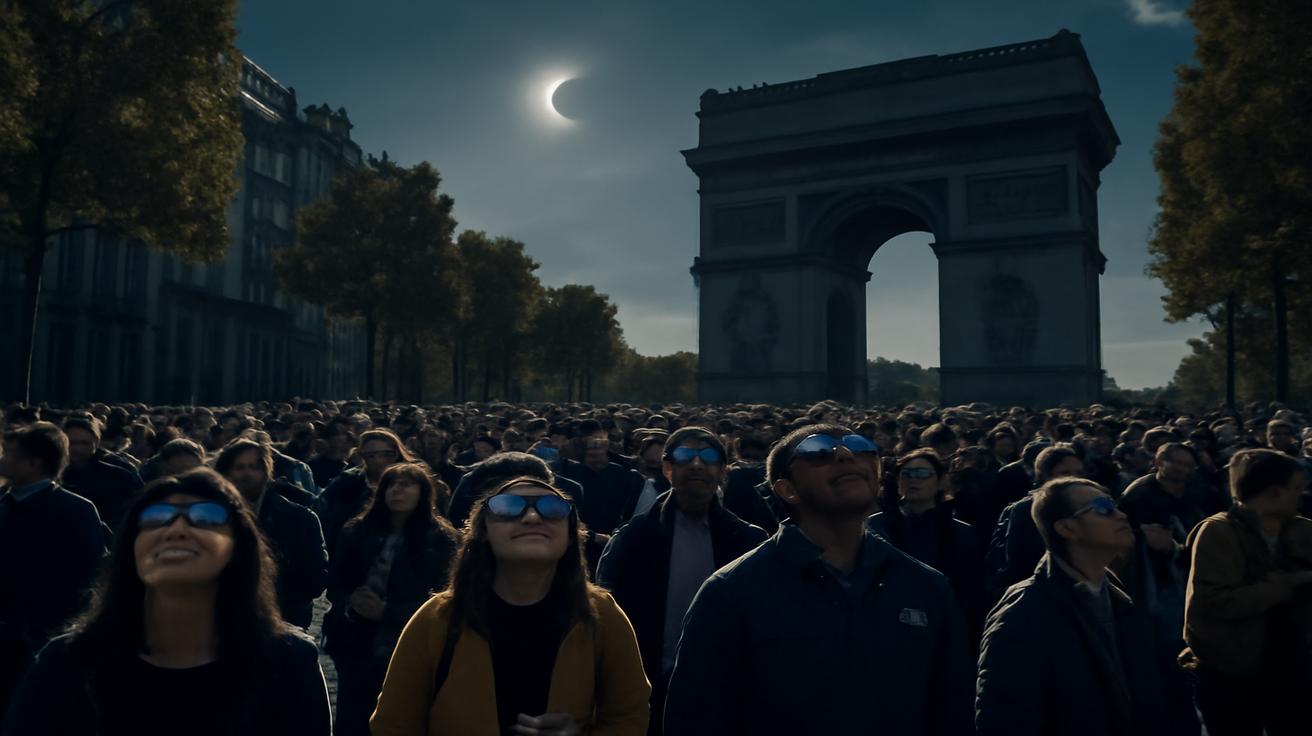
The warning came, fittingly, just as the sun slipped behind a ragged band of clouds over the city. A soft gray hush fell across the street, and for a brief, uncanny moment, the light went thin and strange. Phones buzzed with news notifications. Headlines shouted about the sky: Light will disappear for minutes. Experts warn an extraordinary solar eclipse is officially approaching. People looked up from their screens and out of their windows, as if they might already see the shadow coming. They couldn’t, not yet. But it’s on its way. And it’s closer than it feels.
The Day the Sun Steps Away
Imagine a day that starts like any other. The sun climbs, the air warms, traffic hums. Somewhere, a child is walking to school, holding a paper plate with a small, clumsy pinhole punched through it, because their teacher said it was a special day. Somewhere else, someone is brewing coffee, barely listening to the radio host mention the eclipse in a bright, morning-show voice. The word sounds abstract, like weather in another country.
But then, slowly, almost politely, the light begins to slip. Not quickly, not like a switched-off lamp, but like a dimmer being turned down by a patient, unseen hand. The shadows lengthen in ways our eyes are not used to parsing. Colors drain, then deepen. The air cools, and birds, which pay more attention to the sky than we do, start to falter in their songs, confused by the changing cues.
At first, you might not even notice. The human brain is good at explaining things away: a cloud, haze, maybe your imagination. Yet this is not a cloud. The thing that’s coming is geometry. It is the Moon sliding exactly between Earth and Sun, a piece of celestial choreography so precise it has made humans kneel, pray, calculate, and tremble for thousands of years.
Experts aren’t warning of an apocalypse. They’re warning of awe—of a disruption so profound to our ordinary daylight that, for a few long minutes, we will be reminded that our world moves, that shadows have origins, and that the bright coin in our sky can actually, unbelievably, go missing.
The Science of Vanishing Light
Underneath the poetry of it, an eclipse is a simple thing: alignments and orbits, angles and timing. But “simple” doesn’t mean ordinary. Consider what must line up for daylight to disappear.
The Sun, enormous and seething with nuclear fire, burns at the center of our system. The Earth orbits it, tilted and spinning, while the Moon circles us in a slightly off-kilter path. Most months, the Moon passes a little above or a little below the Sun from our viewpoint, and nothing dramatic happens. But sometimes, on rare and meticulously predictable occasions, the Moon drifts directly in front of the solar disk.
From where you stand on Earth, it’s a magic trick of size and distance: the Sun is about 400 times wider than the Moon, but also about 400 times farther away. By cosmic coincidence, they appear almost the same size in our sky. When the Moon slides into position, its small, stony body is big enough to cover the blazing face of the Sun almost perfectly.
The result is a total solar eclipse along a narrow path, and a partial eclipse over a much wider swath of the planet. For those in the path of totality, the Moon doesn’t just nibble the Sun—it swallows it.
| Eclipse Aspect | What You Experience |
|---|---|
| Partial Eclipse | A “bite” taken out of the Sun, odd lighting, crescent-shaped shadows. |
| Total Eclipse (Path of Totality) | Sun fully covered for minutes; sudden twilight, visible solar corona, stars appear. |
| Duration of Totality | From just a few seconds up to several minutes, depending on location. |
| Temperature Change | Noticeable drop—often several degrees—during totality. |
| Wildlife Behavior | Birds roost, insects buzz like at dusk, animals grow restless or quiet. |
Experts can tell you the exact second the Moon’s shadow will touch your town, the arc it will carve across continents, and the moment the last sliver of sunlight will wink away. It’s all math, all physics. But even the most seasoned eclipse chasers—people who have stood in the Moon’s shadow dozens of times—will tell you the numbers don’t prepare you for how it feels.
When a Star Goes Silent
There’s a peculiar intimacy in watching the light fail in the middle of the day. The Sun isn’t just an object in the sky; it’s the metronome of your body, the reason your plants lean toward the window, the quiet master of your moods. We are, without realizing it, calibrated to its presence.
As the eclipse deepens, the world tilts into strangeness. Shadows sharpen into unnaturally crisp outlines. The landscape takes on a muted, metallic sheen, like the light before a storm, yet the sky remains mostly clear and blue. Your skin tells you something is wrong before your eyes do—the warmth backs off, replaced by a chill that rides in on invisible geometry.
Then comes the moment that experts call “second contact,” the instant when the last beads of sunlight—so-called “Baily’s beads”—blink out along the lunar limb. For you, standing in a field or on a rooftop or in a crowded city park, it’s the moment day surrenders.
You may find yourself gasping. Many do. Some cry. Some laugh outright, a bright, startled sound in the sudden dark. The word “extraordinary” feels too small as the Sun’s white-hot face is replaced by a black circle bordered in ghostly fire: the solar corona, the pale, fluttering halo of superheated plasma that’s usually drowned out by the full blaze of the star behind it.
Warnings from the People Who Watch the Sky
So why are experts warning us? Not because the sky is plotting against us, but because this rare event comes with very real risks—and even more real opportunities.
The first warning is a practical one, repeated like a mantra: do not look directly at the Sun without proper protection, even when most of it is covered. The light that remains is still fierce enough to scar your eyes. The danger is paradoxical—because the Sun seems dimmed, people assume it’s safe to stare. It isn’t.
Astronomers, optometrists, and observatories all urge the same basic precautions:
- Use only certified eclipse glasses that meet international safety standards.
- Never use regular sunglasses, smoked glass, or makeshift filters.
- For cameras, binoculars, or telescopes, use proper solar filters attached at the front.
- During totality only—when the Sun is completely covered—it is safe to look with the naked eye, but you must put protection back on the moment the first bright bead of sunlight returns.
The second warning is more subtle. Grid operators and energy planners pay attention to the sky in a very different way. A total or deep partial eclipse can temporarily rob solar power installations of their source, causing a rapid, predictable drop in electricity generation. It’s a stress test for infrastructure. Schedules are adjusted. Reserves are readied. Somewhere in a control room, someone with an eye on a glowing map plans for the moment the Moon’s shadow slides over solar farms.
And then there is perhaps the most human warning of all: be prepared to feel something you didn’t put on your calendar. Awe is not just a poetic concept; psychologists have begun to quantify its impact on our minds and bodies. Standing under a vanishing Sun can shrink your sense of self in the best way, dilating your awareness of the world beyond your personal orbit. Experts know this, too. They warn, with a certain delighted seriousness, that you might not be quite the same afterward.
The World Pauses Together
If the approaching solar eclipse has a quiet superpower, it’s this: it makes strangers look up at the same patch of sky. In an age where screens tug each gaze in a private direction, the eclipse insists on a collective moment. People gather on rooftops, parking garages, beaches, school playgrounds, balconies, and hilltops. Offices spill employees into parking lots, eclipse glasses shared like precious contraband.
You’ll hear snippets of nervous explanation. Someone will get the timeline slightly wrong and someone else will correct them. Parents will crouch to a child’s level, helping them hold cardboard viewers. In that fragile, slipping light, there is a rare humility. No one can buy better access to the Sun. No one can fast-forward or rewind the shadow. This event does not care about your status, only your latitude and longitude.
As the Moon’s shadow races across the landscape—at thousands of kilometers per hour, faster than any storm—the hush that follows it is filled with human sound. Cheers rise up in waves as totality sweeps from one town to the next. Car alarms sometimes blare in the sudden temperature drop. Dogs bark, then fall oddly silent. Somewhere, a teacher leads a chorus of “wow” on a school field, while a scientist in a remote outpost checks instruments with trembling hands, caught off guard by their own emotion.
For a few minutes, the usual chatter of the day quiets. Deadlines and inbox counts recede, edged out by the shadow of something vast and indifferent and strangely generous. The cosmos has offered a reminder that you live not just on a street or in a city, but on a planet under a star shared by everyone you have never met.
How to Prepare for a Few Minutes of Darkness
Preparing for an eclipse is less about stocking up and more about showing up—with intention. The event itself will unfold with or without human witnesses. The question is whether you’ll be there in a way your future self will remember.
Start by finding out where you’ll be when the eclipse happens and what you can expect there. Will you see a total eclipse, where the Sun is completely covered? Or a partial one, where a crescent of light remains? This changes everything about the experience. Totality is the full plunge: the sudden darkness, the stars popping out, the corona blazing. A deep partial eclipse is still uncanny and beautiful, but you will not see the Sun vanish entirely.
Then, gather your tools. Proper eclipse glasses are small but significant tickets to this show. If you cannot find them, a simple pinhole projector made from cardboard can let you watch the Moon slowly carve into the Sun’s disk without direct viewing. A colander or even the gaps between leaves can turn the ground into a canvas of tiny crescent suns as the eclipse deepens; knowing to look for these transforms a patch of sidewalk into a wonderland.
Think, too, about where you want to stand. A city rooftop offers its own drama, with skyscrapers falling into strange shadow. A rural field might give you the full dome of the sky, a 360-degree view of false twilight ringing the horizon. A park or schoolyard, buzzing with others, can surround you with the electricity of shared discovery.
What the Darkness Reveals
The extraordinary thing about a total solar eclipse is not just what disappears, but what appears. When the bright face of the Sun is erased, other, more delicate features emerge.
The corona, usually invisible, blooms outward like pale white petals or windblown hair. Streamers of plasma trace the Sun’s magnetic fields into space. Sometimes, with luck and a clear sky, you can spot pink prominences licking around the edges of the black lunar disk—tongues of hydrogen tens of thousands of kilometers high.
Planets that normally lurk unnoticed in daytime reveal themselves as bright points. Venus often shines like a lantern. Jupiter may hover in the darkening blue. The brightest stars step forward, as if the curtain has briefly been drawn on a matinee performance of the night sky.
For scientists, these few minutes are a laboratory. Instruments are aimed skyward to measure how the corona behaves, how the upper atmosphere cools and shifts, how animal and human behavior flickers in response. For the rest of us, the metrics are more personal: How fast does your heart race? How small do your daily worries feel when a star above your head flickers off and on again?
When the light returns, it does so with a swiftness that can feel unfair. The first bead of sunlight bursts out from behind the Moon—a “diamond ring” effect that draws involuntary whoops from crowds. Shadows soften. Birds reboot their day. Within minutes, it is, technically, just another afternoon again. Yet the memory of that darkness, those stolen minutes, lingers like afterimages behind your eyes.
Why This Eclipse Matters in Our Time
Solar eclipses have long been read as omens. Ancient chronicles speak of kings shaken, battles paused, priests scrambling to interpret the sky’s sudden silence. We no longer see them as messages from gods or harbingers of doom, but we are not immune to their symbolic heft.
This approaching eclipse arrives in a world lit by human-made screens and neon, in cities that rarely know true darkness. It asks us to notice a different kind of light—and its absence. In an era of relentless news cycles and digital noise, the cosmos is preparing to pull the oldest, grandest stunt it knows, reminding us that there are still unscheduled events of staggering scale.
Experts speak of it in careful, measured terms: rare alignment, predictable path, significant cultural moment. Yet even the most technical language cannot quite pin down what it means to stand under a midday sky gone black, to feel the atmosphere change around you like a held breath.
When they warn that “light will disappear for minutes,” they are telling only part of the story. In the slipping of that light, in the shock of seeing our star corseted by shadow, something else appears: our own smallness, our own connection, our own capacity for wonder, briefly uncluttered by everything else clamoring for our attention.
The extraordinary eclipse is officially approaching. The experts have done their calculations. The path is plotted, the times are listed, the warnings have been spoken. The rest is up to you: whether you will let those few minutes of vanishing light pass unmarked, or step outside, tilt your face to the sky, and watch as the familiar world is rewritten—just for a moment—by the simple, stunning fact of a Moon crossing a Sun.
Frequently Asked Questions
Is it really dangerous to look at the eclipse without protection?
Yes. Looking directly at the Sun, even when most of it is covered by the Moon, can cause serious and sometimes permanent eye damage. Only during the brief period of totality—when the Sun is completely blocked—is it safe to look with the naked eye, and you must protect your eyes again the moment any bright sunlight reappears.
What kind of glasses do I need to watch the eclipse?
You need eclipse glasses or handheld viewers specifically designed for solar viewing, compliant with recognized safety standards. Regular sunglasses, no matter how dark, are not safe for looking directly at the Sun.
How long will the light disappear?
The total phase, when the Sun is completely covered in the path of totality, usually lasts from a few seconds up to a few minutes, depending on your location. The entire eclipse, from first bite to last, can last a couple of hours.
Will animals really behave differently during the eclipse?
Yes, many animals respond to the sudden dimming of light and drop in temperature. Birds may roost as if it is evening, insects that are active at dusk may emerge, and pets can seem unsettled or unusually quiet during totality.
Do I need special equipment to enjoy the eclipse?
No. Beyond safe eye protection, you do not need any special equipment. Binoculars and telescopes with proper solar filters can enhance the view, but a simple pair of eclipse glasses or a homemade pinhole projector is enough to experience the event.
What if I’m not in the path of totality?
Even outside the path of totality, you can witness a partial eclipse, which is still a striking and memorable sight. The Sun will appear as a growing and shrinking crescent, and you may notice unusual lighting and crescent-shaped shadows on the ground.
Will this eclipse affect power or technology?
Solar eclipses can cause temporary reductions in solar power generation along their path, and grid operators plan for this in advance. Everyday devices and communications generally continue to function normally, though scientists often take advantage of the event to study the atmosphere and space weather.




Leave a Comment