
The figs were the first thing you noticed when you moved in. They hung over the fence in heavy, dusky clusters, soft-skinned and sun-warmed, the kind of fruit that never really makes sense in a supermarket punnet. On your second evening there, you stood barefoot in the grass with juice on your fingers and the sound of swifts slicing the air overhead and thought, quietly, “This feels like home.” You did not imagine that one day, that same tree would become the reason you’d start locking your garden gate in the middle of a summer afternoon, listening for footsteps on the gravel, wondering whether you were about to have an argument in your own backyard.
When the Garden Stops Feeling Safe
The first time your landlord mentioned the trees, you thought it was small talk. He was there to check the boiler, standing in the kitchen, half-turned to the window.
“Those apple trees,” he said, nodding toward the garden. “And the fig at the back. Planted them years ago. Best I’ve ever had. I always come by to harvest when they’re ready.”
You smiled politely, unsure whether he meant he’d done that with previous tenants, or whether he was just remembering. The word “harvest” had a wholesome, generous ring to it. You pictured wicker baskets, maybe a shared pie, a bowl of fruit left on the step. You didn’t think to ask, “Do you mean you’ll actually come into the garden while I live here?”
The weeks rolled into July. The apples fattened from hard green marbles into something fragrant and dappled. The fig leaves went from little violin shapes to broad, extravagant hands casting shade on the bench. You watered the herbs, trimmed the roses, started to think of the wild little space as an extension of your living room — a private room under the sky, with its own moods and shadows and morning routines.
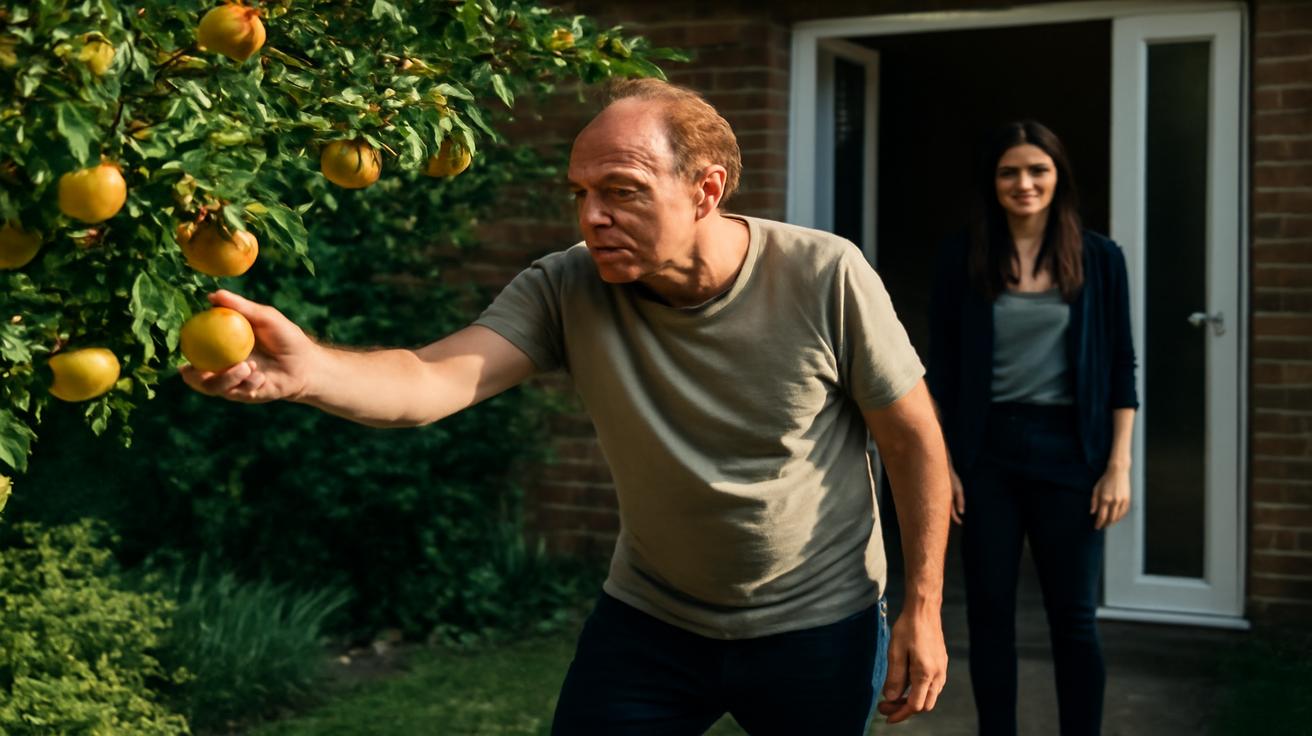
Then, one hot Saturday, you were hanging washing when the latch on the side gate rattled. You froze. It rattled again, then clicked. The gate swung inward, and there he was: your landlord, in cargo shorts and gardening gloves, a crate hooked in one arm like this was the most natural thing in the world.
“Afternoon! Figs are ready,” he called, stepping onto the path as if he were walking into his own garden, because in his mind, he was.
In that suspended second, something shifted. The garden, which had felt like a sanctuary, blurred around the edges. You suddenly noticed the pile of shoes by the back door, your mug of coffee on the chair, the T-shirt you’d left to dry over the armrest. The intimate evidence of an ordinary, private life.
Ownership, Possession, and the Space Between
His argument was simple. He owned the house. He planted the trees before you ever thought about renting it. The fruit was his. Entering the garden to pick it was, in his view, just “using his property.”
Your sense of the situation was just as simple. You paid rent not just for walls and a roof, but for a space in which you could exist unobserved and unbothered. The tenancy agreement spoke — as most do — of “quiet enjoyment” of the property. To you, that meant no surprises. No unannounced footsteps in the space where you sun-dried sheets and let your shoulders unclench after work.
“You can have some,” he said, seeing your face. “I’m not taking all of them. But they’re my trees.”
That word again: my.
He wasn’t shouting. He wasn’t even angry. In some ways, that was what made the whole thing more disorienting. He spoke in the calm, reasonable tones of someone who has never had to consider that ownership and access might be two different things. To him, your discomfort felt like an overreaction. To you, his casual entry felt like someone reaching a hand into your pocket because they once bought the jacket you’re wearing.
The fruit, glistening in the crate he set down on the patio, became a kind of evidence — of how thin the line can be between “your home” and “someone else’s investment,” and what that means when those two stories collide in a garden full of ripening sweetness.
Why This Story Sticks with People
When tenants trade stories, this kind of situation has a particular staying power. “My landlord insists he can come into my garden to pick the fruit” sounds almost comical at first, like a scene from a gentle sitcom. But beneath that surface is a more unsettling question: if a landlord can insist on entering your outdoor space for something as trivial — as optional — as harvesting peaches or figs, what else might they feel entitled to enter for?
It isn’t about the fruit. It’s about the idea that your landlord’s relationship to “his” plants, “his” fence, “his” soil might outweigh your right to feel that you, for the time being, inhabit that space as fully and as freely as any homeowner would.
In many jurisdictions, the law actually sides with tenants more than they realize: landlords typically must give notice, have a valid reason related to maintenance or inspection, and respect that gardens, balconies, and yards form part of the rented premises. But law is one thing; lived power dynamics are another. A lot of tenants, especially those vulnerable to rent hikes or eviction, will swallow their discomfort rather than risk being labeled “difficult.”
| Aspect | Tenant Experience | Landlord Perspective |
|---|---|---|
| Garden Space | Private extension of home, a sanctuary | Part of owned asset, long-term project |
| Fruit Trees | Enjoyed as a perk of renting the property | Personal investment, sentimental value |
| Right of Entry | Should be limited, respectful, with notice | Sometimes viewed as broad and ongoing |
| Emotional Impact | Loss of safety, feeling watched or exposed | Often underestimated or misunderstood |
| Best Outcome | Clear boundaries, voluntary sharing | Agreed visits, written expectations |
Fruit, Power, and the Uneasy Edge of “Home”
There is a particular quiet intimacy to a garden. Inside the house, privacy is about curtains and closed doors. Outside, it’s about the way you exhale when you slide that back door shut and step barefoot into the grass, feeling the air go softer around your shoulders. It’s about the small rituals: coffee on the step at dawn, weeding in old shorts, stretching out with a book in a patch of light where no one is supposed to see you.
From a distance, a landlord’s visit to harvest fruit may look harmless — an hour, a bag of apples, a friendly wave. But what it does is pierce the membrane around those rituals. It introduces the possibility that, at any moment, someone else might step into that frame uninvited. And once that possibility is real, it’s hard to un-know it.
Tenants describe subtle shifts: deciding not to sunbathe in the yard because “what if he shows up,” taking calls inside instead of on the patio, putting on shoes just to take the bins out “in case.” The garden, which could be an antidote to cramped rooms and city noise, becomes another place to self-monitor.
For renters already on edge — in a market where housing is precarious, where a rent rise or notice to vacate can appear with little warning — these small erosions of ease accumulate. When a landlord insists, openly, that their right to harvest outweighs your right not to be surprised in your own garden, it serves as a clear message: this place is not, and never will be, wholly yours. However gently it’s said, that message hits hard.
When Precedents Become Patterns
Stories like yours rarely stay isolated. They travel through group chats, social media threads, and late-night conversations on sagging sofas. “Wait, your landlord did what?” quickly turns into “Mine once insisted on keeping a key to the shed,” then “Ours walks through the side path to check the gutters without telling us,” until suddenly a pattern comes into focus.
That pattern is what makes this feel like a disturbing precedent. It’s not that landlords everywhere will suddenly storm gardens in pursuit of plums. It’s that unchecked assumptions about access — especially when unchallenged — tend to grow. If entering for fruit is okay, why not for pruning? If for pruning, why not “to see how the lawn is holding up”? If for that, why not to “quickly check the windows from the outside” on a Sunday morning?
Crucially, each of these visits may be framed as benign, even caring: maintaining the property, tending to the trees, making sure everything is “in good shape.” Yet from the tenant’s side, they all land in the same place: you no longer control who occupies your living space, and when.
In an era where more people rent for longer — sometimes for life — these boundaries matter more than ever. A culture that treats rented homes as semi-public spaces that an owner can dip in and out of at will is a culture that normalizes instability. It keeps tenants in a state of constant low-level tension, a feeling of being temporary, contingent, never fully allowed to exhale.
Shared Harvests, Shared Respect
It doesn’t have to be this way. The very thing that makes the conflict so raw — that gardens are alive, generous, productive — also offers a way forward. Because between the extremes of “landlord may enter whenever he pleases” and “landlord must pretend his own beloved trees no longer exist” lies a simple third option: mutual consent.
Imagine if the conversation had begun differently. The landlord, remembering his carefully grafted pear tree, might have said at the start of the tenancy:
“I planted those years ago and they’ve become important to me. I know it’s your home now, so I want to be respectful. Would you be open to me coming by once a season, at a time we agree on, to pick some fruit? Or, if you’d rather keep the space to yourself, I’d be happy just knowing they’re being enjoyed.”
At that moment, the power dynamic shifts. Instead of asserting a right, he’s making a request. You, as the tenant, get to choose — to say yes, no, or suggest a compromise. Maybe you’d offer to leave a box of fruit on the front step instead. Maybe you’d welcome an afternoon of shared picking and recipes swapped over the fence. Crucially, the garden remains your space between those agreed moments, not a corridor your landlord feels free to walk through at will.
For many renters, this is the heart of it: not a desire to hoard the harvest, but a wish to be treated as the current custodian of the place, not a guest in someone else’s life. To have your feelings about your own backyard weighed alongside someone’s nostalgia for the day they planted a sapling.
Drawing the Line — Gently but Firmly
Once a boundary has been crossed, restoring it can feel almost as awkward as the original trespass. You may hear your own voice in your head: “I don’t want to cause trouble.” “It was just a few figs.” “What if he raises the rent?” Those fears are not trivial; they are part of the reason landlords’ habits can so easily harden into precedents.
But there is a quiet power in stating your needs calmly, on paper if necessary. An email can say what your adrenaline-flooded tongue might fumble:
“I understand the trees are important to you and I’m happy for you to enjoy some of the fruit. However, the garden is part of my rented home, and I need to feel secure in it. Please don’t enter without arranging a time with me in advance. I’m very willing to agree a date each season so you can harvest, or I can leave some fruit out for you.”
Such a message does two things. It affirms your right to privacy without demonizing the landlord. And it creates a record — of your discomfort, your expressed wishes, and your reasonable offers of compromise. Whether or not you ever need to show that record to anyone, it anchors your own sense that you are not being “over-sensitive” — you are simply asking for the same privacy a homeowner would take for granted.
Because that, in the end, is the unsettling truth at the core of the fruit-harvest dispute: renters are often expected to live with a level of vulnerability and intrusion that would be outrageous if applied to owners. A landlord wandering into the garden of a house he had just sold, bucket in hand, insisting on “his” apples, would be an obvious absurdity. Yet when the occupant is a tenant, the same act is somehow up for debate.
A Different Kind of Abundance
Later that summer, you sit in the garden again. The figs are gone, the heavy scent replaced by the green-sharp smell of tomato vines and wet soil. You’ve replaced the broken latch on the gate with one that makes a firm, satisfying click. It’s a small sound, but it feels like something anchoring in your chest.
You’ve had the conversation. It was awkward. He frowned when you mentioned “quiet enjoyment.” He reminded you of how long he’d owned the place. You reminded him that right now, you live here. On paper and in practice, you said, you need the garden to be yours — not forever, but for as long as you pay to call this patch of ground home.
He muttered something about tenants these days. You, hands unsteady but voice clear, replied that tenants these days are simply asking for what anyone would want: the ability to harvest their own sense of safety from the place they sleep, eat, and hang their washing.
Maybe next year he will email when the fruit begins to swell, asking, not presuming. Maybe he’ll decide it’s easier to let go and buy his figs from a roadside stall. Maybe you’ll have moved on by then, carrying with you the memory of this garden — the purple stains on your fingers, yes, but also the way your chest tightened when the gate creaked open without warning.
Either way, the story will travel. It will join all the other small, specific tales that make up the larger shape of renting in our time — some funny, some bleak, some quietly hopeful. It will remind people that a landlord insisting on his “right” to enter a tenant’s garden for fruit harvest isn’t just a quirky disagreement about produce; it’s a test of how seriously we take the idea that home, even when borrowed, should be a place where the person living there is the one who decides who steps through the gate.
Out in the twilight, a blackbird hops along the fence, eyeing the last of the berries. The air smells faintly of mint and cut grass. You lean back in your chair, bare feet planted firmly on the soil, and listen — not for footsteps on the gravel this time, but for the ordinary sounds of an evening that, for now, belongs entirely to you.
Frequently Asked Questions
Can my landlord legally enter my garden without permission to pick fruit?
In many places, the garden or yard is considered part of the rented premises, so your landlord usually must respect your right to privacy there. Laws differ by region, but landlords typically need to provide notice and have a legitimate reason connected to maintenance or inspection, not personal use like fruit picking. Local tenant advice organizations or legal aid services can clarify what applies where you live.
Does the landlord owning the trees give them automatic rights to the fruit?
Ownership of the property and plants doesn’t automatically override your right to quiet enjoyment of the space while you rent it. In practice, this means the landlord still needs your consent to enter. The fruit may technically be considered the landlord’s, but access to it is limited by your occupancy and privacy rights.
How can I set boundaries without damaging the relationship?
Communicate early, calmly, and in writing if possible. Acknowledge the landlord’s attachment to the trees, but clearly explain that unannounced visits to the garden make you uncomfortable. Offer alternatives, such as arranging a specific time for harvest or leaving a share of fruit somewhere accessible. Framing it as a matter of privacy and safety, rather than accusation, can help.
What if I’m afraid my landlord will retaliate if I object?
Fear of retaliation is common. Keep written records of communication, learn your local protections against retaliatory eviction or rent hikes, and consider seeking confidential advice from tenant unions, housing charities, or legal clinics. Sometimes asking a neutral third party to help you phrase a polite but firm message can make the process feel less risky.
Is there a fair way to share garden produce between landlord and tenant?
Yes. The fairest arrangements are based on consent and clarity: agreeing in advance how and when harvests will happen, ensuring any landlord visit is scheduled, and recognizing the tenant’s everyday connection to the space. Some people choose to share harvests via a weekly box left by the door or a once-a-season, pre-arranged picking day. Mutual respect matters more than the exact split of the fruit.







Leave a Comment