
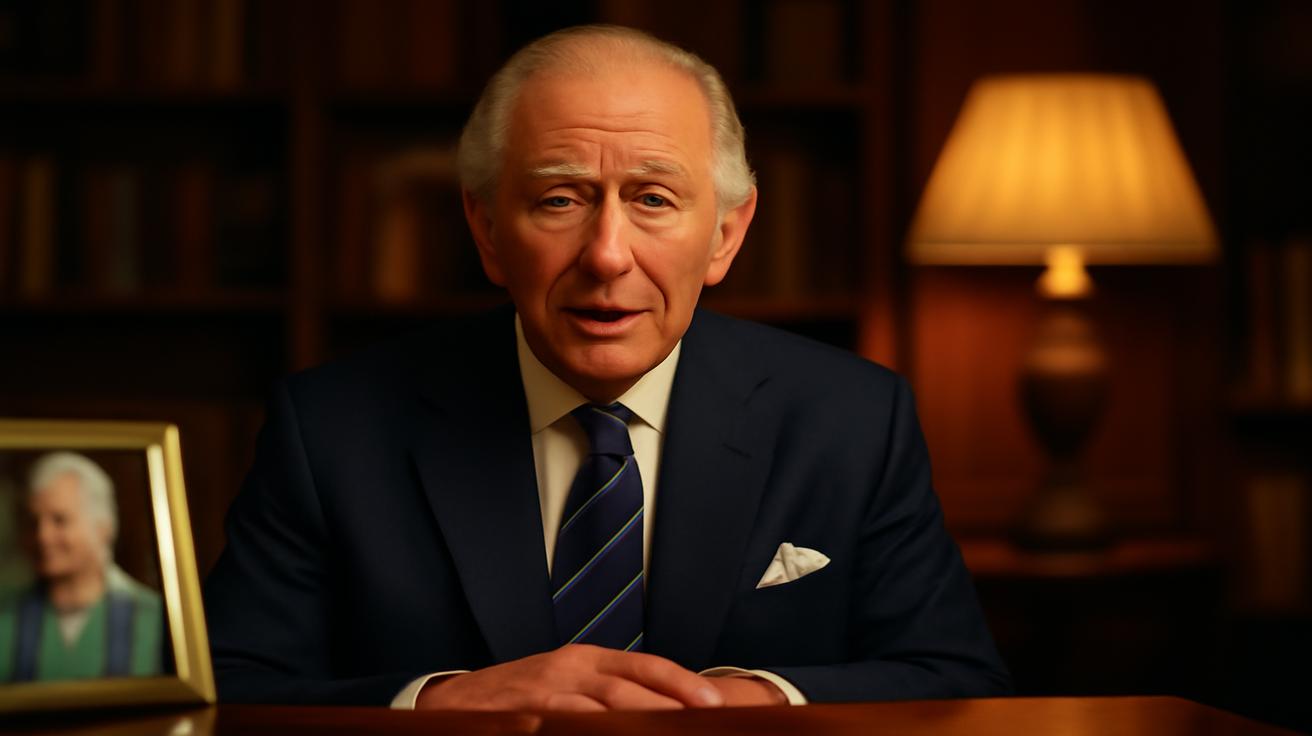
The camera catches the tremor in his voice before we notice the words. In the soft light of the chapel, King Charles III looks thinner, frailer, but somehow more present than ever. His Easter message this year is not a triumphant royal broadcast, nor the polite, polished sermon of a monarch at a safe distance from the world’s troubles. It feels, instead, like something far more disarming: a quiet confession of vulnerability wrapped in the language of faith, duty, and resilience. For a few minutes, the veil of ceremony slips—and Britain, watching from living rooms and mobile screens, sees a man confronting not just illness and uncertainty, but the weight of an entire institution’s future resting on his unsteady shoulders.
A King Who Sounds Less Like a Sovereign and More Like a Neighbor
The first thing that strikes you isn’t the setting, though there is plenty to notice. The polished wood, the flicker of candles, the subdued greens and whites of Easter flowers arranged just so. It’s the intimacy of the moment. There’s no balcony, no parade square, no roaring crowd in the near distance. Just a man in a suit, speaking softly, as if addressing a small congregation rather than an empire of screens.
Charles doesn’t thunder. He doesn’t declaim. His Easter message settles over the viewer like a conversation overheard in a quiet pew. He speaks of compassion in a world that feels increasingly coarse. He lingers on the idea of service, not as royal branding but as a kind of shared, ordinary holiness: volunteers in food banks, neighbors checking in on one another, nurses who slip extra minutes into their day when a patient seems afraid. The examples are small, domestic—and that is precisely the point.
In these careful, almost fragile sentences, the monarch tries to narrow the distance between palace and pavement, between crown and common life. When he talks about “carrying each other through hardship,” it’s hard not to hear the echo of his own precarious health and the quiet worry rippling through the country. This is not the immortal symbol we are used to; this is a mortal man asking—almost pleading—for a renewed sense of kindness and solidarity.
It is, in many ways, the most un-British thing a British monarch can do on national television: sound emotional without sounding sentimental, sound human without sounding weak. But the undertone is unmistakable. This Easter message is not only a reflection of faith; it is a glimpse into fear—his, and perhaps ours.
The Quiet Stagecraft of Vulnerability
For all its intimacy, nothing about this message is accidental. The royal household understands imagery perhaps better than any living institution in Britain. The soft lighting, the modest setting, the close-up framing of the king’s face—every detail works together, not to glorify the crown, but to make it feel strangely close at hand.
In earlier decades, royal messages often carried the serene distance of an oil painting: polished, highly controlled, a voice floating above reality rather than moving inside it. Charles’s Easter address, however, leans in the opposite direction. We are invited to notice the lines on his face, the slower rhythm of his speech, the very real sense that this is a man in the midst of treatment, working to inhabit a role whose scale was already daunting in full health.
Even the language of the message has shifted. There is less emphasis on the timeless majesty of monarchy and more on the fragile continuity of community. The king’s references to people “of all faiths and of none” feels less like a gesture toward inclusivity and more like a quiet acknowledgment of a pluralistic country that no longer moves in lockstep with the Church of England—or, in some cases, with the crown itself.
In that space, between liturgy and lived reality, Charles is trying something delicate: using his own vulnerability as a bridge. He offers up this Easter moment as proof that the monarchy can soften without collapsing, emote without losing its mystique, feel pain without surrendering its purpose. And yet, as he speaks, another question hangs over the scene like incense in a high-vaulted nave: How much vulnerability can an institution built on continuity actually bear?
A Softer Monarch in a Harder Time
We live in an era that trusts feelings more than formality, authenticity more than grandeur. The monarchy, by contrast, has always thrived on ritual and distance, on the slow burn of tradition. But Charles’s Easter message lands in a world no longer content with polished symbols; people want to see the seams.
He gives them those seams. There is no explicit mention of his illness, but it’s present in every pause. The message feels less like a sermon and more like a letter written at a bedside: gentle, deliberate, light on grand pronouncements and heavy on gratitude. When he thanks those who serve unseen, it sounds as if he’s thinking of the doctors and nurses, the aides and staff who shape his own private battle beyond the lens.
For many viewers, this softer, more open posture is deeply moving. A king in uncertain health, speaking about hope and compassion at Easter, is a narrative powerful enough to bend even a hardened skeptic’s attention. In homes where the monarchy has long been treated as remote theater, the sight of a visibly aging Charles trying to extend comfort feels oddly intimate—like a distant relative suddenly phoning with news that reshapes old assumptions.
Yet this very softness raises a paradox. Monarchy draws power from the illusion of permanence, from the idea that even as governments rise and fall, the crown remains, quietly unshaken. To show the strain, to admit fear, to age in public—does this strengthen the bond between sovereign and subjects, or erode the aura that sustains the institution?
| Aspect | Traditional Royal Image | King Charles III’s Easter Tone |
|---|---|---|
| Emotional Distance | Reserved, impersonal, dignified detachment | Gentle vulnerability, reflective, personal |
| Language of Faith | Formal, liturgical, Anglican-centered | Inclusive, interfaith-aware, quietly personal |
| Public Role | Symbol above the fray | Participant in shared hardship and uncertainty |
| Tone on Service | Duty as obligation of rank | Service as communal, almost spiritual partnership |
| Public Perception | Untouchable continuity | Relatable fragility, uncertain continuity |
When Personal Faith Meets Public Fragility
This Easter message is not delivered into a vacuum. It arrives in a season of royal strain: health scares, shifting roles, a public still adjusting to life after the late Queen Elizabeth II, whose very presence once felt like a steady metronome beating behind British life. Now, the tempo is less certain. The royal family appears more exposed, its human limits plain to see.
Charles’s deep interest in spirituality has long been part of his public story—sometimes mocked, sometimes admired. In private, he has studied everything from Orthodox mysticism to Islamic thought, showing an openness that once seemed out of sync with the rigid expectation of a Defender of the Faith. But here, in this Easter address, that searching quality becomes an asset. He sounds like a man who has spent decades turning big questions over in his mind, and who now finds those questions no longer theoretical.
The themes he chooses—sacrifice, renewal, quiet acts of kindness—are classic Easter fare, but also something more like a quiet manifesto for how he hopes the monarchy might survive: not as an untouchable relic, but as a fragile presence that endures because people still find meaning in it. Service, he suggests, is what gives institutions their soul. Without it, crowns are just metal, rituals just choreography.
People listening may find themselves unexpectedly moved, not because he promises certainty, but because he doesn’t. The message allows room for grief, for fear, for fatigue. It suggests that resilience is not the absence of struggle but the willingness to keep turning toward one another in the midst of it.
The Hidden Question Beneath the Homily
And yet, beneath the gentle cadences lies a harder, more structural question: Can the monarchy itself live out the values he invokes? Can an institution born in hierarchy convincingly model the mutuality he so carefully praises—where every act of service, from the palace to the care home, carries equal moral weight?
Charles walks a narrow path here. He cannot confess doubt about the monarchy’s future without undermining it. But he can, and does, lean toward a kind of modesty that invites the idea of the crown as one strand in a wider fabric of civic life, not its shining center. That is both strategically wise and subtly radical.
For centuries, royal messages served to reassure: the crown is strong; the nation will endure. This one does something different. It says, in effect, the nation endures because ordinary people are kind to one another, because someone somewhere decides to show up. The crown, in this telling, isn’t the hero of the story. It’s an onlooker pointing us back to one another.
Resilience on Trial: The Institution Behind the Man
If Charles’s voice trembles, the structure behind him must not. That is the unstated contract of monarchy. The Easter message may glow with feeling, but it also operates as a stress test for the institution itself. How prepared is the crown for fragility, for accelerated transitions, for a society that increasingly wonders—not rudely, but pragmatically—whether this ancient framework still fits the future?
In the weeks surrounding the message, conversations ripple through press columns, family group chats, and social media threads. People debate not only Charles’s health but the line of succession, the role of younger royals, the onslaught of global crises that make pageantry feel both irrelevant and, paradoxically, reassuring. Some argue that a softer monarch could help the crown remain relevant in an age of emotional accessibility. Others worry that too much softness will strip it of the mystique that keeps it afloat.
The truth may lie somewhere in the uncomfortable middle. Institutions survive not by pretending to be invincible, but by shifting shape just enough to meet the age. Charles, with his decades of sometimes awkward modernizing—talking about climate long before it was fashionable, pushing for interfaith dialogue, embracing organic farming—seems almost destined for this moment of gentle upheaval.
His Easter message feels like part of that slow recalibration. The monarchy as solemn anchor, yes—but also as a listening presence, acknowledging its own mortality in order to stand more honestly beside a nation that no longer believes in unbreakable things.
Succession, Symbolism, and the Quiet Countdown
Behind every word he speaks, a quieter clock seems to tick. Talk of future kings, of generational handovers, of the burden waiting on younger shoulders, hums beneath the surface of public life. The more visible the king’s vulnerability, the louder that hum becomes.
For some, this awareness heightens their emotional investment: they watch this Easter message knowing it may be one of a finite number, and that knowledge lends a bittersweet weight to every phrase. For others, it intensifies questions of practicality and cost, of whether an institution so dependent on individual health and charisma can justifiably occupy so prominent a role in a modern democracy.
Still, there is something oddly human about collective life arranged around a fallible figure. It mirrors, in a way, the structures of families, communities, even local institutions: people grow old, they become ill, they hand things on. Continuity is always more fragile than it looks from the outside.
The Emotional Crown in an Age of Screens
This Easter message does not unfold in a hushed sitting room with a nation gathering around a single broadcast. It spreads through glowing rectangles, paused and replayed, clipped and shared. People watch on trains, in supermarkets, in bed with the lights off. The intimacy of the king’s tone finds its match in the intimacy of the devices through which it is heard.
On social media, reactions splice the country into a familiar patchwork. Some users dissect his every phrase with the forensic curiosity of amateur historians. Others focus only on the tremble of his hand, the weary set of his shoulders. For every comment praising his humanity, another raises pointed questions about relevance, cost, and privilege.
Yet the fact that people are still reacting so strongly—arguing, defending, doubting—reveals something the crown’s critics sometimes underestimate: emotional infrastructure is hard to dismantle. Many Britons have never known a time without a monarch. Even when they critique the institution, they often do so from within a shared emotional vocabulary shaped by royal rituals, broadcasts, weddings, and funerals. The king’s Easter message plugs directly into that wiring, even for those who would gladly cut the circuit.
The Double-Edged Power of Feeling
Emotion, however, is volatile currency. It can deepen loyalty, but it can also accelerate disillusionment. A monarchy that invites people into its vulnerability must be prepared for the scrutiny that inevitably follows. If the king presents himself as a kind of national companion in hardship, people will hold him—and the institution around him—to the same standards of empathy and integrity that they expect from any other public figure.
This Easter, Charles appears willing to accept that risk. He places his softer self into the center of the narrative, trusting that people will not mistake feeling for weakness. Whether that trust will be rewarded, only time will tell.
A Crown of Thorns, A Circle of Light
Near the end of his message, there is a subtle shift in his voice, a hint of resolve beneath the gentleness. He speaks of light that returns after darkness, of hope that survives not because life is easy, but because people keep choosing to act with courage and care when it isn’t. It is traditional Easter language, yes—but filtered through a man for whom the metaphor of suffering and renewal is no longer abstract.
The camera lingers for a moment too long after he finishes. We see not a triumphant sovereign but a tired man who has done something quietly brave: stepped into the full glare of national attention while carrying news in his own body that most people would prefer to confront in private. This is not the kind of heroism once expected of kings, all victorious battles and grand proclamations. It is something smaller, but no less real: the decision to keep showing up, to keep speaking into the silence, to keep embodying a role even as it becomes more demanding.
Whether this softer monarch will help the crown weather the 21st century’s storms remains an open question. Resilience, as he reminds us between the lines, is not only about institutions but about the stories people still choose to tell themselves about those institutions. If citizens look at the monarchy and see an unyielding relic, its days are numbered. If they look and see a flawed but evolving companion to the national story, its chapters may yet be extended.
For now, the Easter message hangs in the air: a blend of faith and frailty, ritual and rawness, duty and doubt. King Charles III has offered the country not a fortress, but a human face—lines, tremor, and all. In doing so, he has made the monarchy feel more exposed than it has in years, and paradoxically, more alive.
Behind the candles and the camera lenses, the institution absorbs the impact of this softer light. Somewhere between the echoing walls of the chapel and the glow of the nation’s phones, a question waits, unresolved: In showing us his heart, has the king strengthened the crown—or merely revealed how delicately it rests upon the nation’s head?
Frequently Asked Questions
Why was King Charles III’s Easter message considered especially emotional this year?
The message was delivered at a time of heightened concern about the king’s health, and his tone was unusually gentle and vulnerable. He emphasized compassion, shared hardship, and quiet acts of service in a way that felt personally resonant rather than purely ceremonial, giving viewers a rare sense of emotional proximity to the monarch.
How did this Easter message differ from traditional royal broadcasts?
Traditional broadcasts tend to project calm continuity and formal dignity. This message, while still respectful and composed, leaned into a more intimate, reflective style. It used inclusive language, acknowledged a wide spectrum of beliefs, and focused heavily on ordinary people’s contributions, making the crown feel like a participant rather than the center of the story.
Does the king’s vulnerability risk weakening the monarchy?
It cuts both ways. Showing vulnerability can humanize the institution and deepen public sympathy, but it also highlights the monarchy’s dependence on individual health and personality. Some see this openness as a modern strength; others fear it erodes the aura of permanence that has traditionally underpinned royal authority.
What does the message suggest about the future resilience of the monarchy?
The subtext of the address points toward a monarchy that survives by adapting—emphasizing service, modesty, and emotional connection rather than sheer grandeur. It implies that the crown’s resilience will depend less on unshakable mystique and more on whether people still find moral and emotional value in its presence.
How have people reacted to King Charles III’s softer tone?
Reactions have been mixed but intense. Many found the message moving and appreciated the king’s willingness to appear vulnerable. Others used the moment to renew debates about the cost and relevance of the monarchy. What is clear is that the address sparked conversation, suggesting that, for now, the institution still occupies a powerful space in the national imagination.






Leave a Comment