
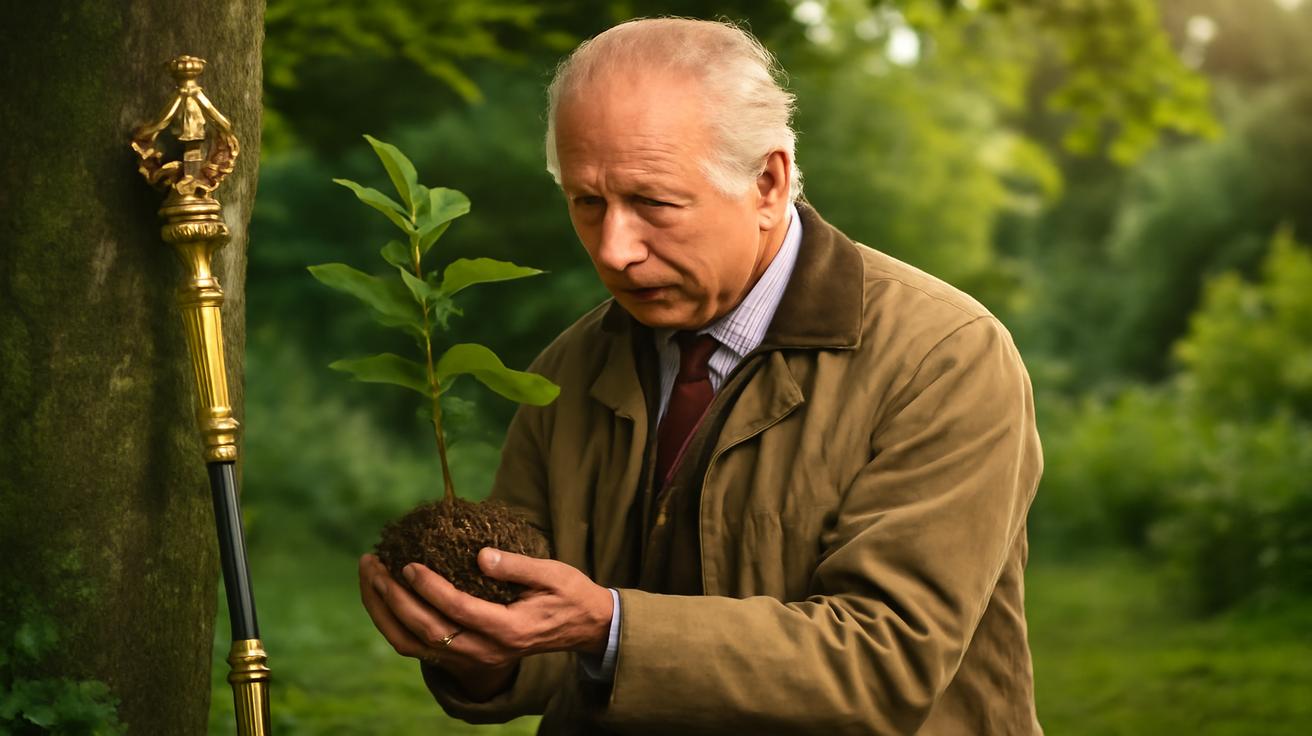
Dawn hangs low and damp over the Scottish Highlands, and the man who will one day be King is standing in the mud with a spade in his hands. The wind whips rain sideways, needling his cheeks. His wool cap is already soaked; his tweed trousers are freckled with dark splashes of peat. Around him, the hills look raw and tired—grazed to the bone, rivers running brown after every storm. He plants a sapling anyway. Then another. And another. It is the 1980s, and Prince Charles is muttering about soil loss and biodiversity to anyone who will listen. Most people don’t. Not yet.
The King Who Was “Too Green, Too Soon”
To understand King Charles III now—silver-haired, newly crowned, carefully measured in every public word—you have to picture that earlier version of him. The one dismissed in headlines as a “crank” for talking to plants, mocked in cartoons for hugging trees, politely tolerated when he insisted that industrial farming might be quietly poisoning the land and the people who eat from it.
He talked about “climate change” when many still called it the greenhouse effect—a phrase that sounded more like a physics problem than a planetary crisis. He warned that we humans were treating the Earth like a “convenience store,” rifling its shelves and walking away from the mess. He railed against plastic waste before beaches were choked with it, before sea turtles tangled themselves in ghost nets and broken bottles.
Back then, his speeches landed somewhere between curiosity and comedy. He was the sensitive royal, the one who preferred hedgerows to boardrooms, who seemed far more animated in a field talking about earthworms than at a banquet making small talk with dignitaries. He spoke of the “harmony” between nature and people in a way that sounded slightly mystical in an increasingly techno-optimistic age.
But he was stubborn. He used the platform he had—even as heir, not yet sovereign—to push for organic farming, conservation, urban green spaces, architecture that respected place and scale. He co-founded charities, launched initiatives, nudged companies and governments, and kept saying, year after year, that we were running out of time.
Today, that clock is loud enough for almost everyone to hear.
From Talking to Plants to Talking to Presidents
The air has changed since those early speeches. Summers crackle with heatwaves that flay city streets. Rivers in Europe and Asia run low, like veins drained of blood. Forests go up in flames that turn the sky amber in places that never expected wildfire seasons to have names.
In this new world, King Charles III no longer looks like the odd man out. He looks, instead, like someone who read the weather early.
Over the decades, he turned his private experiments into public demonstrations. At Highgrove, his Gloucestershire estate, the lawns turned to wildflower meadows. Hedges were allowed to thicken and tangle for birds and insects. Organic farming practices were trialed, refined, then quietly scaled through the Duchy of Cornwall’s agricultural projects. Long before it became fashionable, he tried to prove that business, farming, and environmental care didn’t have to be enemies.
That personal conviction rippled outward. His speeches at climate conferences grew more insistent, edged with something like desperation, even as his tone remained courtly. He pressed corporate leaders to decarbonize supply chains, urged governments to mobilize finance for climate resilience, and helped convene alliances that spoke the fluent, hard language of investment and risk alongside the softer tongue of stewardship.
Now that he wears the crown, though, every word is freighted with new weight. That presents a paradox: the causes he has fought for his entire adult life have never been more urgent, yet his freedom to publicly champion them has never been more constrained.
Climate Urgency Meets Constitutional Neutrality
In the British system, the monarch is meant to float above the quarrels of democratic life. No voting. No public lobbying. No wading into the partisan mud. The crown is symbolism and ceremony, stability and continuity—a role stitched together from ritual and restraint.
Environmental activism, by contrast, is anything but neutral. It cuts straight across political and economic fault lines. Decisions about fossil fuels, land use, regulation, public spending, and corporate responsibility are argued fiercely in Parliament, on the front pages, and in the streets. To call climate change “the defining challenge of our time” is, in practice, to weigh in on tax policy, industrial strategy, foreign relations.
So when Charles became King, a question hovered in the air like woodsmoke: would he have to let the most passionate part of his public life grow quiet?
His own words, even before the accession, hinted at a kind of self-discipline. He signaled he understood that kings and queens do not get to be campaigners. Activism, as such, would have to soften into influence—indirect, carefully framed, intentionally general. The man who once spoke freely about specific policy choices now has to talk in broader strokes: responsibility, stewardship, legacy.
Yet the urgency has not receded. Each passing year heaps more evidence at his feet: record temperatures, vanishing species, destabilized weather, human displacement. The scientific curve is sharp; the constitutional one must be flat. Holding the two in tension is becoming one of the defining subtleties of his reign.
Walking the Thin Green Line
Imagine the tightrope.
On one side: constitutional neutrality, the unwritten but deeply ingrained rule that the monarch must not appear to steer government policy. The King’s weekly meetings with the Prime Minister are strictly private. His public speeches are combed line by line by advisors and, often, by ministers. The crown speaks in generalities, not demands.
On the other: decades of hard-earned credibility in environmental circles. Leaders of small island states who have watched their coastlines slip away know that Charles, as Prince, stood with them long before climate justice became a standard talking point. Indigenous communities have hosted him under their roofs. Scientists and campaigners remember his willingness to show up not just for photo opportunities but for detailed, sometimes technical conversations.
He cannot, as King, lead a protest march. He cannot endorse specific legislation. Yet simply by being who he is—and by how he chooses to use the ceremonial levers of monarchy—he can still tilt conversations.
He can choose which themes to highlight in Christmas broadcasts: flood resilience, intergenerational responsibility, the “small kindnesses” that add up to cultural change. He can accept invitations to open climate research centers instead of luxury developments. He can host roundtables at palaces that bring CEOs, ministers, and community leaders into the same vaulted room, where the chandeliers gleam above and the arguments grow pointed below.
This is not activism in the placard sense. It is quieter, more oblique. Yet in an age when symbolism travels as fast as data, the image of a King standing beside young climate scientists, or visiting communities recovering from flood or fire, lands with its own subtle force.
The Monarch’s “Soft Power” in a Heating World
The phrase “soft power” is often used for cultural exports and diplomatic charm, but it applies differently here. The monarchy, for all its pageantry, can be a strangely intimate institution. People invite the Royals into their living rooms via television, their newsfeeds, their daily conversations.
Charles’s environmental message now arrives wrapped in this intimacy. When he speaks in that slightly clipped, familiar voice about caring for the Earth for one’s grandchildren, he is not just a climate advocate; he is a grandfather, a father, a man visibly aware that his reign will be finite but its consequences will not.
That human scale matters. Climate graphs and emissions scenarios are abstract. A King walking slowly along a flooded street, talking quietly with a shopkeeper whose stock has been ruined—this is narratively potent. It turns megatons of carbon into something you can smell: damp plaster, spoiled food, gasoline-slicked puddles.
His influence is also networked. Over decades he has woven a web of initiatives and organizations that now intersect with governments, private finance, and civil society. He no longer needs to campaign loudly when those networks can help sustain momentum on reforestation projects, regenerative agriculture, green urban design, or sustainable supply chains.
The challenge is to keep that web active without it looking like a parallel policy machine, a shadow cabinet in green. Every thread must be tuned not only to scientific reality but to constitutional optics.
The Long View: A Lifetime in One Reign
There is a particular kind of patience in someone who plants a tree knowing they may never sit beneath its full shade. Charles has been that planter for most of his life. Now, as King, he is no longer an outsider insisting on change; he is an institution trying to embody it.
And the clock is against him. Not personally—though age is certainly a factor—but in terms of planetary timescales. Systems that took centuries to destabilize are tipping quickly. Species that clung on for millennia are, in some places, disappearing in a single human generation.
Set against that, the tempo of constitutional monarchy is almost glacial. It trades in symbolism, continuity, and slow, incremental nudges. Yet the very longevity of his environmental effort may be his greatest asset. He is not a politician on a four-year term, measuring success in polling cycles. He is a man whose public identity has been braided with environmental care across more than five decades.
Young activists, understandably impatient with half measures, often look at institutions like the monarchy with skepticism. Yet some also see in Charles an unlikely elder ally—a figure who can, with a single speech, draw cameras and microphones to issues that grassroots organizers have struggled to amplify.
In that interplay between youth agitation and royal persistence lies a peculiar possibility: a distributed kind of leadership, where the King does not claim center stage but uses his to subtly brighten the lights on others.
A Life in Green: Key Milestones at a Glance
His environmental journey is long enough to be almost its own era. Set against the backdrop of global climate awareness, it looks something like this:
| Period | Role | Environmental Focus |
|---|---|---|
| 1970s–1980s | Young Prince | Early speeches on pollution, organic farming, and conservation; begins transforming personal estates. |
| 1990s–2000s | Prince of Wales | Launches charitable foundations, promotes sustainable agriculture, architecture, and corporate responsibility. |
| 2010s | Global Advocate | Addresses major climate summits, champions rainforest protection and green finance initiatives. |
| 2020s– | King Charles III | Balances constitutional neutrality with symbolic leadership on climate, nature, and intergenerational responsibility. |
The Quiet Radicalism of Restraint
There is an irony here: the most radical thing an environmentally minded monarch can do may be to stay within the lines.
If Charles were to push too far—openly taking sides in specific political fights, publicly backing or opposing legislation—he might energize his supporters, but he would almost certainly trigger a backlash strong enough to damage not just his own credibility but the very causes he champions. Climate policy would become even more tangled in questions of loyalty to or rejection of the crown.
By staying just this side of the boundary, he keeps a wider audience listening. Conservatives who might flinch at a street protest may still lean in when a familiar, steady voice at a state banquet speaks of “the sacred duty” to care for the land. Progressives who mistrust monarchy may nonetheless recognize that, on this issue at least, the King is pushing the cultural window in their direction.
Restraint, in this context, is not passivity. It is strategy. It is the understanding that certain doors only stay open if one walks through them slowly.
What It Means for the Rest of Us
It is tempting to look at a King’s environmental crusade and treat it as spectacle—something happening on a gilded stage far removed from ordinary lives. But part of the unspoken message in Charles’s decades of muddy boots and earnest speeches is precisely the opposite: that the work of living within Earth’s limits is granular, local, painfully specific.
He has spent years trying to show that farms can shift how they treat soil, that companies can reimagine their supply chains, that urban planners can thread green corridors through concrete. None of these steps depends on a crown. They are, in principle, replicable almost anywhere, by people with far fewer resources but often greater urgency.
What the King offers—whether you see it as inspiration, provocation, or background noise—is a narrative spine: the idea that caring for the natural world is not a niche concern but central to how a nation imagines its future. The British countryside, the coasts, the urban parks, the battered but resilient ecosystems of these islands: they all become part of the story of the monarchy itself.
In that sense, the most powerful image may not be of Charles at a global summit flanked by heads of state, but of him once again in a rain-soaked field, older now, back stiff, hands still wrapped around the handle of a spade. The saplings are small, the sky uncertain, the weather more chaotic than ever. He presses another young tree into the earth and steps back, trusting—as he has for half a century—that some things grow stronger precisely because we choose to nurture them before it is popular, before it is easy, before it is guaranteed to succeed.
That, more than titles or trumpets, is the through-line of his environmental crusade: a stubborn insistence on acting as if the future still matters, even when the present keeps shouting otherwise.
Frequently Asked Questions
Why is King Charles III so closely associated with environmental causes?
King Charles III has spoken about environmental issues since the 1970s, long before they were mainstream. As Prince of Wales, he used his position to promote organic farming, conservation, sustainable architecture, and climate action, turning his personal convictions into a central theme of his public life.
Has his environmental work changed since becoming King?
Yes. As monarch, he must remain politically neutral, so he no longer advocates specific policies or campaigns in the way he once did. Instead, he emphasizes broad themes—stewardship, responsibility, and intergenerational justice—while supporting environmental work through convening power, patronages, and symbolic leadership.
Can the King directly influence environmental policy in the UK?
Not directly. In the UK’s constitutional system, elected governments make policy. The King can raise awareness, encourage dialogue, and highlight certain issues, but formal decisions on laws, regulations, and spending rest with Parliament and ministers.
Why does his environmental stance matter if he has limited political power?
His stance matters because of visibility and continuity. As a widely recognized figure with decades of environmental engagement, he can draw attention to issues, legitimize emerging solutions, and encourage collaboration across business, government, and civil society, all without drafting a single law.
Is environmental neutrality possible when climate change is so political?
Complete neutrality is difficult, because climate and nature touch every part of the economy and society. King Charles III’s approach is to stay above party politics while still acknowledging the gravity of the crisis, framing it as a shared moral and practical responsibility rather than a partisan slogan.







Leave a Comment