
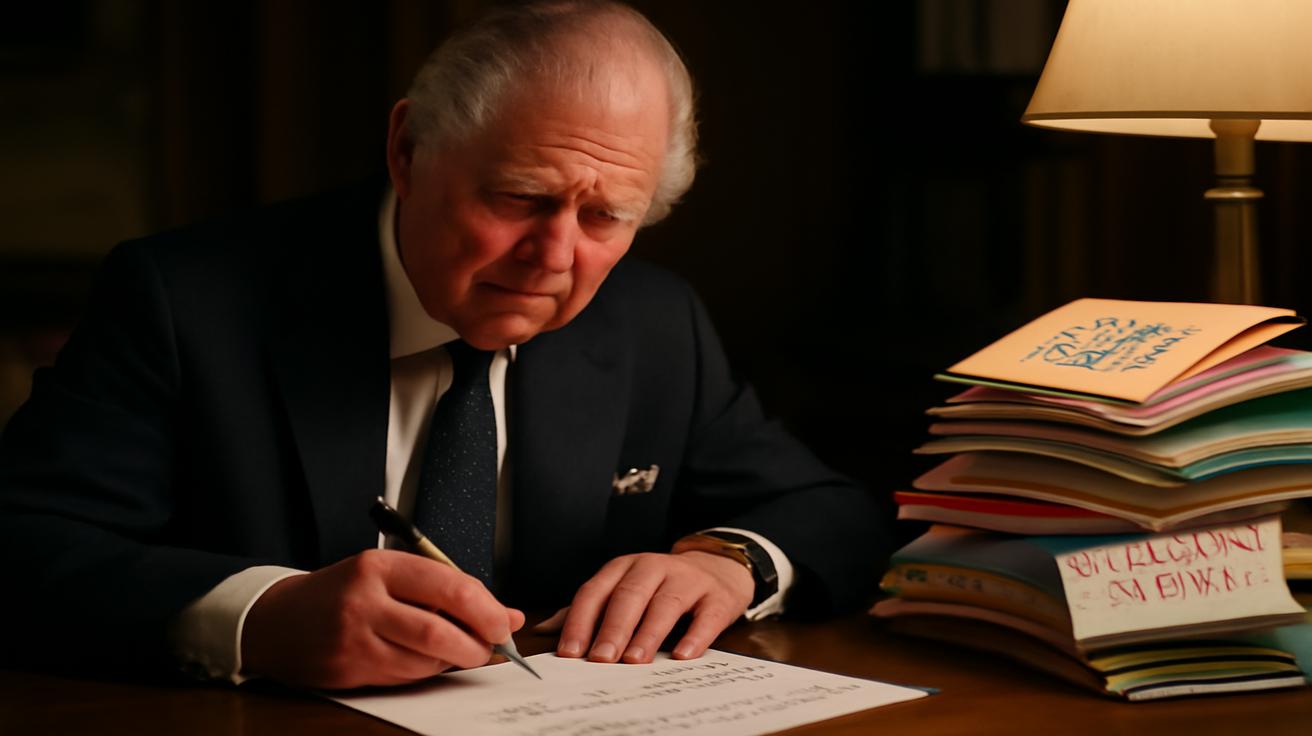
The letter was not long, and yet it seemed to still the air for a moment—as if the country collectively paused between heartbeats. In carefully chosen words, King Charles III stepped out from behind centuries of royal distance and did something that monarchs almost never do. He spoke, plainly and personally, about his own cancer treatment. Not as a sovereign. Not as a symbol. As a man walking, day by day, through an illness that so many others know all too well.
A king in a hospital corridor
Imagine the scene without the gold braid and the polished speeches. A hospital corridor softened by the hiss of air vents and the rhythm of soft-soled shoes. Nurses move like practiced currents, wheeling machines, checking charts. Somewhere beyond a discreetly guarded door, the King sits in a chair identical to a thousand others around the country—vinyl, practical, slightly squeaky when you shift your weight.
There is something quietly leveling about fluorescent light. It cares nothing for crowns or titles. In that light, everyone is simply a patient. A person. A beating heart monitored by the same beeping machines, the same checks of temperature and blood pressure, the same gentle, “How are you feeling today, sir?”
It is in this ordinary, fiercely human setting that King Charles receives treatment for a disease that still carries a word we lower our voices to say: cancer. Though the palace has not disclosed precise medical details, they have made one thing abundantly clear—this is serious, this is ongoing, and this is personal. For the King, and for those watching.
In a rare written statement, he chose to turn toward the public rather than away. He thanked people for their well-wishes in language that carried a surprising emotional weight: “Your messages have meant more than you can imagine.” On the page, those words look simple. Spoken aloud, they sound like someone trying not to let their voice tremble.
The moment the distance closed
We are used to seeing royalty as a kind of living distance—a carefully framed image on a balcony, a figure glimpsed through car windows, a voice polished by years of duty and diplomacy. Sickness, though, has another language. It speaks in waiting rooms and whispered updates, in the quiet ritual of pillboxes and appointment reminders, in the way time begins to be measured not in seasons, but in scans.
When the King chose to acknowledge his diagnosis publicly, that distance flickered. The announcement did not come with trumpets, but with an oddly intimate clarity. Here, at last, was a king speaking in the shared tense of the unwell. Not a heroic narrative tied up with bows, but an admission: he, too, is vulnerable.
In that vulnerability, people recognized themselves. Letters began to arrive at the palace—thousands of them—from strangers whose lives had been bracketed by the same word: cancer. Some wrote from chemo wards, tapping out messages on phones balanced beside saline drips. Others from kitchen tables where prescription bottles huddled in clusters. Some had lost loved ones. Others were living in that strange in-between of remission, never quite sure when to relax.
When he said their messages had meant more than anyone could imagine, it was an acknowledgement not only of gratitude, but of how cancer draws an invisible circle around those who live with it. They may never meet, but suddenly they inhabit the same emotional weather, the same forecast of hope mixed with fear.
A monarch’s diagnosis in a modern age
There was a time when the illnesses of kings and queens were whispered about behind heavy curtains. Diagnosis was the private property of doctors and courtiers, hidden from public view as fiercely as state secrets. The monarchy was meant to be an unshakable symbol; frailty was edited out of the picture.
The twenty-first century has other ideas. Transparency, even in palaces, is no longer optional. People do not just watch the crown; they talk back to it. Question it. Ask for more. And somewhere between tradition and modernity, King Charles has chosen to let a crack of light in.
When the palace confirmed his cancer diagnosis, there was no demand to know every medical detail. What people wanted was simpler, and far more human. Is he in pain? Is he scared? Will he be able to keep working? Has it changed how he sees the world, now that he views it, at least for a time, from a patient’s chair rather than a throne?
The King, of course, remains bound by the discreet language of monarchy. He does not speak in long, confessional paragraphs. But even in his few sentences of thanks, something new flickers—a personal tone, warmer and less formal, as though the illness has sanded down one more layer of royal polish.
He is, we are told, continuing with some official duties while pausing others. The image is strangely familiar to anyone who has tried to “keep going” through treatment. The calendar remains dotted with commitments, but everything is measured now against a quieter schedule built around hospital days, recovery evenings, and the unpredictable fatigue that can sneak in like fog.
The texture of an ordinary, extraordinary fight
Behind formal updates lies a life defined by small, exacting routines. There is the clinical smell of disinfectant; the rubber squeak of gloves. The way medical tape tugs at the tender inside of the wrist. The way time slows down when you’re waiting for results, and speeds up absurdly when you’re told you can go home.
For a man whose adult life has been choreographed to the minute, cancer treatment brings a different tempo. Delays. Cancellations. The way plans are scribbled in pencil, not pen. For every person who has sat in a treatment chair and watched the world spin without them—emails unanswered, social plans postponed—there is something quietly validating in knowing that even a king cannot outrun this particular vulnerability.
And so, when Charles says the messages from across the world have truly moved him, it isn’t just a polite royal phrase. Anyone navigating treatment knows how a single note of kindness can shift an entire day. A text that simply says, “Thinking of you.” A card that arrives when you had slowly convinced yourself the world had forgotten.
Words do not cure cancer. But they can soften its edges. They can remind someone that they are more than a patient—that beyond the diagnosis, they remain held in the web of ordinary love, worry, and stubborn human care.
Letters to the palace, letters to ourselves
In living rooms and hospital wards, people began writing to the King. Not as loyal subjects, but as fellow travelers on a road no one chooses. Some shared their treatment stories, each one its own small epic of side effects and survivals. Some wrote of husbands, wives, parents, or children lost to the same disease now visiting the sovereign.
What they wrote was often what they wished someone had told them earlier. That it’s okay to feel terrified and grateful at the same time. That your body may feel like a stranger for months, even years. That some friendships will fall away, unable to bear the weight of hospitals and uncertainty, while others will step closer, unexpectedly steadfast.
And perhaps, in their own way, those letters acted as mirrors. Every message addressed to the King carried within it a reflection of the person writing: their hope, their anger, their unfinished grief. To write “I wish you strength” is also to whisper it to yourself, to the parts of you that are tired of being brave.
The monarchy, so often criticized as distant and ceremonial, suddenly became a canvas for something else: a national, even global, conversation about illness and vulnerability. In speaking of his diagnosis and his gratitude for public messages, King Charles gave people permission to speak more openly about their own.
How a personal statement ripples outward
A single royal statement might seem like a small thing against the scale of global suffering, but its ripples are undeniable. For older men, in particular, the King’s openness about treatment may chip away at the stubborn silence that often surrounds their health. If a man raised in the steely etiquette of mid-twentieth-century royalty can speak publicly about cancer, then perhaps a grandfather somewhere finds it a little easier to tell his family about that lump, that pain, that appointment he’s been postponing.
There is also the question of visibility. Some illnesses remain socially invisible, tucked behind euphemisms or hidden entirely. Each time a public figure names a disease, it becomes a little harder for society to pretend these conditions belong only in hushed corridors.
King Charles did not use his statement to draw attention to statistics or campaigns. Yet simply by saying the word “cancer” in relation to himself, he pulled the disease out of abstraction and into shared reality. The conversation shifts, subtly but meaningfully, from “those people” to “our King, and by extension, us.”
In the strange arithmetic of empathy, that “us” matters. It may mean a government official thinking a little more urgently about funding. A media outlet choosing a more respectful tone when covering illness. Or a stranger taking a moment to ask a colleague how their treatment is really going, and then actually staying to hear the answer.
A quiet bond: sovereign and subject
There is something almost old-fashioned about the way the King expresses his thanks. The phrasing is formal, yes, but the sentiment is not. “Your messages have meant more than you can imagine” carries inside it a kind of humility not always associated with royal statements. It admits, softly, that encouragement is not just nice to have—it is needed.
In that need, a quiet bond forms. A modern constitutional monarchy does not hinge on personal affection; it operates on law and tradition. But the emotional connection between sovereign and people is still a living thing, fed or starved by the choices made in public view.
To see the King unwell is, for some, unsettling. The monarchy is meant to be a continuous thread of stability, and illness feels like a fray in that thread. Yet there is another way to look at it. In allowing us to see him as mortal, Charles makes the institution itself feel less like a museum piece and more like a human story still unfolding.
And for those already carrying illness, watching a monarch move through treatment with a mixture of duty and fragility can be oddly strengthening. It suggests that needing help, stepping back from certain roles, and admitting to worry do not strip a person of their dignity. If anything, they deepen it.
A glimpse of life beyond the palace gates
We are not invited into the King’s consulting room. We will never sit in the plastic visitor’s chair or hear the exact tone of the oncologist’s voice. But his openness allows us to imagine it, and in imagining, we connect it to scenes from our own lives.
Perhaps it’s the way a loved one squeezed your hand in the moment before a crucial test result. The antiseptic scent that clung to your clothes after a long hospital day. The relief of stepping outside into real air, into trees and ordinary traffic, and realizing that the world continued to move while your own seemed to hold its breath.
For a man whose life has been measured in ceremonies—openings and dedications, speeches and signatures—this season is measured differently. In blood counts. In how many steps he can manage without needing to rest. In the small triumph of a day when food tastes normal, or fatigue loosens its grip, even briefly.
That he chooses to speak of this time, however sparingly, is a form of respect: for those living through similar days, and for those who love them. It says, wordlessly, “I see you. I am, in some way, one of you right now.”
A simple table of shared experience
In the swirl of headlines and official updates, it can be easy to forget that at the center of it all is one human being navigating a deeply personal journey—much like millions of others. The following simple table reflects how closely the King’s experience echoes that of ordinary patients.
| Aspect | King Charles III | Many Cancer Patients |
|---|---|---|
| Place of treatment | Specialist hospital under close security | Local hospitals, cancer centers, or clinics |
| Daily reality | Balancing royal duties with appointments | Balancing work, family, and treatment schedules |
| Support messages | Thousands of letters and cards from the public | Texts, calls, social media, and visits from loved ones |
| Emotional landscape | Gratitude, vulnerability, determination | The same shifting mix of fear, hope, and resilience |
| Reason for speaking out | To thank the public and gently raise awareness | To seek understanding, support, and solidarity |
The quiet power of being seen
What lingers, long after the news cycle moves on, is the image of a man usually framed by velvet curtains and ceremony, sitting instead beneath hospital strip lights. His role has not changed—he is still King—but the lens through which we see him has shifted.
There is power in that shift, not the power of authority, but of recognition. When he thanks the public for their messages with such unguarded sincerity, he validates a truth many patients know in their bones: that to feel seen in your illness is almost as important as the treatment itself.
Cancer can narrow your world until it feels like nothing exists beyond your own body and its rebellious cells. A letter, a message, a gesture of concern—they push gently against those shrinking walls. They insist that there is still a world beyond the drip stand. That you are not forgotten. That your struggle is not invisible.
In that sense, the King’s statement does something quietly radical for a monarchy built on distance. It suggests that compassion, not pageantry, might be the most enduring bridge between crown and country. Not because suffering grants anyone moral specialness, but because it reveals, unmistakably, what we have in common.
Looking ahead: uncertainty and hope
The path ahead for King Charles, as for any patient, is written in pencil. Treatments may change. Good days and difficult days will likely trade places without much warning. Public appearances may be fewer, or shorter, or more carefully chosen.
But somewhere inside that uncertainty lives a form of clarity. It is the clarity of priorities—of what matters when the future feels fragile. Time with loved ones. Meaningful work still possible. Small pleasures that become magnified: sunlight on an old garden wall, the familiar weight of a favorite pen, the quiet of a closed door at the end of a long day.
For those watching from afar, the King’s journey through illness might prompt a recalibration of their own. To schedule that long-postponed check-up. To write that message of support they have been putting off. To sit, for a moment, with the realization that beneath all the structures and stories of power, every life is anchored to the same simple, precarious gift: being here, now.
When the King says, “Your messages have meant more than you can imagine,” he is not only speaking for himself. He is echoing, perhaps unknowingly, the quiet gratitude of countless patients who have been pulled through dark stretches of treatment by the slender threads of other people’s kindness.
In the end, the story of a monarch with cancer is also the story of a world that still, despite everything, knows how to reach out. One letter at a time. One whispered hope. One human heart recognizing another, and saying: you are not facing this alone.
Frequently Asked Questions
What has King Charles III revealed about his cancer diagnosis?
King Charles III has confirmed that he is undergoing treatment for cancer, though the palace has not disclosed specific details about the type or stage. He has spoken publicly only in broad, respectful terms, focusing on gratitude for support rather than medical particulars.
What did he mean by “Your messages have meant more than you can imagine”?
In his personal statement, the King expressed sincere thanks for the letters, cards, and messages he has received from around the world. The phrase reflects how deeply those gestures of kindness have affected him during treatment, and how emotionally significant public support can be for anyone facing serious illness.
Is King Charles III still carrying out royal duties during treatment?
Yes, but in a modified way. He has stepped back from some public-facing engagements while continuing with certain constitutional and behind-the-scenes duties, similar to how many patients adjust their workloads during treatment based on medical advice and energy levels.
Why is his openness about cancer considered significant?
The health of monarchs has historically been closely guarded. By choosing to speak openly about his diagnosis and treatment, King Charles III helps normalize honest conversation about cancer, particularly for older men who may be reluctant to discuss their health or seek help.
How have people responded to his statement?
The response has been widely empathetic. Many people living with or affected by cancer have felt a sense of connection and solidarity, seeing their own experiences reflected, in part, in the King’s journey. The wave of messages to the palace mirrors what happens in families and communities everywhere when someone they care about faces a serious illness.







Leave a Comment