
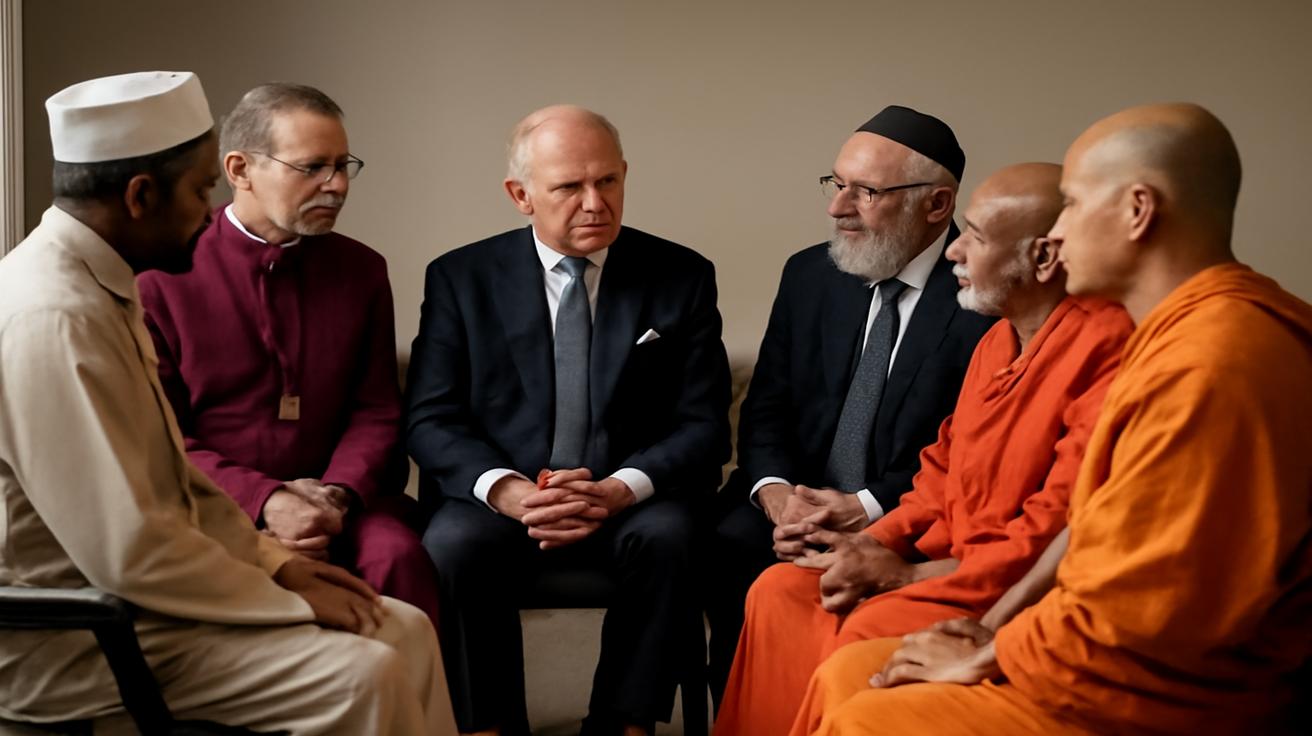
The rain had only just begun to soften when he walked in—a familiar figure, a little stooped now but somehow taller in the quiet. Cameras clicked, murmurs rippled, but for a brief moment it felt like the world outside had paused. No protests, no endless comment threads, no breaking-news banners. Just a room full of people in different colors of cloth, different languages of prayer, different stories of pain and hope, rising to their feet as King Charles III stepped forward to talk about something that suddenly felt deeply radical: respect.
A room stitched together by difference
The hall was not grand in the way royal ceremonies usually are. No trumpets, no gilded balconies. Instead, there were folding chairs, a low hum of whispered greetings, the cold scent of wet coats drying, and the soft rustle of robes and saris. A Sikh leader gently adjusted his turban. A rabbi smoothed the edge of a worn prayer shawl. A Muslim scholar leaned over to greet a Buddhist nun with a smile that melted the remaining stiffness from the air.
Here, the power was not in the furniture or the flags. It was in the closeness. Elbows nearly touching. Different holy books resting in the same row. The quiet recognition that everyone in the room carried stories of their own communities: stories of vandalized mosques and burned churches, of synagogues under guard, of temples drowned out by online storms of hate.
And yet, they had come. They had come to hear a king talk about unity in a world that feels increasingly allergic to the word.
As Charles took his place at the front, he did not begin with policy. He did not begin with blame. He began with a memory—of walking through places of worship as a younger man, taking his shoes off, bowing his head, feeling the physical weight of other people’s devotion. He spoke of incense and candle wax, of old stone and new carpets, of the human need to gather and to believe in something larger than ourselves.
Then he said the line that would echo far beyond those four walls: “Respect must be our common language.”
The fragile art of listening across belief
The room seemed to hold its breath. It’s a simple phrase, one that risks sounding like a slogan on a poster. But in that moment, spoken to people who understand what it means when respect is denied, it landed with the weight of something more like a promise—and a challenge.
In a fractured world, we have mastered the craft of speaking. We speak in all-caps. We speak in hashtags and viral clips. We speak over one another until listening feels like a lost art. But the leaders gathered here—imams, priests, humanist chaplains, rabbis, swamis, community organizers—know that genuine dialogue isn’t built on winning an argument, but on the gentler, riskier work of listening without needing to correct every word.
Charles acknowledged the tension openly. Interfaith work is messy. No one in that room agreed on everything; on some questions, they didn’t even agree on the vocabulary. But what united them was not theological consensus. It was the conviction that human dignity cannot be portioned out only to those who look, love, or worship as we do.
The king spoke not as a distant monarch but as someone who has spent decades visiting gurdwaras and synagogues, mosques and churches, temples and community halls. He has listened to stories of people who feel doubly marginalized: first by prejudice from the outside world, and then by suspicion from within their own traditions when they try to build bridges.
Unity, he reminded them gently, is not the same thing as uniformity. No one was asked to dilute their beliefs, to soften their rituals, to flatten their particularities. Instead, they were invited to do something harder: to stand firmly in their own faith or worldview and still make space for others to do the same.
When the world feels like it’s fraying
Outside the walls of that gathering, the news cycle grinds on, relentless: wars that refuse to end, rising hate crime statistics, neighborhoods turned into shouting matches over identity, borders, and belonging. Algorithms burrow deep into our fears, feeding them like kindling to a fire. It is easy—almost effortless—to believe that we are more divided than ever, that solidarity is a fragile myth from a kinder past.
In that context, a royal speech about unity could be brushed off as symbolic, ceremonial, comfortable. But it didn’t feel comfortable inside that room. It felt urgent. Interfaith leaders know that abstract “division” has very real consequences. They have led funerals after attacks on worshippers. They have stood outside sacred buildings with candles and hand-painted signs, trying to insist that this will not become normal.
Charles did not pretend that a speech could fix all of this. Instead, he turned to something more grounded: small, local acts of courage that never make it into headlines. A mosque offering space for neighbors during a heatwave. A church partnering with a synagogue to run a food bank. A temple opening its kitchen to refugees still learning the language of their new home. These are not grand gestures, but they are stitches in the fabric that holds a community together.
He encouraged those present to see themselves as guardians of that fabric. Not as gatekeepers deciding who belongs at the table, but as weavers making sure the tablecloth is wide enough for more chairs.
The quiet power of shared spaces
There is something almost sacred in the way a room changes when people gather not just to be seen, but to see one another. As Charles spoke, faces in the audience shifted from watchful to open. A bishop nodded along with a humanist who openly doesn’t share his belief in God, but deeply shares his belief in human dignity. A young community organizer, headscarf pinned with careful precision, leaned forward, eyes bright, as if trying to catch every word.
The king returned again and again to the idea of shared spaces—physical, emotional, and moral. Shared streets. Shared schools. Shared parks and buses and public squares where the symbols of many different faiths and philosophies might appear side by side.
This kind of proximity is both a gift and a test. It is easy to call for unity when everyone looks the same. Much harder when your neighbor’s holy days rearrange your traffic route, when their way of dressing confuses you, when their festivals are louder than your quiet.
But proximity is also where stereotypes come to die. It is where “them” slowly becomes “Fatima, who always remembers your child’s birthday,” or “David, who helped you carry your shopping up three flights of stairs,” or “Ananya, who makes enough sweets at Diwali to feed the entire apartment block.”
As he spoke about respect as a shared language, Charles was not asking for a bland politeness that papers over real difference. He was inviting a deeper shift: a move from mere tolerance—which can sound like “I’ll put up with you”—to genuine curiosity and care, which sounds more like “I want to understand what matters to you, even if I never fully share it.”
Stories behind the statistics
It can be tempting to talk about interfaith relations only in terms of data: percentages, surveys, polling numbers about trust and mistrust. But every number has a name, a face, a story. And those stories are often held by the very people who filled that room with the king.
| Interfaith Action | What It Looks Like | Impact on Respect |
|---|---|---|
| Shared Meals | Breaking fast together, community dinners, festival invitations | Builds trust and humanizes “the other” through everyday conversation |
| Joint Service Projects | Food banks, neighborhood clean-ups, visiting the elderly | Shifts focus from disagreement to shared responsibility |
| Dialogue Circles | Small groups discussing faith, values, and fears | Creates space for difficult conversations without hostility |
| Youth Exchanges | School partnerships, interfaith camps, shared projects | Prevents prejudice from taking root in the next generation |
| Shared Mourning & Solidarity | Vigils after attacks, joint statements, presence at funerals | Shows that pain in one community is felt by all |
These actions are quiet, almost invisible at the scale of global politics. But they are exactly the kinds of practices Charles was gesturing toward: everyday rituals of respect that can coexist with profound difference.
“Respect must be our common language”
What does it mean, really, to treat respect as a language we all share?
Languages are more than words. They are patterns of attention. To speak a language, you must sometimes adjust your tongue, your timing, your assumptions. You must be willing to feel awkward at first, to get things wrong, to be corrected.
Respect, in this sense, is not a feeling you either have or you don’t. It’s something you practice. And like language, the more you practice it across difference, the more fluent you become.
Charles’s phrase acknowledges a hard truth: we are not all going to share a creed. In that room, the only thing everyone could confidently affirm together was not a specific dogma, but a commitment to the worth of each person present—and of those not present, too. If respect is our common language, then it becomes the medium through which disagreement is carried, rather than the first casualty of it.
That means choosing words that do not deliberately wound. It means refusing to reduce another’s deeply held belief to a caricature. It means being able to say, “I disagree with you entirely, and still I will stand beside you when your community is threatened.”
The king’s call for this kind of respect is not neutral. It asks something of everyone. It asks majorities to use their comfort not as a cushion, but as a resource: to protect those more vulnerable, to listen more than they speak. It asks minorities not to surrender their identity, but to trust that extending respect does not mean erasing who they are.
When a symbol chooses sides
Monarchs are symbols whether they wish to be or not. They stand on coins, in portraits, on television screens at moments of national grief or celebration. For some, that symbolism feels remote, an echo of history more than a presence in daily life. But when a symbol chooses to stand with interfaith leaders and to publicly insist that unity is not optional, it sends a signal that ripples outward.
By speaking the language of respect, Charles is also writing himself into a longer story: one where religious and civic leaders have stood together in times of strain, refusing to let fear dictate who gets to belong. It is not a perfect story; it includes failures, exclusions, and silences. But it is also a story of unexpected alliances.
There have been moments—after attacks, during tense elections, in the wake of hateful rhetoric—when seeing an imam and a bishop embrace on the steps of a public building has spoken louder than any statement. Moments when a rabbi visiting a mosque or a priest standing guard outside a synagogue has quietly told a different story about who “we” are.
Charles’s presence and language add weight to those gestures. A king cannot legislate empathy, but he can model the posture of it: shoulders lowered, voice steady, eyes open not only to the people who look like him or pray like him, but to all those who now call his country home.
What unity looks like from the ground up
As the gathering continued, something subtle happened. The attention in the room shifted from the dais to the circle of people seated together. During breaks, clusters formed in the corners: a youth worker from one city swapping ideas with a rabbi from another; a Hindu community leader swapping phone numbers with a Muslim chaplain to connect their volunteers.
Unity, in these moments, stopped being an abstract noun and became a set of very practical questions:
- How do we respond together the next time a place of worship is attacked?
- How do we talk to young people who are tempted by extremism—or by despair?
- How do we correct misinformation about each other before it turns into something uglier?
- How do we keep showing up, even when the cameras don’t?
Charles’s role here was not to answer these questions for them, but to shine a public light on the fact that they are being asked at all. To legitimize the labor of bridge-building, which is often underfunded, undervalued, and overworked.
For those leaders, the king’s words were not an endpoint but a kind of endorsement—a recognition that what they do quietly every week matters at the highest levels of national symbolism. Suddenly, their tea-circle dialogues, their crisis calls at midnight, their patient explanations to suspicious neighbors were not just “nice extras.” They were frontline work in protecting the social fabric.
A language anyone can learn
It would be easy to watch such a gathering and think, “This is for leaders. This is for people with titles and invitations.” But the language of respect is not elite. It is spoken—or not spoken—on buses and in break rooms, in playgrounds and group chats.
Respect is in the moment a teacher pauses before making a joke about a faith they don’t understand. It is in the way a neighbor asks about a festival instead of complaining about the noise. It is in the decision to challenge a slur in a group conversation, even if it makes things awkward.
Every small act of curiosity, every moment of restraint, every time we choose to see the person before the label, we are, in our own unroyal way, answering the same call Charles issued to that room: to make respect our common language.
We may never stand in a hall with interfaith leaders and a king. But we do stand, every day, in line at the supermarket with people whose beliefs we don’t know. We sit next to them on trains, pass them in corridors, read their comments online. The question this moment poses is a simple one: what language will we use when we meet?
As the gathering dissolved and the rain outside turned to a fine mist, people drifted back into the city, each carrying their own version of the day. For some, it would be the photograph with the king. For others, a new phone number saved, a future visit promised, a line from the speech echoing in the mind.
“Respect must be our common language.” It is not a policy document. It does not solve conflict on its own. But as a starting point, as a shared ground, it feels like a breath of fresh air in a crowded, angry age.
The rest is up to us.
Frequently Asked Questions
Why did King Charles III meet with interfaith leaders?
He met with interfaith leaders to recognize their role in easing tensions, combating hatred, and fostering understanding between communities. By engaging with them directly, he highlighted that religious and community dialogue is central to social cohesion, not a side issue.
What does “Respect must be our common language” actually mean?
It means that even when people disagree on beliefs, traditions, or worldviews, they should share a basic commitment to treating each other with dignity. Respect becomes the shared foundation on which disagreement, discussion, and cooperation can happen without dehumanizing anyone.
Is this about making all religions the same?
No. The emphasis is not on erasing differences but on living with them peacefully. Interfaith work, as reflected in this meeting, encourages people to remain true to their beliefs while still protecting the rights and dignity of others.
How can ordinary people support the kind of unity discussed at the meeting?
People can support unity by challenging prejudice in everyday conversations, learning about neighbors’ traditions, joining or supporting local interfaith events, and responding to hate with solidarity rather than silence. Simple actions—like showing up for a community in grief—can be powerful.
Does this have any real impact beyond symbolism?
Yes. While the king’s role is symbolic, his support can draw attention, resources, and legitimacy to interfaith initiatives on the ground. It can encourage institutions, media, and policymakers to take seriously the work of those who are building relationships across religious and cultural lines, making it easier for them to expand their impact.






Leave a Comment