
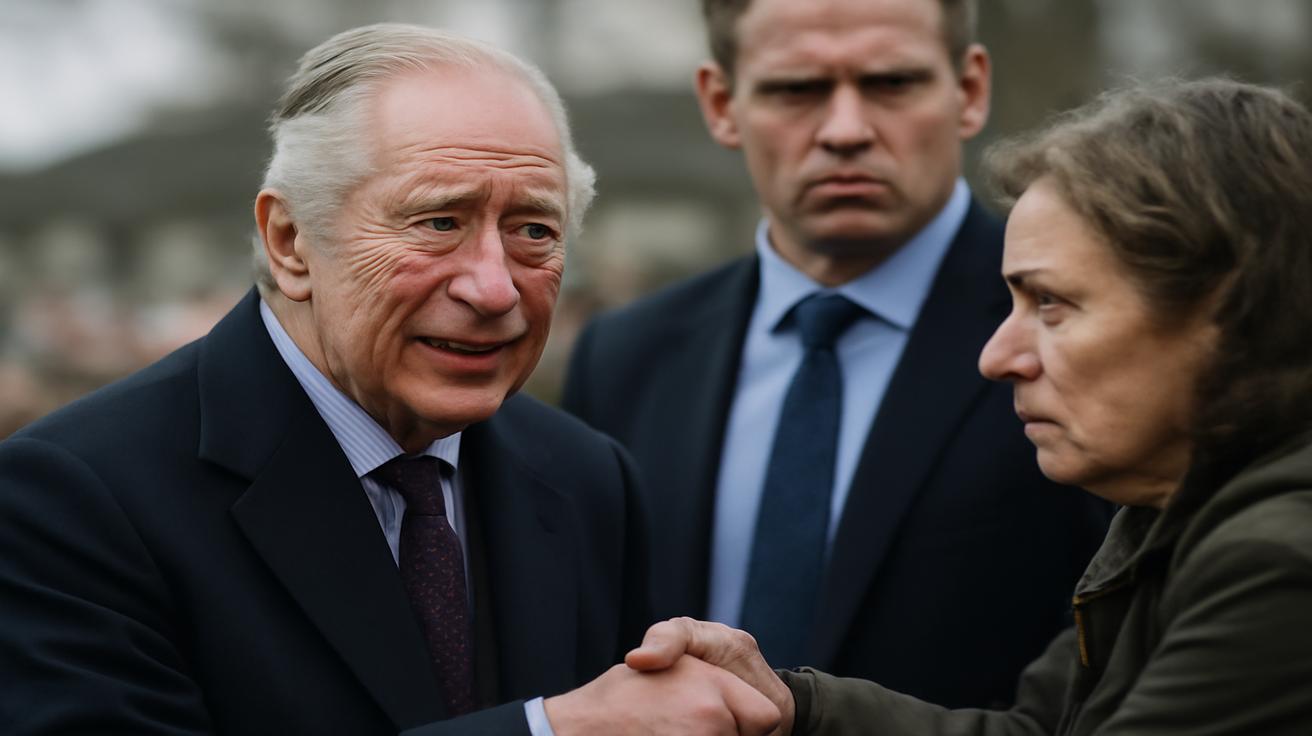
The morning begins, as it so often does in Britain, with a low sky the colour of damp wool. Outside the hospital and palace gates, cameras blink awake like metallic eyes, lenses fogging and clearing in the chill. A black car pulls up; a small wave appears at the window. For a few seconds, the nation leans a little closer to its screens. There, framed by the door, is King Charles III—thinner, paler, but upright, purposeful, and smiling with that slightly wry expression the public has come to know over decades. He steps out, buttoning his coat against the breeze, and walks toward yet another carefully arranged public duty, as the question hums in the background like an electrical current: how well is he, really—and how much of the truth are we allowed to see?
The Quiet Drama of a Monarch in Treatment
On some days, the King’s schedule looks almost ordinary on paper: a visit to a cancer treatment centre, a meeting with faith leaders, a garden walkabout, a brief audience with the Prime Minister. Lines on a page; names, times, locations. But behind each printed entry, there is a choreography of caution—doctors’ notes, security considerations, fatigue calculations, contingency plans in case the day proves too long for a body currently doing battle at the cellular level.
When Buckingham Palace first announced that Charles III had been diagnosed with cancer, the statement was measured and precise. It was not prostate cancer, though it had been discovered after treatment for an enlarged prostate. The type and stage would not be disclosed. The King would step back from major public-facing engagements for a time, but he would continue to undertake State business and official paperwork. Everything about the announcement felt carefully balanced: acknowledging the gravity, reassuring the public, guarding his privacy.
But illness—real, bodily illness—does not run on press-release timing. It moves in waves: days when the King’s face, captured on camera, seems suddenly older, and days where he appears almost his usual, brisk self, striding forward in a carefully tailored coat. As he continues to appear in public while undergoing treatment, a narrative has taken hold: is the monarchy showing us the whole story, or a curated version designed to preserve an image of continuity and control?
The Optics of Strength
Each new photograph of the King becomes its own kind of bulletin. His posture is dissected; his complexion discussed; the speed of his walk measured in social media threads and morning talk shows. One day he’s at a military base, shaking hands with soldiers; another, he’s presenting honours in a room glowing with historic oil paintings. Occasionally, he’s seen leaving a clinic, the setting more clinical white than royal crimson.
There is, undeniably, a deliberate message in this: the Crown endures. The King works on. Britain is weathering this, as it has weathered so much else. The institution is trained to translate vulnerability into pageantry—turning personal setback into a public-facing narrative of resilience.
Yet the human body does not care about optics. Chemotherapy, radiotherapy, targeted therapies—whatever combination Charles is receiving—can be exhausting in ways that are not easily hidden. There are quiet moments that never reach the cameras: the careful timing of medication, the heaviness in the limbs after treatment, the necessary pauses. The image of a monarch cutting a ribbon or sharing a laugh with a child at a charity event is only one layer of the story. The rest remains behind the velvet curtain.
What We’re Told—and What We’re Not
In earlier generations, royal illness was often wrapped in myth and euphemism. Kings “took to their beds” or “suffered from indisposition.” The public rarely received more than the vaguest hints until a death announcement rippled across newspaper ink. That opacity belongs to an older age, yet traces of it remain.
Today, British society is wired for instant updates. We follow live blogs, push alerts, gossip accounts. We expect—even demand—transparency from public institutions, especially when that institution is not elected yet profoundly influential. When the palace chooses not to disclose the exact type of cancer, critics argue that the monarchy is falling back on archaic habits: say as little as possible, control the story, reveal only what is absolutely necessary.
Supporters, however, make a different case: the King is not a spectacle, but a human being with a right to medical privacy. They point out that many patients prefer to share as much or as little as feels safe, and that Charles, who has spent his entire adult life in the public eye, might be trying to carve out a rare zone of personal dignity.
The tension lies in the overlap between two roles that cannot be easily separated: Charles the man, and Charles the monarch. One is entitled to privacy. The other embodies the state. In Britain, the health of the sovereign has historically been seen as a matter of national interest—linked, at least symbolically, to the health of the country itself.
A Quiet Table of Public Promises
Official statements, interviews, and appearances form a kind of silent contract between palace and public. Part of that contract can be sketched out, not in the language of law, but in a simple understanding of expectations.
| What the Palace Shares | What the Public Wants to Know | The Emerging Middle Ground |
|---|---|---|
| General diagnosis (cancer, but not type or stage). | Specific cancer type, prognosis, and treatment details. | Updates on his ability to perform duties, without full medical disclosure. |
| Confirmation he is receiving ongoing treatment. | How intensive the treatment is, and how he is tolerating it. | Occasional appearances that visually demonstrate his condition and capacity. |
| Notice of reduced public engagements. | Clear thresholds for when he might stand down or reduce role long-term. | Signals about shifting duties to other royals, hinting at contingency planning. |
| Images of the King working on paperwork and holding audiences. | Unvarnished insight into his day-to-day health. | Controlled but more frequent appearances that acknowledge vulnerability. |
In the gentle grey zone between secrecy and exposure, the palace is trying to stand. It offers proof-of-life photographs: the King at his red dispatch box, the King meeting ambassadors, the King sharing a light comment with a nurse. It withholds the scan results, the prognosis percentages, the ceiling of risk.
The Specter of “How Bad Is It?”
As with any serious illness, the silence between official updates becomes fertile ground for speculation. In quiet kitchens, on crowded buses, across late-night radio call-in shows, people mull over the same whispered question: are we being told the whole story?
The monarchy’s critics, already skeptical of an unelected head of state funded by public money, sharpen their focus. They point to the long history of royal health being softened or disguised for public consumption. They remember the late Queen’s “mobility issues” that were never fully explained, or earlier eras when kings vanished from view for months, with only whispers of “nervous strain” or “digestive trouble” to fill the gap.
In a time when transparency is touted as a democratic virtue, any hint of withholding fuels suspicion. Is the King’s cancer more advanced than admitted? Are his public appearances brief highlights in otherwise difficult weeks? Has the institution decided that a steady drip of optimistic imagery is better for national morale than the raw truth of a 75-year-old man wrestling with a disease that does not bow to status?
The Emotional Weather of a Nation
Beneath the political and constitutional debate, there is a simpler truth: many people are just worried. Worried in the way you might be for an elderly neighbour who still insists on taking out the bins in the rain. Charles has been a visible figure for so long—first as the serious young Prince of Wales, then as the middle-aged environmentalist, then as the unexpectedly widowed ex-husband, and now as the grey-bearded King who finally got the job he had waited a lifetime to inherit.
For some, his illness stirs memories of other national vigils. The last illnesses of the late Queen. The day the news broke about Princess Diana in Paris. More recently, the public shock at the Princess of Wales’s own cancer diagnosis and the swirl of gossip and online conspiracies that preceded it. Royal health has become a kind of weather system over the British psyche—something you feel even if you claim not to care.
In homes where family members are also fighting cancer, the King’s condition takes on a different weight. They watch him shake hands and smile and they know, maybe more than anyone, what he is not showing. The nausea, the bone-deep tiredness, the nights when sleep won’t come. The peculiar blend of hope and fear that attends every hospital appointment.
Monarchy Under the Microscope
Illness has a way of shrinking life down to the essentials, but it can also enlarge the questions that hang around the edges. As Charles continues his public duties, the conversation about the very nature of monarchy intensifies.
What does it mean for a modern constitutional monarchy when its head is visibly unwell? Should the system have clearer protocols for a regent stepping in—not just temporarily, but in a more structured way when serious illness strikes? Is it fair, or even humane, to expect an older man in cancer treatment to carry the weight of ceremony, diplomacy, and symbolism that the role requires?
The British constitution, unwritten and famously flexible, relies heavily on convention and precedent. Kings and queens have navigated ill health before. George VI struggled with lung cancer and heart problems while trying to maintain a reassuring public presence in the fragile years after the Second World War. His effort to appear strong, some historians argue, came at a personal cost, and his early death at 56 reshaped the monarchy for generations.
The difference now is that this drama plays out not in the slow-moving world of printed newspapers and crackling radio, but under the relentless, instant glare of digital scrutiny. Every apparent tremor in the King’s hand, every cancelled engagement, every slightly stiff expression is noticed, clipped, shared, and endlessly interpreted.
The Heir in the Wings
Hovering just offstage in this story is another figure: Prince William, the heir apparent. His role subtly shifts as his father’s health becomes part of the national conversation. He steps in for certain events, presides over investitures, takes on more visible duties that hint at the long arc of succession.
For some observers, this gradual adjustment feels reassuring—a sign that the institution is quietly planning for every outcome. For others, it raises uncomfortable questions: if the King’s illness is serious enough to necessitate this redistribution of duties, shouldn’t the public be told more clearly? Or is this simply the natural evolution of a monarchy in which the next generation must slowly shoulder the load, illness or no illness?
The palace, for its part, projects calm continuity. No talk of abdication, no whispers of regency. Only the familiar language of “ongoing treatment” and “light duties” and “good spirits.” It is a lexicon designed to soothe, even as the uncertainties of cancer rumble under the surface.
Between Symbol and Human Being
Walk for a moment, in your imagination, behind the cameras. Strip away the microphones, the bright lights, the practiced choreography of a royal visit. What remains is a man in his mid-seventies walking through a hospital corridor that smells of antiseptic and overboiled coffee. The King shakes hands with patients wearing thin cotton gowns, some with cannulas taped to their skin. He pauses at one bedside, listening as a woman, voice trembling, describes her first round of chemotherapy.
He is, in this moment, both monarch and fellow patient. His suit is immaculate, his tie perfectly knotted, but under the fabric his cells are waging their own fraught battles, much like hers. He speaks about hope, about the excellence of the medical teams, about gratitude. The cameras capture the public-facing hymn to resilience. They cannot easily capture whatever private fear flits quickly across his eyes as he listens.
This is the paradox at the heart of the current moment. The monarchy is built on the idea of constancy, of a figure who stands slightly apart from the ordinary turbulence of life. And yet here is that figure, unmistakably mortal, facing an illness that pays no attention to coronation oaths or centuries of tradition.
For some, this makes the King more relatable, more human. For others, it underscores the fragility of an institution that invests so much symbolic weight in the health and presence of a single individual. If the King falters, even temporarily, what happens to the story Britain tells about itself?
A Future Written in Uncertain Ink
As the weeks pass and Charles continues his careful procession of duties, the narrative will keep evolving. There may be periods when he appears more frequently, buoyed by a treatment phase that is gentler on his energy levels. There may be stretches of conspicuous absence, explained by “private recuperation” or “doctor’s advice to rest.” Each public moment will be read like a weather forecast: are things improving, or is a storm gathering beyond the visible horizon?
The monarchy, ever sensitive to symbolism, will lean on familiar rituals for reassurance—the Trooping the Colour flypast, the balcony appearances, the Christmas broadcast. In each of these, the King’s presence or absence, his posture, his tone of voice will become quiet indicators of how he is faring.
Yet there is another possible outcome hidden inside this fraught chapter. By continuing to appear in public while openly undergoing cancer treatment, Charles may unintentionally help to normalize something that is still, for many, shrouded in fear and silence. Seeing a head of state balancing work and illness, acknowledging treatment, moving more slowly but still moving, could chip away at some of the stigma that clings to the disease.
He did not choose this role—no one chooses to be a symbol of mortality in such a public way—but circumstances have placed him there. The question now is not only how severe his condition really is, but how honestly the monarchy will allow that reality to be seen, and what that honesty—or lack of it—will mean for the bond between Crown and country.
Outside, the clouds thicken, then break. Another car door opens. Another carefully managed appearance unfolds. Another day in which a very old institution tries to look unshaken, even as a very human King walks the narrow path between privacy and public duty, each step watched, measured, and quietly worried over by millions.
Frequently Asked Questions
What type of cancer does King Charles III have?
The palace has confirmed that the King has a form of cancer discovered after treatment for an enlarged prostate, but it has chosen not to disclose the specific type or stage. This decision has sparked debate about the balance between royal privacy and public transparency.
Is King Charles still carrying out his royal duties?
Yes, he continues to carry out State business, including official paperwork, audiences, and selected engagements. However, his schedule has been adjusted, with a reduction in major public-facing events to accommodate his treatment and recovery.
Why do some people think the monarchy is hiding the severity of his condition?
Critics point to the limited medical details provided, the monarchy’s historical tendency to downplay royal illness, and the carefully curated nature of the King’s public appearances. These factors fuel concerns that the full seriousness of his condition may not be publicly acknowledged.
Does the public have a right to know full details about the King’s health?
Opinions are divided. Some argue that, as head of state funded by public money, the King’s health is a matter of national interest. Others maintain that he remains an individual entitled to medical privacy, and that only his capacity to perform constitutional duties needs to be clear.
Could King Charles step back or appoint a regent if his health worsens?
There are constitutional mechanisms that allow for a regency if a monarch becomes unable to perform essential duties. However, there has been no indication from the palace that such steps are being considered. For now, responsibilities are being shared more widely among senior royals while the King continues in his role.





Leave a Comment