
The news broke on a soft, gray morning — the kind of sky that makes you want to stay inside and drink something warm. Kate Middleton would be returning to public life, the headlines declared, after months of silence, speculation, and worry. Within minutes, push notifications lit up phones around the world. TV anchors pivoted mid-sentence. Social feeds tilted in one direction, like birds turning on a sudden gust of wind. And somewhere in London, a woman who had been quietly trying to get well, to be a mother and a patient instead of a princess, became once again a global event.
The Day a Walk Becomes World News
Imagine, for a moment, what it feels like to know that your first appearance after a serious illness will be photographed from every possible angle, slowed down frame by frame, and parsed like a crime scene. A step out of a car becomes not just a step, but a symbol. The tilt of your head is measured for “confidence” or “frailty,” the color of your coat read like a coded message. Did she choose blue to signal resilience? Is her smile “genuine” or “strained”? Even the wind, if it catches your hair the wrong way, might become a metaphor.
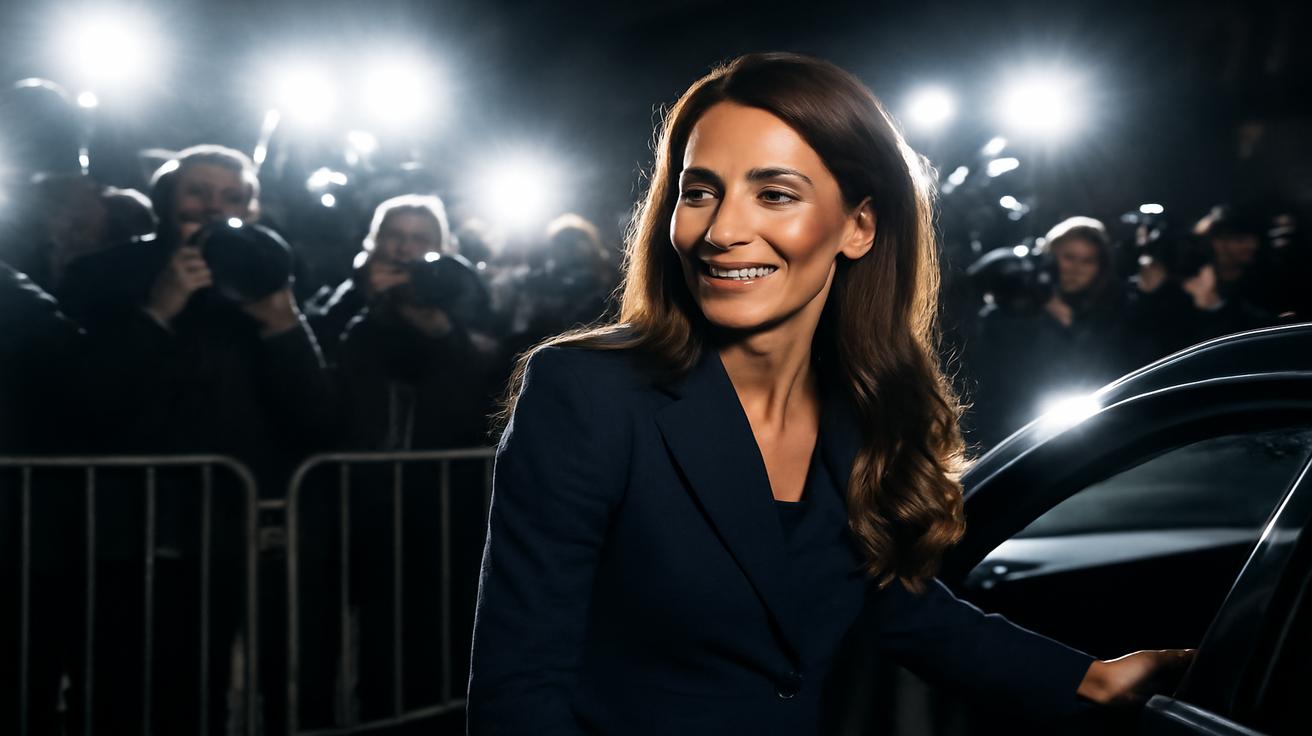
On that day, the air outside the venue was restless. Cameras arrived hours early, their tripods fanning out like metallic legs on the pavement. Lenses were polished, microphones tested, cables wound and unwound with the repetitive nervousness of people waiting for something big to happen. Producers checked their watches. Reporters rehearsed their opening lines in low, urgent voices, trying to balance reverence and scoop, empathy and edge.
By the time the car carrying the Princess of Wales pulled up, the crowd had swelled into a living barometer of public curiosity. Some people clutched flowers; others clutched phones. A few held homemade signs with messages of support. Police officers shifted their weight from one foot to the other, scanning faces, routes, escape paths. Above the murmur of conversations, there was that unmistakable sound of anticipation — a collective breath, half hope and half hunger.
When Kate stepped out, the camera shutters sounded like a sudden rain on tin. Clickclickclickclickclick. Those first seconds — the way she turned toward the waiting crowd, the small wave, the familiar but slightly tentative smile — were instantly beamed to televisions and timelines on every continent. In living rooms and break rooms and subway cars, people watched and weighed what they saw, often with a startling sense of personal investment. Is she okay? Does she seem thinner? Tired? Brave? Is it too soon? Is it not soon enough?
When Compassion Starts to Look Like Surveillance
There is a strange intimacy to watching a public figure in private pain. Illness is something most of us experience in small, contained circles — family, friends, perhaps a few colleagues. We retreat, by instinct, when the body falters. Curtains are drawn, routines shrink, voices drop. So when someone’s weakest moments are dragged into the light of global scrutiny, the whole thing feels off-kilter.
The story around Kate Middleton’s absence and return has been thick with words that sound kind: concern, care, support, sympathy. People write that they’re praying for her, thinking of her, wishing her strength. They mean it, often deeply. And yet this concern has traveled on the same roads as rumor, obsession, and a kind of relentless amateur detective work that would feel invasive in any other context.
Search any social platform during the height of the speculation and the screen turns into a hall of mirrors: threads dissecting her medical possibilities, zoomed-in photos of hospital entrances, sleuthing over reflection patterns in car windows. “I’m just worried about her,” many users would say, then share a video slowed down and color-corrected to better see the tension around her eyes.
It’s here, in that gap between what we tell ourselves — that we are being compassionate — and what we actually do — consuming every detail of another person’s suffering — that the line starts to blur. We are not just sending good wishes into the ether; we are refreshing for updates, chasing rumors, assigning meaning to silence. We are, in a sense, turning someone’s convalescence into a serialized drama.
The Media Machine We Pretend We Don’t Power
It’s easy to blame “the media” as if it were some creature living in a separate ecosystem, feeding on its own strange diet. But the cameras outside that building, the extended specials, the “expert” panels — they do not appear in a vacuum. They exist because we watch. Every click, every view, every share is a quiet little vote that says: yes, more of this.
Newsrooms track data in real time. When a story about a royal appearance soars to the top of the chart, that becomes the story to chase. When a grainy photo of Kate leaving a clinic racks up millions of views, editors make decisions: assign another photographer, commission a timeline, book a body language analyst. The spectacle does not simply descend upon us; we participate in building it, brick by fascinated brick.
And yet, we also recoil. Many viewers feel a pinch of discomfort watching reporters stand outside a hospital, filling the air with speculation because there is nothing new to say. We cringe a little at tabloids blaring headlines about “Brave Kate” or “Sad Kate” or “Secret Struggle,” as if a human being’s internal life could be packaged into a three-word slogan. It is a familiar loop: we consume what unsettles us, then disown our part in its creation.
A Princess, A Patient, A Person
Beneath the titles and the choreography of royal events, there is still a person who has to put one foot in front of the other. The reality of illness — any illness, no matter how carefully worded in official statements — has a texture that never fully shows up in photographs. It is the sound of hospital corridors in early morning, too bright and too quiet. The smell of disinfectant. The paperwork. The awkward, practical conversations about who will pick the children up, who will update the family, who will do the talking when you don’t have the energy.
Kate’s supporters often describe her as “stoic,” “graceful under pressure,” “a stabilizing force.” Those qualities, celebrated in glossy profiles, become expectations when she is unwell. If she looks composed, we say she is “strong.” If she looks tired, we whisper about how bad things must be. Somewhere between the royal role and the human body sits a near-impossible task: be vulnerable enough to satisfy public curiosity and compassion, but not so vulnerable that people become frightened, turned off, or overly speculative.
Her return to public life demands an almost theatrical balancing act. Appear too soon, and it seems like she is performing wellness for the cameras. Wait too long, and the vacuum fills with invented narratives. When she does reappear, every aspect of that presence — from the length of the engagement to the sharpness of her cheekbones — becomes its own micro-story. The person, meanwhile, is likely just trying to make it through the day without pain or exhaustion overshadowing everything.
The Silent Parts We Never See
There are gaps in any public story, and illness makes those gaps wider. What we don’t see in the footage of Kate shaking hands and accepting bouquets are the logistics wrapped around those minutes of visibility. The rest beforehand. The debrief afterward. The check-ins with doctors or staff. The calculation: can I stand this long, smile this much, listen with focus, and still have something left when I go home to my children?
For most people navigating a serious health issue, returning to “normal life” means small, private experiments: trying to work a few hours, meeting a friend for coffee, walking around the block. For a royal, it means stepping into a space that has been pre-lit, pre-planned, and pre-judged, where the margin for spontaneity is almost nothing. The cost of misreading her condition, for both the institution and the audience, feels high. So everything is rehearsed — and then dissected, anyway.
Why We Care So Much About Someone We Don’t Know
The royal family occupies a peculiar place in the global imagination. They are at once real people and mythic characters, stitched into stories that began long before any of us were born. Kate Middleton, in particular, has carried a special narrative weight: the “commoner” who married into ancient power, the modern mother who seems to bend seamlessly between photo calls and school runs, the figure of poise in a family often rocked by scandal.
When someone like that disappears from view, we feel the crack in the story. It unsettles us in ways that don’t always make sense. We may never meet her, but we think we know her, because we’ve seen her laugh with her children, stand beside her husband at ceremonies, greet crowds in the rain. Her absence feels not just like missing news, but like an interruption in a long-running series we’ve been following for years.
So when she returns, it’s staged — consciously or not — as a kind of resolution. The arc bends back toward continuity. The princess is back. Things are okay again, or at least okay enough to be photographed. In this way, her health becomes a stand-in for stability, for the reassuring idea that life’s storms can be weathered gracefully, with good coats and firm handshakes.
The Comfort and Cost of Distance
This is one of the paradoxes at the heart of modern monarchy: its power rests on distance and familiarity at the same time. We need them to be a little above us, a little raised on that balcony, or the entire pageantry crumbles. But we also need them to feel human enough that their joys and pains echo our own. When Kate speaks even briefly about struggles — motherhood, mental health, now illness — we feel that echo and rush to it. It confirms that the golden lights of palaces do not shield anyone from life’s harder chapters.
Yet every disclosure comes at a cost. When you open a door, even a crack, people peer in further. They ask for more detail, more access, more updates. “You shared this,” the logic goes, “so why not that?” Compassion morphs again into entitlement, and entitlement into the low-level fever of obsession.
How the Story Shapes Our Own Boundaries
The spectacle around Kate Middleton’s return doesn’t exist in isolation. It reflects, and then amplifies, the way we relate to other people’s pain in the digital age. We watch public figures navigate illness and grief in real time, and some part of us learns that suffering is now a visible, sharable, even brandable experience. We internalize that template without realizing it.
Think of how many people feel pressure to post about their hospital stays, their diagnoses, their worst days — not because they necessarily want to, but because silence now looks suspicious. If you’re not explaining, are you hiding something? If you don’t document your recovery, are you ungrateful, unbrave, not “inspiring” enough?
The royal spectacle is an extreme version of something more ordinary: the erosion of privacy as a neutral state. Kate’s illness became a global guessing game not only because she is a princess, but because we live in a culture where any empty space of information is immediately seen as a problem to be solved, a puzzle to crack, rather than a boundary to respect.
The Thin Edge Between Care and Control
At the heart of this is a simple but uncomfortable question: when we say we care about someone we do not know, what do we actually mean? Care, in its healthiest form, respects distance. It recognizes the right not to share, not to perform, not to respond on cue. Control, on the other hand, dresses itself up as concern while demanding access and answers.
The roar of attention around Kate’s return — the breathless live coverage, the instantly dissected photos, the commentary about whether she chose the “right” moment — leans heavily toward control. It suggests that her body, her timeline, and her choices are, to some degree, public property. And every time we click with that mindset, we help to reinforce the idea that a public role cancels out private rights.
Choosing What Kind of Audience We Want to Be
There is no way, at this point in history, to undo the global fascination with royal lives. The cameras will keep rolling. The columns will keep being written. Kate Middleton’s every public step for the foreseeable future will continue to carry double weight: as a woman recovering from illness, and as an emblem of an institution that depends on visibility.
But we do have a say in what kind of audience we become. We can begin by noticing the difference between staying informed and hovering. Between reading an official statement and trawling for leaked footage. Between saying “I hope she’s okay” and demanding proof that she is.
We can also hold two truths at once: that public figures, especially those supported by public money and symbolic power, will inevitably face scrutiny — and that there must still be red lines we will not cross. Hospital doors. Children’s faces at vulnerable moments. Medical details shared without consent. These are places where compassionate curiosity should give way to deliberate restraint.
A Quieter Kind of Solidarity
In the end, someone like Kate Middleton does not need our analysis. She does not need our theories, our timelines, or our annotated breakdowns of her posture. What she might need — what anyone in a similar position might need — is the space to have a life that is not a constant feed.
That space is not something she can create alone. It requires a collective softening of our gaze. It requires media outlets to make decisions that rank decency above engagement metrics. And it requires us, as the always-on audience, to sit with the discomfort of not knowing everything, not seeing everything, not consuming every moment of someone else’s journey.
Her return to public life will keep being photographed, wrote about, televised. The spectacle is here to stay. But inside that spectacle, there is still a person trying to move through the world, to heal, to mother, to inhabit her own skin. Perhaps the most radical thing we can do, watching from a distance, is resist the urge to turn every step she takes into evidence — and instead, let it simply be a step.
| Aspect | Compassionate Response | Intrusive Response |
|---|---|---|
| Information | Accepts official updates and acknowledges the right to privacy. | Demands detailed medical disclosure and chases rumors. |
| Media Consumption | Avoids content that feels exploitative or speculative. | Clicks on every “leak” and unverified “sighting.” |
| Commentary | Speaks with empathy, resists judging appearance or timing. | Analyzes body language and appearance as if they were data points. |
| Expectation | Allows for rest, setbacks, and limited public presence. | Expects constant visibility and emotional transparency. |
| Impact | Helps normalize boundaries even for public figures. | Reinforces the idea that illness must be performed for public approval. |
Frequently Asked Questions
Why has Kate Middleton’s return attracted so much global attention?
Her role as Princess of Wales, combined with months of uncertainty about her health, created a powerful mix of concern, curiosity, and longstanding fascination with the royal family. That combination turned what might otherwise be a modest return to public duties into a global media event.
Is public interest in her health automatically a form of intrusion?
Not necessarily. It’s natural to feel concern for a well-known public figure. It becomes intrusive when interest shifts from wishing her well to demanding access, analyzing her every move, or spreading unverified information about her condition.
How do media organizations contribute to the sense of spectacle?
Media outlets amplify attention through live coverage, constant updates, speculative panels, and emotionally loaded framing. They respond to audience demand, but also shape it, turning a personal health journey into a rolling narrative designed to keep viewers engaged.
What role do social media users play in blurring the line between compassion and intrusion?
Users drive the cycle by sharing posts, engaging with rumors, and dissecting photos or videos. Even when motivated by concern, this behavior can increase pressure on public figures and reward outlets that push ethical boundaries.
Is it possible to follow stories like this in an ethical way?
Yes. It means relying on verified information, avoiding clickbait and invasive content, resisting speculation about private medical details, and accepting that some aspects of a public figure’s life — especially health — are not ours to know.
Why does Kate’s story feel so personal to people who have never met her?
Years of coverage have made her seem familiar, almost like a distant acquaintance. Her experiences with marriage, motherhood, and now illness mirror many people’s own lives, creating a sense of emotional connection that can easily slide into over-identification.
What can individuals do to support healthier media boundaries around public figures?
On a small but meaningful scale: choose not to click on invasive stories, avoid sharing speculative content, question coverage that feels exploitative, and remember that even the most photographed people are entitled to parts of their lives that are not on display.




Leave a Comment