
The video opened not with trumpets or balcony waves, but with wind in the trees and the soft creak of a garden bench. No ballroom, no polished palace corridor—just a princess in a striped sweater, framed by bare branches and early spring light. Catherine, Princess of Wales, sat with her hands gently folded, looked straight into the camera, and said the word that the royal family has spent lifetimes sidestepping in public: “cancer.” In that moment, the centuries-old choreography of royal distance cracked, and something startlingly modern stepped through.
The Day the Silence Broke
For weeks, the absence had throbbed louder than any public appearance. Kate, usually the polished center of royal photo calls and school runs, had vanished into the gaps between official statements. The palace said she’d undergone “planned abdominal surgery.” Then: months off. No images. No casual sightings. In the information vacuum, social media filled the space with pixelated conspiracies and TikTok sleuthing, a global guessing game played over a woman’s body.
The royal family, historically trained to rise above gossip by ignoring it, found themselves trapped in a world that no longer lets power stay silent. From Twitter threads to YouTube breakdowns, the question—Where is Kate?—mutated into something uglier: is the palace hiding something, and why?
When Kate finally appeared, speaking in measured, almost fragile cadences, the noise stalled. Here was the answer, not delivered by a spokesperson or press release, but by the future queen herself. Chemotherapy. A diagnosis that came as a shock, even to her. A quiet admission of fear, of needing time, of asking for privacy in a world that devours public figures alive.
In those brief minutes, the narrative surrounding the British monarchy tilted. This was not just about one woman’s illness; it was about how power, tradition, and the future of the Crown collide in an era that demands transparency as relentlessly as it refreshes its feeds.
The Weight of a Future Crown
It is impossible to separate Kate Middleton the patient from Catherine, Princess of Wales, the institution. Her personal diagnosis ripples outward, touching not only her own family but the line that determines who will one day wear the crown.
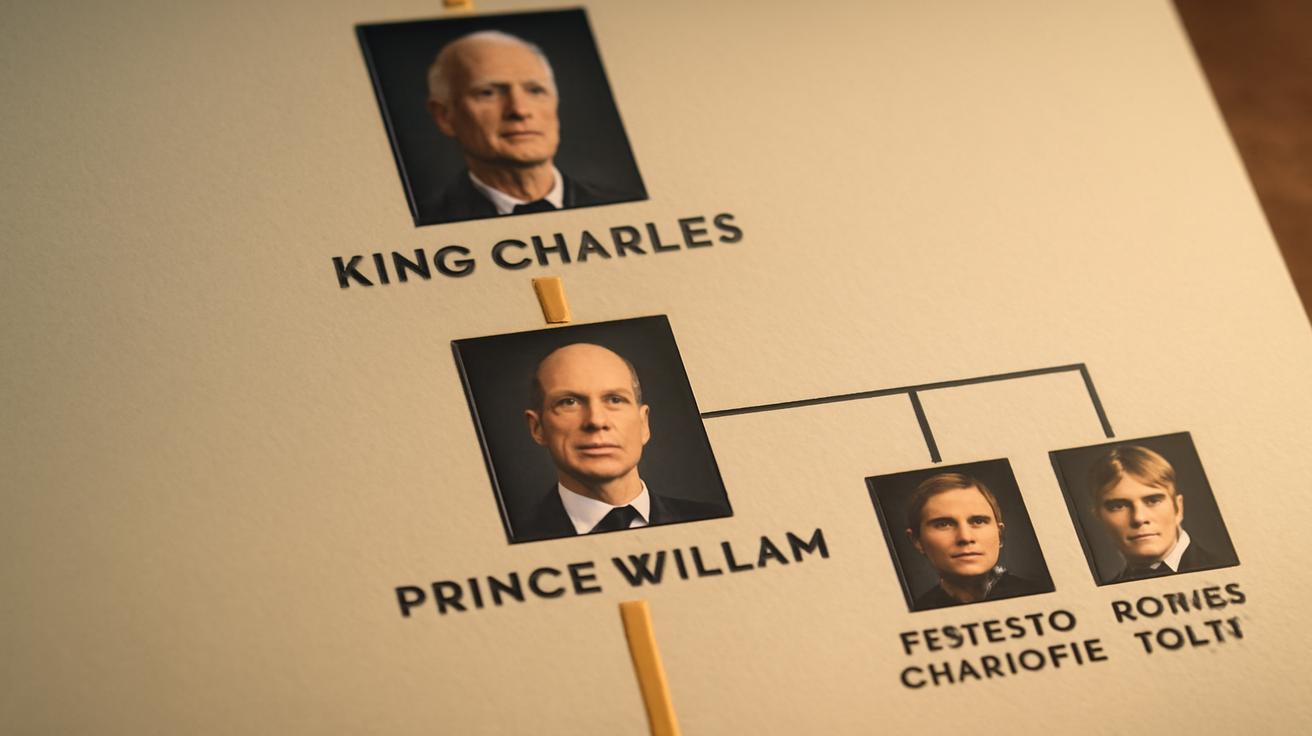
On paper, the succession is simple—almost brutally so. It doesn’t care about human stories, only birth order and law. Yet behind the clean lines of diagrams and constitutional language is a deeply human arc: a grandmother lost, a father crowned, a mother taken ill, three young children in the shadow of something they are too young to fully understand.
To understand how her diagnosis threads through that story, it helps to see the current order not as a list, but as a fragile, living thing.
| Position | Royal | Role in the Future of the Crown |
|---|---|---|
| 1 | Prince William, Prince of Wales | Heir apparent, expected to become king after Charles III. |
| 2 | Prince George of Wales | Second in line; a child slowly being introduced to royal duties. |
| 3 | Princess Charlotte of Wales | Third in line; symbol of modern, gender-equal succession rules. |
| 4 | Prince Louis of Wales | Fourth in line; a “spare” in a post-spare era. |
| 5 | Prince Harry, Duke of Sussex | Still in the line despite stepping back from royal duties. |
In this list, Catherine appears nowhere. She will never be queen in her own right; she will always be queen consort, the wife of a king. Yet culturally, symbolically, and emotionally, she stands at the center. She is the thread tying William’s looming kingship to George’s distant, abstract future, and the emotional ballast for a generation of royal watchers who saw her not as an untouchable aristocrat, but as someone who once shared a university hallway, a student house, a normal life.
Her illness does not rewire the actual rules of succession, but it does redraw the public story that hangs around those rules. The fairy tale of the stable, smiling young family who would gently and steadily modernize the monarchy has fractured. Now, we are looking at something messier, more fragile, and unexpectedly human: a future king spending nights at a hospital bedside; three heirs growing up with the vocabulary of oncology and treatment cycles; a nation realizing that even its most carefully curated figures bleed, bruise, and fear.
Transparency by Necessity, Not by Choice
The British monarchy has always clung to its mystique as fiercely as it holds its jewels. “Never complain, never explain”—the old mantra floats like a ghost over past scandals, illnesses, and tragedies. When George VI had lung cancer, the word was scrubbed from official statements. When the Queen Mother underwent surgery, euphemisms did the work of truth. The veil protected the Crown, even if it left the public quietly guessing.
This era is different. Transparency is no longer a noble gesture; it is a survival strategy. Kate’s diagnosis, announced not via a single stiff press release but through a carefully crafted, deeply personal video, felt like a pivot. Not toward full openness—this is still the House of Windsor—but toward something that resembles modern accountability.
The timing of that video tells its own story. Initial statements in January emphasized “planned surgery” and a long recovery, but not the specter of cancer. Weeks later, after the online frenzy hit fever pitch, after even edited Mother’s Day photographs were dissected and dismissed, the palace recalibrated. It was as if the institution recognized that its old muscle memory—stay silent, ride it out—no longer works when the world can crowdsource speculation at scale.
So the princess spoke. She didn’t release medical notes or stage hospital corridor photos. Instead, she chose an environment that matched the tone the monarchy wanted to project: natural, calm, controlled. You could almost hear the rustle of the bushes behind her, the distant murmur of London traffic disguised by birdsong. The visual language was clear: human, vulnerable, but not chaotic. Unwell, but not undone.
Yet beneath the framing and the carefully chosen sweater, the message was radical by royal standards. Kate not only named cancer, she described the emotional shock, the delay between surgery and diagnosis, the need to tell her children slowly and gently. She acknowledged the difficulty of living this deeply personal experience under a spotlight. That kind of candor has been rare in a family that usually reserves its emotional honesty for private courtyards and tightly closed drawing rooms.
Two Patients, One Crown: A Parallel Story with the King
Layered over Kate’s revelation is another story still unfolding: King Charles III’s own cancer diagnosis. Within weeks, the monarchy’s past and future were both tethered to hospital appointments and oncology briefings. For the first time in living memory, the sovereign and the woman expected to be the next queen consort were simultaneously undergoing treatment.
It is almost novelistic: the aging king, who waited seventy-three years to wear the crown, now having to step back from public duties while confronting his own mortality; his daughter-in-law, for years described as the monarchy’s most steadying presence, suddenly navigating an illness that doesn’t respect titles or timelines.
This dual vulnerability has forced the institution into a kind of reluctant openness. Bucking centuries of tight-lipped discretion, the palace confirmed Charles’s cancer, clarified that it was discovered after treatment for an enlarged prostate, and shared the broad shape—though not the specific type—of his treatment. The tone was careful but unusually detailed, a nod to the reality that a head of state’s health is no longer seen as purely private.
Kate’s announcement followed a similar pattern, but it felt even more personal. Unlike the King, she occupies a cultural space infused with maternal imagery, youth, and vitality. The public had grown used to seeing her at school gates, sports days, and ribbon cuttings, the royal who could crouch down to a child’s eye level without losing a shred of composure. To see her speak of chemotherapy shattered the illusion that the next generation of royals would somehow be immune to the frailties that stalked their predecessors.
Together, their illnesses create an uncomfortable but necessary question: how does a hereditary institution—rooted in lineage, continuity, and spectacle—adapt when the human bodies that carry its symbols are visibly vulnerable? The answer, it seems, is inching toward a new, if unsteady, balance of candor and control.
Children in the Line of Succession, Children in the Crosshairs
In the middle of this all are three small figures with wide eyes and carefully parted hair: George, Charlotte, and Louis. To the world, they are positions in a line. To their parents, they are children who needed to be told that their mother is ill—gently, in language suited to bedtime, not statecraft.
Kate spoke about this directly: the time they took to explain what was happening, the emphasis on her getting better, the reassurances that she was “well” and focused on full recovery. Between those lines is another narrative: of a family trying to preserve fragments of normalcy for children who cannot escape cameras even at school gates.
For George, second in line to the throne, the weight is heavier than most can imagine. His childhood is not only a private journey but a public apprenticeship. Every time he appears—at a coronation, a balcony, a football match—commentators dissect what his expression might say about the future of the Crown. Now, he must absorb the existence of cancer not as an abstract concept, but as a presence in his own home.
Charlotte and Louis, meanwhile, occupy an increasingly complex space: essential to the story, but not essential to the institution’s continuity. The rules of succession, changed in 2013, ensured that Charlotte would not be bumped down the line by a younger brother. It was billed as a modern win for equality. But the emotional reality is more subtle. All three children are being raised in full view of a public that has watched the monarchy’s “spares” struggle in different ways.
Kate’s illness reframes their story. It forces the palace to tread more carefully around their public visibility—how much they work, how much they are seen, how much of their private grief is allowed to become public content. Every photograph now arrives with a twin responsibility: to reassure the nation that the family is coping, and to protect the children from being reduced to symbols of resilience.
A Monarchy Learning to Speak Human
In the weeks after the announcement, the atmosphere around royal reporting changed. Headlines that once speculated wildly about Kate’s whereabouts now carried words like “empathy,” “privacy,” “recovery.” Even some of the harshest critics of the Crown paused, if briefly, at the reality that illness does not check political opinions before arriving.
Yet the deeper shift lies not in sympathy, but in expectation. The British public—and, by extension, the world—has been schooled by modern life to crave authenticity. Politicians share family stories; celebrities film themselves waking up from surgery; influencers narrate their therapy journeys. In that context, the monarchy’s traditional distance can feel cold, even suspicious.
Kate’s video did something the institution has long resisted: it made the royal story legible in human terms. Not as a fairy tale, not as a scandal, but as something closer to the truth that most families will recognize—bad news in a doctor’s office, sleepless nights, rewriting the future quietly over kitchen tables.
This doesn’t mean the palace has suddenly become transparent in the way a democratic institution is. We still do not know the specific cancer, the prognosis, the detailed timeline. But the bar has been raised. If the monarchy expects the public to emotionally invest in its continuity, it must now accept that people will also demand honest glimpses into its vulnerability, not just its pageantry.
Behind the scenes, advisors and courtiers are almost certainly recalibrating: What kind of health information should be shared, and when? How do you acknowledge suffering without inviting intrusion? How much humanity can the Crown display without eroding the mystique that keeps people lining the Mall in the rain, craning for a glimpse of a carriage?
Cancer, Continuity, and the Story We Tell Ourselves
Stand back far enough, and the entire spectacle of monarchy looks like a story about time. About how a nation convinces itself that something unchanging sits at the center of all its upheaval. Coronations, jubilees, balcony waves—they all whisper the same promise: the Crown endures.
Kate Middleton’s cancer diagnosis punched a small, necessary hole in that illusion. Not in the institution’s ability to function, but in the myth that the people who carry its symbols are somehow protected by them. Watching her speak from that bench, you could feel the quiet collision between two timelines: the ancient one, engraved into ritual and law, and the very modern one, measured in treatment cycles, scan results, and recovery periods.
It is tempting to ask whether this will truly “reshape” the line of succession. The answer, strictly legally, is no. Unless something catastrophic and improbable happens, the crown will pass from Charles to William to George, whether or not the public sees every twist in their private lives.
But the narrative around that line—the lens through which the world sees it—has shifted. The next generation of royals will not only inherit titles and estates; they will inherit an expectation of transparency forged in moments like this, when silence felt less like dignity and more like evasion.
In the seasons to come, there will be more staged photos, more balcony appearances, more carefully worded updates. There will be days when the palace feels like it has slipped back into the old script. But something has changed. We have seen a future queen admit she is scared. We have watched a royal family navigate the raw, unphotogenic fog of serious illness in near real time. The story of succession is no longer just about who stands where on a diagram. It is about how those people move through something as ordinary—and as devastating—as disease.
Some evening, years from now, George may stand on a balcony not as a child, but as a prince on the edge of kingship. The crowd below will cheer, cameras will flash, and the machinery of monarchy will spin as smoothly as ever. Yet behind that choreography, there will linger the memory of benches and whispered hospital visits and a mother in a striped sweater, asking the world to understand that before she was a symbolic figure, she was human.
That, more than any change in law or title, is how Kate Middleton’s cancer diagnosis is reshaping the royal narrative: not by rewriting the line of succession, but by insisting that we see the human pulse beneath it.
FAQ
Does Kate Middleton’s cancer diagnosis change the official line of succession?
No. The line of succession is determined by law, primarily by birth order and legitimacy. Kate’s health does not alter the fact that Prince William remains first in line, followed by Prince George, Princess Charlotte, and Prince Louis.
Why did the royal family choose to speak publicly about her diagnosis?
The palace likely recognized that intense speculation, misinformation, and online conspiracy theories had spiraled in Kate’s absence. A personal statement from her, naming cancer directly, was a way to regain control of the narrative and ask for privacy while acknowledging public concern.
How does King Charles III’s illness factor into this new transparency?
With both the monarch and the Princess of Wales undergoing cancer treatment, the royal household has been pushed into unusual openness about health. It has had to balance privacy with the public’s legitimate interest in the well-being of central figures in constitutional and symbolic roles.
Are Prince George, Princess Charlotte, and Prince Louis affected in their roles?
Their positions in the line of succession remain unchanged, but their public roles may be handled with extra sensitivity. The palace must now consider not only their status as future working royals, but also their emotional well-being as children whose mother is seriously ill in full public view.
Could this moment permanently change how the monarchy communicates with the public?
It is unlikely to produce total transparency, but it has raised expectations. Many observers now anticipate more direct, human statements in moments of crisis, rather than the old reliance on vague bulletins and silence. Over time, this could subtly reshape the relationship between the monarchy and the public it serves.







Leave a Comment