
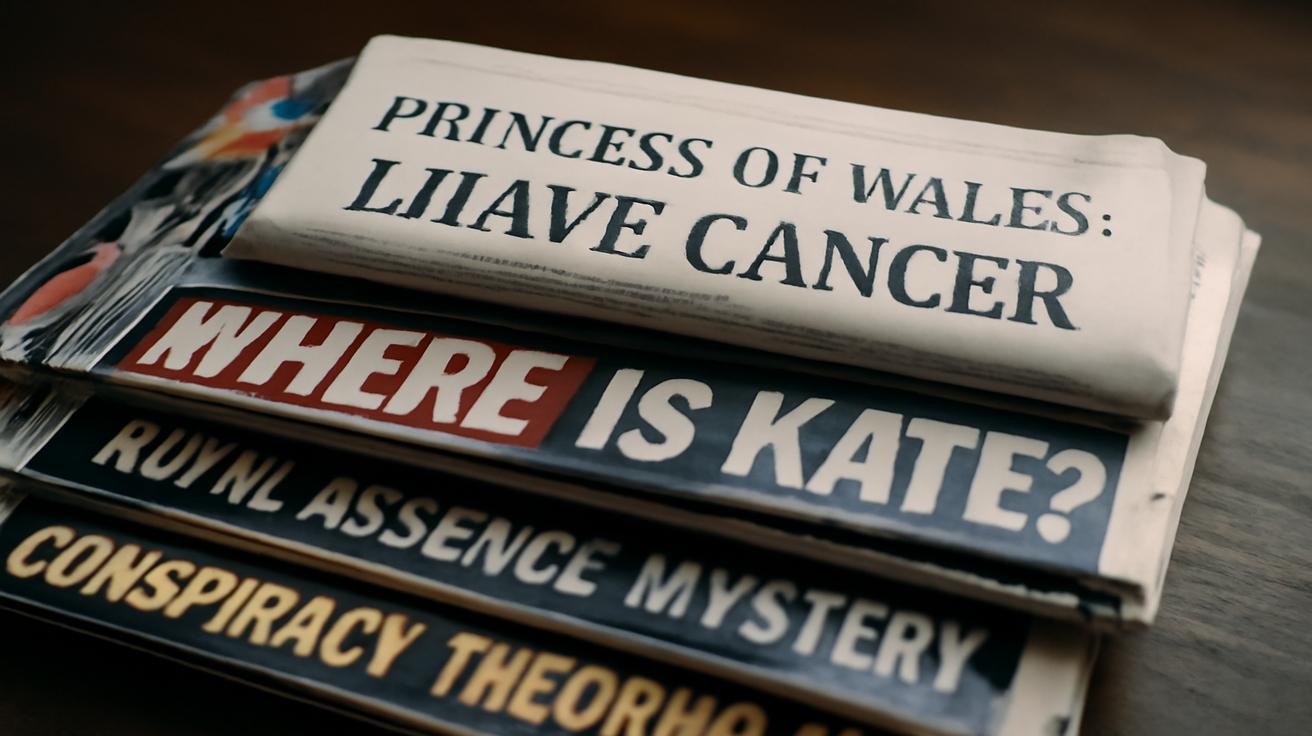
The first photographs that surfaced felt strangely hollow—grainy shots from a long lens of a woman in a car, her profile half‑obscured by shadow and glass. Was that really Kate? The Princess of Wales, so often seen in polished public poise, was suddenly reduced to a blur, a question mark rolling past in a dark vehicle. All winter, rumors had been stalking the silence she left behind. A surgery. A recovery. A calendar emptied of royal color. Then, as the weeks stretched on and familiar faces took her place at the frontlines of royal duty, the whispers thickened into something heavier, sharp-edged, and relentless. Before the world knew the word “cancer” would enter the story, it was spinning its own, framed in conjecture, conspiracy, and the very human fear of not knowing.
The Winter She Vanished
It began quietly, as these things often do. In January, Kensington Palace issued a neat little statement, as precise and carefully arranged as one of Kate’s tailored coat dresses. The Princess of Wales had undergone “planned abdominal surgery,” it said, and would be out of the public eye until after Easter. It was the kind of announcement that, in another era, might have drawn a few lines of sober print in the newspapers and then drifted away.
But this was not another era. This was the era of real-time speculation, of timelines stitched together by strangers, of comment sections turning into crime scenes. People know when a royal is missing from the seasonal rhythm. There is a certain choreography to the modern monarchy: hospital visits, school engagements, handshakes outside charity centers, balcony waves, the small soft power of showing up. When Kate, one of the most visible members of the family, stopped appearing at all, the air around the Palace seemed to hollow out.
Those first weeks passed almost politely. There was sympathy. Recovery takes time. Abdominal surgery is no small thing. But as winter thinned and the first snowdrops appeared in palace gardens, the silence did not soften. No new photographs. No grainy hospital exits. No casual sightings of the Princess on a quiet walk near Windsor. The public, accustomed to a steady drip of imagery and reassurance, looked around and realized there was nothing to hold onto.
Into that vacuum poured imagination.
The Internet Fills the Silence
In the digital ecosystem, silence is rarely accepted at face value. When answers are withheld—whether out of necessity, privacy, or simple human fear—people begin to weave their own narratives. For Kate, those narratives multiplied overnight. Her absence from key engagements—events where her presence would once have been a certainty—did not go unnoticed.
One by one, the fixtures on the royal calendar ticked by without her. Public ceremonies, charitable gatherings, even the informal moments that often show her at her most relaxed—all conspicuously Kate-free. A timeline, once gentle and unremarkable, started to look more like a pattern.
| Date / Period | Royal Engagement | Public Question |
|---|---|---|
| January – Announcement | Planned abdominal surgery, recovery period stated | Expectation of privacy; limited concern |
| February – Early March | Absence from routine engagements, charity visits | “Why no updates?” “Where is Kate?” |
| Key Spring Events | Noticeable absence from high-profile royal occasions | Surge of rumors and conspiracy theories online |
| Pre-Video Period | Leaked and disputed photos, edited images controversies | “Is the Palace hiding something?” |
| Cancer Revelation | Kate’s personal video message to the public | A stunned silence; reconsideration of prior speculation |
On social media, hashtags bloomed like invasive species. Wild theories raced ahead of facts. Some posts were almost playful in tone, as if the Princess’s absence were part of a mystery game. Others carried a darker edge, accusing, suspicious, convinced that a cover-up was underway. In blurry screenshots and breathless threads, people dissected old photographs, her last public appearances, the smallest details of her expression or posture, as if the truth had been hiding in plain sight.
Speculation feeds on absence the way fire feeds on dry wood. The longer Kate stayed out of the public eye, the more fuel was added. The monarchy, dealing with its own internal stresses and the King’s health concerns, offered no elaborate counter-script—only the same quiet insistence on recovery and rest. For many, that was enough. For others, it was a red rag waved in front of a charging bull of online suspicion.
The Echo Chamber of Doubt
What made this period so painfully revealing was not just the rumors themselves, but the speed at which doubt can become entertainment. You could feel it in the giddy tone of posts that treated Kate’s private health as a puzzle to be cracked. The Princess of Wales had become both character and commodity—her absence a narrative device, her silence a cliffhanger.
Each edit of a photograph, each pixel analyzed, was another step away from the person at the center of the storm. It is easy, behind a screen, to forget the hospital corridors, the late-night anxieties, the held breaths before each new medical update. In their place, the internet conjured secret plastic surgeries, marital collapse, body doubles, even more grotesque suggestions that felt like picking at the fabric of someone’s humanity.
When a public figure goes quiet, it is a test of whether we believe they are entitled to being just a person for a while. In those months, large parts of the online world seemed to answer: no.
Behind the Palace Walls
Imagine, for a moment, the other side of the glass: the closed doors, the hush of a royal household rearranging itself around an illness that, at first, even they might not have fully understood. Kate is not just a title or a headline. Within those walls she is a mother, a wife, a daughter-in-law, a woman in her early forties suddenly thrust into a medical landscape most of us dread to even name.
Abdominal surgery is rarely simple; major procedures can uncover questions that need more tests, more time, more waiting. Those weeks of her convalescence would not have been filled with the drama that conspiracy theorists adore. They were more likely slow, repetitive, and anxious: managing pain, watching the children’s routines continue around the strange stillness of their mother, absorbing each new fragment of medical information.
The monarchy excels at public ritual, but private vulnerability has never been its natural language. Yet here it was—unavoidable, insistent, systemic. A princess, suddenly patient. A palace, suddenly powerless in the face of something their titles cannot erase. Information, once carefully curated, now needed to serve a different master: medical truth and personal readiness.
In such a context, silence is not always secrecy. It can be the shape that courage takes while it is still forming. It can be a buffer between the sharp shock of a diagnosis and the enormity of admitting it to millions of strangers. Inside palatial rooms and quiet hospital bays, the story of Kate’s absence was not theatrical. It was brutally ordinary: illness, fear, decisions.
The Weight of Duty and Vulnerability
What do you owe the world when your body betrays you? For Kate, duty has long been part of the architecture of her life. Appearances, causes, handshakes, speeches—these have built her public identity. But illness knocks at the door with no respect for calendars or obligations. It rewrites priorities in a language that is both intimate and uncompromising.
There is a peculiar cruelty in expecting someone to perform transparency on command, particularly when they themselves may still be absorbing the impact of their diagnosis. Somewhere in those weeks, between surgery and treatment plans, there would have come a moment when the words “cancer treatment” were first laid out in front of her with clinical calm. In that instant, all the noise outside the palace likely fell away, replaced by a different kind of echo: What next? How do we tell the children? What does the future look like now?
While strangers spun fairy tales of scandal, the reality within those walls was something far simpler and far more human—grappling with a disease that, even in the age of advanced medicine, still carries a weight of primal fear. The Princess of Wales, whose public grace has often seemed effortless, was facing the same raw questions that thousands of families ask every day.
The Video That Changed Everything
When the time finally came to speak, it was not in the form of a press release or a choreographed balcony appearance. It arrived as a video—a still, almost intimate frame, the world’s cameras narrowed to one lens and one voice. Kate sat on a bench, framed by early spring greenery, her hair soft around her face, her eyes carrying that unmistakable blend of fragility and resolve.
The internet, mid-conspiracy, mid-theory, ground to a halt as the play buttons lit up. And then her words poured into living rooms, onto phones gripped in scrolling hands, across oceans and time zones. She spoke of surgery, of an unexpected discovery, of further tests that revealed what no one wants to hear: the presence of cancer. She talked about preventative chemotherapy, about her need to focus on recovery, about her children and the care with which she and Prince William had tried to explain what was happening.
For a global audience used to polished royal statements, there was something almost disarming in her tone. This was not the clipped distance of protocol, nor the vague reassurance of vague “health issues.” This was the clear, direct vulnerability of a woman stepping through fear into public honesty, knowing the world had been talking about her in her absence.
In those few minutes, the conspiracy theories did not just look wrong—they looked profoundly small.
From Speculation to Stillness
As the video spread, feeds that had been crowded with jokes and snark about her whereabouts shifted in real time. Commenters who had hours before been dissecting shadows in photographs were suddenly leaving messages of apology and support. The narrative pivoted so abruptly it was almost dizzying: from detective work to remorse, from mockery to solidarity.
Illness has a way of resetting the scale. Gone, in that moment, was the titillating appeal of palace intrigue. In its place stood a mother facing treatment, a couple navigating shock, a family adjusting to a landscape they never chose. For many, the revelation became a mirror, reflecting the times their own families had been pulled abruptly into the orbit of cancer wards and test results, of waiting rooms and protective smiles.
Kate’s choice to speak was not just about quashing rumors; it was about reclaiming the narrative from the wild edges of the internet and placing it back in the realm of simple truth. Not every detail was shared, nor should it have been. But she offered enough to transform her absence from a mystery to a deeply human reality.
What Her Silence Revealed About Us
If the first phase of Kate’s disappearance exposed our appetite for drama, the second exposed something more uncomfortable: how poorly we often handle uncertainty, and how quickly privacy becomes a casualty of public fascination. Her absence from key engagements earlier in the year became a kind of Rorschach test, onto which the world projected its assumptions about the monarchy, about women in the public eye, about entitled access to other people’s lives.
Some of the questions people asked were understandable. When you build a national identity partly around highly visible figures, their sudden withdrawal does create a sense of unease. But what followed went far beyond concern. It veered into ownership—as if the public, having invested years of attention, believed themselves owed a constant stream of explanation.
In that sense, Kate’s story is not just about royalty. It is about the culture we have created around visibility, where absence feels like an affront and mystery a problem to be solved rather than respected.
The Cost of Turning People into Stories
Long before we knew it was cancer, the online treatment of her disappearance carried a quiet dehumanization. Kate was not being discussed as someone’s daughter or mother, or as an individual who might be going through something excruciatingly private. She was a storyline. A role. A gap in the script to be filled with fan theories.
When the truth arrived, it did more than silence critics—it indicted the kind of criticism that had thrived on guessing games. It forced a pause. The “Where is Kate?” memes suddenly sat beside the reality of chemotherapy and recovery. The laughter, in retrospect, felt different.
Yet, from that discomfort, there is an opportunity. To remember that we never see the full story in the curated frames of public life. To hold space for what might be happening in the unseen interior of someone’s days, long before they are ready—or willing—to share it.
After the Storm of Theories
Now, when we look back at that stretch of missing engagements and unanswered questions, the timeline reads differently. The empty spots on the royal calendar are no longer ominous—they are the shape of a medical journey unfolding far from cameras. The rare sightings through car windows seem less like clues and more like fragile bridges between two worlds: the duty-bound public and the fiercely protected private.
Kate’s cancer revelation did more than quiet the loudest conspiracy theorists. It carved out a new kind of space around her, one defined less by fascination and more by something like respect. Her critics were not just silenced; many were forced into a rare moment of introspection about how easily we treat real people as fodder for endless content.
The Princess of Wales may return to the public stage in time, her schedule slowly repopulated with engagements and causes and crowds. When she does, each appearance will likely carry an extra layer of resonance, not because of her title, but because we will see her through the lens of what she has weathered. She will be a symbol, yes—but also, unmistakably, a survivor moving through her life under a scrutiny few of us can imagine.
Between the winter of absence and the spring of revelation, something fundamental shifted. The story we told about Kate changed from one of suspicion to one of empathy. It is a fragile transformation, easily lost in the next news cycle. But if we are paying attention, her journey offers a quiet warning and a gentle invitation: to be slower to judge, more patient with silence, more willing to accept that not every gap in our knowledge is ours to fill.
Sometimes, the most human thing a public figure can do is vanish for a while—and the most human thing we can do in response is simply let them.
Frequently Asked Questions
Why was Kate Middleton absent from royal engagements earlier in the year?
Kate Middleton was recovering from major abdominal surgery and undergoing further medical assessment. At the time, the palace shared limited information to protect her privacy and allow her space to heal, which is why she did not attend key engagements during that period.
What led to the surge in conspiracy theories about her?
The long stretch without public appearances, combined with the lack of detailed updates, created a vacuum. Social media, speculation in the press, and a culture that is uncomfortable with not knowing turned that vacuum into a breeding ground for conspiracy theories about her health and personal life.
How did she eventually address the speculation?
Kate addressed the speculation through a personal video message. In it, she explained that during and after her abdominal surgery, tests had revealed the presence of cancer, and that she had begun preventative chemotherapy. Her calm, direct explanation reframed months of rumors into a single, powerful truth.
Did the palace mishandle communication about her health?
Opinions differ. Some feel more transparency earlier on might have limited the wilder theories. Others argue that health is inherently private, and that the palace’s priority—protecting Kate’s physical and emotional well-being—was justified. The situation highlighted the tension between public expectation and personal privacy.
What impact did her cancer revelation have on public opinion?
Her revelation dramatically shifted public sentiment. Many who had speculated or joked expressed regret, and the conversation turned toward compassion and support. The disclosure highlighted how quickly online narratives can change once real, human vulnerability is placed at the center of the story.
What broader lesson does this episode offer?
Kate’s absence and the response to it underline how easily public figures are stripped of their humanity in the age of instant commentary. It’s a reminder to treat silence with respect, to resist filling every unknown with suspicion, and to remember there is often a private reality far more serious than the theories we invent.



Leave a Comment