
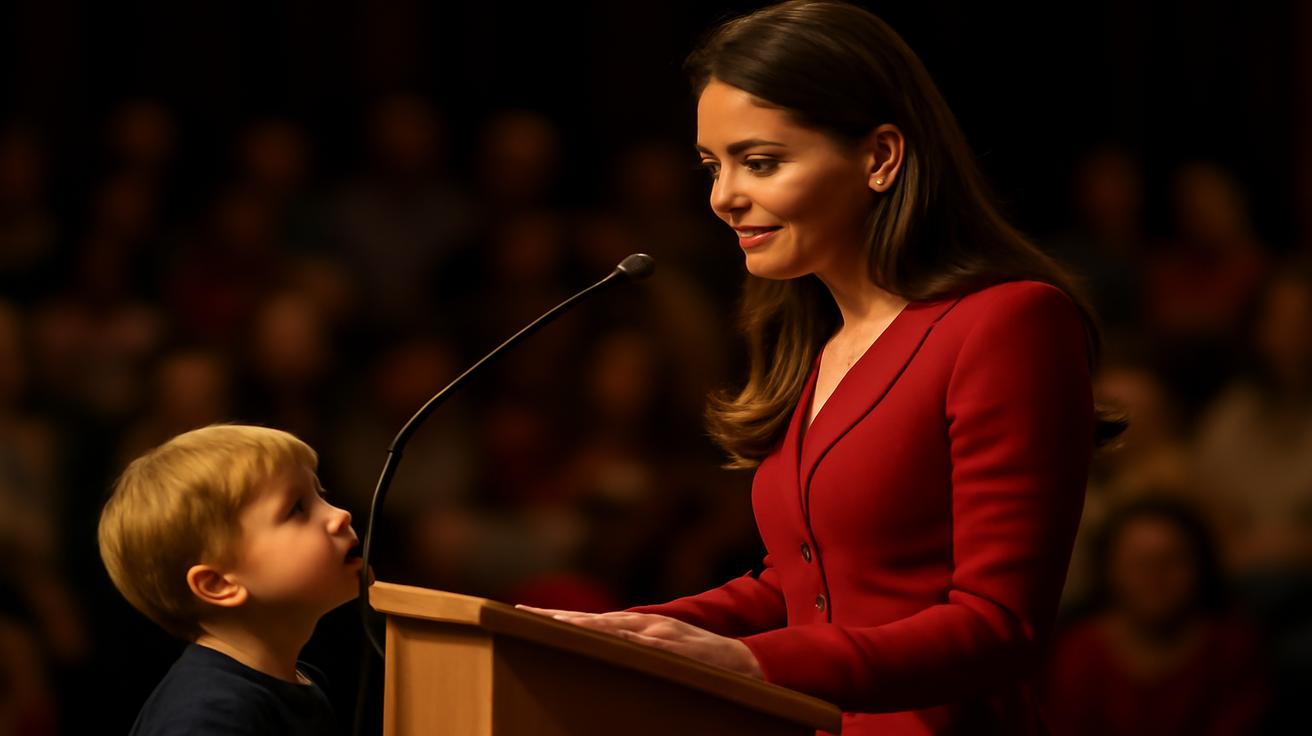
The room is quiet in that particular way that feels almost sacred—soft coughs, a shuffle of papers, the hum of cameras held at bay. Then Kate Middleton, the Princess of Wales, steps to the lectern. Gone is the glossy distance that once defined so many royal addresses. Her voice, when she begins to speak about early childhood, carries something different—something warm, tentative, and disarmingly human, like a parent leaning across a kitchen table at the end of a long day, finally saying what’s really on their mind.
A Princess, a Parent, and a Question We All Recognize
In the spotlight, she doesn’t lead with statistics or policy. She starts, instead, with feeling. With the tangle of love and worry that every parent, guardian, or caregiver knows in their bones. She talks about those early years—birth to five—as a time shaped as much by play mats and picture books as by midnight doubts.
There is something almost cinematic about the contrast: the elegance of a royal figure wrapped in tailored fabric, speaking of spit-up, sleepless nights, and the fragile, invisible architecture of a child’s emerging world. It’s in that contrast that her message lands. Early childhood development, she reminds us, isn’t a niche interest reserved for experts, educators, or policymakers. It’s a shared ecosystem we all live in, whether we have children or not.
She describes moments of uncertainty from her own journey into motherhood—not with melodrama, but with the steady vulnerability of someone who has done the inner work. The early days when feeds blurred into each other, when the weight of responsibility felt heavy enough to bend the spine. The unspoken question humming under the surface: Am I doing this right?
The honesty is subtle but startling. There is no attempt to pretend that royal status insulates her from the universal experience of new parenthood. In a world where we’re used to carefully polished narratives, hearing a princess say, in essence, “I’ve been scared too,” hits a nerve that feels unexpectedly tender.
The Science Beneath the Story
As she speaks, it becomes clear that this is more than a heartfelt confession. It is a bridge between feeling and fact. Between the soft, instinctive love we have for little ones, and the hard data about what those first years mean for a lifetime.
Early childhood development is not just about hitting milestones—first steps, first words, first days at school. It’s about the invisible foundations forming beneath those moments: neural connections firing at an astonishing rate, emotional templates being written as children learn what safety, comfort, and connection feel like.
Kate highlights how the brain in those early years is like wet clay—malleable, impressionable, and highly responsive to its environment. Positive, nurturing interactions—cuddles, songs, eye contact, simple conversations—aren’t just sweet moments. They are construction work, quietly building the architecture of resilience, empathy, and self-worth.
Her message isn’t framed in jargon. Instead, she translates dense research into lived reality. A baby soothed after a fall learns that the world can be kind. A toddler whose curiosity is met with patience learns that questions are welcome, not bothersome. A child whose emotions are acknowledged—“I see you’re upset; I’m here”—begins to map their internal world against a safe external one.
And when this goes missing—when stress, poverty, isolation, or trauma become the background noise of childhood—the effects don’t evaporate with time. They echo. Into school performance, mental health, relationships, even physical health decades later.
The Hidden Stakes of the Earliest Years
There’s a moment in her speech when the air seems to tighten; she gently lays out the stakes without accusation. So much of what shapes our societies—the kindness or cruelty of strangers, the patience of teachers, the openness of leaders—can be traced back to tiny, everyday interactions in living rooms, kitchens, clinics, nurseries, and playgrounds.
Kate isn’t scolding a world that’s failing its children. She is inviting it to see. To look more closely at what we often overlook because it seems too ordinary to matter. The bedtime stories. The caregiver who squats to eye level. The neighbor who smiles instead of sighs at a crying baby on a bus. These are not extras. They’re infrastructure.
Motherhood, Spotlight, and the Weight of Expectation
What makes her speech feel deeply personal is how she situates herself not above the issue, but inside it. She does not claim mastery. Instead, she admits—without fanfare—that she has wrestled with the same questions that haunt many caregivers.
Did she feel prepared when she first held her newborn? Not entirely. Did she feel pressure to be perfect? Absolutely. Did the world’s gaze make that pressure heavier? You can almost hear the answer in the pauses between her words.
Many listening will recognize their own story: the flood of advice, much of it contradictory. The online forums that swing wildly between reassurance and judgment. The quiet realization that no one really hands you a map. You patch one together out of intuition, culture, memory, and a dozen whispered “you’re doing fine” from people you hope are telling you the truth.
In her honesty, there is a crucial message: even with privilege, support, and resources, the emotional terrain of early parenthood is confusing. This admission does not flatten the very real differences between her life and that of a single parent juggling two jobs and rent past due. But it does carve out an important common ground: vulnerability.
It’s from that ground that she invites us to think about the support structures wrapped around families—or missing from them. If she, with all her access to help, sometimes felt overwhelmed, what does that say about the parents who are doing it alone, with fewer safety nets and more obstacles?
Beyond the Palace: Why Everyone Has a Stake
One of the most resonant threads in Kate’s speech is her insistence that early childhood is not only a “parent issue.” You can feel her tugging gently at the edges of a much broader circle.
Don’t have children? You’re still in this story. Work in a shop, a lab, a café, or a boardroom? Still in the story. Live in a city apartment or a rural village, young or old, introvert or extrovert—you are, in some way, part of the environment in which children grow. The glance you offer a frazzled parent. The policies your company adopts. The patience (or lack of it) you extend to the sound of small, uncontained lives.
Her words push against the modern habit of siloing responsibilities: education for schools, health for clinics, parenting for families, economics for policymakers. Early childhood development slips between those silos because, in reality, it touches them all. A resilient adult workforce? It starts in secure early attachments. Lower crime rates? Start with safe, responsive caregiving. Better mental health outcomes? Begin where our nervous systems first learned what safety feels like.
To make that scale visible, it helps to see the wide arc of impact. Consider the different layers of life early childhood influences:
| Area of Life | Early Childhood Link | Long-Term Effect |
|---|---|---|
| Emotional Health | Secure attachment and responsive caregiving | Lower anxiety, better coping with stress |
| Learning & Education | Early play, language, and exploration | Improved school readiness and curiosity |
| Relationships | Modeling empathy and trust | Healthier friendships and partnerships |
| Physical Health | Reduced toxic stress in early years | Lower risk of chronic disease later in life |
| Community & Society | Supportive networks for families | Stronger social cohesion and safer communities |
When Kate speaks, these aren’t bullet points on a slide. They’re woven into narrative, into story, into the simple but radical idea that what happens in the quiet corners of childhood doesn’t stay there. It walks out into the world in every body that was once a baby held—or not held—when they cried.
The Power of Saying “I Don’t Have All the Answers”
There is a particular sentence she returns to often in her work: the notion that no one is born knowing how to parent. It’s a small phrase, but for many, it lands like a deep exhale.
Because here is the truth: early childhood research can be intimidating. Talk of neural pathways, attachment theory, developmental windows—it can make any misstep feel catastrophic. But woven through her speech is a different tone: possibility instead of panic.
She emphasizes that what children need most is not perfection but presence. Not flawless execution, but good-enough care delivered with warmth, consistency, and repair when things go wrong. The apology after the snap of impatience. The hug after the slammed door. The willingness to keep learning alongside your child.
Small Acts, Lasting Imprints
As she describes reading with her own children, you can almost see the scene: a pile of books, pages bent at the corners, a tangle of small limbs draped across her lap. These are not grand gestures; these are ordinary moments rendered luminous by the awareness of what they quietly shape.
For anyone listening, it becomes harder to dismiss their own daily routines as insignificant. The walk to nursery where you name the colors of cars. The time you pause and actually answer a child’s spiraling “why?” questions. The way you respond to their fear of the dark. Every tiny interaction is a message: about their worth, about how deeply they belong here on this planet.
The magic, and the challenge, is that we don’t always see the immediate payoff. A tantrum soothed today doesn’t earn you a neat gold star tomorrow. The arc is longer—sometimes stretching across years. That’s why speeches like Kate’s matter: they keep our eyes on the horizon, reminding us that these unseen investments are not just “nice if you have time,” but vital.
From Private Doubts to Public Conversation
One of the most striking things about Kate’s advocacy is the way it quietly chips away at the old perfectionist myths surrounding family life. By speaking personally about early childhood, she implicitly grants permission for others to speak too—to say, “Actually, this is harder than I expected,” or “I love my child more than I thought possible, and I’m still overwhelmed.”
In doing so, she shifts early childhood development from something whispered about behind closed doors to something we can put on a podium, in policy debates, in workplace conversations. It becomes not a private failing when things are hard, but a public responsibility to make things better.
Her message stretches well beyond royal circles because it taps into a deeper cultural moment. Around the world, more people are asking: How do we build societies that don’t merely survive, but heal? How do we interrupt cycles of trauma, disconnection, and burnout? Increasingly, the answer keeps circling back to the same place: the earliest years, and the people caring for children in them.
What It Means to Truly Value the Early Years
To value early childhood is not just to coo over baby photos. It’s to design policies that allow new parents to rest and bond, rather than rush back to work before their bodies and minds are ready. It’s to train and pay early years educators as the skilled professionals they are, not as an afterthought at the edge of the education system.
It’s to weight budgets, not just speeches, in favor of the first five years. To shape cities with green spaces and safe play areas, recognizing that a child’s sense of wonder is an asset, not a nuisance. To treat postnatal depression, anxiety, and parental burnout as urgent health issues, not private embarrassments.
In raising this subject again and again, Kate is not simply championing a cause; she is asking a culture-wide question: What do we really believe children are worth? The way we answer is written, not in our slogans, but in our structures.
A Story We Are All Writing Together
When the speech ends, the applause comes—polite at first, then fuller. Cameras flash. People shift in their seats, ready to return to schedules and emails and the residual buzz of daily life. But her words linger, like the after-image of light when you close your eyes.
Perhaps someone in the room is a policymaker who will go back to a white paper with a slightly different sense of urgency. Perhaps a teacher will look at a struggling four-year-old tomorrow with a fresh, gentler curiosity. Perhaps a grandparent will call their grown child and say, “You’re doing better than you think.”
Or perhaps, somewhere not even remotely connected to royal circles, a neighbor will knock on a new parent’s door with a casserole and a simple offer: “If you ever need an hour to yourself, I’m right next door.” It won’t make headlines, but in the story of early childhood, such small gestures are turning points.
This is the quiet revolution at the heart of Kate Middleton’s deeply personal speech. It is not a revolution of spectacle, but of attention—of who we notice, who we support, and how seriously we take the small humans just starting their long walk through the world.
Long after the microphones are turned off, the work continues in low-lit nurseries, crowded buses, clinic waiting rooms, and classroom reading corners. In each of those places, someone is offering a hand, a story, a reassuring word, or a listening ear. In each of those places, early childhood development is happening in real time.
And whether we ever set foot in a palace or not, every one of us has the power to shape that unfolding story—with patience, with curiosity, and with the simple, radical act of caring about how the smallest among us begin.
Frequently Asked Questions
Why is early childhood development such a major focus for Kate Middleton?
Early childhood development has become one of Kate’s core areas of work because research consistently shows that the first five years of life have an outsized impact on mental health, learning, relationships, and physical well-being. She has repeatedly emphasized that supporting children and caregivers in these years can change the trajectory of entire communities.
How does her personal experience as a mother influence her message?
Kate often draws on her own experiences of uncertainty, adjustment, and learning as a parent. By acknowledging that she, too, has felt overwhelmed and imperfect, she helps remove the stigma around talking honestly about parenthood and mental health, making the conversation more relatable for families everywhere.
Does early childhood development only matter to parents?
No. One of the key points in her speech is that early childhood affects everyone. The quality of early care and experiences shapes future citizens, workers, neighbors, and leaders. Even those without children play a role—through community support, workplace policies, public services, and everyday interactions with families.
What are some simple things adults can do to support healthy early development?
Small, consistent actions matter: talking and reading to young children, responding to their emotions with empathy, offering safe opportunities to play and explore, and supporting caregivers with practical help and understanding. Advocating for family-friendly policies and accessible early years services is another powerful way to contribute.
Why does her speech resonate beyond royal circles?
The speech resonates widely because it blends science, story, and vulnerability. By speaking as both a public figure and a parent, Kate bridges social divides and reminds people that early childhood is not a rarefied royal topic but a universal human one. The issues she raises—stress, support, belonging, hope—touch lives in every corner of society.





Leave a Comment