
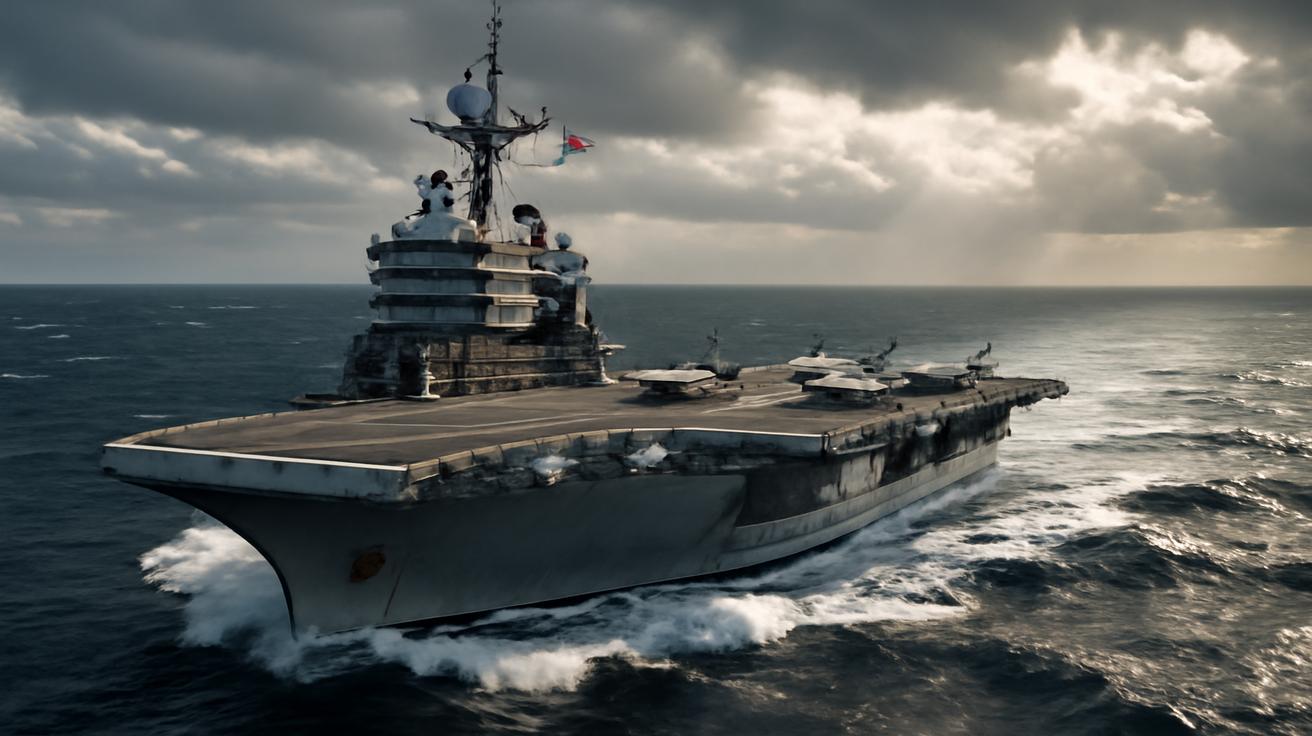
The first thing you notice is the sound. Not a noise, not a roar—something deeper, a layered vibration that seems to rise out of the water itself. The dawn is a gray-blue smear over Toulon, and the French aircraft carrier Charles de Gaulle is waking up, shrugging off the harbor like an animal stretching its limbs. On the pier, the air is cold enough to sting the lungs, full of the sharp smell of salt, oil, and steel. Crew members move like purposeful shadows against the white hull, voices lost in the thrum building somewhere underfoot. Today, they are doing something they rarely do. Today, the Charles de Gaulle is turning her bow toward the open Atlantic.
A Silent Giant That Doesn’t Stay Silent for Long
You don’t realize how big an aircraft carrier really is until you see it swallowing the horizon. Photographs flatten it; numbers blur it. But standing alongside the Charles de Gaulle, your neck craned back, the thing feels less like a ship and more like a slab of continent that has changed its mind and decided to float. The hull rises, clean and immense, a city block sculpted from steel and sealed with layers of paint that smell faintly chemical even this early in the morning.
The deck above is busy: silhouettes of Rafale Marine jets, their wings folded like resting seabirds, the squat bulk of E-2C Hawkeye radar aircraft, helicopters tethered against the wind. Yellow-vested deck crew cross and re-cross the flight deck like ants, already rehearsing the ballet that will play out once the ship is at sea. Somewhere deep inside, nuclear reactors are cycling up, feeding electricity into miles of wire, heating water, turning turbines. You can’t see any of that, but you can feel it—a low, patient tremor in the soles of your feet, as if the ship is clearing its throat.
For much of her career, the Charles de Gaulle has been a creature of the Mediterranean: a familiar outline off the coasts of Corsica, Sicily, Lebanon; a steady presence in the Middle East, the Indian Ocean, the waters where world headlines seem to gather. That is her usual stage, the warm seas that cradle Europe’s southern flank. But not today. Today, she will leave the protective geography of the “Méditerranée” behind and slide through the Strait of Gibraltar into the wild, unpredictable theater of the Atlantic.
Westward, Toward the Weather
Even before the ship moves, the anticipation feels different. The Atlantic means weather in capital letters. It means long, rolling swells bred a thousand miles away. It means fog that arrives without sound, wind that shifts without warning, a sky that can change its mind three times in an afternoon. In the chart room, over neat paper maps and glowing digital displays, lines have been drawn hours ago, sometimes days: waypoints, exclusion zones, areas of interest. Its course is no longer the usual loop of familiar patrols, but a confident arrow pointing toward unset fences of water and sky.
When the tugs arrive, they seem almost comically small, like bright toy boats pushing at the heel of a sleeping titan. Thick ropes slap against metal bollards. Orders travel over radios and through practiced hand signals. Slowly, so slowly you can’t at first tell it’s happening, the Charles de Gaulle begins to move. The quay slides past in reverse, the city loosening its hold. Overhead, gulls complain, wheeling in the ship’s widening slipstream of air.
Out beyond the harbor wall, the Mediterranean waits, its surface ruffled by a light wind from the east. The ship’s bow points toward the gap in the breakwater, toward the line where the sheltered blue meets the first suggestion of open sea. From here, the Atlantic is still just an idea. Yet that idea is enough to rearrange everything on board: the routines, the training scenarios, the conversations in the wardroom late at night when officers trace imaginary arcs over the North Atlantic with their fingertips and talk in low voices about weather patterns, NATO exercises, and distant coastlines.
Life on a Moving City of Steel
As the last smudge of land fades astern, the carrier becomes its own world. Inside, the lighting turns to a clean, steady white, artificial daytime that never ends. Passageways smell faintly of waxed floors and machines warming up. There is always the background hum: ventilation systems breathing, distant fans, a clatter of tools in a far-off compartment. You walk through it as you would walk through a forest of sound—rustle, creak, murmur—each noise telling someone onboard a story they understand instinctively.
In the hangar bay, the air is thicker with the smells of jet fuel and hydraulic fluid, the faint tang of metal and hot rubber. The Rafales sit in tight rows, their gray skins catching the light. Pilots in green flight suits talk quietly with mechanics. A hand runs under a wing edge, checking for nicks. A helmet is adjusted. A checklist is scanned, thumb moving down the page as if tracing a prayer.
Up one deck, in a quieter room, a radar screen glows at the center of a darkened hive. Green arcs pulse across a digital ocean that now includes the western approaches to Europe and the swelling body of the North Atlantic. Here, there are no waves, no wind, no taste of salt—only echoes turned into symbols. Blips appear and slide; some are tagged as commercial traffic, others as “unknowns,” their identities waiting to be unmasked by transponder codes or radio calls. The ship’s path is a firm line through this green-black darkness, a commitment to a direction.
Out on the flight deck, the Atlantic announces itself not with drama but with subtlety. The swell grows longer; the horizon becomes less perfectly level, a line that tilts and rights itself with the grace of an enormous, slow pendulum. The air feels different too—denser, cooler, carrying the faint, dry cold that has traveled from some high northern latitude. There is a taste of faraway ice in it, a whisper of places where the sun sits low and the seas are steel-gray for months on end.
A Rare Course, A Different Kind of Mission
For all its power, a nuclear aircraft carrier does not wander without purpose. When the Charles de Gaulle sets course for the Atlantic, people notice: analysts, governments, fishing crews who spot her distant profile where they do not usually see it. This is not a routine ferry trip; it is a strategic statement written in steel across thousands of nautical miles.
The Atlantic is where Europe meets North America across a restless expanse. It is studded with unseen lines of trade, data cables, air routes—arteries of the modern world. Sending a carrier there is like placing a hand firmly on the table in the middle of a conversation. It says: we are here, we are listening, and we are ready.
Exercises with allies might be on the calendar: coordinated maneuvers with other navies, air patrol drills in complex weather, antisubmarine warfare practice in deep, cold waters where sound behaves differently. There might be new technology quietly tested in real conditions: sensors that see farther, software that thinks faster. Or, just as importantly, there might be the simple need to remind everyone—friends and rivals alike—that France’s only aircraft carrier is not a regional asset chained to its home sea, but an ocean-going tool of policy and presence.
Where Steel Meets Sea and Story
From the outside, it’s easy to think of a ship like this as pure function: weapon systems, flight operations, logistics. But the moment you stand at the rail as the Atlantic breathes underneath, function becomes story. The ocean is not interested in strategies or acronyms. It responds only to physics: to displacement, to wind, to the moon lifting the tide up and letting it fall again.
On deck, salty spray coats the railings now. The ship moves with an almost seductive steadiness, but you can feel the longer, heavier rhythm of ocean swells. A cup of coffee left unattended on a table inside leaves faint rings on a napkin with each slow rise and fall. Somewhere forward, a wave slams just wrong against the bow and sends a shudder throughout the hull—an immense, booming reminder that for all its reactor power and electronics, this vessel is still at the mercy of water and weather.
At night, the sensory world shifts. Under a sky finally free from coastal light pollution, the stars arrive in dense clusters, so bright you feel you could scoop them up. The Milky Way is no longer a vague idea from an astronomy book, but a river of light arcing from horizon to horizon. The ship itself runs dark above, a stealthy outline with only essential lights showing, while below decks the artificial day continues, crew trading sleep and wakefulness in carefully staggered watches.
Look over the stern and you see the wake etching a luminous scar through the black water, a ribbon of foam where bioluminescent plankton explode into ghostly light when disturbed by the hull. Each turbulence, each swirling eddy behind the rudder, becomes a brief constellation underwater. The Charles de Gaulle’s passage turns the dark Atlantic into a living galaxy for a few moments at a time, then leaves it to heal over in the ship’s absence.
Scale, Measured in People
You could measure this ship in meters or displacement tons, but onboard, scale is understood in footsteps and in faces. There are close to two thousand souls on a full deployment—a floating town where everyone has a role and almost nowhere is ever truly empty. The mess halls ring with clatter and talk at meal times; the gym pulses with grunts, clanks, and the sharp rhythm of someone’s playlist echoing off steel bulkheads.
Conversations change as the ship moves farther west. In the ready rooms where pilots plan their flights, Atlantic conditions creep into the slides: crosswinds over cold water, cloud layers stacked like blankets, gusts spiraling off invisible weather fronts. In the engineering spaces, the sea’s temperature matters too; cold water is better for cooling systems, but it can also mean condensation where you least want it. Every department feels the ocean in its own professional language.
For some sailors, this is their first time beyond the familiar pattern of the Mediterranean. They mark the day the GPS track crosses the invisible threshold into the Atlantic, even if nothing obvious changes outside. A few veterans grin and mutter about “real waves” still to come. Others simply stand at the rail when they can, hands in pockets, letting the wind tell them what latitude feels like now.
Atlantic Light, Atlantic Mood
The weather has its own personality out here. Some mornings arrive as soft surprises: a pale, filtered sun pushing through a gauze of cloud, seas calm as poured mercury. Other days step onto the horizon with a square jaw: dark band of cloud, whitecaps chiseling the surface, wind already pawing at faces and jacket zippers hours before the front rolls over the ship.
The flight deck becomes a stage for this drama. Launching and recovering aircraft over the Atlantic demands a different attention, a sharper reading of the air. Gusts roll down invisible corridors between layers of cloud. A pilot approaching to land sees a runway that is not exactly fixed, its far end lifting and dipping on the long-period swell. The landing signals officers—those watchful figures at the side of the deck, eyes narrowed behind green-tinted visors—study each approach with an intensity that borders on intimacy: power… power… left for line-up… hold it… settle…
Down below, sensors and sonar project their curiosity into the water. The Atlantic’s depths swallow sound and bend it, reflecting it off underwater layers of different temperatures. Submarines live in this three-dimensional maze; so do whales, their calls sometimes straying into the edge of human hearing as faint, mournful moans picked up by equipment designed for entirely different purposes. Occasionally, a technician in a monitoring room will pause, tilt their head, and listen to something that is not a ship at all, but a living, breathing giant passing in the dark below.
Rarity, Written in the Logbook
For a ship with the Charles de Gaulle’s capabilities, going to the Atlantic should, on paper, be unremarkable. After all, she is built to cross oceans. Yet in the ledger of her actual movements, this decision is anything but routine. Most of the time, strategic necessity pulls her toward the east and the south, toward littoral zones where tensions simmer and flare. When she points west instead, the ink in the logbook records something out of the ordinary.
Rarity, in this case, has layers. There is the practical rarity: the limited number of days a year a carrier can be at sea, the finite budget of fuel for escorts and aircraft, the demanding maintenance schedule of a nuclear heart beating below decks. There is also the symbolic rarity: each unusual movement will be measured, interpreted, discussed in rooms far from any shoreline. An Atlantic deployment reconfigures expectations; it reminds allies that shared waters remain a shared responsibility and signals to others that eyes and ears now span a different stretch of ocean.
Onboard, however, life continues in its strict choreography. Drills are run; alarms blare and are silenced. Firefighting teams race through passageways with hoses and breathing gear, rehearsing for dangers that everyone hopes will remain theoretical. Medical staff run scenarios: man overboard in cold Atlantic water, hypothermia timelines, evacuation routes by helicopter under marginal conditions. The sea out here is not just wide; it is uncompromising. Its remoteness demands a certain humility from even the most advanced machines and the people who operate them.
Numbers That Hint at the Story
Amid all the sensations—the throb of engines, the taste of salt, the sudden clearing of sky after a squall—there is a quieter story told in numbers. They never capture the full experience, but they lean close, like a whisper next to the roar.
| Aspect | Approximate Value | What It Feels Like at Sea |
|---|---|---|
| Length of the Charles de Gaulle | 261 meters | Walking from bow to stern feels like crossing a neighborhood block, with the sea on every side. |
| Typical crew on deployment | ~1,900 people | Every corridor holds a story, every watch a different accent, yet all moving in the same rhythm. |
| Maximum speed | Over 25 knots | The horizon approaches faster than your thoughts can fully catch up with where you were yesterday. |
| Aircraft capacity | ~30–40 aircraft | A constantly shifting forest of wings, rotors, and tails, each with its own sound and smell. |
| Atlantic wave heights during rough weather | 6–10+ meters | The ship heaves like a living thing, and even steel seems to remember it can bend. |
Numbers can’t tell you what it feels like the first time a squall wall slams over the bow and the world turns white for a few heartbeats. They can’t translate the hush in the operations room when a new contact appears on the edge of radar range, or the way the crew’s mood quietly lifts on a rare, perfectly clear day when the Atlantic lies down flat and forgiving.
And yet, together with the compass heading, the latitude and longitude entries, the fuel consumption and sortie counts, they become part of the carrier’s Atlantic story—a story measured in days and nights, storms ridden out and missions flown, distances crossed and impressions carried home.
The Return Will Change the Map
Eventually, every deployment writes its own ending. The Atlantic, for all its immensity, will not hold the Charles de Gaulle forever. There will come a day when the bow swings back toward Europe, toward the narrow gape of the Strait of Gibraltar, toward the familiar blue of the Mediterranean and the solid reassurance of Toulon’s harbor walls. The same tugs will arrive, lines will be caught and made fast, and the ship’s great momentum will bleed away into stillness.
But when the gangway touches the pier again and boots clatter down to shore, something subtle will have shifted. Maps inside people’s heads will be redrawn. Young sailors who had never before seen the Atlantic in anything other than satellite images will carry its scent somewhere in their memory, ready to surface in a gust of cold wind on a winter day. Officers will recall the weather briefings, the coordination with distant allied ships, the way the carrier group looked from above in reconnaissance photos: tiny specks arranged in a purposeful pattern on an endless gray canvas.
The hull itself will carry traces: a slightly different pattern of salt marks, microscopic wear from Atlantic swells, the invisible fatigue and resilience of metal that has flexed to a new rhythm and held. Logs will be closed, reports compiled, lessons distilled into bullet points and slide decks that can never quite convey the full texture of those days when the compass needle pointed stubbornly west.
For observers on shore, the deployment will be remembered in headlines and policy notes, discussed in conferences and buried in long PDFs. For the Atlantic, it will be another brief visit from a human-made island, a temporary disturbance on its restless surface. But for the Charles de Gaulle herself—for the crew who felt the deep swell beneath her nuclear heart, who heard the different pitch of the wind and saw the specific gray of the western ocean’s sky—it will remain what it truly is: an extremely rare turning of the bow into a different kind of sea, a reminder that even the largest ships are still, in essence, travelers chasing horizons.
FAQ
Why is it rare for the Charles de Gaulle to operate in the Atlantic?
The Charles de Gaulle usually focuses on the Mediterranean, Middle East, and Indian Ocean, where France’s operational priorities and ongoing missions often lie. Time at sea is limited by maintenance and training cycles, so sailing into the Atlantic represents a deliberate shift in focus, making such deployments relatively uncommon.
What makes Atlantic operations different from Mediterranean missions?
The Atlantic generally brings larger swells, more rapidly changing weather, and longer distances between ports. Operations there emphasize high-seas coordination with allies, complex flight operations in challenging conditions, and blue-water tasks like antisubmarine warfare in deep, cold waters.
Does the carrier group change when heading into the Atlantic?
The escort composition can adapt to the mission. Typically, the carrier sails with frigates, a submarine, and support vessels. For Atlantic missions, there may be particular emphasis on antisubmarine escorts and long-range logistics to match the open-ocean environment.
How long can the Charles de Gaulle stay at sea?
Her nuclear reactors allow very long endurance, but practical limits come from food, spare parts, aircraft maintenance cycles, and crew stamina. Deployments can last several months, often broken up by port calls and periods of intense versus lighter operations.
Why does a French carrier in the Atlantic matter strategically?
The Atlantic is a vital artery for trade, energy, and data links between Europe and North America. A French carrier presence signals commitment to collective security, reinforces ties with allies, and reminds potential adversaries that the North Atlantic is actively monitored and defended, not just a blank space on the map.





Leave a Comment