
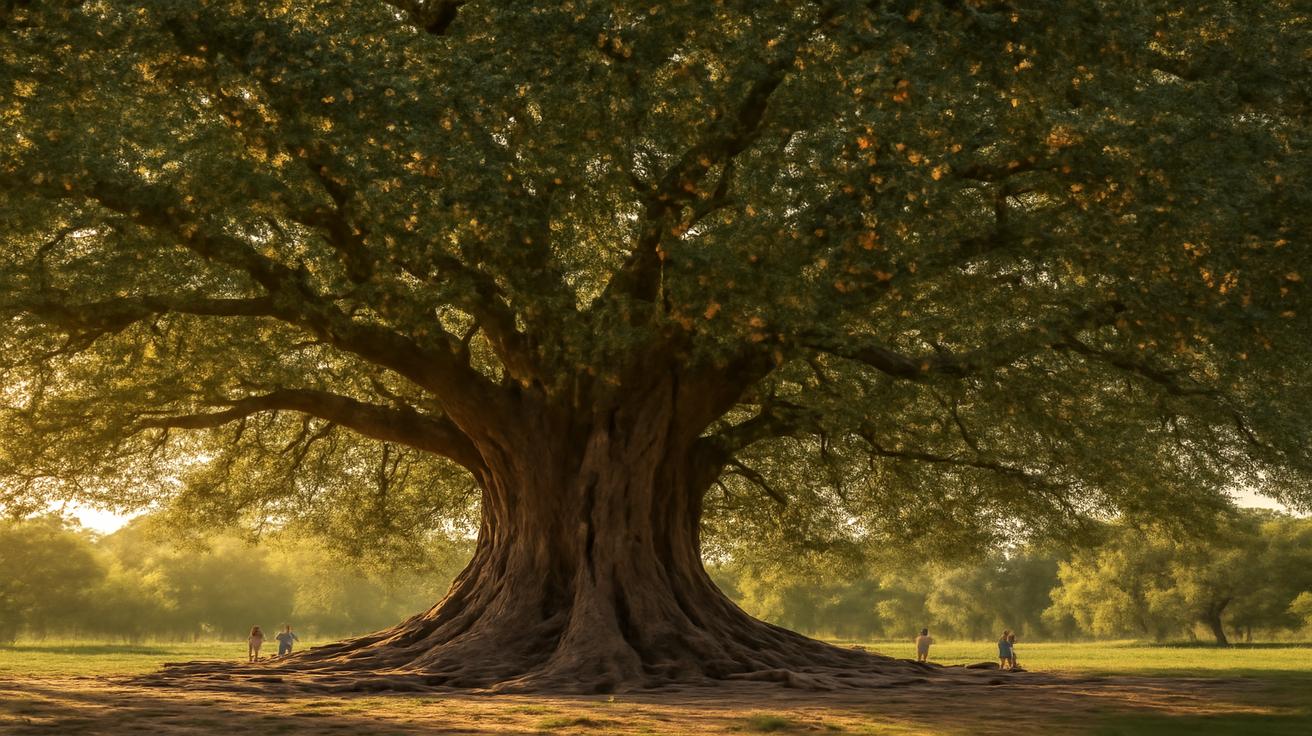
From the hilltop, it looks like an ordinary forest. A dense green dome, wind-rumpled, alive with birdsong and the faint shimmer of insects. Children in the nearby village grow up believing it’s a wild woodland, the kind that might hide foxes or spirits or the last traces of some ancient kingdom. But step closer, press into the shade, follow the maze of trunks and branches—and the illusion begins to fall apart. What you’re seeing isn’t a forest at all. It’s one tree. One single, sprawling organism stretching over 8,500 square meters, rising as high as a six-story building, and heavy every season with up to 80,000 fruits.
The Forest That Isn’t: First Steps Under the Canopy
The air changes the instant you cross into its shade. Outside, the sunlight is sharp and hot, humming on rocks and dust. Inside, it dissolves into a soft green glow, broken into a thousand shards by leaves layered over leaves. The temperature drops a few degrees; sound does, too. Your footsteps feel quieter, wrapped in leaf litter and the thick, sweet scent of ripening fruit.
At first, your mind insists this must be a grove—maybe even a small jungle. Pillars of wood rise everywhere, some straight and muscular, others hunched and twisted, leaning on neighbors like old friends. Vines drape from above, birds flicker from one bough to another, and squirrels disappear into tangles no human shoulder could slip through.
Then someone points to the base—a gnarled central trunk, wide and scarred, from which the whole living labyrinth unfurls. Every “tree” you thought you saw is really just a limb, a shoot, a reiteration of that same body, grown outward over decades, rooting as it spreads, folding space into an endless loop of shade.
You rest your hand on the main trunk. The bark is thick, rough like a woven mat, warm from a lifetime of storing sunlight. This is not a forest. This is a single creature that has learned how to behave like one.
The Giant That Grows Sideways
How One Tree Becomes a Thousand Trunks
Most trees obey a quiet, vertical ambition: up for the light; down for water and nutrients. But some species, under the right conditions, discover a different strategy. They grow wide instead of tall, sideways instead of skyward. They push branches out, let them droop, let them dip toward the soil until, in some moment of patient contact, wood becomes root.
Over years, those grounded branches thicken, harden, and rise like new trunks. From afar, it defies logic. You see dozens, even hundreds of stems standing on their own, and it seems obvious that they must be separate individuals. Yet follow the wood with your hand—feel how branch becomes trunk, curves, returns, and forks again—and the truth reveals itself: it’s all one. A connected web of living tissue, perforated by time but still flowing with the same sap, driven by the same genetic code.
The tree’s footprint now spans 8,500 square meters—more than a soccer field’s worth of continuous crown. Underneath, its root system is just as extraordinary, fanning out to drink from underground streams, sharing resources from one side of its body to another. A dry corner at the eastern edge can be quietly subsidized by the wetter soil on the western side. Shade here can afford fruit there. Nutrients, water, and information move invisibly along living bridges of wood.
This horizontal expansion is the tree’s survival masterpiece. Instead of gambling everything on one towering trunk that could be snapped in a storm, it distributes its risks. A branch lost here, a limb broken there—none of it threatens the whole. The tree simply grows around the damage, sending fresh shoots into the gaps. The canopy heals itself, like skin closing over a wound.
Listening to a Tree That Feeds a Village
80,000 Fruits and a Calendar Written in Ripeness
In the village nearby, conversations about the future don’t begin with dates on a page. They begin with this tree. When the first pale blossoms open, the elders say the hot season is truly here. When the heavy fruits start to plump and color, the harvest preparations begin. No one needs a smartphone alert or a printed calendar—the tree keeps its own time, and everyone has learned to read it.
During harvest, the canopy shifts from quiet abundance to organized chaos. People move like ants beneath the boughs, their voices rising and falling as they pick, sort, and carry. Every branch seems to drip with fruit, each segment a small world of color and fragrance. This single organism can produce up to 80,000 fruits in a season—a number that is almost impossible to hold in your mind until you see the baskets, crates, and woven sacks piled high, bright as lanterns.
Children scramble up the lower limbs, nimble and laughing, while older hands work with practiced care, feeling for the exact balance of softness and weight that signals ripeness. There is almost no need to walk in the open sun; the harvesters simply move deeper into the cool, the tree offering fruit after fruit like a generous tide.
For the families here, this is more than a botanical wonder. It is food, work, income, and ritual rolled into one. The fruits are eaten fresh, cooked, dried, traded in markets, stored for leaner months. Many people can trace memories—of childhood, of celebrations, of bad years softened by a good harvest—back through the canopy of this one tree. In a way, it shelters their stories as surely as it shelters their bodies.
| Feature | Details |
|---|---|
| Total Area Covered | Approximately 8,500 square meters |
| Maximum Height | Around 20 meters at its tallest points |
| Number of Trunk-like Supports | Dozens to hundreds, all part of one organism |
| Fruits per Harvest | Up to 80,000 fruits in a productive season |
| Ecological Role | Shade, habitat, soil protection, food web support |
A City of Creatures in the Branches
Life Under a Continuous Roof of Leaves
Stay still under the canopy long enough and the tree’s residents begin to reveal themselves. A rustle on your left becomes a lizard, a flicker overhead becomes a pair of lovebirds arguing. Ants march along the bark in glossy, determined lines, weaving their own invisible highways around the grand wooden avenues. Somewhere nearby, something drops—a fruit half-eaten by a monkey that slips away before you can even look up.
What looks like a single plant is, in truth, an entire vertical neighborhood. The upper branches catch blazing sun, hosting insects and birds that thrive in heat and brightness. Mid-level boughs offer a dappled half-light where nesting birds find safe resting spots and epiphytes cling to tiny patches of mossy damp. Near the ground, the shade is deep and cool, welcoming beetles, frogs, and shy mammals that prefer a softer, quieter world.
The tree’s fallen leaves build up in thick, fragrant carpets. As they decompose, fungi bloom in delicate fans and buttons, returning nutrients to the soil. Worms and tiny invertebrates tunnel through this organic layer, turning it and aerating it, ensuring the ground stays fertile and spongy. When heavy rains come, this leaf mattress slows the water, letting it soak in instead of washing away the earth.
From root tip to canopy edge, the tree is a continuous act of generosity—offering food, shelter, and structure to a web of life that expands far beyond its own wood. Birds disperse its seeds. Insects pollinate its flowers. Mammals spread its fame from one valley to the next simply by following the trail of sweet, fallen fruit.
How Do You Protect Something That Feels Immortal?
Ancient Roots, Modern Pressures
Standing beneath it, you might feel as if this tree has always been here and always will be. It looks timeless, an anchor in a world that keeps slipping its moorings. But like every living thing, it is fragile in ways that aren’t immediately visible.
Climate patterns are shifting. Rains that used to arrive like clockwork now come late, or not at all; when they do, they may fall all at once, overwhelming soil that’s used to slow, careful soaking. Prolonged heat can stress even the hardiest canopy, pushing the tree to spend more energy on survival and less on fruiting. A harvest of 80,000 fruits is a triumph—but it is also a question: how long can such abundance be sustained if the environment it depends on keeps changing?
Human pressures add another layer. Paths trodden too often near shallow roots, careless cutting of branches for firewood, fires set in nearby fields that leap unexpectedly into the lower limbs—each small act can leave a mark. Because the organism is interconnected, wound one part badly enough and the shock can ripple through the whole.
Locals have learned to read its warnings. A cluster of branches that stop flowering. Leaves that yellow unevenly on one side of the canopy. A sudden drop in fruit quality. These aren’t just quirks of a single season; they’re messages from a living landmark asking for different treatment. Some communities respond with protective rituals, new rules about grazing and woodcutting, or volunteer groups that patrol the area during the driest months, watching for smoke.
The Language of a Single, Vast Living Thing
Rethinking What a “Tree” Really Is
Most of us learned about trees as solitary columns: a trunk, some branches, a crown. But this enormous organism scrambles that tidy picture. It suggests that an individual can be spread out in space, repeated in form, and still be one self. It behaves a bit like a coral reef wrapped inside the body of a tree—many visible parts, one underlying life.
Scientists who study such giants look at more than the above-ground spectacle. They examine root connections, analyze the flow of sap, compare the genetic makeup of distant “trunks.” Over and over, they find the same signature: this is not a collection; it is a continuation. What your eyes perceive as many is, biologically, one.
In forests across the world, even seemingly separate trees communicate through shared fungal networks, passing signals and even resources to each other. This single-tree “forest” goes a step deeper. It doesn’t only cooperate with neighbors; it is its own neighbor, a looping circuit of selfhood stretching over thousands of square meters.
To stand inside it is to be reminded that our human categories—one, many, individual, community—are often too small for the living world. Here, individuality and togetherness coexist in a single, breathing form. The tree is both a single life and a crowd, an organism and an ecosystem, all at once.
Why This One Tree Matters to All of Us
What a Giant Can Teach a Changing World
You don’t have to live in its shadow to feel its significance. A tree that covers 8,500 square meters and rises 20 meters into the air does more than feed a village. It cools the land around it, shading soil so moisture lingers longer in the ground. It pulls carbon from the atmosphere, storing it not just in its trunk but in its sprawling network of branches and roots. It slows winds, tempers storms, and creates microclimates where smaller, more delicate plants and animals can survive.
In an age of shrinking forests and rising temperatures, such beings are not curiosities; they are allies. They show us what resilience can look like when it’s allowed to take its time and occupy space. A single storm can snap a sapling in half, but it has a much harder time toppling a living architecture built from dozens of co-supporting limbs.
At the same time, the giant tree is a mirror held up to our own choices. It took decades, maybe centuries, to reach its current size and productivity. Its 80,000 fruits per harvest are the result of careful adaptation and long, quiet persistence. We, by contrast, rush: planting fast-growing species in straight lines, clearing land in broad swipes, trading complexity for convenience.
Standing under the canopy, you feel the difference physically. The air is cooler, more humid, less frantic. You can hear your own breathing more clearly. You can sense, in the tangled geometry of limbs above you, a different rhythm of time—one that doesn’t care for election cycles or quarterly profits but moves instead by rings in wood and layers of soil.
Maybe that is the tree’s most important gift: perspective. It reminds us that what looks like a forest might be one patient life, and what seems like a single choice—cut, keep, protect, ignore—can ripple through space and time far beyond what we can see.
Frequently Asked Questions
Is it really just one tree and not many trees growing together?
Yes. Although it looks like a small forest, all the trunk-like supports are connected to a single root system and share the same genetic identity. What appear to be separate trees are actually branches that have grown down, rooted, and thickened into new supports for the same organism.
How big is 8,500 square meters in everyday terms?
An area of 8,500 square meters is roughly equivalent to more than a standard soccer field. Imagine standing at one goalpost and walking all the way to the far end, then knowing that the entire stretch—and more—is covered by a connected canopy belonging to a single tree.
How can one tree produce up to 80,000 fruits per harvest?
Because the tree spreads over such a large area and has so many productive branches, its total flowering and fruiting capacity is immense. Each segment of the canopy can support clusters of fruits, and when multiplied across thousands of square meters, the overall yield adds up to tens of thousands per season.
How old does a tree like this have to be to reach such a size?
While the exact age depends on the species and local conditions, a tree that covers 8,500 square meters has typically been growing for many decades, and often well beyond a human lifetime. Its size represents the accumulated result of slow, steady expansion and the ability to survive storms, droughts, and human presence over a long period.
Why is protecting a single giant tree so important?
Protecting a single giant tree safeguards far more than one plant. It preserves a complex habitat, a local climate regulator, a food source, and a cultural landmark all at once. Because this one organism functions as an entire mini-forest, its loss would be equivalent to clearing an extensive, mature grove in a single blow.






Leave a Comment