
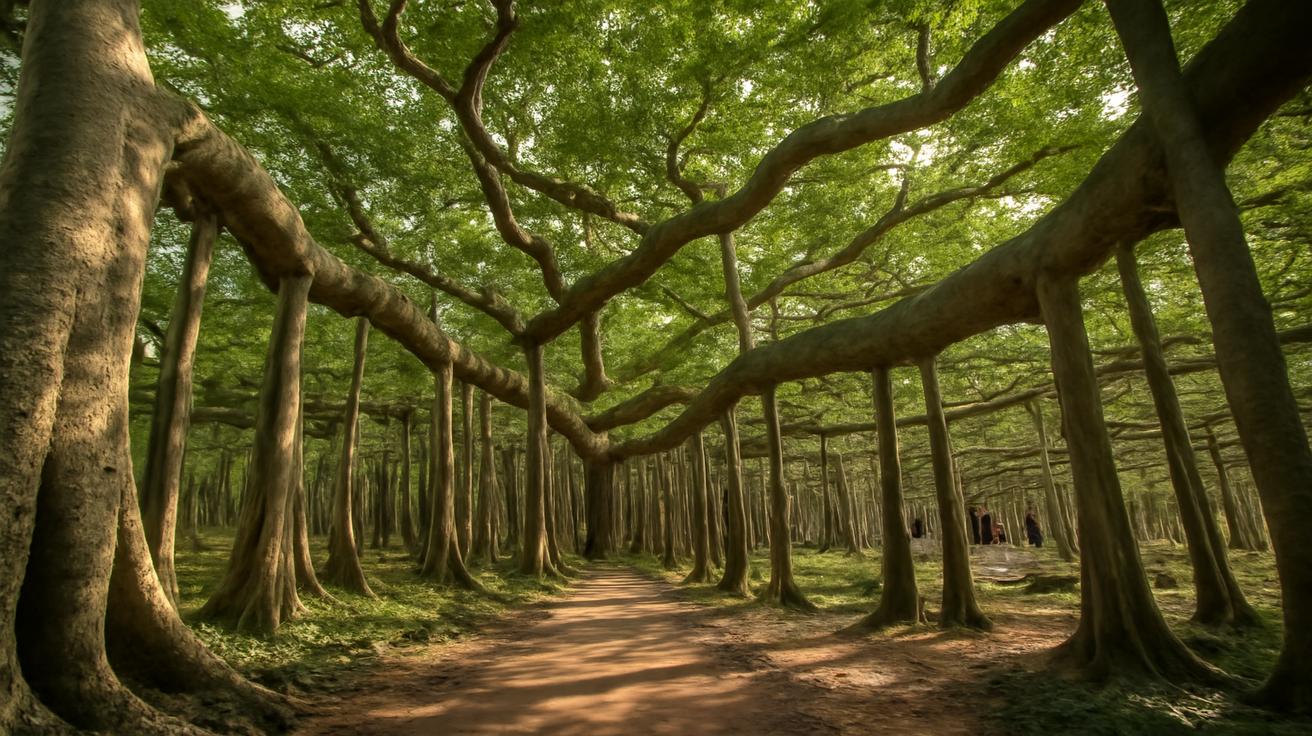
The first thing you notice is the sound. Not birdsong, though there is plenty of that. Not wind, though it moves constantly here, combing through thousands of leaves as if brushing the hair of something enormous. It’s the sound of a forest breathing—footsteps muffled on thick leaf litter, insects humming, distant voices swallowed by green. You walk forward, craning your neck to see where one tree ends and another begins, and that’s when the guide smiles and tells you the truth: there is no “another.”
You are standing inside a single tree.
A Forest That Isn’t: First Steps Into the Giant
At first, your mind rebels. A forest is a collection of trees; this is something everyone knows. Yet here you are, surrounded by hundreds of trunks, each rising from the ground like the pillars of a natural cathedral. Sunlight filters through a layered roof of leaves twenty meters above your head—about the height of a six-story building. Vines hang in soft loops, birds flicker between branches, and the air feels thick with the kind of damp sweetness you only find in old, undisturbed groves.
“All one,” the guide says, spreading his arms to take in the entire landscape. “One organism. One life.”
You circle the nearest trunk, pressing your palm to the bark. It’s warm from the day, rough beneath your fingers, smelling of resin and earth and rain. A few meters away, another trunk—slightly narrower, its bark patterned with moss and lichen. Beyond that, another. Dozens. Hundreds. You glance up, following the path of branches that disappear into the canopy, trying to spot a point where one ends and another begins… and you can’t. Instead, the branches arc upward, curve sideways, and merge with one another in a seamless, woody lattice. It really is one enormous living body, spread across 8,500 square meters of land—nearly the size of a city block in some places. From above, it would look like a solid island of green. From within, it feels like standing in the ribcage of a benevolent giant.
The tree—this sprawling, patient being—has grown by copying itself. In the simplest possible language, each “trunk” is a branch that once bent, touched the ground, took root, and rose again as if starting life anew. Except it never truly started over. Every new shoot remained connected to the original, sharing sap and secrets in an underground network of roots and in the braided wood above.
The Weight of an Invisible Giant
As you walk, the air changes with each step. Near the edges of the tree, sunlight pours in at low angles, stabbing through gaps in the leaves so sharply that every floating dust mote looks like a tiny planet. Move inward, and the light softens, filtered through more layers of foliage, becoming the color of deep green tea. The soil underfoot is spongy with decades of fallen leaves, rich with the quiet industry of fungi and bacteria and unseen tunnels of beetles.
The guide pauses where several trunks thicken and twist together, forming something like a broad, buttressed wall. You touch it and feel the cool press of living wood. Above you, branches tangle and braid, as if the tree has been slowly weaving its own architecture over centuries. This is what time looks like when it isn’t rushed—a slow accretion of decisions: to reach this way for light, that way for water, downwards for stability, upwards for the sun.
“This one stands about twenty meters high,” the guide says. “It doesn’t look like the tallest thing you’ve ever seen, but think of what’s underneath—how far the roots stretch, how much they feed, how much they endure.”
The idea is dizzying. We are used to measuring life in visible terms: height, shape, color, how much space a thing occupies above the ground. This tree demands you flip that habit. Its grandeur lies as much in what you can’t see—its tangled root systems, its shared yet hidden circulatory pathways—as in the visible forest of trunks. If you could trace each fine root with glowing ink, you’d see the ground beneath you illuminated like a galaxy, every trunk connected, every leaf fed, every fruit ultimately drawing its sweetness from the same deep source.
You begin to understand that calling this a “tree” or a “forest” is a limitation of language. It’s more like a single, sprawling intention expressed in wood and leaf and fruit.
80,000 Fruits: When the Forest Feeds
You arrive just as the season is tipping from blossoms to fruit. Scattered on the ground are early fallen globes—still firm, still bright, like discarded ornaments rolling in the dirt. Higher up, the branches sag slightly under clusters of maturing fruit, each one a promise waiting to ripen. The scent in the air is faintly floral, faintly sticky, as if the tree is rehearsing the sweetness to come.
The numbers sound impossible: 80,000 fruits in a single harvest. You try to imagine them all at once, hanging like lanterns from this green architecture. Enough to fill trucks, enough to feed villages, enough to leave piles of sweet, fermenting pulp for animals and insects to feast on, even after humans have taken their share.
“We measure it every year,” says the guide. “It changes a little, but on average, around eighty thousand. Some seasons more, some less. The tree knows the year better than we do.”
When the fruit is fully ready, the place transforms. Families arrive with baskets and crates. Children weave between trunks, calling to each other. The air fills with the smell of ripeness—thick and sugary, mingled with the sharper scent of leaves and sap. People climb, but carefully; this is not a commercial plantation with rough ladders and hurried hands. It’s more like a community ritual, and there’s an unspoken understanding that the tree’s health comes first.
On the ground, you can hear fruit hitting the soil with solid, heavy thuds, sometimes followed by laughter, sometimes by a quick scramble to pick it up before something else gets to it. Birds and small mammals watch from the periphery, waiting for their opportunity. The tree does not distinguish between human and animal in its generosity. Every fruit is a vessel of seeds designed for travel—by mouth, by gut, by time. Every bite taken is part of the tree’s long game of continuation.
The Taste of Patience
Someone cuts a newly fallen fruit open and offers you a piece. The knife slides through the skin with a soft, resistant give, revealing a pale, moist interior. You bring it to your mouth and take a bite. The juice floods your tongue—sweet, layered, more complex than the quick sugar of store-bought fruit. There’s depth here, a whisper of soil and rain and sun stored over months. You can taste the slowness in it, the long, unhurried way this tree has drawn minerals from the ground and light from the sky, turning them into something your body can use.
A single harvest here is more than just food. It’s a calendar event, a social glue, a reminder that time is cyclical and shared. For the local community, this tree is pantry, gathering ground, story source, and quiet employer all at once. For wildlife, it’s an extravagant banquet. For the tree, it’s strategy—an annual burst of investment in the future, casting thousands of seeds into the sphere of chance.
How a Single Tree Becomes a Many-Trunked World
The origin story of this giant is almost modest. It began like any other tree: a seed finding a crack of promise in the soil. A small stem pushing upward, a tender pair of leaves catching light. What turned that ordinary beginning into this living colossus is time—and a particular growth habit that blurs the edges between individual and colony.
Some tree species are gifted with a skill called vegetative propagation. They can clone themselves, not only through seeds but through branches and roots that become new trunks while still remaining physiologically tied to the old. Imagine a branch that, instead of reaching straight for the sky, slowly bends until it touches the ground. In that contact point, it does something quietly remarkable: it sprouts roots. From this anchored point, it turns skyward again, stiffening and thickening, becoming what your eyes read as a separate tree.
Repeat this again and again over decades and centuries. Each new trunk has its own roots, its own supporting structure. But deep underground and within the knotted wood of their bases, they remain fused. They share water, nutrients, and chemical messages—warnings about pests, responses to drought, hormonal signals to flower or rest.
In this way, a single individual can expand horizontally across a huge area, not by marching outward in neat lines like a plantation, but by folding and curving, testing spaces, rooting where it finds opportunity. Over time, wind, storms, and gravity become collaborators. A heavy branch here, overloaded with leaves or fruit, bows. A storm there, snapping a limb that later resprouts from where it broke, now closer to the ground. Each accident becomes a future trunk.
When we walk through the resulting grove, our eyes and our language mislead us into calling it a forest. Our brains look at separate vertical columns and file them under “many.” Yet if you could peer inside, map the veins of sap and the web of roots, you would trace them all back to one original life, multiplied yet never fully split.
The Mathematics of a Living Network
On paper, the statistics are impressive: 8,500 square meters of continuous living tissue, twenty meters of vertical reach, tens of thousands of fruits in season. If you could lay all its branches end to end, you might cross a modest town. If you weighed its entire mass—trunk after trunk after trunk—you’d likely be holding thousands of tons of stored carbon, all drawn down from the atmosphere over years. In an age when we talk urgently about carbon footprints, this single tree silently offers an outsized, leafy counterweight.
But there’s another math here, more subtle and more human. How many generations have lived with this tree in their landscape? How many hands have harvested its fruit? How many stories have been told beneath its shade, how many decisions made, how many quarrels cooled by standing in its calm, green light? Multiply that across decades and families, and you begin to understand that the value of such a being cannot be fully captured in hectares, meters, and kilograms.
Lives Woven Into Bark and Leaf
Spend a full day within this tree’s boundaries and you start to feel your own pulse slow. Morning begins with a soft gradation of light—from deep blue shadow to diluted gold, each leaf catching a sliver and turning it into an emerald spark. Birds begin their shift calls: a rising chorus of questions and answers thrown from branch to branch. Somewhere, a small mammal scurries down a trunk, pausing halfway to listen, fur pressed flat to the bark as if merging with it.
By midday, the shade is almost absolute in some pockets, the temperature several degrees cooler than the fields just beyond the tree’s reach. You can step out briefly into that glare and heat, feel the sting of sunlight on your skin, then duck back under the canopy and feel as though you’ve slipped into another season entirely. Here, microclimates nestle within each other: a damp hollow where moss thrives, a sunlit limb where epiphytes stake their claim, a mid-story branch frequented by birds that never touch the forest floor.
Insects carve their lives into the tree’s surface. You run your fingers along the bark and find tiny trails, pinprick holes, delicate shelves of fungi fanning outward like stained-glass ears. None of this feels like damage so much as dialogue—the organism and its community constantly negotiating space, resource, and survival. Predatory beetles patrol the bark. Spiders set up nets between leaves. Ants march in determined lines carrying fragments of things you cannot see clearly, but the tree feels them all, registers them chemically, responds in ways far too slow for your human nerves to detect.
Above you, the canopy sways. A branch the thickness of your waist flexes as a bird of prey lands, sending a shiver through the leaves. Somewhere else, a fruit drops, thudding softly into the duff. Life here is never still; it just moves on a spectrum of speeds, from the lightning-quick flick of a bird’s wing to the agonizingly slow expansion of new wood. The tree occupies the entire spectrum, its life spread across minutes and centuries at once.
Human Stories in a Green Cathedral
Even for the people who live nearby, this tree retains an almost mythic aura. Children grow up tracing its trunks like familiar streets—“meet me by the forked root,” “let’s hide near the mossy side”—turning it into a living playground and map. Elders sit in circles beneath its densest shade, telling stories of years when the harvest was sparse, or when the branches bowed so low with fruit that you could pluck it while standing on tiptoe.
In some years, storms tear through, ripping away sections of the canopy. Afterward, the community walks among broken limbs, assessing the damage like you might check on an injured relative. People gather fallen wood for practical use, but always with a sense of care. They know the tree will heal, slowly knitting its wounds with new growth, but they also know it will never look quite the same again. Every scar becomes part of its biography, like a wrinkle on a familiar face.
There is, too, the knowledge that nothing lasts forever. Even as the tree continues to expand at its edges, some inner trunks are beginning to hollow, their hearts turned to dark, crumbly soil that feeds new roots just a few meters away. It is dying and renewing at once, a constant internal recycling that ensures the network continues even as pieces of it fall away.
A Different Way of Being Big
Perhaps the most quietly revolutionary thing about this organism is the way it holds its size. Humans, when we grow large collectively—into cities, nations, systems—often do so by competition and division. This tree has achieved its magnitude by staying connected. It spreads, but it doesn’t disconnect. Each trunk is distinct, but not alone. The suffering of one part can be mitigated by the well-being of another through shared roots. When one trunk grows in an unfavorable patch of soil, its stronger neighbors can help feed it. When one section is attacked by pests, the alarm chemicals can travel through the network, prompting distant leaves to fortify themselves before the threat even arrives.
Stand quietly inside this many-trunked world long enough, and you may find yourself wondering what it would mean if more of our own systems behaved this way—growing not through relentless replacement and separation, but through decentered, interconnected extension. This tree has no single, obvious, towering trunk claiming all the sky. Its power is distributed, its survival strategy collaborative by design.
As the light begins to fade, you head toward the edge of the canopy. The moment you step beyond it, the world feels strangely bare. The field outside is open, blunt, honest. The sky is bigger here, but also harsher. You look back at the tree, now a silhouette of interlocking crowns against the evening, and you understand why it seemed like a forest when you first arrived. In outline, it is a small world unto itself. In truth, it always was one being—patient, rooted, outliving our quick, anxious years with a calm we can barely imagine.
Somewhere inside that darkening mass of leaves, a new root is taking hold, a new branch is bending toward the ground, a new trunk is preparing to rise. The giant continues, quietly, one cell at a time.
A Snapshot of the Living Colossus
| Approximate Area Covered | 8,500 square meters (about the size of a small city block) |
| Maximum Height | Around 20 meters (roughly a six-story building) |
| Fruits per Harvest | Approximately 80,000 fruits, varying by season |
| Number of Visible Trunks | Hundreds, all part of the same organism |
| Growth Strategy | Branches root where they touch ground, forming new trunks while staying connected |
Frequently Asked Questions
How can one tree cover such a large area?
This tree expands horizontally rather than only vertically. When its branches touch the ground, they can sprout roots and grow upward again as new trunks. Over many decades, this process repeats, creating a vast, interconnected network that appears to be many trees but is actually a single organism.
Are all the trunks genetically identical?
Yes. Because new trunks arise from existing branches and roots rather than from seeds, they are essentially clones of the original tree. They share the same genetic makeup and remain physically connected through their roots and lower stems.
How does the tree produce 80,000 fruits in one harvest?
With hundreds of trunks and a massive canopy, the tree has an enormous number of flowering branches. Each flowering cluster can set multiple fruits, and when you add all those branches together across 8,500 square meters, the total fruit yield can easily reach tens of thousands in a good season.
Is this kind of tree structure common in nature?
The specific scale of this tree is unusual, but the underlying strategy is not. Many plants and some trees can reproduce vegetatively—through runners, suckers, or rooting branches. What makes this case remarkable is the size, age, and the clear continuity of the organism across such a large area.
Why is this tree important for its ecosystem?
It provides extensive shade, moderates local temperatures, and offers food and habitat for a wide range of animals, insects, and microorganisms. Its massive root system stabilizes soil and helps retain moisture. As a large, long-lived organism, it also stores significant amounts of carbon, playing a role in regulating the local climate and contributing to broader environmental balance.
Can such a tree survive major storms or droughts?
Its interconnected structure actually increases resilience. If one trunk is damaged by a storm or suffers during a drought, others can help supply water and nutrients through the shared root system. While severe events can still cause serious harm, the distributed nature of the tree gives it a better chance of recovery than a single, isolated trunk might have.
How do local people interact with and use the tree?
For nearby communities, the tree is both a natural resource and a cultural landmark. They harvest its fruit, seek shade beneath its canopy, use fallen wood and leaves, and often gather there for social or ceremonial occasions. Over time, it becomes woven into daily routines and local stories, transforming from a mere plant into a shared reference point in community life.






Leave a Comment