
The house on Maple Ridge didn’t look like the kind of place that could fracture a family. It was small, white, and forever in need of a paint job, the front porch sagging just enough to creak a welcome (or a warning) under careful feet. In summer, the climbing roses smothered the railing in a tumble of pink, and in winter the kitchen windows glowed like a promise against the dark. For the Martinez siblings, it had been the backdrop to everything that mattered: first steps, slammed doors, reconciliations over late-night cocoa. They always assumed it would stay in the family, the way a heart stays in a body.
The Last Sunday Before Everything Broke
On the last Sunday before the reading of the will, the house smelled like chicken soup and lemon oil. The old clock on the wall ticked with its stubborn rhythm as though time, too, believed things would continue as they always had. Ana stood at the kitchen sink, rinsing dishes in water that had long gone cold, her fingers pruned and pale. Her younger brother, Mateo, leaned against the counter, scrolling through his phone, pretending not to be watching her.
“You really think she’s going to do something wild?” he asked, finally looking up. “It’s Mom. She labels the salt.”
Ana didn’t answer right away. The window above the sink framed the backyard, where the tired oak cast a long shadow over the patch of lawn where their father once pitched wobbly pop flies to them until the light disappeared. Out there, buried somewhere in the dirt, were the bottle caps they’d used as treasure and the secrets they’d sworn never to tell.
“She called a lawyer,” Ana said, her voice tight. “That’s not nothing.”
From the living room came the sound of a low laugh—hoarse, but still musical. Their mother, Elena, was talking to someone, her voice slipping between English and Spanish like it always did when she was comfortable. Not to them, though. That easy warmth was for the stranger who had arrived a year ago and, somehow, managed to become essential.
Nate.
He wasn’t a nurse, not exactly. More like a home aide, hired after Elena’s second fall. He was in his late thirties, with kind eyes and an ease that seemed built for sickrooms: never rushed, never loud, always ready with a story that made the beeping machines feel less like a countdown and more like background noise. In the beginning, the siblings had been grateful for him. Someone to be there when they couldn’t. A bridge between their mother’s increasing frailty and their own overstuffed lives.
But over months, the gratitude soured into something suspicious and raw, because being “there” had seemed to take on a new meaning.
The Stranger at the Center of the Story
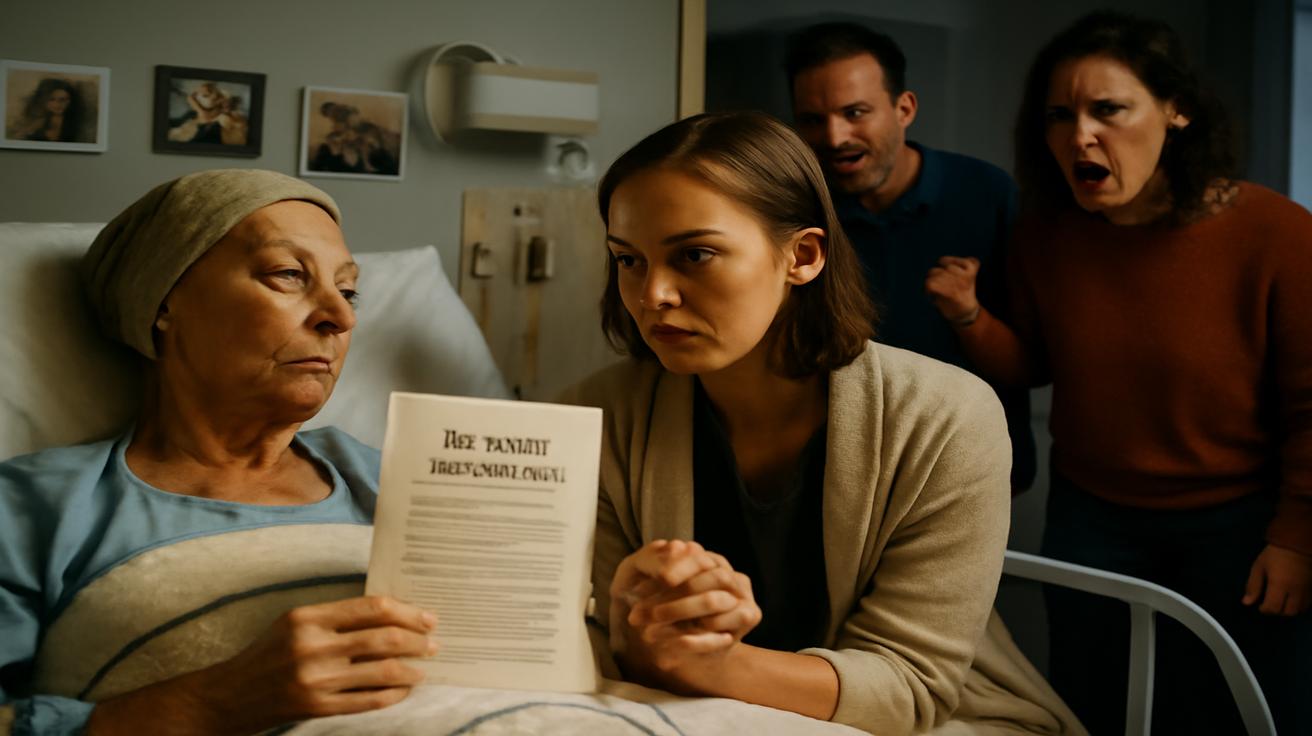
The first time Ana realized things had shifted was over a bowl of bland hospital pudding. Elena had been in for a battery of tests, thin hospital blankets pulled up to her chin, her hair tucked into a messy bun that made her look simultaneously younger and impossibly old. Ana had taken off work, arguing with her boss until he grudgingly approved the time. She’d sat at her mother’s bedside, expecting Elena to be relieved.
“You came,” her mother said, but the words carried surprise instead of expectation. Her hand fluttered briefly to Ana’s wrist, then dropped away, as if the effort of touching cost more energy than Elena had to spare.
A moment later, the door swung open and Nate stepped in, his arms full: a real blanket from home, the good chamomile tea, the crossword puzzle book Elena liked. Her whole face transformed, lit from within in a way Ana hadn’t seen in months.
“My hero,” Elena said, laughing softly. “You remembered the blanket.”
Hero. The word hit Ana like a slap. For a second she could only stare at them—the way her mother reached for him, the ease with which he navigated the room, the way he knew where the extra tissues were without looking. It was intimate, practiced, a quiet choreography of care.
That afternoon, on the ride home, Ana’s jealousy had tasted metallic and shameful. Of course her mother needed help, she told herself. Of course someone had to pick up the pieces left by her own full-time job, Mateo’s double shifts, their older sister Caro’s three kids. Being there every moment of every day simply wasn’t possible.
Still, a thought settled in the back of her mind like a burr she couldn’t shake: At what point does help become something else?
A House Built from More Than Wood
The family home wasn’t grand. If you looked closely, you could see where the linoleum had been patched, where the baseboards carried scars from years of toy trucks and moving boxes. The roof had been redone after a spring storm peeled it back like loose skin, and the backyard fence leaned as if listening too closely to the neighbor’s yard. But for the Martinez children, it was more than square footage and shingles.
This was where their father—gone ten years now—had taught them to ride bikes, jogging alongside them until their training wheels rattled uselessly in the air. This was where Elena had hosted chaotic holiday dinners, every surface covered with steaming dishes, her laugh rising over the clatter of plates. The narrow hallway had borne witness to slammed doors, whispered apologies, and the shuffle of uncertain teenage footsteps long after curfew.
Money had always been tight, but the house was constant. “Whatever happens,” their father used to say, resting a heavy hand on the kitchen doorframe, “this is ours. This is where we come back to.”
So when Elena’s health began to fail, the siblings assumed—without discussing it—that the house would pass to them. Maybe they’d sell it one day, maybe one of them would move in. But the idea of it leaving the family was unthinkable. The house was not just an asset; it was an anchor. And in the storm of their mother’s illness, that anchor felt like the only solid thing left.
They didn’t talk about it directly, not until it was almost too late. Talking about the future of the house meant talking about a future without Elena, and no one wanted to be the first to say that out loud.
Secrets Written in Legal Ink
The envelope arrived three weeks before Elena died. It was cream-colored and stiff, the kind of paper that felt expensive, with the return address of a law office printed in tidy black letters. It sat on the kitchen table for a full afternoon before Ana dared to open it, their mother’s thin signature like a small wound in the lower right corner.
“You knew she went to a lawyer?” Caro asked on the phone, her voice coming in sharp between the background noise of children and cartoon soundtracks.
“She said something about ‘getting her affairs in order.’ I thought it was just… paperwork.” Ana’s stomach twisted as she unfolded the letter. The formality of the language was a slap: “Last Will and Testament,” “bequeath,” “hereby.” It all sounded so remote, so tidy, compared to the mess in her chest.
But the will itself, the one the lawyer would later read aloud in a quiet conference room that smelled faintly of coffee and furniture polish, was anything but tidy in its impact.
Most of it made sense—small savings accounts divided equally among the children, sentimental items listed with surprising precision. The rosary that had belonged to Elena’s mother would go to Caro. The old record player would go to Mateo. A set of faded photo albums to Ana, “because she always remembers.” Each bequest pulled a thin thread of memory, stitching together a picture of Elena as she had been: thoughtful, stubborn, careful with what little she had.
Then the lawyer reached the part about the house.
“As for my primary residence at 48 Maple Ridge,” he read, his voice steady but not unkind, “I leave it in its entirety to Nathaniel James Hart, who was there for me when you weren’t.”
The words hit the room like a physical blow.
Ana felt her breath vanish, her chest suddenly hollow. She glanced at her siblings. Caro’s face went pale, her mouth parted in an ugly, unfinished word. Mateo blinked slowly, then shook his head as if trying to clear water from his ears.
“There must be a mistake,” Caro said. “That has to be—what, a draft? Or there’s another page?”
The lawyer cleared his throat, eyes flicking from one stunned face to the next. “I’m afraid not. Your mother was very specific.”
Very specific. The phrase churned in Ana’s stomach. The line—who was there for me when you weren’t—felt like someone had taken every late shift, every rushed phone call, every guilty compromise she’d made and pinned it up on a wall under harsh light. It didn’t matter how many miles she’d driven to doctors’ appointments, how many nights she’d slept upright in that awful hospital chair. To Elena, apparently, it had not been enough.
The Invisible Ledger of Care
In the days that followed, everything became a tally. Every memory was weighed, measured, held against that terrible sentence.
When had they not been there?
Ana thought of the night she’d chosen to stay late at work instead of visiting the hospital, calculating overtime against mounting medical bills. She remembered Mateo’s trip to the coast with friends, the photos he’d posted of cliffside sunsets while Elena lay recovering from surgery. Caro’s kids’ soccer tournaments, the weekends she’d said, “Mom understands, I’ll come next week.”
Under the harsh light of grief and accusation, all those choices, once understandable, now looked damning.
At the same time, another ledger existed—less visible, but just as real. Every rent payment made late because one of them had fronted money for medication. Every argument with a boss over another request for time off. Every time they’d lied to their own children, promising, “I’ll be home for dinner tomorrow,” knowing they’d likely be back at Maple Ridge instead.
But the problem with care is that it doesn’t fit neatly into columns. It is not always about who is physically present in a given hour, or who knows just how their patient likes their tea. It is paid for, often, in unseen currency: anxiety, lost sleep, compromised futures.
From where Elena lay—hours stretching out like long hallways, nights punctured by beeping machines and the quiet shuffle of nurses’ shoes—it may have looked different. She saw who held her hand at 2 a.m., who brought her the blanket without being asked, who listened to the same story about her childhood three times in a row without glancing at a buzzing phone.
To her, perhaps, it was simple: someone had been there when she needed them most. Someone who wasn’t bound to her by blood or history, but who showed up, day after day, when the world had grown small and uncertain. And she wanted to honor that, to carve it into law so it could not be ignored.
How a House Becomes a Fault Line
News of the will spread through the family like smoke. Cousins whispered on group chats, aunts muttered disapproval over simmering pots. Some took the siblings’ side immediately—outraged, indignant.
“After everything you did? She gave him the house?” one cousin texted Ana. “That’s messed up.”
Others, more cautiously, suggested another view.
“Maybe she just wanted to thank the person who was there in the end,” an older aunt wrote. “It doesn’t mean she loved you any less.”
But intent and impact rarely align neatly in families. To the siblings, the decision wasn’t just about property. It was a verdict. Their mother had taken the most tangible symbol of their shared life and handed it to someone who had existed in their story for barely a chapter.
The next time they all stood together on the front lawn of 48 Maple Ridge, the house loomed behind them, quiet and watchful. The roses on the porch had begun to wither in the late autumn chill, petals browning at the edges.
“So that’s it?” Mateo’s voice was sharp. “We just walk away and let some guy live here? In Dad’s house?”
“It was Mom’s house,” Caro snapped back. “She got to decide.”
“You agree with this?”
“I didn’t say that. But what are we supposed to do, storm the place?”
Their arguments, once about whose turn it was to do the dishes or who had borrowed whose sweater without asking, now orbited bigger, darker planets: loyalty, abandonment, duty. Each sibling clung to their version of the story because it was also a defense of their own life choices, their own sense of self.
Ana found herself standing on the porch, hand resting against the splintered wood of the railing. Behind her, through the thin door, she could almost hear echoes: the thump of music from some long-ago teenage party, their father’s baritone shout, her mother’s exasperated cluck of the tongue.
She remembered Elena’s face the last time they’d spoken alone, days before she died. Her mother had been lucid, her eyes strong, a hint of the old steel in her voice.
“You’re angry with me,” Elena had said, instead of hello.
“I just… I don’t understand,” Ana replied, confrontations melting on her tongue. “This house… we thought…”
“You thought it was yours.” Elena’s smile had been sad, not unkind. “All your lives, you talked about leaving. Going somewhere bigger, better. You did good. You built your own homes. You were supposed to.”
Her fingers had moved restlessly over the edge of the blanket. “This place, in the end, it was mostly me and the ghosts. And then it was me and him. He saw me when I was small again. When I couldn’t reach my own glass of water. That matters, mija.”
“We saw you too,” Ana had whispered, but even as she spoke, she knew what Elena meant. There is a difference, sometimes, between dropping in and dwelling in the hardest hours of someone’s life.
When Love, Guilt, and Law Collide
The legal options were clear but cold. Contesting the will would be expensive, time-consuming, and emotionally brutal. They would have to argue, in front of strangers, that their mother had been confused or coerced. They would have to turn her last decision into something broken and suspect.
“Do we really want to spend the next two years fighting in court?” Caro asked one night over a three-way video call, each face framed by a different kitchen, each lit by a different shade of regret.
“It’s not just about the house,” Mateo insisted. “It’s about what she said. ‘When you weren’t.’ Like we abandoned her.”
“Maybe we did,” Ana said quietly.
The words fell between them like a stone.
It wasn’t that any of them had truly walked away. But there are so many ways to partly leave: the unanswered late-night calls, the visit you postpone until after the big project at work, the way you assume there will always be another weekend, another holiday, another chance.
They had lived their lives on the unspoken belief that love would be understood without constant proof. That their mother, who had once seemed indestructible, would see the invisible threads of their care even when they weren’t physically in the room.
Elena, facing her own end, had apparently wanted something more concrete. A house deed. A line in a will. A thank you etched in permanence.
So the siblings were left holding two truths that sat uneasily side by side:
- They had loved their mother, imperfectly but genuinely.
- Someone else had been there, more consistently, at the end.
How do you make peace with both?
What the Story Looks Like from the Outside
From a distance, inheritance injustices can look simple: greedy siblings, manipulative strangers, vulnerable elders taken advantage of. The headlines write themselves—words like betrayal, gold digger, disowned leap to mind. But up close, the lines blur.
From Nate’s perspective, the story read differently. He hadn’t asked for the house. When Elena first mentioned “changing some paperwork,” he’d tried to wave it off.
“Your kids will want this place,” he’d said, sitting at her bedside as afternoon light slanted through the curtains. “You should talk to them.”
“They have their own lives,” she replied, breathing shallow but firm. “They visit when they can. You are the one who is here when it’s dark.”
He thought of his own past—of a mother he’d lost too young, a cramped apartment where no one had thought to protect what mattered for the future. Maybe, he told himself, accepting the house was honoring Elena’s agency. Maybe refusing it would have been another kind of dismissal.
Still, he felt the siblings’ eyes on him as he packed his small car with boxes weeks later. Their resentment pressed against his back like heat. In his hands, the house keys felt heavier than metal.
Outside of this family, this story repeats itself in endless variations: an adult child cut out of a will for marrying the “wrong” person; a neighbor unexpectedly gifted the family farm; a caregiver left with a house they never expected and a side of simmering hatred. Each case creates its own weather system, sending shockwaves through people who once assumed blood would always trump paper.
Yet, for all the drama, there are patterns—small fault lines where cracks often begin.
| Hidden Fault Line | How It Shows Up | What Might Help Earlier |
|---|---|---|
| Unequal caregiving | One person is there daily; others help from a distance. | Acknowledging roles and burdens openly before crises. |
| Unspoken expectations | Children assume inheritance; parent assumes they’ll understand any choice. | Honest conversations about wishes, property, and feelings. |
| Resentment and guilt | Old sibling rivalries flare around money and “who did more.” | Naming tensions early, maybe even with a neutral mediator. |
| Silence around death | No one wants to talk about wills until it’s too late. | Treating end-of-life planning as an act of care, not doom. |
What Remains When the Doors Close
Months later, passerby might see a man tending roses in front of a modest white house on Maple Ridge. They wouldn’t know that the trellis was hammered together by a teenager and his father on a late-spring afternoon, or that once, a little girl had sat on those steps, watching ants carry crumbs like treasure. To them, it’s just another house on just another street.
For the siblings, it is now both landmark and ghost.
Ana drives past sometimes on her way back from work, slowing just enough to see lights in the kitchen, new curtains in the living room window. She tells herself she’s not looking for anything, but her chest tightens all the same.
Inside their own homes, they are building new traditions—Sunday dinners that taste slightly different, holidays arranged around different tables. Their relationships with each other bear scars: unreturned calls, conversations that skirt too close to certain topics, long pauses where laughter used to sit. The will was a spark, but the tinder was older: years of assumptions, sacrifices that went unrecognized, fears no one knew how to put into words.
Over time, they may talk about it more gently. They may find ways to honor both the love they knew and the hurt they carry. They may even, one day, invite Nate into that conversation, letting the story become more complex and less like a clean break. Or maybe they won’t. Some families never do.
Yet beneath the specific pain of 48 Maple Ridge lies a quieter question, one that hums under so many modern lives: What does it really mean to be “there” for someone? Is it measured in hours logged at a bedside, or in years of keeping the household afloat from a distance? Does love prove itself in presence, in sacrifice, in money, in memory?
Elena tried to answer that question with a legal document and a sentence that burned: who was there for me when you weren’t. In doing so, she carved her truth into a deed, but left her children to untangle theirs from the rubble.
In the end, the house did what houses do: it sheltered the person who held the keys. The deeper inheritance—the tangled, invisible legacy of love, care, resentment, and longing—remained in the hearts of those who had passed through its doors. No will can ever fully control that.
FAQ
Why would a parent leave the family home to a non-family caregiver?
Often it’s a way of expressing gratitude for intense, day-to-day care in the final years. For someone who feels abandoned or simply isolated, the caregiver becomes a lifeline. Leaving a home or large asset can feel like the only meaningful way to say “you mattered,” especially when the parent believes their children are already financially or emotionally established elsewhere.
Is it common for siblings to fight over inheritance like this?
Yes. Inheritance disputes are one of the most frequent sources of long-lasting family conflict. Old rivalries, guilt, and different understandings of “who did more” during a parent’s decline can turn legal decisions into emotional battlegrounds, especially when a major asset like a home is involved.
Could the siblings have prevented this kind of inheritance shock?
They might not have changed their mother’s wishes, but open conversations could have softened the blow. Talking clearly about wills, property, and feelings—before illness becomes critical—gives everyone a chance to understand the parent’s reasoning, suggest alternatives, or at least prepare emotionally for difficult choices.
Is leaving more to a caregiver always unfair to the family?
Not necessarily. Fairness can look different depending on perspective. A caregiver may have given up income, time, and opportunities to provide intimate, daily support. A parent might feel it’s fair to compensate that sacrifice. The hurt often comes not from the gift itself but from the way it’s communicated—or not communicated—to the family.
What can families do now to avoid similar inheritance conflicts?
Start early, even when everyone is healthy. Encourage parents to create clear, legally sound wills and discuss them openly. Acknowledge who is providing care and how that might be recognized. Consider written agreements, family meetings, or neutral mediators to surface unspoken expectations. Most importantly, treat end-of-life planning as an act of love and clarity, not as a taboo to be avoided.






Leave a Comment