
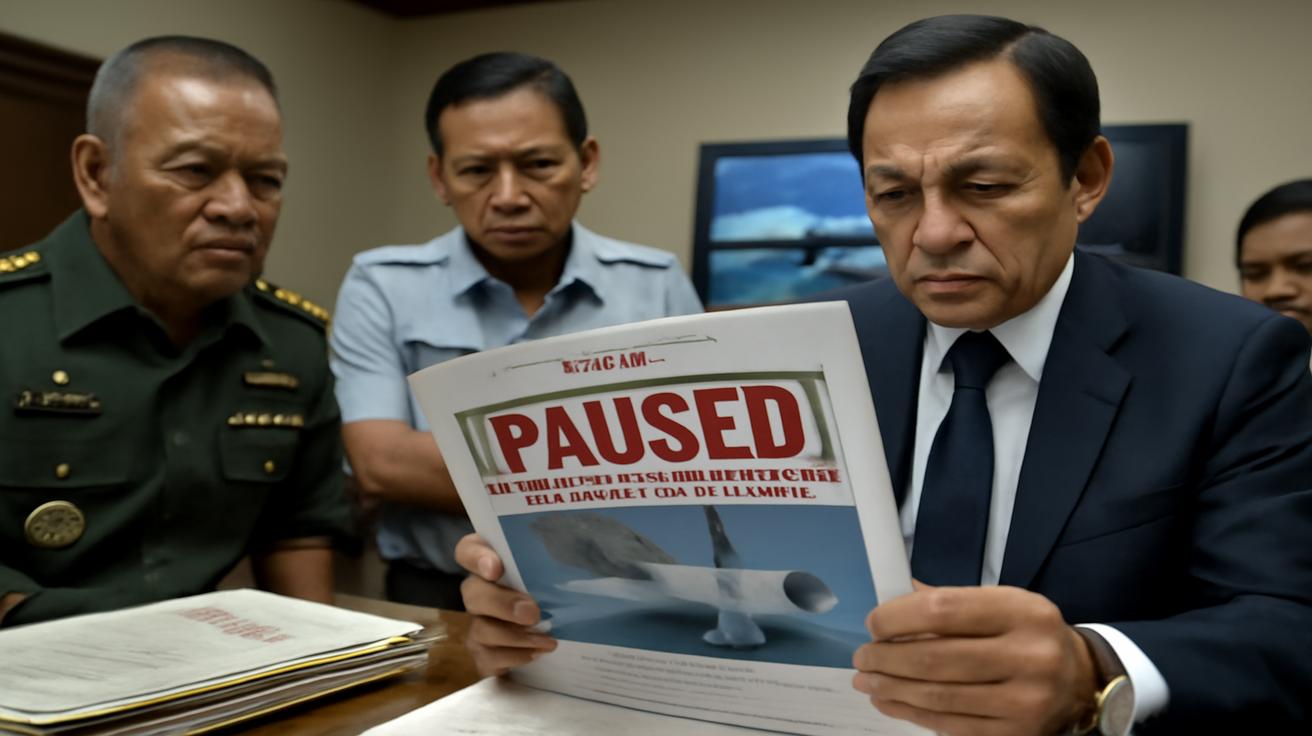
The first thing you notice is the heat. Not the kind that simply warms your skin, but the kind that shimmers off Jakarta’s tarmac and makes the air itself look restless. Somewhere beyond the haze, beyond the car horns and the call to prayer, decisions are being weighed that could shift the balance of power in the skies over half the world. A single condition, repeated calmly in closed rooms and crisp cables, now hangs over one of the most ambitious defense projects outside the West: Indonesia will not move forward on Turkey’s Kaan fighter unless the aircraft can be built with absolutely zero United States components. Not fewer. Not “as few as possible.” Zero.
Whispers Over a Runway
Picture a small group of officers on a humid evening at Halim Perdanakusuma air base, watching the last light bleed out over the runway. Behind them, the roar of an aging F-16 scrapes the sky; ahead of them, on a tablet balanced over someone’s arm, grainy footage loops of a sleek gray prototype taxiing under a colder Turkish sun. That aircraft is Kaan, Turkey’s answer to the global race for fifth-generation fighters—stealthier, smarter, built to stand apart from the U.S.-dominated F-35 ecosystem that once promised Ankara a bright future and then abruptly shut its doors.
Indonesia, archipelago of 17,000 islands and stubborn strategic independence, has been quietly interested. On paper, the story writes itself: two middle powers, both tired of being squeezed between superpower suppliers, trading expertise and funding to build a fighter that doesn’t come with a leash. But the details are never on paper; they sit instead in the fine print of export licenses, the quiet vetoes of foreign governments, the invisible circuits and software that carry another country’s flag in every bolt and chip.
That is where the demand was born. Indonesian officials, seasoned by years of navigating sanctions, delays, and arm-twisting, have drawn a bright red line: no U.S.-origin components in Kaan, not if Jakarta is to consider serious co-investment or long-term acquisition. This isn’t simple stubbornness. It is survival instinct, sharpened by experience.
A Sky Full of Strings
To understand why that single condition matters, you have to step back—up, even—into the broader sky Indonesia flies in. The country’s current fighter fleet is a patchwork of geopolitics: American F-16s humming with systems that can be switched off at the swipe of a Washington pen, Russian Su-27 and Su-30 Flankers now increasingly tangled in the spiderweb of Western sanctions, and a tentative embrace of Western Europe via a commitment to the French Rafale. Each jet carries not only weapons and sensors, but also history and leverage.
When Indonesia abandoned an earlier plan to buy Russia’s Su-35, it wasn’t just a technical decision. It was a reaction to the pressure of U.S. sanctions laws aimed at countries doing major defense deals with Moscow. Likewise, Jakarta’s long and sometimes frustrating dance with South Korea over the KF-21 Boramae fighter project has been shadowed by the reality that many parts in that plane ultimately trace their ancestry to U.S. technologies and approvals. One blocked export license, and an entire wing of dreams can stall on the factory floor.
So when Turkey came knocking with Kaan—a sleek, angular promise of independent capability—Indonesia’s strategic thinkers saw both opportunity and a familiar danger. Would they be trading one set of strings for another? Were they simply stepping from under one cloud of vetoes into another, hidden in the supply chains of radar modules, engine parts, avionics, or encrypted communications gear?
The Weight of a Word: “Zero”
Ask a defense engineer what “zero U.S. components” means, and watch them exhale slowly. At first glance it sounds technical enough: no American-made hardware, no U.S.-licensed subsystems, no chips that need Washington’s permission before crossing an ocean. But dig a little deeper, and the edges blur. What about a European-made radar that quietly incorporates U.S.-patented algorithms? What about a sensor suite designed by a Turkish firm that relies on a U.S. semiconductor at its core? Supply chains in modern aerospace are like mycelium networks—vast, largely invisible, and intimately entangled.
For Indonesia, the demand for zero is not naïve about these complexities; instead, it is a political compass bearing. Anything that gives Washington the legal right to intervene in a sale, block critical spare parts, or restrict upgrades over the fighter’s 30- or 40-year life span is a risk. Jakarta’s nightmare scenario isn’t just a cut-off in wartime; it is the quieter pressure that can be applied over contested waters in the South China Sea or over how Indonesia votes at the United Nations.
Turkey, meanwhile, understands this language fluently. Its ouster from the F-35 program after buying Russian S-400 air defenses was a brutal reminder of dependency. One moment Ankara was a key industrial partner, set to build major portions of the F-35; the next, it was frozen out and blacklisted from the jet it had helped craft. The Kaan program is in many ways Turkey’s answer to that trauma: an aircraft meant to prove it can exist, and sell, without asking U.S. permission.
Turkish Ambition Meets Indonesian Caution
Early on, Ankara made sweeping claims about Kaan’s independence, talking up domestic design, local avionics, and future homegrown engines. The prototype that took to the skies, though, did so with a distinctly foreign heartbeat: U.S.-made F110 engines, closely related to the powerplants in American F-16s. Other systems, too, appear to be derived from or intertwined with Western technologies that carry layers of licensing and export rules.
That is where the Indonesian pause begins. To Jakarta, prototypes are promises, not products. A true partnership—money on the table, engineers embedded, training pipelines built—is something different. It requires not just a glossy brochure and a first-flight video, but credible answers to hard questions: How fast can Turkey replace those engines with an entirely non-U.S. design? Can every critical component be audited for origin and export limitations? What happens if, midstream, Ankara finds it simply cannot decouple some subsystem from American intellectual property?
And beneath those direct questions lies an unspoken one: how much risk is Indonesia willing to accept that it might be buying into yet another project where the hidden hand of a distant capital can still flip the switches?
| Fighter Program | Key Partners | U.S. Component Exposure | Indonesia’s Concern |
|---|---|---|---|
| F-16 / Legacy Fleet | United States | Full systems, logistics, software | High dependency, potential sanctions leverage |
| Su-27 / Su-30 | Russia | Minimal U.S. parts, but subject to Western sanctions | Logistics squeezed by global sanctions regimes |
| KF-21 Boramae | South Korea (U.S. tech involved) | Significant U.S. subsystems, export licenses | Exposure to U.S. approval at each sales step |
| Rafale | France | Limited U.S.-origin content | Reduced U.S. leverage, but still Western-aligned |
| Kaan | Turkey (seeking other partners) | Prototype with U.S. engines; other systems evolving | Demand for “zero U.S.” to avoid future restrictions |
Between Volcanoes and Vetoes
Fly over Indonesia’s spine of volcanoes and you understand why aircraft matter here. Islands stretch like beads scattered by a careless hand, separated by dark water and thick weather. Any serious defense posture demands reach—fast, flexible, able to leap from Sumatra to Papua in hours. But that reach loses meaning if invisible political chains can yank the aircraft back to the hangar or turn off the tap of spare parts and software updates.
Indonesia’s foreign policy has long prided itself on “free and active” principles, steering clear of formal alliances, wary of becoming anyone’s staging ground. In practice, that means hedging: buying a bit from Washington, a bit from Moscow, something from Paris, talking to Seoul, listening to Ankara. It is, in its way, a kind of ecological strategy—diversify your sources, so no single failure wipes you out.
The demand for zero U.S. content in Kaan is the hedging instinct taken to its logical extreme. With Washington already inside the house via F-16s and future upgrades, and with Europe invited through the Rafale deal, why invite a third form of dependency hidden under the skin of an aircraft that is being sold precisely as an escape from Western control?
A Pause, Not a Goodbye
Officials close to the matter describe Indonesia’s position less as a slammed door than as a hand held firmly on the handle. Talks have not collapsed into anger; they have slowed into calculation. Ankara continues to court other partners and potential buyers, from the Gulf to Asia. Jakarta, for its part, has made clear that enthusiasm alone cannot cross its red line. No fresh rounds of serious negotiation, no new commitments, until Turkey can place on the table a credible pathway to a U.S.-free Kaan—engine to antenna, sensor to software.
Behind closed doors, it is likely that Turkish engineers and planners are already mapping out what such a pathway might require. New engine collaborations with Britain, deeper ties with domestic chip and electronics producers, negotiations with suppliers in countries less entangled with U.S. control regimes. All of this takes time, money, and political risk of its own. The gamble is that the long-term payoff—true independence in the high temple of modern airpower—will justify the cost.
A Future Written in Contrails
There is a wider story unfolding beyond the immediate back-and-forth between Jakarta and Ankara. Kaan is one chapter in a global reordering of who gets to build what flies above the clouds. Japan, South Korea, India, Europe, even the Gulf states—many are pushing for fighters that do not rely entirely on U.S. or Russian pipelines. Each program is both a technical challenge and an act of political storytelling: we can protect ourselves, and we can do it on our own terms.
Indonesia’s firm stance may look, to some, like overreach from a country still struggling to fund and modernize its current fleet. But in another light, it is a quiet assertion of agency. Instead of passively accepting whatever terms a supplier sets, Jakarta is trying to shape the market itself, sending a signal not just to Turkey but to every future partner: sovereignty is not negotiable. If you want our flag on your aircraft, don’t bring someone else’s fingerprint in the wiring.
Whether that signal will resonate—or simply leave Indonesia watching from the ground as others fly ahead—is still unclear. Kaan may or may not ever wear Indonesian roundels on its wings. There are other options on the horizon, other negotiations brewing in hotel conference rooms lit too brightly against the night. But the line Jakarta has drawn around U.S. components is unlikely to fade soon; it has been etched by too many years of watching the world’s supply of power tilt on the axis of sanctions law.
Listening to the Engines We Cannot Hear
If you stand close enough to any modern fighter jet during takeoff, sound becomes something physical, rattling your ribs and making speech meaningless. Yet the most consequential noises in this story are the ones you cannot hear: the soft buzz of officials reading classified export-control memos; the click of a mouse approving or denying a license; the muted ring of a secure call between Washington, Ankara, and Jakarta.
Somewhere, a Turkish engineer is sketching out an engine design that might one day replace the U.S.-made heart at the center of Kaan. Somewhere else, an Indonesian planner is updating spreadsheets of fleet availability and projected gaps in air coverage in the 2030s, eyes drifting to columns of numbers that depend on decisions made far away.
Between them stretches not only distance, but a series of questions that feel less technical than philosophical: How much control is worth sacrificing for raw capability? When does partnership become dependency? And, perhaps most pressing for nations like Indonesia and Turkey, can true sovereignty be bolted together from parts bought on the open market?
For now, the answer seems to be: only if those parts are free of certain shadows. Indonesia’s insistence on a Kaan without U.S. components is not a quirk of pride; it is the expression of a world where great-power tension has seeped into every circuit board and turbine blade. To fly above that tension—to really own the sky—Jakarta wants an aircraft that doesn’t carry anyone else’s invisible keys.
As the sun goes down over runways in both countries, Kaan continues its early test flights, carving white scars across the Turkish sky. In Indonesia, decision-makers watch from afar, weighing risks and possibilities against the hum of their own aging jets. The air between them is thick with heat, history, and the faint, rising roar of futures still being negotiated.
Frequently Asked Questions
Why is Indonesia insisting on zero U.S. components in Turkey’s Kaan fighter?
Indonesia fears that any U.S.-origin parts would give Washington legal and political leverage over the aircraft’s export, maintenance, and upgrades. By demanding zero U.S. content, Jakarta hopes to avoid scenarios where sanctions, policy shifts, or export-control decisions could ground its fleet or limit how it uses the jets.
Does Kaan currently use U.S. technology?
The Kaan prototype has flown using U.S.-made F110 engines, and some other systems may be linked to Western technologies and supply chains. Turkey has stated it aims to replace these with fully indigenous or non-U.S. alternatives over time, but that transition is complex and still in progress.
Has Indonesia completely withdrawn from talks with Turkey about Kaan?
No. Indonesia has effectively paused deeper negotiations, stating that substantive progress and new commitments will depend on Turkey presenting a credible plan for a Kaan configuration free of U.S.-origin components. The door remains open in principle, but Jakarta’s condition is firm.
How does this affect Indonesia’s broader fighter plans?
Indonesia is already committed to French Rafale fighters and remains linked to South Korea’s KF-21 program, while operating U.S. and Russian aircraft. The Kaan issue is part of a broader strategy to reduce dependence on any single supplier or political bloc and to avoid vulnerabilities created by sanctions and export controls.
Is it realistic to build a modern fighter with zero U.S. components?
It is technically possible but extremely challenging. Modern fighters rely on complex, globalized supply chains where U.S. technology and intellectual property are deeply embedded. Creating a fully U.S.-free aircraft requires major investment, time, and careful design to avoid even indirect dependencies that could trigger U.S. export controls.
Why is Turkey motivated to reduce U.S. content in Kaan?
After being removed from the U.S.-led F-35 program due to its purchase of Russian S-400 air defenses, Turkey is seeking more autonomy in defense production. Reducing U.S. content in Kaan would not only appeal to customers like Indonesia, but also protect Ankara from future political and export-control shocks.
Could this dispute reshape future arms deals beyond Indonesia and Turkey?
Yes. Indonesia’s firm stance sends a signal to other middle powers that they can demand greater autonomy and fewer political strings in defense deals. Suppliers, in turn, may accelerate efforts to “de-Americanize” some systems to stay competitive in a world increasingly shaped by sanctions and great-power rivalry.





Leave a Comment