
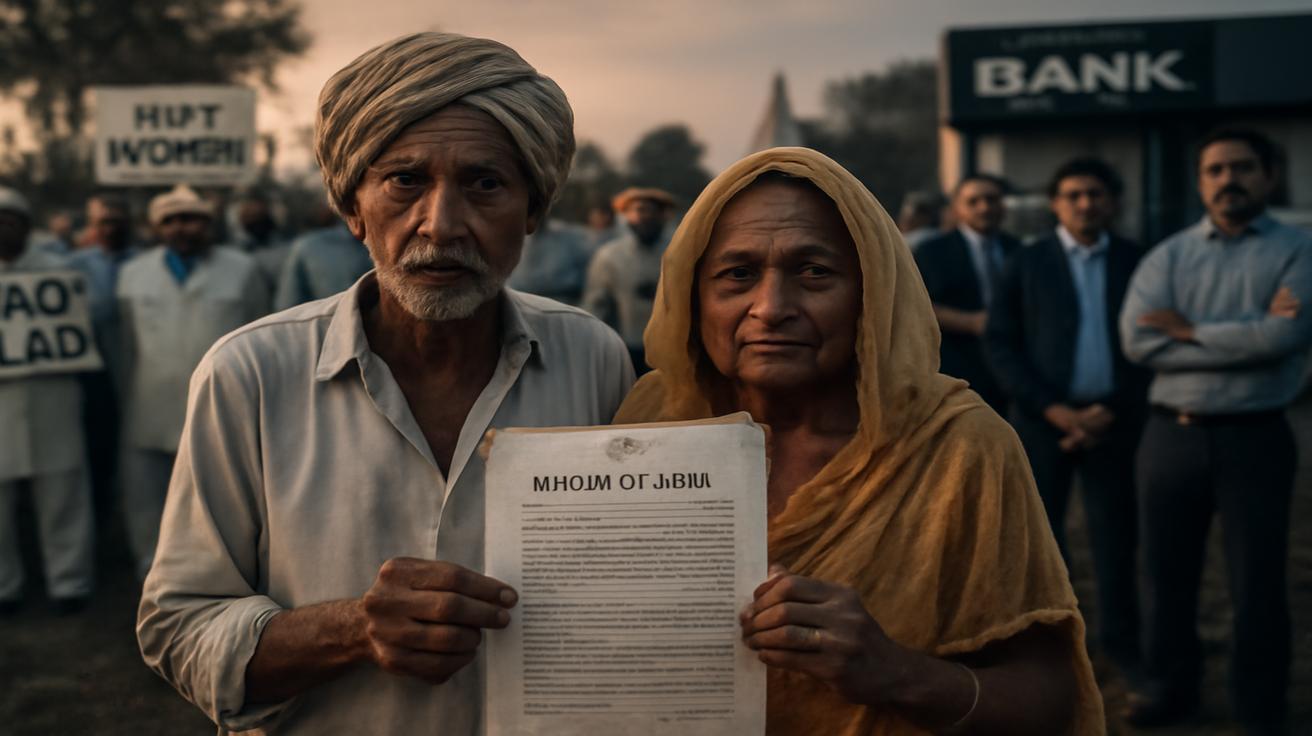
The last of the evening light was draining out of the sky when the notice came. A thin envelope, dust‑stained at the edges, slipped through the rusted gate and landed near the old neem tree. In the fields beyond, winter wheat shimmered silver, ready for harvest. Inside the clay‑walled house, an elderly farmer named Raghu and his wife, Savitri, were bent over a single lantern, counting coins for the next day’s diesel. They did not know yet that, with a few stamped pages of legal language, the land beneath their feet—their past and their future—had already been sold.
The Land That Remembered
Raghu liked to say the soil knew his name. If you walked with him at first light, when mist hugged the earth and egrets stepped like quiet priests between the furrows, you could almost believe it. Each ridge of this five‑acre plot in northern India carried a story: the year the monsoon failed, the season the canal breached, the time his daughter planted marigolds along the bunds before her wedding.
His family had tilled this land for four generations. It was not large, not the sort of estate you’d see in news photos or political speeches, but it was enough. Enough to raise three children, enough to feed the soil with cow dung and home‑saved seeds, enough to host the annual village feast under the banyan at the boundary. The trees at the edge—jamun, babool, a solitary mango—had been planted by his grandfather. Their roots, he would say, “hold our names underground.”
The land was more than property. It was memory, insurance, reputation, even a kind of quiet dignity. In village disputes, when tempers rose and voices grew harsh, people softened around Raghu. “He has land,” they’d say simply, meaning: he has something to lose, a stake in the future, an investment in peace.
To watch him work was to see a man reading an old, familiar book. He ran soil between his fingers to feel its moisture, squinted at clouds to guess the afternoon wind, pressed a seed into the earth with the same care others might lace the fingers of a child’s hand. Savitri walked behind, her sari tucked high, scattering fertilizer in arcs that glinted briefly in the sun. Their world was ordinary and small, and it was complete.
The Seed of a Loan
The trouble began, as it so often does, with a small need that felt urgent and entirely manageable. Their youngest son had left for a nearby city to train as an electrician. “Just a course,” the boy promised, “then a job. I’ll send money. We can repair the roof before the rains.” The institute fee was modest by urban standards, but for a household that calculated expenses by the kilo of wheat and the day’s price of diesel, it was large enough to pinch.
The new bank branch at the main road had bright posters promising easy micro‑loans. Smiling faces, fields of golden grain, phrases like “financial inclusion” and “empowering rural India” beamed down from laminated cardboard. The manager—a young man from another district who called everyone “sir” and “madam” with the same smooth politeness—spoke of opportunities.
“Just a tiny collateral, uncle,” he said, sliding a form across the desk. “Government‑backed scheme. Only thirty thousand rupees. It will help your son stand on his feet. You people are the backbone of the nation.”
Raghu hesitated. He had seen neighbours fall into debt traps with local moneylenders, men who loaned quick cash at interest rates that climbed like wildfire. But this was a national bank, a building with air conditioning and a tricolour fluttering outside. The manager pointed to the form. The loan would be secured against a part of his land—only as a formality, he said. Interest was modest, repayments flexible, deductions automatic at harvest when grain was sold to the procurement centre.
The couple whispered their doubts over milky tea that evening. “It is for the boy,” Savitri said finally, looking at the cracked plaster of the ceiling that trembled whenever it rained. “And we can pay. Wheat looks good this year. We have never gone hungry, have we?” Pride and hope did their quiet work. The next morning, Thumb impressions were pressed into ink and then onto paper. The loan was approved in days.
When Fine Print Turns into Iron Chains
No one can pinpoint the exact moment when a simple loan becomes a burden heavy enough to bend a life. Sometimes it is a missed payment after a failed crop; sometimes a hospital bill that eats into the instalment money. For Raghu and Savitri, it was a season of bad luck strung like beads on a thin, fraying thread.
First, the rains misbehaved. The monsoon arrived late and left early, compressing its fury into a handful of violent storms that washed fertilizer straight off the fields. Then the electricity supply, already erratic, worsened. Pumps lay silent on crucial nights. A stray cattle herd broke through the fence and feasted in the young wheat. It was not a complete disaster, but it was enough to shrink the harvest and, with it, the margin Raghu had set aside for the bank.
He made the first few repayments by selling a goat and dipping into the emergency jar of cash stored inside an old metal trunk. Then Savitri fell ill—fever, weakness, a stubborn cough that would not leave. The nearest government hospital was crowded and understocked. The doctor there suggested tests “if you can manage,” scribbling test names on a paper already crowded with patients’ stories. They went to a private clinic, one of those clean, glass‑fronted places that glow late into the night like aquariums. The bills stacked up quietly.
Missed calls from the bank turned into urgent visits. The friendly manager was transferred. His replacement was brisk, overworked, and less inclined to small talk. There were reminders about interest, late fees, the sanctity of contracts. Each month, a new piece of paper arrived with bold numbers marching down the page, the principal amount growing teeth as penalties and compound interest bit into their modest world.
“You signed, uncle,” the new manager said once, not unkindly but without room for argument. “We can’t change the system. You must pay, or we must act. There are rules.”
The Courtroom and the Cracked Voices
When the bank initiated proceedings to seize the mortgaged portion of the land, it felt at first like an absurd threat, something that could not truly touch them. How could a few missed instalments uproot generations of sweat? Surely someone would understand. Surely the system had space for explanation, for weather and illness and bad luck.
The notice to appear in court was written in legal Hindi dense enough to be almost a foreign language. A local lawyer translated selectively. “Routine,” he assured. “We’ll get time, maybe a restructuring. Don’t worry. Just keep coming when called.” Each visit to the district court cost them money and a day’s labour. They sat on hard benches between strangers clutching their own bundles of documents and anxieties, listening to fans whir overhead and advocates call out case numbers like train announcements.
Inside the courtroom, words turned sharp. The bank’s lawyer spoke of non‑performing assets, contractual obligations, and the need to maintain the “health of the financial system.” The loan file was thin; the language around it, heavy. When Raghu was asked to speak, his voice came out smaller than it sounded in his own ears.
“Sahib, we are not refusing to pay,” he tried to explain. “The crop failed. My wife was sick. Give us some time. The land is all we have.”
But the law, the judge observed, must be blind to individual stories. He spoke instead of precedent, statutory mandates, and the larger framework of banking discipline in a growing economy. Around the same time, newspapers were full of headlines about corporate loans running into thousands of crores being “restructured” or “written off,” but those conversations belonged to another universe—air‑conditioned boardrooms and policy panels, not a retired farmer’s trembling hands.
The court ruled in favour of the bank. The language of the verdict was clear, careful, and cool, like water in a steel tumbler: the micro‑loan agreement was legally valid; the mortgage documents properly executed; the borrower had defaulted; the bank had followed due procedure. Therefore, seizure and auction of the pledged land was lawful.
For legal purists, it was a textbook decision. For Raghu and Savitri, it was a sentence delivered not just upon their debt but upon their history. They walked out into the afternoon glare, the court’s stone steps hot under their bare feet, clutching copies of the order that confirmed what the slim envelope under the neem tree had first announced: the soil that remembered their names no longer belonged to them.
A Family Uprooted, A Nation Divided
Word spread quickly. Villages are skilled networks of whispers; every courtyard is a newsroom. Some neighbours shook their heads in sympathy; others shrugged. “The bank is the bank,” one man said. “What could the judge do? There are rules for everything now.”
Yet the story refused to remain local. A visiting journalist, in the area to report on unseasonal rains, heard of the couple’s ordeal. His article—framed around the bitter irony of a tiny micro‑loan costing a family their ancestral farm while much larger debts by the powerful were quietly renegotiated—struck a nerve. Photos of Raghu and Savitri standing by a boundary stone they no longer owned ran on front pages and lit up TV debates.
Within days, a line had been drawn across the national conversation. On one side stood those who saw the court’s ruling as a necessary, even painful, affirmation of law and order. “If contracts don’t mean anything,” a former banker argued on a primetime panel, “the entire financial system collapses. We want farmers to have access to credit, but that requires discipline. Micro‑finance is built on trust and enforcement.”
On the other side were voices heavy with anger and sorrow. They spoke of power imbalances: old couples signing documents they barely understood; banks with legal departments and algorithms; farmers at the mercy of rain, pests, and volatile markets. “Is it justice,” a social activist asked, “when the law treats a five‑acre farmer and a five‑thousand‑crore corporation as if they carry the same weight?”
Social media, as always, turned nuance into battle lines. Hashtags called for boycotting the bank, for reforming micro‑finance, for protecting “mother earth from mortgage.” Some posts carried sweeping calls to cancel all farm debts; others railed against what they saw as a culture of entitlement. The elderly couple from a small village found themselves pulled into a national storm of opinion that had little space left for the granular, muddy details of their actual life.
The Invisible Arithmetic of Rural Debt
Behind the outrage and the legal arguments lies a quieter arithmetic, one written not in spreadsheets but in seasons. Rural debt is rarely a single, clean figure; it is a tangled knot of loans—from banks, from cooperatives, from neighbours, from informal lenders at the weekly market. A small micro‑loan might be the only formal, documented part of a much larger, invisible web of obligation.
Consider how fragile that balance can be, especially for older farmers who lack secondary sources of income. A simple table, compressed from the stories of thousands like Raghu, shows the shifting ground beneath their feet:
| Year | Key Event | Impact on Farmer |
|---|---|---|
| Year 1 | Micro‑loan taken for education / inputs | Optimism; repayment plan tied to harvest |
| Year 2 | Partial crop failure, health emergency | Missed instalments; borrowing from informal sources |
| Year 3 | Accumulated interest and penalties | Debt spiral; fear of legal action |
| Year 4 | Court case, land attached | Loss of collateral, livelihood, and social standing |
Within this progression, there are few villains and many vulnerabilities. The loan officer chasing targets in a competitive banking environment; the judge bound by statute; the activist demanding mercy; the economist worrying about moral hazard—all are caught within a system where the smallest shock can tip a family from precarious stability into free fall.
What the Soil Says About Us
After the auction, the land did not change overnight. The wheat still waved when the wind crossed it. The mango tree still dropped fruit with soft thuds at dawn. But for Raghu and Savitri, walking along those familiar furrows became an act of trespass. The deed now bore another name, a buyer from a neighbouring town who saw opportunity where they saw history.
They moved into a smaller plot by the road that belonged distantly to a cousin, paying a modest rent and helping with his fields. The days were filled with work not entirely different from what they had always done, but stripped of the invisible armor that ownership provides. Without land to mortgage, they were suddenly more “creditworthy” only in an abstract sense; in practical terms, they were right back where their ancestors had started—a pair of hands to hire by the day.
Their son, the one whose course had set this chain in motion, felt the weight of guilt settle on him like a second skin. He found work wiring new apartments in the city, sending home money each month, but there was no amount large enough to reclaim their lost acres. Land sold under court order does not wander back easily; it enters another orbit of speculation, rising prices, and distant investors.
The case, meanwhile, continued to echo in policy circles and opinion pieces. Some advocated for caps on how much ancestral or primary farmland could be pledged against small loans. Others called for mandatory cooling‑off periods and stronger counselling before elderly borrowers signed away collateral they barely understood. A few argued for a tiered system of enforcement, where micro‑loans secured on livelihood assets would trigger intensive mediation before any court‑sanctioned sale.
Yet beneath these proposals lies a more uncomfortable question: what does it say about a society when the clean operation of its legal and financial systems can, in a single ruling, sever a family from the land that has held their stories for generations?
Law, Mercy, and the Space Between
In the weeks after the verdict, one image lingered in the media: Savitri, sitting on a low charpoy, sifting grain through her fingers while reporters hovered with microphones. “We borrowed so our son could stand tall,” she said softly. “Now we stand on someone else’s field.” Her words were not an attack on the judge or the bank; they were a simple observation of dislocation.
Supporters of the ruling insist that without strong enforcement, rural credit would collapse. Banks would retreat from villages, fearful of being turned into involuntary charities. “If every emotional story overrides a contract,” a retired central banker noted, “we will return to moneylenders and high‑interest traps. Formal finance must be predictable.”
Critics counter that predictability without compassion erodes legitimacy. Law may be blind, they argue, but justice cannot be deaf to context. They point to existing protections in other sectors—consumer courts for small disputes, ombudsmen for grievances—and ask why similar layers of protection cannot surround tiny secured loans that threaten a family’s only means of survival.
Somewhere between these positions lies a path not yet fully mapped—a landscape where credit flows but people do not drown, where contracts matter but do not erase the fragile, messy realities of those who sign them under neon lights and hopeful promises.
The Bitter Harvest and What Comes After
Seasons have a way of moving on with or without our consent. The year after the land changed hands, a good monsoon came. The new owner invested in a deeper borewell; yields rose. From the road, if you didn’t know the story, the fields looked like a small success story of modern agriculture: shiny pump, fresh fencing, healthy crops.
Nearby, in a smaller rented plot, an old couple planted what they could—some wheat, a row of mustard, a narrow strip of fodder grass for the two cows they still kept. They worked as they always had, reading the sky, smelling the soil, listening to the quiet gossip of insects. At dusk, children walking home from school still called them “dada” and “dadi,” grandpa and grandma. The rhythms of rural life, like a river, curved around their loss but did not stop.
Yet something invisible had shifted. Neighbours grew warier of signing loan papers; village meetings grew sharper when talk turned to banks. Local activists used Raghu and Savitri’s story as a cautionary tale; bank officers used it to stress the importance of timely repayment. The same narrative became, in different mouths, either a warning against indebtedness or an argument for stricter discipline.
In cities far away, the case became a symbol to attach larger arguments to: about inequality, about the power of institutions, about whose suffering counts as “systemic risk.” Some saw in it the outline of a broader pattern: elderly farmers losing land over small sums, while much larger economic failures were absorbed quietly into the balance sheets of the state.
The soil itself did what soil always does. It held roots and water and the memory of footsteps, indifferent to the names on paper. Wheat grew, harvests came and went, another generation of hands learned to sow and reap. But for one couple, and for many who saw themselves in their reflection, the harvest had turned bitter in a way that no season’s bounty could fully sweeten.
In the end, the story of Indian farmers’ bitter harvest is not just about one couple or one court ruling. It is about the fragile meeting point between law and life, between financial inclusion and humane protection, between a nation that calls its farmers “annadata”—givers of food—and a system that can, with formal correctness, strip them of the very earth they feed.
The envelope under the neem tree has long since crumbled, its ink faded. But the questions it carried remain, rustling like dry leaves at the edge of our public life: How much should we ask the poorest to risk for access to credit? What safeguards must surround the land that feeds us all? And when the scales of justice balance law against mercy, which weight do we quietly place our thumb upon?
Frequently Asked Questions
Why did the court side with the bank in this case?
The court found that the micro‑loan agreement, including the mortgage of part of the farmer’s land, was legally valid and properly executed. Since the borrowers had defaulted and the bank followed due legal procedures, the judge ruled in favour of the bank to protect the integrity of contracts and the stability of the formal credit system.
Are cases like this common in rural India?
Exact numbers are hard to track, but similar disputes occur across rural India where small, secured loans are tied to farmland. Most are resolved before reaching higher courts, but enough cases surface in local media and activist reports to suggest that the tension between micro‑credit enforcement and farmers’ land security is a recurring issue.
Could the bank have written off or restructured such a small loan?
In principle, banks can consider restructuring or rescheduling small loans, especially after verified hardships like crop failure. However, such decisions depend on internal policies, regulatory constraints, performance targets, and the discretion of officials. In many instances, frontline staff are under pressure to treat even tiny loans as strictly enforceable assets.
What protections do Indian farmers currently have against losing land over small debts?
Protections vary by state and by the type of loan. Some regions restrict the sale or attachment of smallholder or tribal lands; certain government schemes offer interest subventions, insurance, or moratoriums in distress years. However, these safeguards are uneven, and legal enforcement of secured loans can still lead to auction of primary farmland, as seen in this case.
What reforms are experts suggesting to prevent similar tragedies?
Proposals include clearer caps on how much essential farmland can be mortgaged for micro‑loans, mandatory financial counselling for elderly or first‑time borrowers, independent mediation before land seizure, more flexible restructuring options after verified shocks, and better alignment between farm income realities and repayment schedules.
Does stricter protection for farmers’ land risk harming the credit system?
There is a real tension. Over‑protection can discourage banks from lending in rural areas, pushing people back to informal moneylenders. Under‑protection can erode trust and trigger public backlash. The policy challenge is to design a system where contracts are respected but small borrowers are not left bearing disproportionate, life‑altering risks.
What can individual farmers do to protect themselves when taking micro‑loans?
Farmers can try to: avoid pledging essential ancestral land when possible; have contracts read and explained by someone they trust; understand interest, penalties, and seizure clauses clearly; diversify borrowing sources; and seek early help from cooperatives, local officials, or legal aid services when repayment troubles begin, rather than after defaults accumulate.








Leave a Comment