
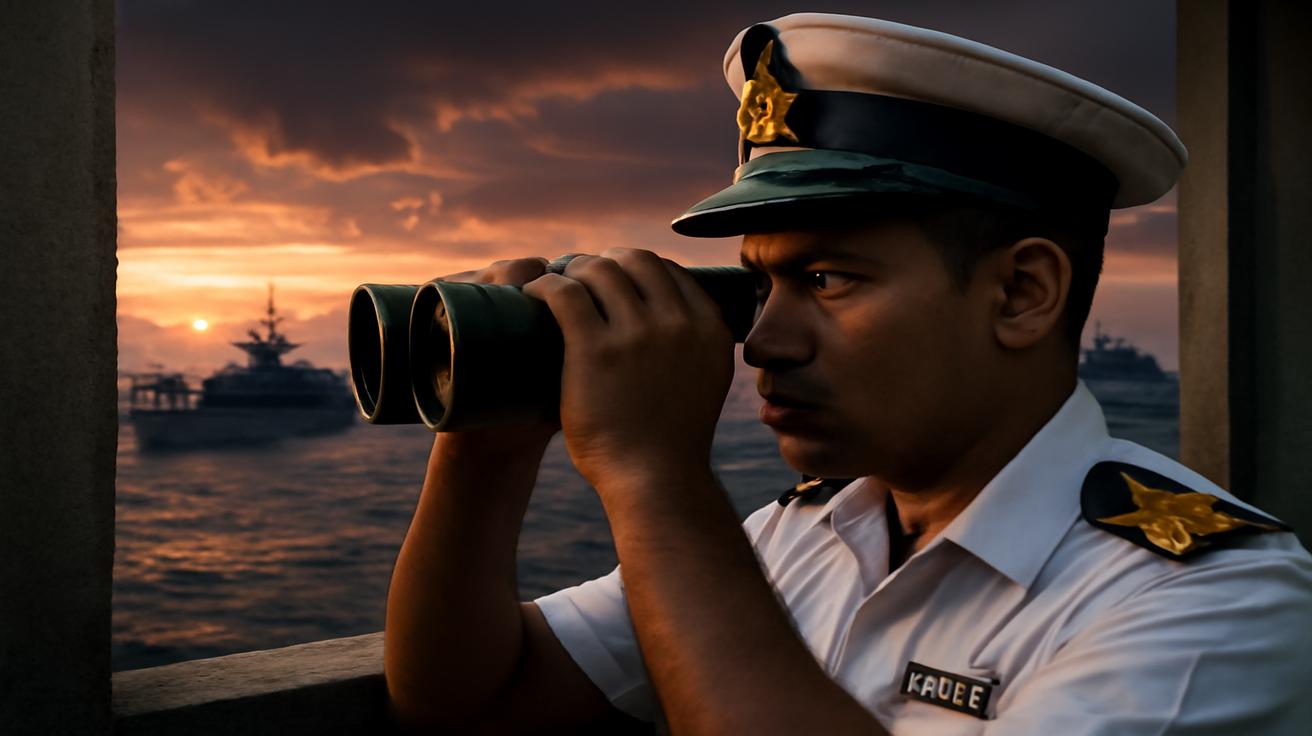
The news filters in on a humid evening in Delhi, the kind of evening when the sky hangs low and the air is thick with dust and speculation. Phones light up in newsroom corners, defense offices, WhatsApp groups. A familiar alert scrolls across TV screens: India’s main rival is moving to buy 50 new warships. It’s not a drill, not a rumor, not a line in some obscure policy paper. It’s an intention, loud and clear, to redraw the balance of power at sea.
When the Sea Suddenly Feels Smaller
In the dim operations room of India’s Naval Headquarters, the ocean is not blue. It’s a lattice of grids, arcs, and blinking symbols, each one a story of steel and strategy. On this map, distance is measured not only in nautical miles but in minutes to respond, missiles’ range, and fuel endurance. A new fleet of 50 warships slipping into this map is like adding a new mountain range to a well-known landscape: everything else must be navigated differently.
The Indian Ocean, for most people, looks like an expanse of water on the map between Africa, India, and Australia. For India, it is more intimate, almost like an extension of its own body. Ninety percent of its trade by volume crosses these waters. Energy lifelines snake from the Gulf to India’s western ports. Undersea cables carry conversations, stock trades, love notes, and video calls, pulsing beneath the waves. To live in India is, in some quiet way, to live by permission of the sea.
So when word comes that a rival navy is set to add 50 new hulls to the water—frigates, destroyers, support ships, perhaps even more submarines—the sea suddenly feels smaller. The long blue horizon compresses, crowded with silhouettes you might not recognize until it’s too late. It is not yet a crisis, but it is more than just a headline.
The Quiet Language of Steel and Tonnage
Naval power doesn’t shout; it hums. You hear it in the low thrum of engines, in the metal-on-metal clank of anchor chains, in the subtle shift of a nation’s rhetoric once it feels secure behind its armadas. Ships move slowly compared to jets or missiles, but the politics they carry move with an inexorable weight.
India’s rival—never named outright in official Indian statements but ever-present in the back of every strategic mind—has been pouring money into its navy for years. New shipyards have risen along its coasts, cranes standing like praying mantises above half-built hulls. Satellite images show fresh keels laid down, dry docks full and busy. Time-lapse the last decade and you’d see a navy blooming like a timelapse flower made of steel.
It’s not just about how many ships you have, of course. It’s about what they can do, how far they can go, what they can see. Still, in Asia’s crowded waterways, numbers have a particular kind of power. Fifty warships mean more patrols, more flags flown, more “presence missions” in waters others once casually considered their backyard. It means more confidence in negotiations, more leverage in disputes, more eyes and ears in crucial sea lanes.
India’s naval planners know this language well. For decades, they have nursed their own fleet along—refitting, refueling, stretching lifespans, and pushing for new builds. Yet budgets are finite, and India’s security needs sprawl from the icy crests of the Himalayas to the sultry depths of the Andaman Sea. Every rupee spent at sea is a rupee not spent on mountain troops, drones, or satellites. Strategy here is always a kind of quiet triage.
A Table of Tension: Comparing Fleets at a Glance
On a smartphone screen, in a Delhi café or a coastal town in Kerala, the numbers can seem abstract. But pull them into a neat little table, and the competition starts to feel more tactile, more real.
| Category | India (Current Approx.) | Rival (Current + Planned 50) |
|---|---|---|
| Major Surface Combatants (Destroyers/Frigates) | 30–35 | 50+ existing, potentially 80+ with new orders |
| Submarines (Conventional & Nuclear) | 15–20 | 50+ in total fleet, with modernization ongoing |
| Aircraft Carriers | 2 operational (1 more planned) | 2–3 (mix of operational and in development) |
| Coastline & Maritime Zones | 7,500+ km coastline; vast Indian Ocean reach | Long regional coastline; expanding into distant seas |
These figures are approximations, but they trace the shape of the anxiety. India is no lightweight at sea, yet its rival is scaling up in ways that could, over time, reshape the entire maritime conversation.
Salt, Memory, and the Indian Ocean
To understand why India watches the water so intensely, you have to leave the air-conditioned command centers and step out onto the humid decks of history.
Stand on the beach in Kochi early in the morning, before the heat becomes a wall you walk into. The Arabic Sea is more grey than blue at this hour, textured with the silver of first light. Wooden fishing boats head out the way they have for generations; behind them, in the hazy distance, the outlines of naval ships sit at anchor. On some mornings you can almost see time layered on the water surface—Arab dhows, East India Company frigates, Portuguese carracks, modern Indian destroyers—each using the same winds, the same currents, the same natural highways.
Empires have come and gone here, and almost every major power that mattered in the Indian Ocean eventually tried to rule it with ships. For India, the ocean is bound up with invasions and ideas, with spices and conquest. The water brought both prosperity and plunder. Somewhere in the collective memory is the sense that whoever owns these seas, even partially, can tilt India’s fate.
The modern Indian Navy is acutely aware of this. Its focus has long been on securing the “choke points”—narrow passages like the Strait of Hormuz, the Bab-el-Mandeb, and the Malacca Strait—through which vital trade flows. These places are like valves in the global circulatory system. Close one and you don’t just choke a country; you shock entire regions.
India’s rival, with its new warship shopping list, is clearly thinking along similar lines. A larger, more modern fleet means more ability to escort its tankers and cargo ships, more leverage in disputed maritime zones, more capacity to send ships far from home. And each warship is not just a weapon; it is a signal—a visible, floating argument about who belongs where.
Shipyards, Dreams, and Delays
Far from the quiet hum of strategic documents, a shipyard is a violently physical place. Sparks scatter from welding torches. The smell of hot metal mingles with salty air. Gantry cranes swing heavy blocks into place with a delicacy that seems almost out of character for their bulk. Here, ambition is measured in hull sections and delivery deadlines.
India’s own shipyards are busy and proud. Over the past few decades, they’ve turned out stealth frigates, corvettes, patrol vessels, and even indigenous aircraft carriers. Local designers sketch out new hull forms; workers in hard hats assemble modular sections big as houses. The notion of “Atmanirbhar Bharat”—self-reliant India—rings particularly strongly here. Every ship launched is a small rebellion against dependence on foreign suppliers.
But steel doesn’t always cooperate with timetables, and neither do budgets. Many of India’s naval projects have faced delays, cost overruns, technological kinks. A sonar system not working as expected. A propulsion system needing redesigned components. A global supply chain disruption pushing delivery dates back by months, sometimes years. Each delay is not just an inconvenience but a strategic window that stays open longer than planned.
Meanwhile, India’s rival has poured money into building not just ships but the entire ecosystem: shipyards, component factories, design bureaus. The result is an ability to push out vessels at a pace that can feel dizzying from across the water. Where India scouts for foreign collaborations to plug capability gaps, its rival increasingly offers itself as the world’s shipbuilder, even selling warships abroad.
Inside India’s naval circles, this contrast is discussed in the matter-of-fact tones professionals use when they have no time for drama. “We need more hulls in the water,” you might hear an officer say quietly over tea, as if he were talking about ordering more chairs for a canteen instead of multibillion-dollar platforms. But under that calm is an unspoken acknowledgement: momentum matters. If your neighbor is racing ahead in capacity and numbers, even a strong navy can start to feel like it’s standing still.
Technology, Sensors, and the Invisible Battlespace
Yet war at sea is no longer just about who has more ships. It’s also about who knows more, sooner. Radar sweeps, sonar pings absorbed by the deep, satellites watching from above, listening posts on islands and seafloors—this is the invisible layer of the maritime contest.
India has been investing steadily in this invisible realm: long-range maritime patrol aircraft soaring high above the waves, drones sampling the sky at lower levels, seabed mapping to understand the acoustic fingerprint of the ocean itself. Its rival is doing the same, often with dizzying speed—launching constellations of satellites, building networks of undersea sensors, experimenting with unmanned surface and underwater vehicles.
When one side adds 50 warships, it’s not just 50 new hulls on the map. It’s potentially 50 additional nodes in a vast, networked sensing and shooting web. Each new ship can carry more advanced radars, electronic warfare suites, and communications systems. Each one might quietly plug into a larger data architecture that sees and reacts faster than a human mind can process.
In that world, geography begins to blur. An enemy ship might never stray near your coast, yet still influence what your navy dares to do. A patrol aircraft might avoid an area not because a ship is physically there, but because sensors and missiles might be watching from far away. The ocean becomes not just a physical medium to sail across, but a digital battlespace to enter cautiously.
Nervous, Yes. Helpless, No.
To say India is watching nervously is to say that it understands the stakes. But nervousness is not the same as panic. In strategic circles in New Delhi, the reaction has been a mixture of concern and quiet determination, like a runner noticing a rival speeding up and deciding to lengthen their own stride rather than abandon the race.
India’s answer will not, and cannot, be simply to match ship for ship. The economic burden of trying to mirror a wealthier, single-minded rival would be crushing. Instead, the conversation increasingly turns to “smart asymmetry”—where do you invest to get more security per rupee?
Some of the answers are already visible. Strengthening ties with friendly navies in the region, so that India’s footprint is multiplied by partnerships. Investing in anti-ship missiles and coastal defense batteries that make any approach to Indian shores costly. Building up island infrastructure—from the Andaman and Nicobar to Lakshadweep—as unsinkable aircraft carriers and sensor hubs. Doubling down on submarine capabilities, which remain one of the most quietly effective tools of sea denial.
There is also a growing public awareness that the ocean is not just a distant blue expanse but a living force in daily life. Storms in the Bay of Bengal, cyclones in the Arabian Sea, coral bleaching, rising seas—these things are beginning to figure in conversations about security alongside frigates and fighter jets. The ocean doesn’t care about national boundaries, and any destabilization—military or environmental—will ripple into the lives of ordinary people on the coast.
In that sense, the anxiety about 50 new warships is not merely about metal; it’s about the kind of future Asia writes for itself. Will it be a region where every new ship is answered with another, where the water bristles with weapons and suspicion? Or can it be a region where power is balanced carefully enough that the sea remains, first and foremost, a highway of trade and connection?
Listening to the Waves
On a clear night off the coast of Visakhapatnam, if you stand near the waterline and listen, you can hear the waves fold and collapse and return in an endless rhythm. Far offshore, beyond the range of sight, ships move like patient shadows. Some are cargo vessels hauling containers stacked like lego blocks; others are military, grey silhouettes that leave no lights on for casual observers.
The people on those naval decks are not thinking in abstractions. They feel the pitch and roll of the hull under their boots; they smell the tang of salt and diesel; they know that the sea is both cradle and threat. For them, the news of 50 new warships across the horizon is not a headline. It is a future patrol where a radar contact appears a little sooner than expected, a radio call comes in a tone a little more assertive than before.
In Delhi, Mumbai, Kochi, and Port Blair, India is adjusting its mental map of the ocean. Analysts run simulations. Politicians hold closed-door briefings. Admirals argue quietly over whether the next rupee should go into submarines, aircraft, drones, or new destroyers. The public sees only the tip of this discussion, in brief news clips and snippets of speeches.
Yet somewhere behind all the acronyms and procurement files lies a simple, almost primal recognition: the sea is a living boundary. When a rival moves to flood that boundary with 50 new warships, you pay attention. Not because war is imminent, but because power at sea is the slow, tide-like kind—it rises over years, and if you don’t notice early, you can wake up one day to find the familiar shoreline has shifted.
For now, the Indian Ocean still feels like India’s ocean in many ways—a space where the country’s presence is natural and deep. But the water itself is restless, and so is the competition upon it. India’s task is to ensure that, as more steel enters these waters, the sea remains wide enough for more than one story of power—and that in the long swell of history, its own story is not washed aside.
Frequently Asked Questions (FAQ)
Why is India concerned about its rival buying 50 new warships?
India is concerned because such a large expansion in naval assets can significantly shift the balance of power at sea. More warships mean greater presence in key sea lanes, more surveillance capability, and more leverage in regional disputes. For a country like India, which depends heavily on maritime trade and energy imports, any change in naval balance is a direct security concern.
Does this mean a naval war is likely in the near future?
No, a naval war is not inevitable. Most countries expand their navies to gain influence and deterrence, not to trigger immediate conflict. However, a rapid buildup raises the risk of miscalculations, close encounters at sea, and heightened tensions—especially in disputed or strategically important waters.
Can India match this buildup ship for ship?
Realistically, matching ship for ship would be economically and logistically difficult for India. Instead, India is more likely to focus on smart investments: submarines, long-range missiles, partnerships with friendly navies, and better surveillance systems that can offset numerical disadvantages.
How does this affect ordinary Indians?
The impact is indirect but real. Naval power helps protect trade routes that bring in fuel, food, and goods. If those routes become contested or risky, it can affect prices, economic stability, and even the availability of essential imports. A stable maritime environment is crucial for India’s long-term growth and everyday economic life.
What is India doing to strengthen its own navy?
India is building new destroyers, frigates, submarines, and an additional aircraft carrier. It is investing in indigenous shipbuilding, upgrading older vessels, enhancing surveillance through aircraft and drones, and deepening cooperation with partner navies in the Indo-Pacific region. The approach is to build a balanced, modern navy rather than competing simply in numbers.








Leave a Comment