
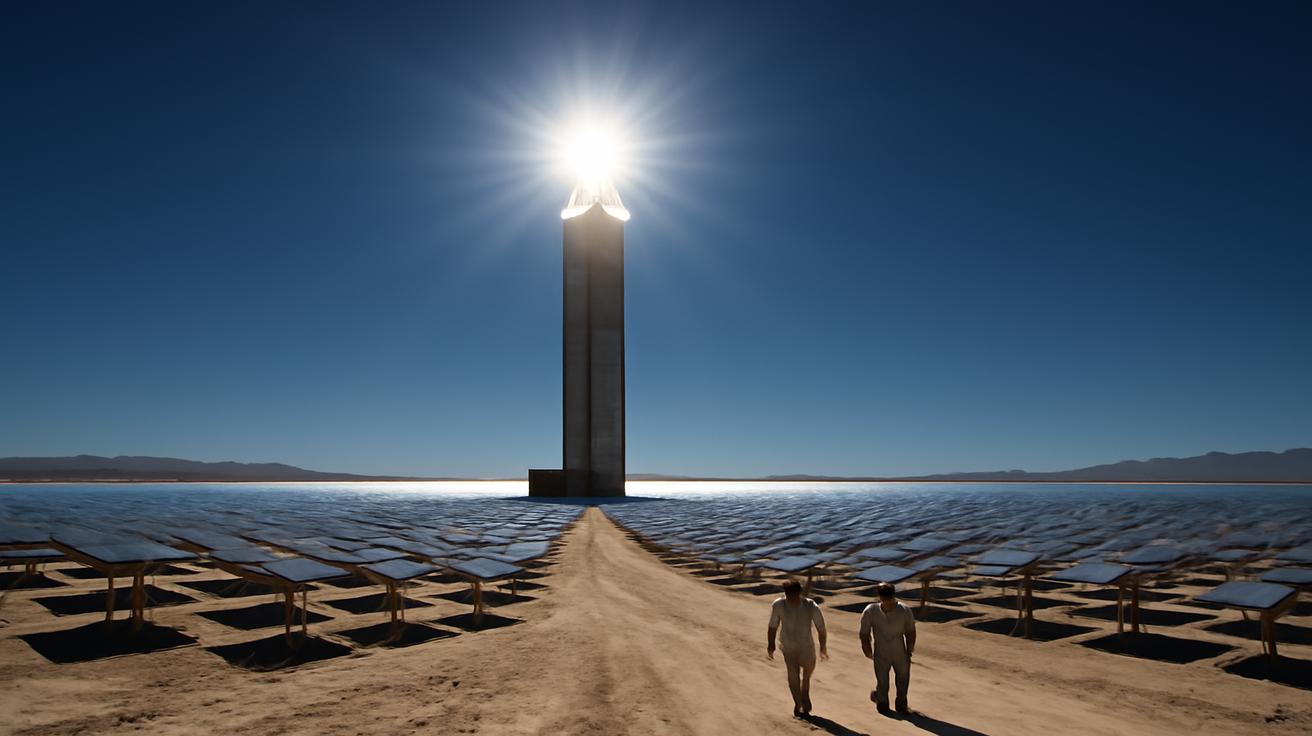
The sun is sinking behind the mountains when the desert starts to glow—only it’s not the usual washed-out gold of evening. Out on the horizon, a tower is catching the last light and hurling it back, brighter than it arrived, a needle of white against a violet sky. At its feet, thousands of mirrors glint like a frozen metallic sea. There are no tour buses this late, no gift shops, no snack stands. Just a wind that smells of dust and hot stone, the quiet creak of metal, and the strange feeling that you are looking at the future: an “artificial sun” rising from the emptiness, built not for worship, but to power our cities.
The Desert That Learned to Shine
The first thing you notice, standing on the edge of a solar tower field, is the silence. It’s not empty silence—the desert never really is—but a layered one: a low murmur of transformers, the soft whirr of tracking motors nudging mirrors toward the fading light, the occasional slap of a loose cable in the wind. Yet underneath is the old, geological stillness of a landscape that remembers oceans and dinosaurs and millennia of nothing much at all.
Now, in that stillness, we are assembling our most audacious idea in centuries: a way to bottle sunlight at scale, to capture day and pour it into the night. Not with scattered rooftop panels or lonely wind turbines, but with something almost mythic in appearance. Central-tower concentrated solar plants—these are the technical names behind the poetic shorthand “artificial sun.” They look like science fiction that somebody forgot to turn off at the end of the movie.
A visitor driving in sees it long before they reach it. The mirrors, called heliostats, are arranged over thousands of acres, aligned like disciplined soldiers, each turning slowly to follow the real sun across the sky. Together, they focus light on a receiver at the top of a tall central tower. There, under the desert sky, that focused beam unleashes a ferocity of heat that we once thought only stars could manage.
The sand crunches underfoot as you step out of your vehicle. There’s an odd vertigo in realizing that almost every glint in your peripheral vision is a machine quietly aligning itself with something 150 million kilometers away. The mirrors tilt and swivel like a vast, silent choreography, each motion calculated by algorithms taking in the arc of the sun, the curve of the earth, and the shape of the seasons.
The “Artificial Sun” at the Heart of It All
If you could stand safely at the top of the tower—eye-level with the receiver—you’d see a ring of light so bright that it ceases to be just “light.” It feels like a presence, a white-hot crown hammered into place by thousands of tiny reflections. Temperatures here can push past 500°C, 600°C, even 1,000°C, depending on the design. No human can stand in that blaze; even steel must be carefully shielded. And yet this is where the magic happens.
Instead of solar panels converting light directly into electricity, concentrated solar power (CSP) collects heat. And heat, unlike light, is something we can store. Liquid salt—most often a mixture of sodium and potassium nitrates—flows through the receiver, absorbing that brutal energy until it becomes a molten river as hot as volcanic rock. It’s pumped down into insulated tanks the size of cathedrals, where it waits like a captured sunrise.
Later, long after the actual sun has sunk and the desert stars are out, operators can release that stored heat. The molten salt passes through heat exchangers, making steam that spins turbines, just like in a fossil-fuel plant—but without the fossil fuels. The glow from the tower may have faded, but the power plant hums on into the darkness, feeding electricity to distant neighborhoods where lights flick on, kettles boil, fans whirl, and most people never think about where their energy came from.
“Artificial sun” is a metaphor, sure. But when you stand there at dusk and feel the air still pulsing with the day’s heat, it doesn’t feel like much of an exaggeration. We have built a machine that mimics the star that made us, translating its radiance into something we can store, schedule, and send across a continent.
The Science Is Old; The Scale Is New
We have known how to concentrate sunlight for centuries. Ancient stories tell of polished shields setting ships ablaze, of glass lenses focusing beams into death rays. In the 19th century, engineers experimented with solar boilers. But we never before tried it at this scale—never before aligned thousands of mirrors with millimeter precision to hit one high target, hour after hour, day after day.
What changed? Partly, computing: the algorithms that choreograph mirror movement and maximize reflection efficiency would have been fantasies a few decades ago. Partly, materials: heat-resistant alloys, high-reflectance glass, corrosion-resistant salts. And partly, urgency: a growing realization that our fossil-fueled civilization is both powerful and fragile, and that our demand for energy is outpacing what the planet can safely give.
Standing in the control room, you see the digital nervous system of this man-made star. Rows of screens show sun positions, power output, temperatures in each molten salt tank, mirror alignment maps that look like shimmering mosaics. Operators in work boots and sunburnt necks tap at keyboards, watching graphs climb and settle like vital signs on a patient monitor.
Cities Plugging Into the Desert
Out beyond the fence, the desert sprawls on, unchanged. But over the horizon, the artificial sun has already seeped into daily life. Its energy runs through high-voltage lines to grids that thread into cities, towns, industrial zones. Most of the people living there have never set foot in the plant. They may not know that the glow in the distance isn’t an ordinary transmission tower lit by orange sodium lamps, but a beacon of reflected starlight that once bounced off quartz grains and lizard scales miles away.
Yet in planning offices and energy ministries, the desert’s role is being re-written. Once dismissed as “empty,” these landscapes are being drafted as the quiet backbone of a new energy map. Wide open, dry, drenched in sun for much of the year—the same harshness that made deserts inhospitable to human settlement makes them perfect for this work.
There’s a paradox here. Our cities are dense with people, glass, metal, and appetite. But increasingly, their lifeblood—energy—may come from the opposite of density: vast, remote spaces where there is room to lay out rows upon rows of mirrors, towers that catch the eye from miles away, heat tanks sunk into the gravel like inverted silos.
To make that idea less abstract, imagine one of these plants on a human scale. Below is a simplified snapshot of what a single concentrated solar power project can look like:
| Feature | Typical Value | What It Means in Everyday Terms |
|---|---|---|
| Plant capacity | 100–200 MW | Enough to power roughly 150,000–300,000 homes |
| Number of mirrors (heliostats) | 10,000–20,000 | A “sea” of glass covering several square kilometers |
| Tower height | 150–250 m | Roughly the height of a 50–80 story building |
| Thermal storage duration | 8–15 hours | Can keep generating electricity long after sunset |
| Water use | Low–moderate (depends on cooling type) | Dry-cooled systems use far less water than old thermal plants |
Seen this way, that bright point on the horizon stops being abstract “infrastructure” and becomes an invisible, constant participant in millions of daily routines: someone charging a phone, cooking dinner, or studying under an LED desk lamp, all unknowingly linked to a desert teeming with metallic reflections.
Why Build a Star in the Sand?
The simplest answer is also the most pressing: fossil fuels are destabilizing the climate, and we are running out of “later.” Solar panels and wind turbines have surged across landscapes and rooftops, but they ebb with clouds and calm air. Batteries are improving, but they are still expensive and resource-intensive at massive scales.
Concentrated solar power with thermal storage offers something precious: dispatchable clean energy. That word—dispatchable—is beloved by grid operators and almost invisible to everyone else. It means power can be turned up or down on demand, not just when the sun is shining. Stored heat in molten salt can be held for hours and used when evening peaks hit, when millions of people come home, turn on lights, start cooking, and flip on cooling or heating. The artificial sun doesn’t just shine when it wants to; it follows a schedule.
And the desert, long treated as a void on maps, becomes a battery for civilization.
The Desert Remembers Its Own Stories
But deserts are not empty, however they might look from the air. They are full of stories: of peoples who learned to read the wind and the stars; of animals that sleep underground and sprint only at dusk; of plants that hoard every drop of moisture like treasure. To build a new kind of star here is to add another story—one that must sit beside, not erase, the others.
Walk the perimeter fence at dawn and the air is cold enough to bite. Tracks crisscross the sand: fox, beetle, snake, the delicate triple-pronged prints of a small bird. Some of those trails end at the fence, turn aside, and continue; others stop abruptly where access roads cut across old paths. The mirrors themselves can confuse birds, drawing them toward bright sky that isn’t sky at all.
Engineers, biologists, and local communities are wrestling with these impacts in real time. How do you build something enormous and luminous without shattering the fragile, subtle systems that were already there? Some answers are practical: wildlife corridors that allow animals to move around the site; altered lighting to reduce attraction and disorientation; careful routing of transmission lines. Other answers are cultural, and slower: making sure that nearby communities are not just watching a new industry rise from their land, but shaping it and sharing in its benefits.
There is also the question of beauty. Is a field of mirrors and a shining tower an intrusion on the stark elegance of a desert, or a new kind of desert bloom? From certain angles, the heliostats look like lakes, capturing the sky and reflecting clouds that never bring rain. The tower gleams differently at midday and at dusk, sometimes a sharp white flame, sometimes a muted amber. There is a language of light being written here, in a dialect that belongs neither wholly to technology nor to nature, but to the awkward, ongoing negotiation between the two.
When the Stars Come Out
Stay late enough, and you see the handover. The tower’s crown of brilliance fades, then winks out. The sky deepens. First, one or two stars appear, then ten, then hundreds. Out on the horizon, the faint orange halo of a distant city smudges the darkness. Somewhere in between is the invisible path of the power lines carrying energy from this very spot toward that glow.
Inside the plant, though, things are just warming up. The molten salt in its tanks is still hot, still ready. Turbines spin. Valves open and close with hollow knocks. Control screens tick upward as demand climbs in the city. For a few hours, at least, the desert becomes the night-shift sun, quietly radiating power while the real star sleeps below the horizon.
There is a subtle satisfaction in that inversion. For millennia, humans organized their lives around the sun’s schedule. Now, in a small, carefully engineered way, the sun has been persuaded to work on ours.
Dreaming in Light and Heat
These “artificial suns” are not the only vision of our energy future. They live alongside wind farms, rooftop photovoltaics, geothermal wells, hydropower dams, and the promise (or mirage) of fusion. But they occupy a unique emotional space. They are not just boxes tucked on roofs or spinning blades on distant hills; they are shimmering monuments, visible for miles, that make people pull over on highways and squint in curiosity.
They raise questions that are as much about identity as about electrons. What does it mean for our civilization to be lit by the focused glare of deserts? How will it feel, decades from now, for a child growing up in a city whose very existence depends on those far-off bright towers, just as older generations depended on coal seams and gas fields they would never see?
Maybe, by then, the idea of an artificial sun will feel entirely ordinary. There will be school trips where kids walk between mirror rows, their faces fractured in reflection; there will be coffee mugs printed with stylized towers and rings of light; there will be novels and films that set love stories, crime plots, and quiet epiphanies in the blue shade of heliostat arrays. The strange will become familiar. But the core gesture—turning the desert into a luminous partner rather than a blank space—will remain radical.
A Future Written in Radiance
Not every project will succeed. Some early plants have struggled with cost overruns, technical glitches, and skeptical investors. Clouds still roll in, dust still coats mirrors, global markets still swing. The story of concentrated solar power is not a straight line from idea to triumph; it is a path of experiments in steel and glass and molten salt, some of which will quietly fade into footnotes.
And yet, it is difficult to stand at the foot of one of these towers, to feel the desert heat breathe around you while a man-made star blazes overhead, and not sense that you are standing inside a turning point. For most of our history, we have dug power from beneath our feet: coal, oil, gas, ancient sunlight trapped in stone. Here, in these deserts, we are learning instead to look up, to translate fresh photons into the heartbeat of cities—without tearing the world under our boots apart.
In the end, that may be what matters most. Not that we have built an “artificial sun,” but that we have done so in a way that teaches us to live within the original one’s generosity. To match our cleverness with humility, our appetite with restraint, and our speed with the patient, cyclical rhythms of a planet that has been basking in starlight for billions of years.
For now, the tower’s last gleams are fading. The night wind picks up, carrying the smell of cooling metal and dry earth. Somewhere far away, a city flickers brighter as the desert’s stored daylight rushes in. You turn away from the light, toward the dark, and start the drive back, knowing that behind you, in the sand and the silence, a human-made star is quietly holding the line between day and night.
Frequently Asked Questions
What is an “artificial sun” in the desert?
It’s a poetic way of describing concentrated solar power plants with central towers. Thousands of mirrors focus sunlight onto a receiver on top of a tall tower, creating extreme heat that can be stored and used to generate electricity long after sunset.
How is this different from regular solar panels?
Regular solar panels convert sunlight directly into electricity and usually need batteries for storage. Tower-based concentrated solar plants capture heat instead, store it in molten salt, and use that stored heat to make electricity on demand, often for many hours after dark.
Can these plants really power entire cities?
Single plants typically power hundreds of thousands of homes. Multiple plants integrated into a regional grid, alongside other renewables, can supply a significant share of a city’s electricity, especially during evening peaks.
Why build them in deserts?
Deserts get strong, consistent sunlight and have large open areas for mirror fields. Their dry air and clear skies help maximize solar energy capture, making them ideal locations for concentrated solar power.
Are there environmental downsides?
Yes, there are trade-offs. Large plants can disturb habitats and affect wildlife, and construction requires land, materials, and access roads. However, they emit no greenhouse gases during operation and can be designed with wildlife corridors, careful siting, and reduced water use to lower their impacts.
Is the technology safe?
The main risks involve very high temperatures and industrial fluids like molten salt, which are managed with well-established engineering and safety standards. These plants don’t use nuclear reactions or emit radiation, and they produce far fewer pollutants than fossil-fuel plants.
Will concentrated solar replace all other power sources?
Unlikely. It’s more realistic that it will be part of a diverse mix that includes solar panels, wind, storage batteries, hydro, and other sources. Each technology has strengths in different climates, geographies, and economic contexts.







Leave a Comment