
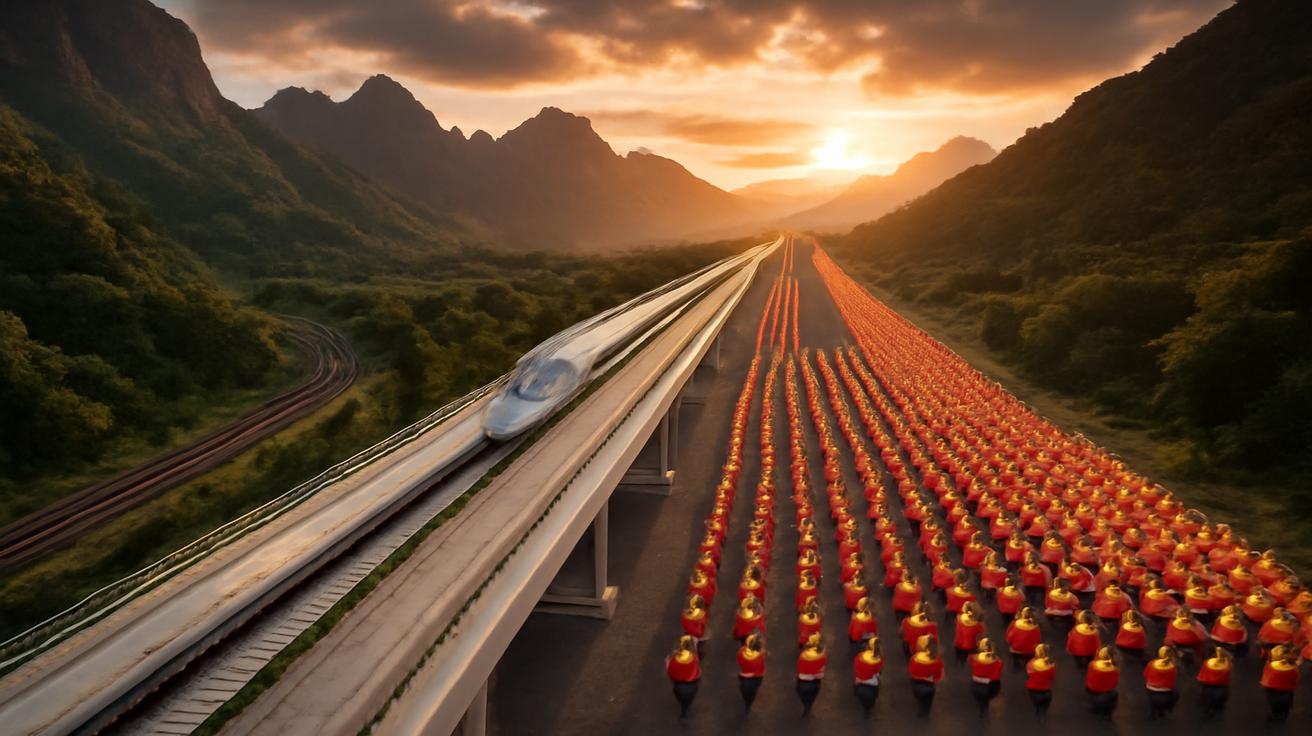
The floodlights made it look like noon at midnight. A rectangle of earth, still breathing dust and diesel fumes, lay exposed in the small hours as if some giant had peeled back the skin of the countryside. Around it, in yellow helmets and reflective vests, people moved with the purposeful urgency of a pit crew before a big race—only this “race” was to rebuild an entire piece of China’s rail network in less time than most of us spend at work in a single day.
There were more than a thousand of them. Welders set off showers of sparks that hissed in the cool night air. Cranes swung overhead with the slow grace of prehistoric birds, carrying rails and concrete sleepers as if they weighed nothing. The smell of hot metal and damp earth mixed with the faint sweetness of early spring grass crushed beneath machinery. Somewhere beyond the construction zone, a dog barked once, then went silent, as if even it understood: something unusual was happening tonight.
By the time the sun pushed a faint gray line over the horizon, a new rail alignment was almost ready. What had been a seven-hour slog across the landscape was on the verge of becoming a 90-minute glide. In just nine hours—less than the duration of an overnight train itself—China had stitched a new piece into its vast rail tapestry, using speed, coordination, and an almost orchestral sense of timing that bordered on choreography.
The Night the Tracks Moved
If you had wandered onto that site by accident, you might have mistaken it for a movie set—floodlights flaring, engines roaring, orange sparks floating in the dark like fireflies made of iron. But this was very real, and the stakes were equally concrete: an old rail route that wound laboriously through the countryside was being cut, shifted, and tied into a straighter, faster line that would dramatically shorten travel time between two regions.
The project has become something of a legend online: “In just 9 hours and with 1,000+ workers, China cut a seven-hour trip to 90 minutes with a new rail line.” The phrase gets passed around with a mix of disbelief and admiration. It sounds almost mythic, as if an ancient empire had woke up overnight with a new artery pulsing in its chest.
Yet on the ground, it was less about magic and more about method. The team included track engineers, signal specialists, excavator drivers, crane operators, surveyors, safety inspectors, and logistics planners. Each person knew, down to the minute, what they were supposed to do and when. The choreography was laid out in sheets of diagrams pinned under gloved hands, in digital models glowing on tablets, in radios crackling short, clipped messages over the thrum of generators.
The work began long before the nine-hour window ever opened. Weeks of planning went into this fleeting construction sprint. Temporary bypass tracks had been prepared, earthworks graded, concrete pylons cured and waiting. Everything that could be prefabricated was stacked neatly at the edges of the site, labeled and ready, like ingredients laid out before a cook starts the meal.
When the last scheduled train rumbled through on the old alignment, the clock began. Within minutes, excavators were biting into the ballast, lifting out old sleepers like bones from a skeleton that had served its time. The line that had once been a lifeline for thousands of daily commuters was being rapidly, almost ruthlessly, unmade so a new one could take its place.
The Sound of Time Shrinking
Travel time is something we usually feel more than we measure. Seven hours is a day trip, a stretch long enough to doze off, watch the countryside change colors, eat a couple of meals, and still have time to feel bored. Ninety minutes, by contrast, is just long enough to sit with a thought before you’re there. They are different kinds of journeys, and they produce different kinds of days.
Imagine this through the senses. On the old seven-hour route, maybe the train left before sunrise, your breath a pale cloud in the early chill as you shuffled onto the platform. You’d settle into a worn seat, the world outside slowly brightening, villages sliding by in that half-waking blur. The rhythm of the wheels—clack, clack, clack—acted like a metronome for your thoughts. The train might stop, wait for a signal, roll again. You would sip lukewarm tea, read a few pages, and feel the distance in your body.
Now picture the new train. You step into a sleek, climate-controlled car; the door closes with a soft sigh. The interior is quiet, almost hushed, insulated from the outside. The acceleration is smooth, a growing pressure against your back rather than a jolt. There is no familiar clatter of joints and gaps—just a low hum, like the purr of a cat too big to imagine. The landscape smears into streaks beyond the window, fields and rivers and roads melting into abstraction.
Where once a commuter might have planned their whole day around the journey, now they can leave after breakfast and arrive in time for a mid-morning meeting. A student who used to spend half a day on the train to reach a university town now makes the trip in less time than a long movie. Time itself has been folded, and you can feel that fold in your muscles, in the way your day suddenly seems to stretch farther than it used to.
The People Behind the Precision
Somewhere in that dense constellation of workers—more than a thousand in reflective vests—was a young engineer standing by the edge of the site, a clipboard in one hand, radio in the other. For days, he had barely slept. Every bolt, every length of rail, every concrete sleeper had been counted, checked, checked again. The thought of a missing part wasn’t just annoying; it was potentially catastrophic for the schedule.
Nearby, a welder wiped sweat from his forehead with the back of his glove, though the night air was cool. Sparks showered around him as he fused steel with a practiced motion that came from years of repetition. Each weld would be hidden beneath trains and time, but for now, under the glare of the work lights, it was a bright, brief star in the dark.
At the far end of the site, under a flimsy tent that flapped in the occasional gust, a small group watched computer screens displaying colored lines and blinking signals. They were the guardians of the invisible currents that race through a modern rail line: information, power, control. It wasn’t enough to lay tracks. Those tracks had to be able to talk—to each other, to trains, to stations dozens or hundreds of kilometers away.
Coordination like this is something we rarely see, because when it works, it becomes invisible. The trains run. The crossings open and close. The signals flip from red to green exactly when needed. We experience the end result as something simple: a shorter trip, a smoother ride. But in that nine-hour window, the machinery of precision was laid bare, with human beings at its heart.
| Aspect | Before Upgrade | After Upgrade |
|---|---|---|
| Typical Travel Time | About 7 hours | About 90 minutes |
| Track Design | Winding, lower-speed alignment | Straighter, high-speed alignment |
| Key Construction Window | Extended interruptions when needed | 9-hour intensive “sprint” |
| On-Site Workforce | Standard maintenance crews | 1,000+ coordinated workers |
| Daily Life Impact | Long-distance trip, limited commutes | Same-day returns, new commuter patterns |
Rewriting the Map Without Redrawing It
On paper, a new rail line looks like a simple stroke: a straightened segment, a few new junctions, perhaps an additional curve shaved off here or there. But in reality, it rewrites how a region lives, works, and thinks about itself. Cutting a journey from seven hours to 90 minutes isn’t just a technical improvement—it’s a quiet revolution in geography.
Time, after all, is our most intimate measure of distance. Two cities that are seven hours apart may share history, language, and weather, but everyday life between them feels distant. News travels faster than people do. Opportunities in one place remain theoretical for those in the other. Families visit occasionally, not spontaneously.
Change that trip to 90 minutes, though, and the relationship alters overnight. A job that once seemed impossibly far now feels like a plausible daily commute. The university in the “other” city becomes a realistic option. A weekend visit to aging parents transforms from a twice-a-year obligation into something you can decide on over Friday night dinner.
As the first high-speed trains begin to glide along the new route, they carry more than passengers. They transport expectations. Local businesses start to ask: Who might come now that couldn’t before? Cafés near the station stay open a little later. Hotels consider renovation. Small manufacturing firms think about expanding their customer base, tied not to how far their trucks can drive, but to how swiftly people can travel for meetings or training.
Even the mental map shifts. Places that used to be “out there” become “just over there.” The invisible elastic that once stretched tight between two dots on a map slackens, and suddenly, they feel like neighbors.
The Environmental Equation
There’s another layer to this transformation, one you can’t quite see from the window of a speeding train but can sense in the quieter ways landscapes change. High-speed rail, in many cases, is not only faster but cleaner than the alternatives it replaces. Each route that upgrades from slow, winding tracks or long bus rides and short-haul flights to electrified high-speed trains is also adjusting the region’s carbon footprint.
Picture the old corridor between those two cities before the new line. Highways carrying lines of buses and private cars, each burning fuel, each leaving a thin, invisible trail of exhaust. Regional flights might leap between airports, their contrails stretching across the sky. Freight trucks rumble alongside, shaking the air with each gear change.
Now imagine more people choosing a train that hums along on electricity, powered increasingly by cleaner grids. The air in the small towns the old buses passed through smells a little less of diesel in the morning. Roads ease ever so slightly, no longer bearing quite the same load at weekends and holidays. The fields silent at dawn before were punctuated by distant engine noise; now the sound is different—a low, passing murmur as a train flashes through a cutting or over a viaduct.
Of course, building such a line is itself an environmental act: concrete poured, steel forged, hills carved and spanned. It’s not a simple story of “trains good, everything else bad.” But when the equation is done over decades, the balance often leans toward a quieter, cleaner kind of movement. The speed that shrinks time can also, paradoxically, give future generations a bit more of it, unclaimed by rising seas or harsher droughts.
A New Kind of Neighborliness
For the communities near the line, adjustment is both visible and intimate. A farmer who once timed his planting around the distant rumble of slow trains now sees sleek silver streaks in the corner of his eye as he bends over the soil. A shopkeeper near the upgraded station watches a new clientele flow in: people pulling small suitcases, commuters checking their phones, students in unfamiliar school jackets.
Inside the trains, new rituals emerge. Regular passengers develop favorite seats. Some use the 90 minutes as a hard shell of time to think, to read, to rest between the demands of two cities. Others lean into the novelty for months, noses almost pressed to the glass as the landscape races by. For young children, this might be the only way they will ever know this journey—not as a long, meandering expedition, but as a brisk crossing, like stepping from one room of a house into another.
What It Takes to Move a Nation This Fast
It’s tempting to see the nine-hour construction sprint as an isolated spectacle, something singular and extraordinary. And in many ways, it is. But it also rests atop a deeper culture of infrastructure building, one that has turned China’s map into a dense lattice of lines, stations, and nodes over the past two decades.
Behind that spectacle are thousands of smaller, less visible decisions. There are the quiet meetings in conference rooms, where engineers debate the subtle curve of a track that will shave seconds without straining safety. There are the procurement teams tracking every shipment of steel and ballast. There are the environmental reviews, the community consultations, the rerouted roads and power lines.
This is logistical literacy at a national scale: the ability to align money, materials, manpower, and political will toward a piece of infrastructure that will outlive almost everyone who worked on it. The nine hours that capture the headlines are just the tip of a long, methodical iceberg of planning and coordination.
Yet it’s those nine hours that linger in the imagination. Floodlights in the dark. More than a thousand workers moving in concert. Rails being lifted, pivoted, and laid with a precision that leaves millimeters to spare. And then—almost as suddenly as it began—the site falling quiet, the last machine switching off, the last helmet disappearing into the early light. A few hours later, passengers step onto a train and feel only the smooth, unremarkable glide of progress.
Speed, With a Human Face
In a world where “fast” often conjures images of notifications buzzing, deadlines looming, and a constant pressure to keep up, there’s something almost reassuring about speed expressed as a train quietly eating up kilometers under its own ordered rhythm. High-speed rail is a kind of speed we can inhabit without feeling chased by it. You sit. You breathe. The world outside does the rushing for you.
The story of this nine-hour transformation is not just about engineering prowess or national ambition. It’s about how humans, in all our complexity, respond to the chance to move differently. The workers on that night shift knew they were part of something that would alter how strangers would live their everyday lives. The passengers, months later, boarding the sleek trains that now race along those tracks, may never think of the mud, the sweat, the aching backs that made their quick journey possible. They simply know that home, or opportunity, or love, is closer than it used to be.
Somewhere, an elderly parent who once saw their children only on long holidays can now expect more frequent visits. A young entrepreneur can test a business idea in a new city without uprooting their life. A teenager, headphones on and forehead pressed against the window, feels their world expand as the train gathers speed.
From Legend to Everyday Life
Stories like this one—the 9-hour construction, the thousand workers, the seven-hour journey compressed into ninety minutes—tend to circulate as breathless anecdotes, shared with a mix of awe and skepticism. They sound like tall tales from the age of steam, when railroads were first stitching continents together.
But over time, what begins as a marvel becomes the new normal. The incredible turns into the expected. Children born into this network will grow up thinking of 90-minute intercity trips as nothing special. They will yawn and scroll and glance occasionally at scenery flashing by, unaware that the land beneath them was once dug up and relaid in a single fevered night by a small army of workers under white-hot lights.
Every so often, though, it’s worth pausing to look beneath the smooth surface of our travel routines. To remember that behind the calm, punctual arrival of a train lies a wild, sleepless night when time itself seemed to be bent by human hands. To listen, if only in memory, to the clang of steel and the murmur of voices in the dark, as people worked together to bring two distant places a little closer.
In the early morning, after the work was done and the site cleaned, a thin mist rose from the freshly packed ballast. The new rails gleamed, still unmarked by the passage of wheels. For a few quiet minutes, there was only birdsong and the distant sound of a river, as if the land itself were taking a breath before the first train arrived. Then, somewhere down the line, a horn sounded—low, confident, and steady. The future was on its way.
Frequently Asked Questions
How did the workers manage to change the line in just 9 hours?
The 9-hour window was the highly compressed execution stage of a project planned over weeks and months. Materials were prefabricated and stockpiled, temporary alignments prepared, and tasks broken down into minute-by-minute sequences. During the window, more than 1,000 workers and dozens of machines operated in parallel, following a tightly rehearsed schedule to remove the old track section, install the new alignment, connect signaling and power systems, and test the result before reopening.
Was safety compromised to achieve such speed?
The speed came from preparation and coordination rather than cutting corners. Safety teams were embedded throughout the process, standards for welding, alignment, signaling, and power were pre-defined, and inspection steps were built into the schedule. Like any large-scale construction, there are risks, but the entire operation was designed to meet existing railway safety codes before trains were allowed to run.
Why not just build the new line slowly without a big overnight change?
Because the line was already in use, shutting it down for extended periods would have disrupted thousands of passengers and freight services. By staging most work around the active tracks and compressing the critical connection phase into a single intensive window, planners minimized long-term interruptions while still achieving a major upgrade.
How does reducing a trip from 7 hours to 90 minutes affect local communities?
It changes how people live and work. Commuting becomes feasible over longer distances, students can attend schools farther away, and families can visit more often. Businesses near upgraded stations may see increased foot traffic, while regions once considered “far away” suddenly feel like nearby neighbors. Over time, this can reshape housing patterns, job markets, and even cultural exchange between cities.
Is high-speed rail really better for the environment?
Over the long term, high-speed rail can significantly reduce per-passenger emissions compared to private cars, buses, and especially short-haul flights—particularly when trains run on increasingly clean electricity. Building the infrastructure does have environmental costs, but spread over decades of service and millions of passengers, the overall impact is often much lower than maintaining a car- or plane-dependent corridor.






Leave a Comment