
The rider appears first as a speck of yellow against the gray morning, gliding through the smog-softened light of a Shanghai boulevard. His insulated backpack is almost as large as his torso, a blue box plastered with QR codes and a cartoon logo smiling far more brightly than anyone on the street. Behind him, towers rise like glass bamboo, vanishing into a sky the color of boiled rice water. In one of those towers, almost half a kilometer above his head, someone has just tapped a glowing icon on their phone. A ping buzzes at his wrist. Another order. Another climb.
The Vertical City
In China’s densest cities, people no longer talk only about traffic; they talk about altitude. Shanghai’s skyline bristles with supertall towers; Shenzhen’s glass lances seem to poke actual holes in the clouds. Chongqing stacks buildings like Lego on the steep hills above the Yangtze, bridges threading between towers at the twentieth floor like they were built for flying cars. Down on the pavement, where scooters hum past hotpot stalls and convenience stores, delivery apps throb with orders.
For years, food delivery has been the restless heartbeat of urban life here. Office workers order bubble tea between meetings, coders call up late-night noodles, students summon fried chicken at midnight. Platforms like Meituan and Ele.me turned the city’s streets into a rush of color-coded uniforms, drivers zigzagging through traffic with the easy confidence of people who know the back alleys better than Google ever will.
But as the buildings grew taller, a quiet new challenge emerged: last hundred meters, straight up.
In a twenty-story office block, a single elevator bank can just about handle the lunchtime wave. In a fifty-story complex with residential, co-working spaces, hotel rooms, restaurants, gyms, and an infinity pool on the roof, things get complicated. Now imagine towers that push past seventy floors, ninety floors, more. The journey is no longer just across the city but up through layers of secure access, lobby checkpoints, card-swiped doors, and elevator systems that think in zones like air-traffic controllers.
Time, in this world, stops being measured only in kilometers. It’s measured in floors, in elevator wait times, in the improbable odds of getting from the street to the seventy-eighth floor in under fifteen minutes when ten thousand other people are trying to do the same thing.
A Job Born from Elevators and Hunger
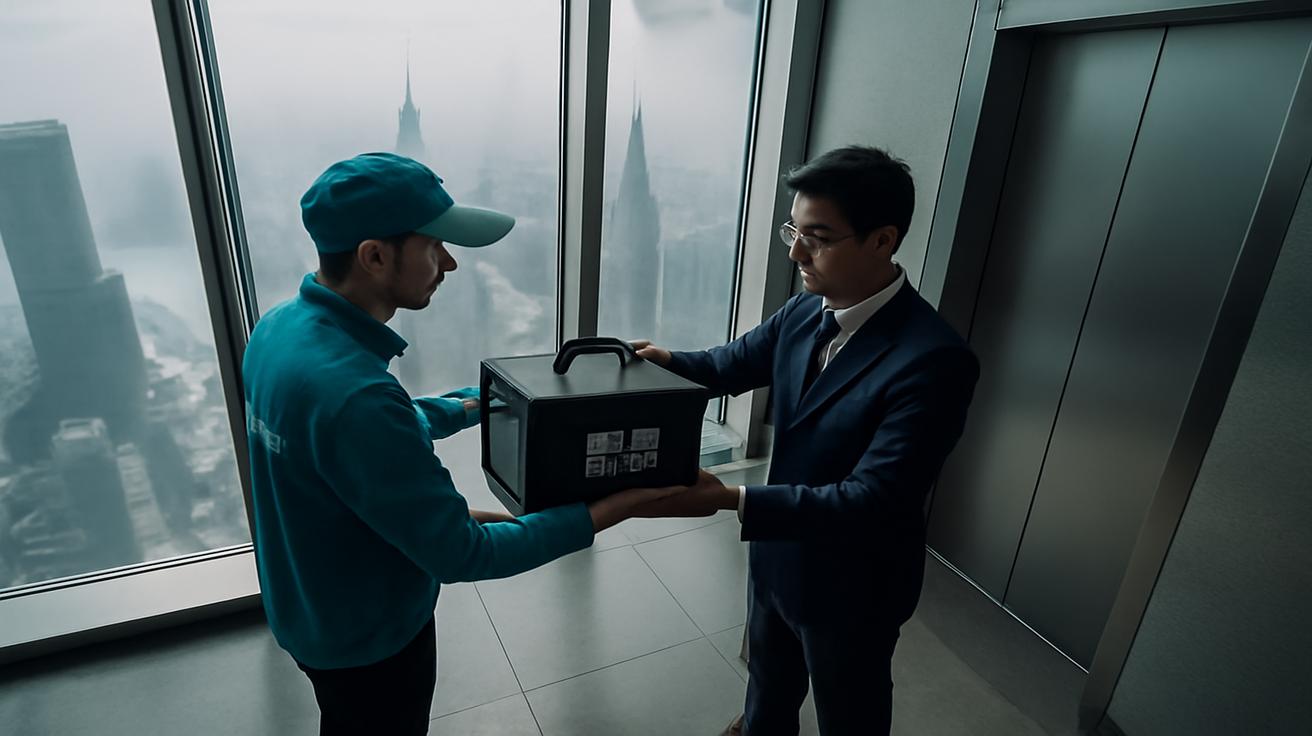
That is how a new job quietly formed, somewhere between the patience of security guards and the impatience of hungry office workers: vertical couriers, people whose work begins not in the streets, but in the elevator lobbies and sky bridges of China’s tallest skyscrapers. They are not the ones weaving through traffic. They are the ones pacing the marble floors forty, sixty, a hundred stories above it, hustling food the final stretch to offices that seem suspended in the haze.
The system usually works like this. A traditional delivery rider navigates the city’s maze to reach the base of the tower, threading through congested side streets and dodging luxury cars nosing out of underground parking garages. They check the time—every app has a countdown clock, a steady reminder that late deliveries mean bad ratings, and bad ratings mean fewer orders tomorrow. And then they stop. They hand the insulated bag or carefully balanced tray to someone wearing a different badge, sometimes a different color uniform entirely.
This is the “lounei peisongyuan”—the in-building delivery worker. While the rider heads off toward the next destination, the tower courier pivots toward the vertical labyrinth inside.
He (and increasingly, she) knows that labyrinth the way taxi drivers once knew every city street. They know which of the four elevator banks will go to floors 60–88, which sky lobby transfers to the observation deck, which security guard might wave them through if they smile and lift the bag just enough to show the steaming soup inside. They know where the biometric scanners are likely to break down and where the line for the lunchtime express elevator will coil around an indoor garden of potted ficus trees and murmuring water features.
Inside the building, their scooter is meaningless. Their tools now are timing, charm, and a mental map: the law firm on 52 with the perpetually broken reception phone; the media startup on 36 that changes its office layout every three months; the co-working space with tenants who always forget to approve external delivery access.
The Sky Lobby Rhythm
Walk with one of these couriers and your sense of the city changes. The ground disappears. You begin to navigate by elevator speed and hallway scent. At a sky lobby midway up a Shanghai financial tower, the air tastes faintly of roasted coffee and printer ink. Sunlight filters through double-height glass, so bright it hurts after the dimness of the elevator shaft. People spill out of lift doors, checking downward at their phones rather than upward at the astonishing view of barges crawling along the Huangpu River.
Our courier, a young man in his mid-twenties with a clipped buzz cut and a phone permanently in his palm, moves in lines that look chaotic but are anything but. He never stands in the wrong elevator queue. He knows that elevator A is full of people heading to the law firms, while elevator D always has space because it stops at the awkward mid-40s—the “unlucky” floors fewer tenants choose. He slips in just as the doors close, box in hand, app silently counting down the seconds until the order expires.
His world is timing and thresholds. Two minutes lost at the lobby because a visitor is arguing with security. Four minutes trapped in an elevator as a tour group boards on a sky bridge, everyone craning at the city like it’s a movie screen. Thirty seconds wasted when a client doesn’t pick up the phone. It all adds up. The job is no longer about physical distance. It’s about moving through a city sliced vertically, where each zone has its own gravity of delays.
Inside the Tower’s Hidden Ecosystem
In the shadow of these towers, it’s easy to imagine them as cold, impersonal machines of concrete, steel, and glass. But step inside and follow the path of a tower courier, and a different picture appears: an ecosystem of small, human dramas played out in recycled air.
There is the receptionist who tips generously because she has seen what the lunch rush really looks like from behind the marble counter. The security guard who remembers which courier once helped carry his own takeout upstairs when his shift ran late. The office worker who orders from the same noodle shop four days a week and leaves notes like, “Careful, the sauce leaked last time, sorry!”
On some floors, the courier is almost a regular. In one open-plan office, a cheer goes up whenever a bright delivery box appears in the doorway—like a bell rung for freedom from spreadsheets. On another floor, people barely look up; they lift their QR codes, scan, accept, and return to their monitors. Even here, a hierarchy of attention exists. Free snacks still draw more excitement than the people who bring them.
There’s a curious intimacy to this new profession. Couriers rarely know their customers’ full names, yet they come to recognize their habits, their preferences, their bad days. “Seventy-second floor, corner desk near the window, always orders extra chili,” one courier might say, shrugging. “If she doesn’t order by one p.m., I know she’s probably stuck in a meeting.”
Yet for all that, the job can be emotionally invisible. They pass through spaces designed for people with printed badges and door access. Their presence is tolerated, sometimes welcomed, often overlooked. The building is not truly theirs, yet no one navigates it quite like they do.
Numbers in the Sky
It helps to think of the scale. A single mixed-use supertall in a Chinese megacity can hold tens of thousands of people. Imagine a vertical town squeezed into a single footprint: banks, tech firms, law offices, gyms, dental clinics, luxury apartments, boutique hotels, rooftop bars, maybe even a small supermarket wedged into a mezzanine floor. At noon, hunger syncs like a shared alarm across these layers.
The elevators become arteries, flashing open and shut. Without dedicated in-building couriers, the system clogs badly. Street riders would queue at turnstiles, wait for access, lose precious minutes in transit. Orders would get cold. Ratings would plummet.
Instead, the city has improvised a solution: a relay race. The street courier runs the horizontal leg. The tower courier takes the vertical baton. Data stitches them together—real-time tracking, digital signatures, performance scores stored and analyzed. But the work itself is sweaty, breathless, and undeniably human.
| Aspect | Street Rider | Tower Courier |
|---|---|---|
| Primary Route | Across city streets and alleys | Within skyscrapers, between floors |
| Key Skills | Traffic navigation, speed, road safety | Elevator timing, building access, route memory |
| Main Challenges | Weather, congestion, accidents | Elevator delays, security checks, time limits |
| Typical Tools | Electric scooter, helmet, navigation app | Access cards, floor maps, order management app |
| Space Navigated | Horizontal city grid | Vertical “city within a tower” |
Life Between Floors
For many of these vertical couriers, the job is both an opportunity and a compromise. They avoid the danger of weaving through chaotic traffic, but trade it for the pressure cooker of time limits and security procedures. Some used to be street riders themselves, tempted indoors by the promise of steadier hours, less exposure to rain and winter wind that slices through the bones. Others come from service jobs—hotel bellhops, retail assistants—finding that familiarity with formal buildings transfers better than they expected.
Physically, the work is its own kind of endurance challenge. While the elevators do the heavy lifting, stairs still wait in the background like a stern backup plan. When an elevator breaks down, a system crashes, or a security checkpoint suddenly reconfigures for a visiting VIP, someone still has to climb. Some couriers tell stories of racing up fifteen floors because the express lift skipped a level, or discovering that a connecting sky bridge is closed “temporarily” for maintenance. The app clock, indifferent to such details, counts down just the same.
There is also the psychological oddness of living life mostly indoors, yet never truly belonging to any one place. A courier might spend their entire shift between the fifteenth and eightieth floors of a single building, walking its carpeted corridors, breathing its filtered air, seeing the same lobby plants and digital advertising screens over and over. The view from the windows shifts with the weather—fog, rain, harsh sunlight, neon reflections at night—but they are rarely looking out. Their gaze is inward: on elevator numbers, office doorplates, order IDs.
Stories from the Upper Floors
Spend enough time in this vertical world and stories gather like dust in the corners of elevator doors. There was the time a courier had to deliver a cake to an office farewell party on the eighty-third floor. The elevators were packed. Every second mattered. At the sky lobby connecting two elevator banks, someone stumbled, the cake lurched, and the box tilted dangerously. A stranger in a suit, late for an important meeting, reached out without a word and steadied it, walking the last hundred meters carrying a corner of the cardboard like a pallbearer for a sugary, fragile future. The party got its cake. The courier got a rare “thank you” and a story to tell.
On another day, an in-building courier got stuck during a power glitch on a mid-level sky bridge—windows on both sides, city roaring below, the floor shuddering just enough to remind everyone of the wind tugging at the building’s sides. People murmured nervously. Someone joked about being closer to heaven than hell. The courier leaned against the glass, watching tiny scooters thread the streets far below, wondering which of them had just handed off a delivery to him minutes earlier. In that moment, the city felt like a layered game board, and he was simply a piece that moved vertically instead of horizontally.
There are quieter moments too. A rare lull at mid-afternoon when most people have eaten and the dinner rush is still a few hours away. The courier leans on a bench by a planter of glossy indoor palms, sipping lukewarm tea from a plastic bottle, eyes on the elevator display scrolling through floors. He is simultaneously inside a luxury tower and at the very edge of it, a necessary presence woven into the fabric but never quite foregrounded.
Designing for the Hungry Sky
As architects and planners imagine the next generation of Chinese skyscrapers, they can no longer ignore something as mundane—and essential—as lunch. Buildings that were once designed purely to impress from the outside now have to function like efficient micro-cities on the inside. That means thinking about food as infrastructure, not just amenity.
Some new towers are experimenting with dedicated delivery lobbies, separate from grand marble entrances. These back-of-house spaces are scruffier but highly efficient: racks for insulated bags, screens that show order numbers, lockers that keep meals warm or cool until the in-building courier arrives. Building management teams negotiate with delivery platforms to streamline access, issue digital passes, or designate specific elevator runs just for deliveries during peak hours.
In a few experimental projects, architects tuck in-service corridors behind the glossy façade—circulation routes for staff, cleaners, technicians, and now, food couriers. This backstage city allows orders to slip up and down without clogging the main elevator halls. The vertical courier moves along these hidden arteries, emerging only when they reach the door of an office or apartment, like a stagehand stepping briefly into the spotlight.
But many existing buildings were not designed with such flows in mind. For them, the solution is human, improvisational, and sometimes messy. Security guards who look the other way when a courier rushes into a staff elevator. Office managers who create ad-hoc pick-up shelves outside glass doors. Tenants who pool orders to reduce traffic. In these spaces, in-building couriers become the unofficial mediators between architecture’s ambition and daily life’s demands.
The Future of Vertical Work
Technology is already sniffing at the edges of this job. Prototypes of delivery robots roll through some shopping malls, chirping politely as they avoid toddlers and lost tourists. In concept videos, drones hover near skyscraper windows like oversized dragonflies, dropping off boxed lunches onto neat landing pads. Autonomous elevator systems promise to allocate cabins more intelligently, anticipating lunch rushes and programming priority routes.
Yet for now, reality is stickier, more human. Elevators malfunction. Robots struggle with spilled soup and late-night overtime orders that require a reassuring human “ni hao” at the door. Biometric scanners fail to recognize faces streaked with sweat under fluorescent lights. Security protocols, written for an older world, tangle with the expectations of instant app-based gratification.
And so, the vertical couriers endure—flesh-and-blood solutions to the graceful, unsentimental problem of getting hot food from street to sky. Their work sits at the intersection of labor and architecture, of algorithms and appetite. In those intersections, something revealing glints about the way cities adapt not only in plan and elevation, but in the tiny, repeated gestures of everyday survival.
Eating at the Top of the World
As evening falls, the city’s towers flicker on like a constellation of private stars. Office lights wink out gradually, replaced by softer apartment glows and the neon halos of rooftop bars. Down below, the last of the lunch-hour desperation has long passed, but another kind of hunger pulses through: late workers ordering from their desks, couples calling up dinner to avoid the long elevator dive to the street, night-shift cleaners buying boxed meals in the small hours.
Somewhere between the lobby and the eightieth floor, a courier is still riding the elevator up and down, the hum of the cables now as familiar as the sound of his own breath. Outside, the streets belong again to scooters and buses and the occasional honk. Inside, the city hums vertically, a silent choreography of doors opening and closing, trays passing from hand to hand.
In China’s new vertical age, even something as simple as a bowl of rice and vegetables has learned to travel in three dimensions. Hunger doesn’t care about floor numbers. It simply rings through glass and steel with the same insistence it always has, from peasant fields to factory floors to open-plan corner offices scraped against the edge of the sky. And answering that call now is a new kind of worker, one whose job description could only exist where skyscrapers have grown so tall that getting lunch to the top has become not just a task, but an entire profession.
Frequently Asked Questions
Why did in-building food delivery jobs emerge in Chinese skyscrapers?
They emerged because ultra-tall buildings created bottlenecks. Street delivery riders were losing time in elevator queues and security checks, leading to late orders and inefficiency. In-building couriers specialize in navigating the interior of skyscrapers, handling the last vertical stretch from lobby to office or apartment.
How is a tower courier’s job different from that of a regular delivery rider?
A regular rider moves horizontally across the city on scooters or bikes, dealing mainly with traffic and weather. A tower courier works vertically inside one or a few high-rises, dealing with elevators, access control, internal routes, and very tight time limits between floors.
Do these vertical couriers earn more than street riders?
Earnings vary by city, building, and platform. Some in-building couriers appreciate the steadier hours and less physical danger compared to street traffic, but their pay is still tied to delivery volume and performance ratings, much like traditional riders.
Are robots or drones replacing in-building delivery workers?
Experiments with robots and drones exist, especially in malls and tech-focused developments, but large, complex skyscrapers with security layers and unpredictable human behavior still rely heavily on human couriers. Automation may grow, but for now it coexists with, rather than replaces, human workers.
How have skyscraper designs adapted to this new kind of job?
Some newer towers now include dedicated delivery lobbies, service corridors, and smarter elevator systems to handle meal traffic. Older buildings often improvise with ad-hoc pick-up points, internal rules for couriers, and informal cooperation between security staff, tenants, and delivery platforms.







Leave a Comment