
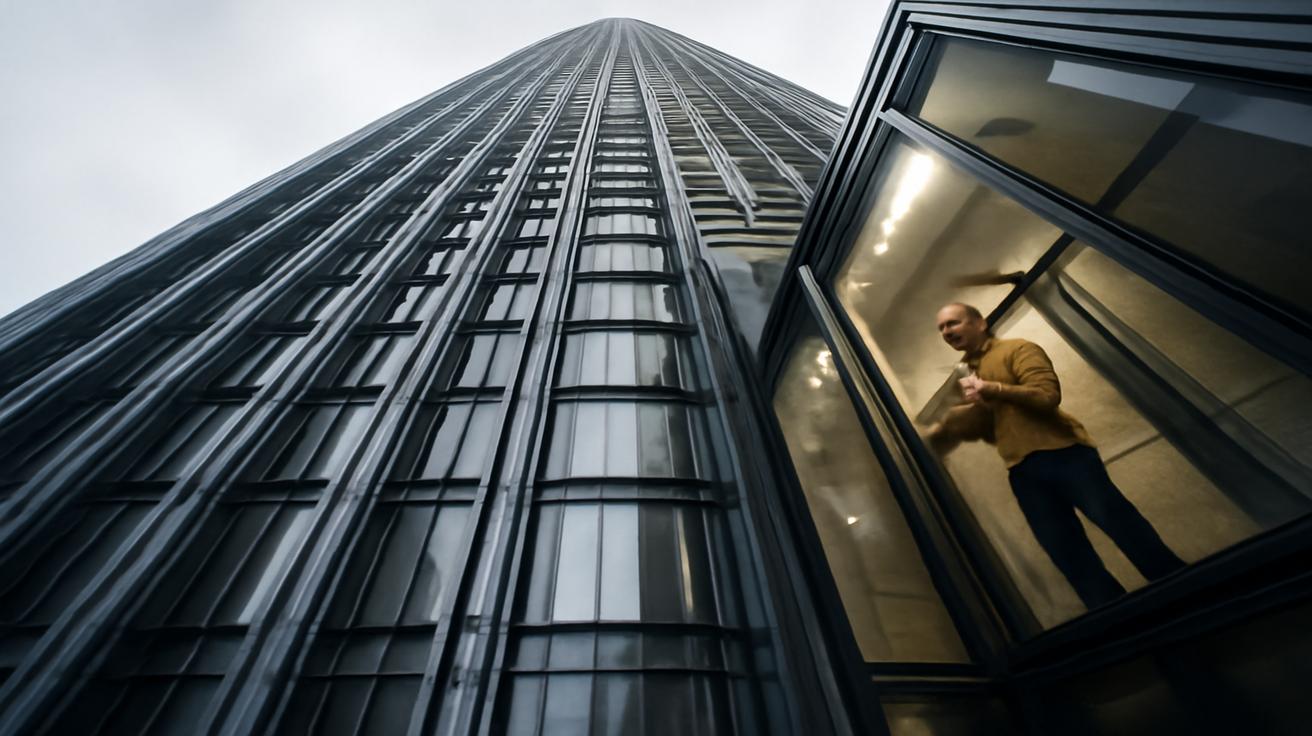
The elevator doors close with a soft sigh, and the world falls into a vertical blur. Floor numbers blink past in a glowing countdown: 38, 39, 40… The box hums, cables singing somewhere far above. A young man in a bright insulated jacket cradles three paper bags against his chest, the smell of cumin lamb and chili oil filling the tiny chrome space. On his phone, a timer ticks down in red. The app shows a cartoon skyscraper, an animated scooter, and a promise: delivery in 28 minutes or less. He glances up as the number jumps—74, 75, 76—and shakes his head in the half‑amused, half‑exhausted way of someone who lives more in the air than on the ground.
In China, where skyscrapers can rise like forests of glass and steel, a curious new job has appeared: people whose full-time work is simply getting food from the ground to the sky. Not cooking it. Not driving it across town. Just taking it those last dizzying hundreds of meters into the clouds—through elevator queues, security gates, and rabbit-warren corridors, all for a few yuan per trip and the satisfaction of watching a hungry office worker’s face light up when the door finally opens.
Skyscraper Forests and Vertical Hunger
Stand in the middle of a business district in cities like Shenzhen, Guangzhou, or Chongqing, and you feel small in a very particular way—not just dwarfed, but embedded in a vertical ecosystem. Glass towers shimmer, their mirrored skins catching clouds that race overhead. Advertisements climb the sides of buildings in neon scripts. Drones buzz faintly above billboards. Street-level life is dense and familiar: noodle stalls steaming in the morning, fruit sellers yelling prices, scooters weaving through the gaps. But lift your eyes and there are floors upon floors of lives you’ll never see, stacked like invisible villages in the sky.
For the thousands of people working on the 60th, 80th, or 100th floors, lunchtime is a logistical puzzle. Going down to eat means joining the lunch-hour stampede: queues curling out from elevator banks, security cards flashing, time ticking. Ten minutes to get down, ten to fight through crowds and order, ten to get back up—if the elevators cooperate. In some towers, that’s half your break gone, just for the commute.
And so, high above the street markets and snack stalls, a different marketplace emerged. Apps buzz with orders from floors that never see sunlight. Dumplings, bubble tea, burgers, rice bowls, hotpot in portable tins—everything you can find on the street can now be summoned to a fingerprint-smudged office desk. The catch is that getting from sidewalk to sky can be more complex than driving five kilometers across town. Enter the vertical couriers: people who specialize not in distance, but in altitude.
The Moment the Jobs Went Vertical
Food delivery exploded in China over the past decade, but at first, it was simple: riders on electric scooters sped between restaurants and apartment gates, weaving through traffic like water around rocks. They passed the food to a doorman or directly to the customer downstairs. Easy, fast, and relatively predictable.
But as soon as towers started stretching higher and higher, the system frayed. Delivery riders, already racing the clock, found themselves stuck at lobby security desks. “You can’t go up without registration.” “Use the freight elevator.” “Wait for the next batch.” Ten, fifteen, twenty minutes lost just standing in a lobby with a bag of slowly cooling noodles. In giant complexes with multiple elevator banks, riders got hopelessly lost, missing timers and racking up complaints.
Office workers, trapped upstairs, began to complain in the opposite direction. “My food is always cold.” “The rider gave up at the entrance.” “I had to go down 43 floors to pick it up.” Apps started to reflect the tension—endless back-and-forth messages: “Can you meet me in the lobby?” “No time, I’m in a meeting.” “Please just send someone up.”
Somewhere between the glass doors and the 92nd floor, opportunity appeared. Large office towers hired building-side staff whose entire role was handling deliveries. App platforms experimented with “in-building runners” who waited in lobbies at lunchtime, ready to grab incoming bags and shoot them upwards. And gradually, in the megacities where towers grew tallest, the vertical delivery specialist became a recognizable figure: not quite a courier, not quite a concierge, but something that belonged distinctly to the age of supertall living.
Inside the Life of a Vertical Delivery Runner
Ask one of these workers what they do, and they’ll likely shrug and say something modest like, “I take meals upstairs.” But follow them for a day, and the rhythm is anything but simple.
Morning starts not with a scooter ignition, but with the chime of turnstiles. Many of them are based in one building or a cluster of neighboring skyscrapers. They arrive before lunch rush, scan into staff entrances, and change into vests or uniforms that are part security badge, part moving advertisement. Their phones light up with jobs—sometimes assigned by platform, sometimes coordinated by the building itself. The names of tenants become their mental map: investment firm on 47, game studio on 63, law offices on 81, a mysterious foreign company that always orders spicy hotpot on 52.
By 11:30 a.m., the lobby transforms. Delivery riders swarm outside like mayflies around a lantern, dismounting scooters, balancing cardboard drink trays, calling out order numbers. The vertical runners stand at the boundary between street chaos and controlled interior air-conditioned quiet. One by one, they scan, check, and collect—bags swinging from their forearms like the branches of an overloaded tree.
Then comes the real work: threading these packages into the vertical arteries of the building. Elevators become their highways and bottlenecks all at once. They learn which lift serves which range of floors, when a bank is best avoided (right after a big firm’s all-hands meeting, for example), and which security guards will wave them through with a nod instead of a paperwork lecture.
They don’t just ride up once and down once. On a busy day, a runner might rack up dozens of vertical trips, leaping between elevator banks, cutting across carpeted corridors, dodging conference rooms spilling out their tie-loosened inhabitants. The building smells change with altitude: lobby perfume and polished stone at the base, then coffee and printer ink through the middle floors, then the scent of tired late nights—instant noodles, takeout sauces, cold air-conditioning—higher up where the lights burn longest.
A Table of Heights, Time, and Effort
To understand how specialized this job has become, it helps to look at the numbers that shape each delivery.
| Factor | Typical Range | Impact on Runner |
|---|---|---|
| Building Height | 40–120 floors | More transfer elevators, more complex routes |
| Average Elevator Waiting Time | 2–8 minutes per trip | Directly affects how many orders can be completed |
| Orders per Lunch Rush | 20–60 orders | Requires stacking deliveries by floor and direction |
| Distance from Elevator to Desk | 10–150 meters | Adds hidden time often ignored by customers |
| Extra Income per Delivered Order | 1–5 yuan | Small amounts multiplied by vertical speed and stamina |
Each of these numbers translates into an almost athletic performance. The runner has to mentally layer time and space: “If I take 46, I can hit 43 on the way back down. But 52 is in a separate tower that needs a different access card—I’ll batch those later.” It’s city planning in miniature, played out between elevator doors.
Voices in the Elevator: Stories from the Sky
On some days, the job feels like a long blur of scented plastic and passing faces. But there are moments when it sharpens into memory. A runner named Li will never forget the first time he rode to the 99th floor of a newly opened tower in Shenzhen. The elevator was so fast his ears popped twice. When the doors opened, the air felt thinner, quieter, almost muffled. Blue-grey mountains hovered in the distance beyond floor-to-ceiling glass, and the city spread below like a printed map… while a young programmer in a hoodie barely looked up from his screen, hand outstretched for his beef rice bowl.
Then there are the regulars. The woman who always orders black coffee and a single steamed bun at 8:30 a.m. “Meeting,” she mouths with a grimace when the runner appears at her glass-walled conference room. The design studio that buys bubble tea for the whole team every Friday, cheering when the carrier trays appear, lids wobbling. The law partner who, during a thunderstorm that shook even the reinforced windows, told the runner quietly, “You’re braver than we are today,” as he accepted his neatly packed soup and rice.
Some runners say they’ve watched lives unfold in fragments: a desk that slowly fills with potted plants, then baby photos; a manager who stops ordering late-night takeout after a health scare; a young intern who orders the cheapest noodles for weeks and then suddenly splurges on hotpot after getting a job offer. Delivering meals becomes a way of browsing human stories at high speed, each door a thumbnail glimpse into another vertical life.
The Odd Physics of Vertical Work
Vertical delivery also changes how the body experiences work. Traditional courier jobs move horizontally through neighborhoods, past changing street scenes, shifting weather. Here, the landscape is far more controlled, yet the body still adapts. Runners learn to brace for elevator lurches, to balance drink trays in cramped spaces as people squeeze in around them. They become experts in door timing—slipping into an elevator just before the sensors close with a practiced sideways step that would impress a dancer.
Time behaves strangely. A 30-second elevator ride can feel endless when the countdown timer on the delivery app is blinking in angry red. A five-minute wait at a transfer floor can stretch, elastic and suffocating, even as the air smells faintly of carpet cleaner and someone else’s perfume. Outside might be typhoon rain or blistering heat, but inside the tower, the climate is set to an artificial, unchanging spring.
And then there’s the soundscape: the constant soft chime of arriving elevators, the murmur of office conversations leaking through half-closed doors, the tiny electronic notification pings layered over the faint thrum of air conditioning systems. The job may be physically repetitive, but it takes place inside a uniquely modern ecosystem—a kind of man-made canyon where people, machines, and hot food share the same narrow vertical paths.
Designing Buildings for Food and People
What makes this job both necessary and complicated is the way many skyscrapers were designed—precisely planned for office density and safety, but not originally for thousands of takeout bags flowing through them every day. As the food delivery boom matured, architects and property managers began to notice that the “last hundred meters” problem inside towers was costing enormous amounts of collective time.
Some buildings responded in neat, almost futuristic ways. Dedicated delivery waiting zones appeared just inside the ground floor, with digital screens calling out order numbers like flight information boards. Separate service elevators were reassigned during lunch hours, temporarily becoming food highways. A few complexes experimented with smart lockers on intermediate floors, where couriers could deposit meals and office workers could retrieve them using a code—breaking the problem into two shorter journeys rather than one complicated one.
But even these fixes still relied on human runners. Elevators can be programmed; they cannot yet wander down identical carpeted corridors or politely knock on glass doors. The vertical couriers became part of the unacknowledged design language of tall buildings: as necessary as fire exits and loading bays, even if they appear on no official blueprint.
Talk to forward-thinking planners and they’ll mention even more extreme ideas—dedicated dumbwaiter shafts for food, drone delivery platforms on mid-level terraces, app-connected drop boxes that align with automated guided carts inside a tower. For now, these remain prototypes and pilot programs. Reality, most days, still looks like a person in a bright vest, riding a humming elevator with a bag that smells faintly of garlic and ginger, on their way to yet another unremarkable, hungry door.
Invisible Labor in a Vertical Age
The story of these runners is not just charming or futuristic; it’s also about labor and what we choose to see. Office workers on the 80th floor may rarely think about the chain of people that made their lunch appear—chef, packer, scooter rider, lobby staff, vertical courier. Algorithms manage time. Ratings systems reward speed, sometimes at the expense of safety or fairness.
For vertical runners, pay can be a patchwork of base wages, building contracts, and per-delivery bonuses. A day’s earnings rise and fall based not just on their own effort, but on passenger congestion, elevator malfunctions, building security policies, and weather that might delay riders outside. A single broken elevator can slash their output; a sudden rainstorm can flood them with incoming orders from workers reluctant to leave their desks.
Yet many runners speak with a certain pride. They know the building better than most tenants. They are the ones who see lights still on at midnight, who know which companies secretly order cheap boxed meals instead of the fancy catered lunches their public image might suggest. They understand, more than any workplace survey could reveal, who is staying late, who is cutting costs, who celebrates small wins with milk tea on a Tuesday afternoon.
What These Towers Say About the Future
It’s easy to treat the image of someone whose whole job is carrying food up skyscrapers as a quirky detail of present-day China—a trivia fact to drop at a party. But it points to something larger: the way human jobs keep adapting to the shapes of our inventions. Build high enough towers, create dense enough office clusters, compress enough time into a workday, and you’ll eventually need a person whose expertise is riding elevators efficiently.
In older cities, jobs grew out of docks, out of railway yards, out of marketplaces and harbors. In the vertical megacities of 21st-century China, work emerges from lobbies and sky lobbies, from security gates and elevator banks. It’s a reminder that architecture is never just concrete and glass. It is also a set of instructions for how people will move, wait, carry, and earn.
Someday, perhaps, a combination of automation, redesign, and culture shift will erase the need for these roles. Maybe office towers will have integrated canteens again, or working cultures will relax enough for slower, longer lunch hours. Maybe drones really will dock at mid-level balconies, depositing steaming containers into smart lockers. But for now, the vertical couriers are still riding, one hand on the elevator rail, one eye on the countdown clock, carving invisible paths through the upper air of the city.
A Small Human Exchange, Hundreds of Meters Up
Late in the evening, long after the lunch rush and dinner spike, the building quiets. The lobby echoes. Office windows become black mirrors, reflecting the tiny glowing rectangles of cleaning crews’ phones. A lone vertical runner, wrapping up his shift, rides the elevator down for the last time that day. He has delivered dozens of hot meals to people whose names he barely knows, whose lives he sees only in fragments: a thank-you nod at a door, a muffled “finally!” in a bustling open-plan office, a shy smile from a tired intern.
At the base of the tower, scooters are already humming away into the night, their tail lights blinking like fireflies along the avenue. The runner steps out into the damp, neon-lit air. Above him, the tower’s top floors disappear into a low ceiling of cloud, their lights a distant constellation.
Somewhere up there, plastic containers are being opened, chopsticks snapping apart, keyboards pushed aside. Hungry people tuck into food that has traveled across districts and up nearly a hundred floors. On most days, they don’t think about who brought it. But if you listen in the elevator, in that humming, mirrored airshaft between worlds, you can hear the faint stories of a new kind of work born in the age of supertall cities—work that exists in the narrow, overlooked space between ground-level chaos and sky-level appetite.
FAQ
Why are special delivery runners needed in tall buildings in China?
Super tall and high-density office towers create long elevator waits, strict security checks, and complex internal layouts. Regular scooter couriers would lose too much time navigating these obstacles, so specialized runners handle the “last vertical stretch” from lobby to office.
How is this different from regular food delivery jobs?
Traditional couriers focus on horizontal distance and traffic. Vertical runners focus on altitude and building logistics. They rarely ride scooters; instead, they move through elevators, corridors, and security systems, often within a single building or complex.
How do these workers get paid?
Payment models vary. Some are employed by buildings with a fixed salary plus bonuses. Others work through delivery platforms and earn a fee per order handled inside the tower. Their income depends heavily on order volume and elevator efficiency during peak hours.
Do buildings in China really reach 80–100 floors and more?
Yes. In major cities like Shenzhen, Shanghai, Guangzhou, and Chongqing, office and mixed-use towers regularly exceed 60–80 floors, and some soar past 100. Many of these are packed with offices that rely on delivery apps for everyday meals.
Could technology replace these runners in the future?
Possibly. Ideas include dedicated food elevators, smart lockers on multiple floors, and even drone platforms. But for now, human runners remain the most flexible and reliable way to navigate security, find specific desks, and handle all the small, unpredictable details of delivering meals high in the sky.




Leave a Comment