
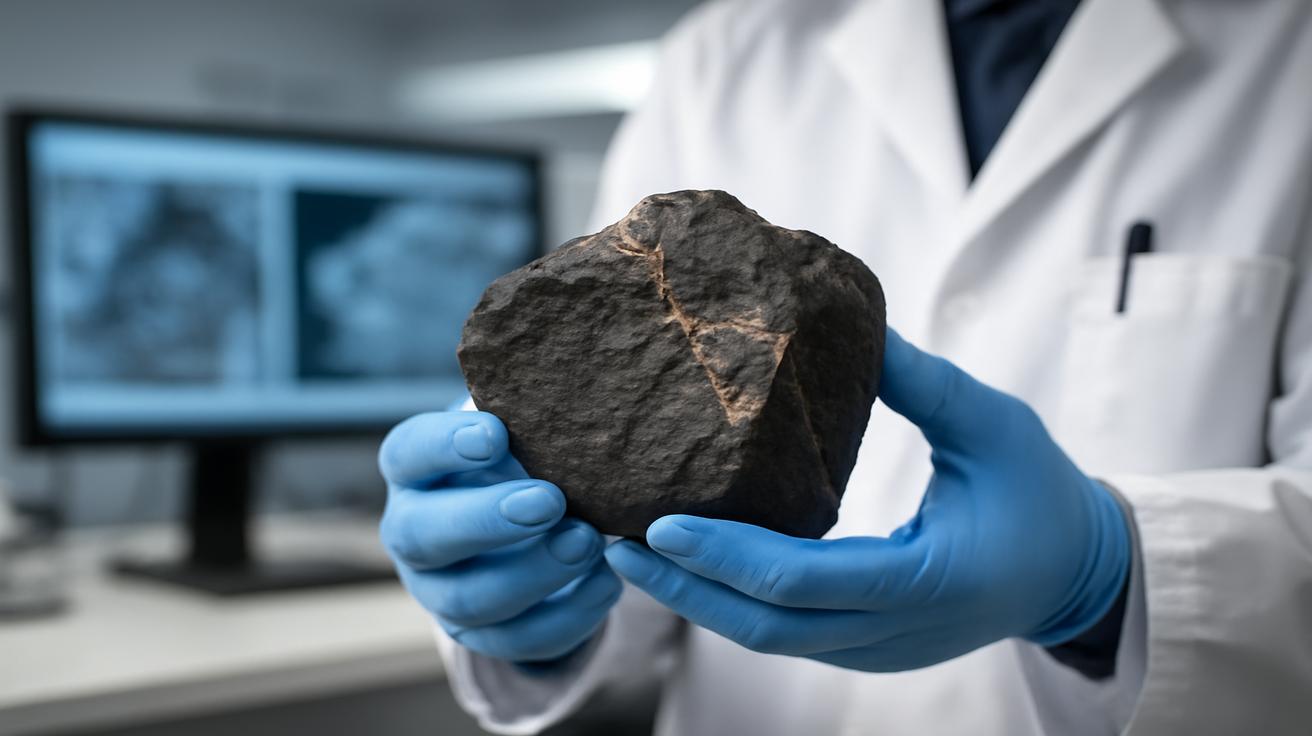
The man did not go to the Moroccan desert to find Mars. He went, like so many others, for stones that fall from the sky—objects whispered about in markets, passed between calloused hands, wrapped in newspaper and plastic. Yet on a nondescript day in 2011, a single dark rock traded for cash became something far more astonishing: the clearest physical evidence we’ve ever held in our hands that warm, flowing water once moved through the crust of Mars.
The stone in the stall
Picture a market town on the edge of the Sahara. The air is dry and metallic, dust curling around ankles, the sun baking the roofs into a shimmering palette of rust and amber. In a maze of stalls where camel tack hangs beside cell phone chargers, where spices swirl in ochre heaps and the scent of mint tea rises on invisible currents, meteorites are just another commodity.
Morocco has become a crossroads for space rocks. Nomads and desert walkers roam the stony hammada after meteor showers, scanning for anything that looks out of place—a smooth rind of fusion crust, a weight that feels wrong in the hand, a subtle sheen in the harsh light. These finds often end up here, on tarps and tabletops, waiting for buyers who might pay a few hundred dollars for a stone that fell from nowhere.
In 2011, among the usual chondrites and dusty, unclassified fragments, a collector bought a small, dark rock. To anyone else, it was just another meteorite: about the size of a fist, dense and nondescript. But something about it—the fine-grained texture, the way its surface had fractured—made it look different. It would take scientists thousands of kilometers and many months to uncover its true identity. For now, it slipped into a bag and left the marketplace like any other piece of desert contraband.
In a sense, this is how discoveries begin—not with trumpets and press releases, but with quiet exchanges in hot air, the slow drift of a rock from the emptiness of space into a human palm, where curiosity has a chance to catch fire.
The slow naming of a Martian
When that stone finally reached a laboratory, it entered a process that meteorite people know well: cutting, polishing, peering, testing. Under bright, clinical lights and the hum of instruments, the meteorite was sliced into thin sections just micrometers thick. These slivers were placed under microscopes that don’t merely look at color and shape, but at the very chemistry of minerals.
Almost immediately, the stone started to reveal its story. It wasn’t an ordinary stony meteorite. The ratios of oxygen isotopes—the subtle fingerprints of where a rock formed—were unlike those of Earth, the Moon, or the asteroid belt. They matched a family of rare meteorites known as SNCs (shergottites, nakhlites, chassignites), which scientists had already tied to one place: Mars.
Martian meteorites are a strange gift. We have never brought back rocks from Mars ourselves, but Mars has sent us samples the messy, violent way: impacts large enough to blast boulders free of the planet’s gravity, flinging them into space. Some of those fragments wander the solar system for millions of years before falling on Earth, flaming across our skies and landing anonymously in deserts and on ice fields.
This particular Moroccan meteorite would eventually be named NWA 7034—Northwest Africa 7034. Collectors nicknamed it something more evocative: “Black Beauty.” Unlike the more common Martian shergottites, NWA 7034 was a breccia—a rock made of fragments welded together—and it was astonishingly old. Some of the pieces inside it dated back more than two billion years. Locked inside them was a geological diary from deep time on another world.
For a while, the meteorite was simply thrilling in the way that rare things are thrilling. It was exotic, ancient, clearly Martian. But as scientists began to probe deeper, they realized it contained a particular mineral that would change the way we imagine Mars under its red dust: a mineral born in hot, circulating water.
Hot water under a cold sky
To understand why this matters, it helps to slow down and think about what water does to rock. On Earth, when rain seeps into cracks and percolates through the ground, it doesn’t travel alone. It dissolves minerals, carries ions, reacts with volcanic glass, alters basalt into clays and other hydrated minerals. If the water is hot—warmed by magma, radioactive decay, or simply the heat of a young planet—these reactions intensify. New minerals form that should not exist without liquid water flowing through stone.
NWA 7034 carried some of those minerals. When researchers examined its composition, they found evidence of clays and other alteration products that are only stable if water has spent serious time creeping, soaking, and chemically dancing with the Martian crust. More than that, the isotopic patterns suggested this wasn’t just any water—it was thermal water, heated and circulating, perhaps driven by volcanic activity.
Imagine a very different Mars than the one in today’s photographs. We know the dusty plains and the towering shield volcanoes, the gaping canyons and polar caps. But now picture warm groundwater moving through fractured basalt, dissolving and depositing minerals, building an underground plumbing system of veins and pockets. At the surface, perhaps there were hot springs, steaming where they met the thin chill air. Below, chemical reactions were quietly rewriting the rock.
For astrobiologists—scientists who study life’s possibilities in the universe—this is more than geology. On Earth, thermal waters are among our richest biological laboratories. Around hydrothermal vents on the seafloor, at hot springs like those in Yellowstone, in deep, dark aquifers kilometers below our feet, microbes thrive on chemical gradients. They tap into the energy stored in rocks, not sunlight, living in worlds of heat and minerals. If Mars once had such systems, it had some of the key ingredients that make Earth’s hidden biospheres possible.
The Moroccan meteorite, which left its home planet perhaps 5–10 million years ago and fell to Earth only recently, carried with it a sampled memory of that warm, reactive past—a direct, tangible piece of evidence that water on Mars wasn’t only frozen in polar caps or fleeting on the surface, but circulated in depth, as thermal water, over geological time.
Reading water in stone
What does “direct evidence of thermal water” really mean when all you have is a rock slice under a microscope? It comes down to details: the textures of minerals, the elements they hoard, the ratios of unstable isotopes that drift and decay in mathematically predictable ways.
In NWA 7034 and its paired stones, scientists found:
- Hydrated minerals—like certain clays—that form only when water has been intimately involved with the rock.
- Signs that these minerals had formed at elevated temperatures, not in icy or near-freezing conditions.
- Chemical patterns suggesting long-term water–rock interaction, rather than a brief, passing splash.
On a lab bench, this may look like colored maps on a computer screen, tiny shimmering crystals under an electron beam, graphs of peaks and valleys showing the presence of hydroxyl groups, iron in different oxidation states, or rare trace elements that move only when water is there to carry them. Each line of evidence on its own is subtle. Together, they conjure a world where water didn’t just trickle; it circulated and transformed.
In the desert markets, meteorites are weighed by grams and carats. In the lab, they are weighed by the stories they can bear. This one told us Mars was never simply a place of dry volcanoes and frozen caps, but a world of heat and fluid, where geology and chemistry had time to experiment.
A pocket-sized planet history
One of the strangest things about holding a Martian meteorite is scale. In your palm is a piece of crust from a planet nearly half the size of Earth, a world that has been slowly cooling and quieting for billions of years. NWA 7034, with its complex mixture of grains of different ages, acts almost like a core drilled from a layered planet.
Some of its components crystallized when Mars was young, its interior hotter, its magnetic field stronger, its atmosphere thicker. Back then, surface water may have pooled in lakes and shallow seas, rain may have fallen, rivers may have carved the beginnings of canyons. Other fragments inside the meteorite are younger, altered by processes that continued long after the early exuberant era—long enough, perhaps, for thermal waters to percolate again and again through the rocks, rewriting them in stages.
Researchers have measured the age of certain minerals in NWA 7034 at about 2.1 billion years. That places their formation well after the earliest, wettest Mars, in a time when the planet was thought to be cooling and drying out. Finding evidence of thermal water from that era stretches the timeline. It says: Mars did not shut down its hydrologic and geologic imagination quickly. Warm water systems may have flickered on and off for far longer than we guessed.
To better understand the surprising richness of information in this single rock, it’s helpful to see how its key characteristics compare to more familiar meteorites and to Earth rocks. The details are technical, but they paint an intimate portrait of a world once in motion.
| Feature | NWA 7034 (Black Beauty) | Typical stony meteorite | Earth volcanic rock |
|---|---|---|---|
| Origin | Martian crust | Mostly asteroid belt | Earth’s crust |
| Rock type | Breccia (fragmental, welded) | Often uniform chondrite | Basalt/andesite, often uniform flow |
| Notable minerals | Clays, altered phases, hydrous minerals | Olivine, pyroxene, metal grains | Olivine, pyroxene, feldspar, variable |
| Water evidence | Strong—thermal water alteration | Usually weak or absent | Common, many alteration types |
| Scientific value | High—direct record of Mars’s wet interior | Moderate to high—records early solar system | Local—records Earth tectonics and volcanism |
Desert, lab, and the human thread
It’s tempting to tell this story as purely Martian: a rock born in lava flows on another world, soaked in hot water, blasted into space, and caught by Earth’s gravity. But threaded through it is something more intimate: human attention. Without the hands that picked it up from the Moroccan desert, without the bargaining and the shipping and the curiosity of a collector, NWA 7034 might still be just another dark pebble on a wind-scoured plain.
In that sense, the discovery is also about how science now depends on a global, sometimes messy network. A nomad’s eye for out-of-place stones. An informal market. A collector willing to fund the search for rare meteorites. Scientists in distant labs with expensive instruments. A chain of trust, economics, obsession, and rigor bringing a tiny part of Mars into sharp focus.
When researchers published their findings, the headlines focused on the spectacular: “Rock from Mars shows evidence of water,” “Meteorite reveals wet past.” Behind those phrases lie years of meticulous sample preparation, arguments over interpretations, cross-checking of data. Was the water truly Martian, and not contamination from Earth? Did the minerals really demand hot water, or could they form in cooler settings? Each of these questions had to be nailed down before the words “direct evidence” could be used without flinching.
They were, and we now speak of NWA 7034 as one of the most important Martian meteorites ever found. It contains the oldest known Martian igneous material we’ve held, a complex, altered crustal brew, and the chemical scars of thermal water circulating deep under a cold, thin atmosphere.
Mars, made more habitable in memory
Standing under our own sky at night, Mars appears very small, a ruddy pinprick drifting between the constellations. Through telescopes we see canyons, dunes, the ghostly outlines of dried river valleys. From orbiters and rovers we get sharper views: layered sediments, salts, wind-carved rocks. It’s easy to think of the planet as a place thoroughly mapped by cameras and instruments.
But holding a meteorite like NWA 7034, the perspective shifts. Instead of distant landscapes, we are confronted with the textures of a world at the scale of grains and pores. We feel its weight. We see, through thin sections and spectrometers, the intimacy of water touching rock, of heat rising from depth. Suddenly Mars is not just a landscape but a set of processes: water moving, minerals changing, a planet experimenting with habitability.
Direct evidence of thermal water does not tell us whether life ever took hold there. It does, however, push Mars further into the realm of plausibility. Here was a world where hot water could circulate underground, protected from harsh surface radiation, for long stretches of time. Here were energy sources, gradients, and chemistry not unlike those in some of Earth’s deepest, most robust ecosystems.
There is a quiet but profound difference between saying, “Mars may once have had standing water,” and saying, “Mars once had thermal water circulating through its crust.” The first suggests puddles and lakes, perhaps fleeting climates. The second points to the engine room below: a dynamic interior, heat flow, and a slow, persistent exchange between rock and water that shapes planetary histories and, sometimes, nurtures life.
Somewhere in Morocco, there are still people walking the deserts, eyes tuned to anomalies, hands ready to pick up another dark stone that doesn’t quite fit. Somewhere in a lab, thin slices of meteorites older than any human dream glow under electron beams. Each piece adds to a mosaic of what Mars was, and maybe, in quieter ways, still is beneath its dusty skin.
In 2011, a collector bought a meteorite that was simply labeled and weighed, a curiosity from the sky. Today, that same rock stands as one of our clearest messages from Mars’s past: a message written in minerals, delivered across millions of kilometers, and unsealed by the combined attention of nomads, traders, and scientists. It tells a simple, astonishing story: once, under a cold red sky on another world, the water was not just there. It was warm, it moved, and it changed the planet from the inside out.
FAQ
How do scientists know this meteorite is really from Mars?
Scientists compare the chemical and isotopic composition of meteorites to measurements taken by spacecraft and rovers on Mars. NWA 7034’s oxygen isotope ratios and trapped gases match the Martian atmosphere as measured by missions like Viking, leaving Mars as the only plausible origin.
What makes NWA 7034 different from other Martian meteorites?
Most Martian meteorites are volcanic rocks of a single type. NWA 7034 is a breccia—a mixture of fragments from different rocks welded together—representing Martian crust rather than just lava. It’s also unusually rich in water-bearing minerals and contains some of the oldest known Martian materials.
What exactly is “thermal water” on Mars?
Thermal water is liquid water that has been heated by the planet’s internal heat, often through volcanic or geothermal activity. On Mars, this would mean warm groundwater or hydrothermal systems circulating through cracks and fractures in the crust, altering the rock as it moved.
Does this meteorite prove there was life on Mars?
No. The meteorite provides strong evidence for conditions that could support life—liquid water, heat, and active chemistry—but it does not contain direct signs of life such as fossils or biological molecules. It shows that Mars had some of the right ingredients, not that those ingredients assembled into organisms.
Could this meteorite be contaminated by Earth’s water?
Scientists are careful to distinguish Martian signatures from terrestrial contamination. They look at minerals that could only have formed at high temperatures and deep within the crust, long before the rock ever left Mars. They also examine isotopic ratios that would not be changed by brief exposure to Earth’s environment.
How old is NWA 7034?
Some components in NWA 7034 are more than 2 billion years old, making it one of the oldest known Martian rocks in our collections. Its brecciated structure suggests a long and complex history of impacts and alteration on Mars before it was finally ejected into space.
Why are many Martian meteorites found in deserts like Morocco?
Dark meteorites are easier to spot against light-colored, barren landscapes. Deserts preserve rocks well because there is little vegetation, low humidity, and slower weathering. That combination makes places like the Sahara prime hunting grounds for rare meteorites—including those from Mars.








Leave a Comment