
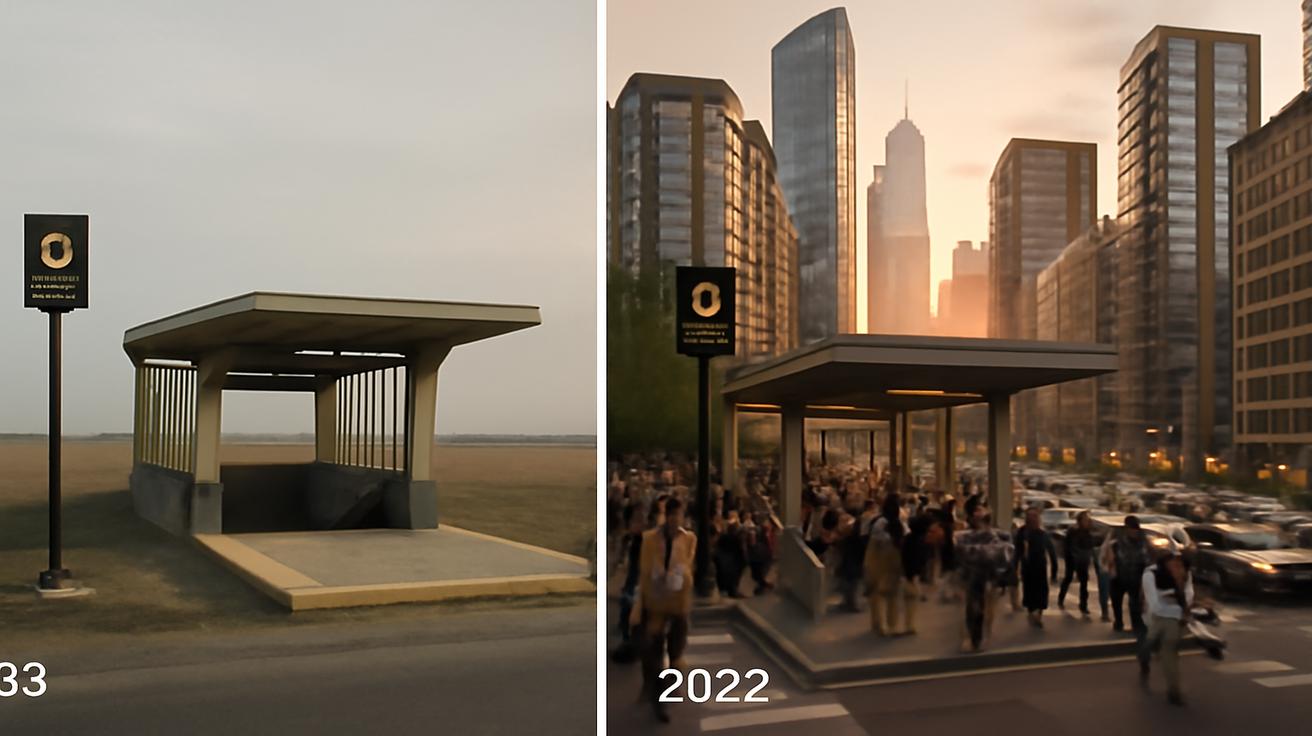
The first time I saw a photo of a Chinese subway station standing alone in a field of dirt, I laughed. There it was: a gleaming glass entrance, railings polished, tiled stairways spotless—surrounded by absolutely nothing. No apartments, no offices, not even a proper road. Just cranes in the distance and a haze of dust. Commentators joked that China was “building subways for ghosts” and “stations in the middle of nowhere.”
Back then, in 2008, it felt like the perfect symbol of how over-the-top, how wildly optimistic, how naive large-scale planning could be. But then the years passed. The cranes kept moving. People kept coming. And by 2025, those “stations to nowhere” had become something else entirely—a quiet lesson in how cities grow, and how slow the human imagination can be when it tries to keep up with concrete, steel, and the stubborn force of population.
The Station in the Wheat Field
Imagine standing on the outskirts of a third-tier Chinese city in 2008. The name of the city doesn’t matter; there were dozens like it. The afternoon air smells of dust and diesel. Farm plots stretch out in neat rectangles, the edges frayed by earthmovers and survey stakes. A single elevated road runs toward the horizon, half-finished, its concrete pillars rooted in what used to be someone’s wheat field.
At the end of that road, as if dropped from the future by mistake, stands a subway entrance.
The glass canopy is flawless. Escalators glide, humming softly. There are ticket machines, turnstiles, warning signs in bright, clean font. The fluorescent lights are on even in daylight, a sterile glow against the brown earth around it. But from where you stand, you can’t see a single apartment block. The nearest cluster of low-rise village houses is ten, maybe fifteen minutes away by bike.
A farmer, pushing his cart of cabbages along a muddy track, pauses to stare at the entrance. A group of schoolchildren in dusty uniforms gathers at the top of the steps to peer down into the cool, tiled underworld, giggling as they echo their voices in the empty station. A young engineer in a hard hat, taking a smoke break, watches them, his expression neither amused nor defensive. He has seen this scene all week.
“There will be buildings,” he says if you ask. “You’ll see.”
But if you were a foreign journalist or an outside observer back then, you might have looked around at the vacant fields and laughed. You might have snapped a photo, filed it under “China’s Ghost Infrastructure,” and written a clever caption about grandiose plans outrunning reality.
What no one could fully feel, standing on that dusty edge of the map, was the pressure building just beyond the event horizon of those fields.
The 2008 Mindset: Ghost Cities and Grand Illusions
To understand how we misread those subway stations, you have to remember the mood of 2008. The world’s financial system was cracking. Western media were filled with images of half-built American suburbs, abandoned Vegas condos, and empty Irish housing estates—monuments to a burst bubble.
Then came the photos from China: vast highways with almost no cars, brand-new districts with more cranes than residents, and most strikingly, subway systems that seemed to serve no one. Underground tunnels threading beneath farmland, platforms where the only passengers were station staff.
We blended those images with what we already believed about economic excess. To many outside observers, China was repeating the same mistake, only on a more dramatic scale: building for a future that would never arrive. “Ghost cities,” we called them—dark shells of apartment towers and empty malls, doomed to remain architectural mirages on the plains.
What we failed to account for was that China’s “ghosts” were not vanishing dreams; they were simply early arrivals. They were the first actors on a stage still under construction. And those lone subway stations? They were not proof of naivety. They were bookmarks in a yet-to-be-written story.
The Waiting Game: When Trains Come Before People
Urban planners like to talk about sequencing. Do you build housing first, then roads, then schools, then transit? Or do you put down the skeleton of a city before the population fills in its skin and muscle? In many Western cities, transit comes last. People move in, traffic jams ensue, and then, often decades later, someone starts a feasibility study on whether to put in a rail line. Meanwhile, habits have calcified around cars.
In China, especially after the early 2000s, the sequence flipped. Transit wasn’t a luxury; it was the spine. Rails first, people later.
This is how you end up with a subway entrance sitting alone in the dust. Construction schedules for metro systems are long and complex. Tunnels must be bored before towers can safely rise above them. Land needs to be acquired in large, integrated chunks. And the national government, staring down the reality of hundreds of millions of people leaving the countryside, decided to make a bet: build the tracks now, and the riders will come.
At first, they didn’t. Or not in the numbers that made sense to casual onlookers. Some early metro lines, especially those running far out into new districts, carried more air than passengers. Stations echoed. Escalators hummed for almost no one. Trains glided through almost-empty platforms like silver whales moving through a deserted sea.
The mockery wrote itself. “China is wasting money.” “White elephant projects.” “Naive planners.” But cities don’t move on social media timelines. They move in decades, in cohorts, in waves of babies born in villages who graduate college in cities, in grandparents who finally agree to leave the old house, in companies that shift office parks from one edge of a region to another because a transit node exists—long before the coffee shops and bakeries arrive.
By 2015, some of those stations in the dirt had acquired neighbors: a few residential towers, a school, a convenience store with bright red signage. The area still looked raw, like new skin, but the crucial shift had already happened. People planning their lives—where to rent, where to buy, where to enroll their kids—began to include a simple question: “Is there a subway station nearby?”
The View from 2025: A Station Surrounded
Return, in your mind, to that same subway entrance in 2025.
The air smells different now—not of dirt and diesel, but of grilled skewers, frying dough, and the faint exhaust of thousands of motorbikes and electric scooters weaving past. The muddy track is gone. In its place: a four-lane boulevard lined with trees, flanked by bike lanes, busy with morning traffic. The station entrance is almost hard to see at first, swallowed by a forest of signage: pharmacies, bubble tea shops, real estate offices, chain bakeries. Above them, layer upon layer of balconies rise into the sky—thirty, forty stories of apartments, curtains half-drawn, laundry fluttering.
At 7:45 a.m., the station is a living organism. Office workers in lanyards surge down the steps, eyes on their phones. Teenagers in matching school uniforms jostle and joke. Elderly residents in soft-soled shoes move more slowly, carrying cloth bags for the morning market. Electric buses sigh to a stop at the curb. A courier balances three oversized cardboard boxes on the rear of his e-scooter, one earbud in, checking the location of his next delivery.
Inside, the tiled platforms are no longer blank canvases. They’re worn in the places where people stand to wait for the train, polished by a million footsteps. Digital displays flicker with departure times; there is a faint smell of metal and hand sanitizer. When the train arrives, it is full—not crush-loaded like the very inner-city lines, but filled with enough passengers that you have to angle yourself sideways to find a place to stand.
If you show someone a photo of this scene and then the old one—the lonely station standing in a sea of dirt—they’re often startled by how short the time gap really is. Seventeen years is, in the lifespan of a city, almost nothing. For a child who watched the first escalator come to life from the edge of a village field, it’s only the span between third grade and university entrance exams.
What felt like naivety in 2008 now reads as audacity. Or, perhaps more accurately, as a kind of ruthless clarity about the direction of history.
The Numbers We Didn’t Believe
Part of our misjudgment came from scale. We understood, in theory, that China’s cities were growing. But the raw numbers didn’t sit properly in the imagination. They were too large, too abstract, like someone telling you the distance to a distant galaxy as a string of digits.
Consider just a simplified snapshot of how things looked across a swath of Chinese cities, from the late 2000s into the mid-2020s:
| Year | Typical New Metro Lines in Medium/Large Cities | Urban Population (Approx., Billion) | Common Public Perception |
|---|---|---|---|
| 2008 | Lines opened into future districts, many stations sparsely used | ~0.61 | “Overbuilding, ghost stations, unrealistic planning” |
| 2015 | Network expansions connect more suburbs; ridership rising fast | ~0.77 | “Some areas filling in, but still many empty-looking stops” |
| 2020 | Multiple lines in dozens of cities; outer stations see steady use | ~0.85 | “Maybe not ghosts after all—development catching up” |
| 2025 | Integrated networks; formerly “remote” stations now urban hubs | ~0.90+ | “We underestimated how fast cities—and lives—would move” |
The numbers are just scaffold. The real story lives in the daily routes of millions of people who, by 2025, are threading their lives through systems that seemed absurdly premature in 2008. The very emptiness that made those stations look foolish was part of a deliberate, unsettling strategy: build for the city you will have, not the one you currently see.
The Human Side of “Naive” Planning
Behind every big piece of infrastructure are people making bets with other people’s futures. Sometimes that feels like a faceless machine of the state, but on the ground, it’s a cascade of very human decisions.
There was the young couple in 2012 who bought a tiny apartment near one of those barren stations because it was all they could afford. Their friends warned them: “There’s nothing out there. It’s just dirt.” But the couple rode the almost-empty line into the city center every day, watching, year by year, as scaffolding turned into buildings, and bare lots turned into parks, kindergartens, and clinics.
There was the grandmother who moved reluctantly from a crumbling village house into an apartment block within walking distance of a new metro stop. At first, she was terrified of escalators, of the crush of the train doors. By 2025, she rides the subway twice a week to visit her grandchildren on the other side of the city, carrying home bags of fresh fruit from a market that didn’t exist when the station opened.
There were the skeptics—plenty of them—inside China too. Local officials nervous about debt loads, residents who feared their old neighborhoods would be bulldozed to make way for lines, people who wondered if the stations would turn into permanent monuments to overreach. The naivety, if we can call it that, was not that no one saw the risks. It was that enough people, from planners to ordinary citizens, were willing to lean into a future that hadn’t quite arrived.
Sometimes, standing on a crowded platform in 2025, you can almost feel both timelines at once: the silence of 2008, when the first test trains ran through empty tunnels, and the roar of today, as doors chime and close on lives so varied and numerous they blur into one continuous stream.
Lessons from a Station That Used to Be Nowhere
What, then, do those “stations in the middle of nowhere” have to say to the rest of the world, watching from the outside?
First, that what looks like waste from a short-term view can be necessity from a longer one. Building transit before people come is not always a boondoggle; it can be the condition for people choosing to come at all. A subway line dug after the fact, under already expensive, built-up land, is a different creature than one carved through fields where the city is only a rumor.
Second, that our intuitions about speed are often wrong. We tend to overestimate what can change in a year and underestimate what can change in fifteen. The soil around those stations in 2008 did not sprout skyscrapers overnight. But year after year, the process compounded: one developer took a risk, then two, then ten. One school opened, then a hospital, then a shopping street. Each addition made the others more viable. The “middle of nowhere” quietly turned into “the middle of somewhere.”
Third, that infrastructure is not just about moving bodies; it’s about shaping stories. A subway station is an editing tool for the map in our minds. When a place appears on the schematic of a city’s metro network—one colored dot among many—it suddenly seems more real, more connected, more possible. Before the rails went in, those fields and villages on the edges of Chinese cities were psychologically distant. Afterward, they were one, two, maybe three stops away.
Finally, and perhaps uncomfortably, the story nudges at a question: what would it mean for other nations to plan as if they truly believed their own population projections, climate commitments, or housing needs? To build transit lines where there are only empty lots today, trusting that dense, walkable neighborhoods will grow around them? To accept a period of “underuse” as part of the cost of long-term sanity?
It’s easier to scoff. It’s easier to call the empty station foolish and feel clever about being “realistic.” Yet, standing in the crush of commuters in 2025—shoulder to shoulder with office workers, students, grandparents, delivery riders—it’s hard to shake the feeling that our realism, back in 2008, was just another name for short-sightedness.
Looking Back from the Train Window
If you ever find yourself riding one of these lines in 2025, try this: stand by the subway door and watch the stations tick past through the window. Each name, each chime, is a bookmark in time.
Here’s the one that opened onto nothing but a construction fence and a single dirt road. Now it’s wired into three bus routes and surrounded by towers.
Here’s the one that served as a glorified shuttle stop for a half-finished tech park; now the tech park is a self-contained ecosystem with cafes, labs, gyms, and a small forest of glass-walled offices.
Here’s the one that, in the early days, was so quiet you could count the number of passengers getting off in a single minute. Now the crowd is so thick you’re swept along whether you want to move or not.
You can feel the past and the future rubbing against each other in these places. Once, they were symbols of hubris. Now they’re just…normal. Ordinary infrastructure, like water pipes or power lines, humming beneath the surface of everyday life.
There is a kind of humility in that. The planners, the engineers, the construction workers—they don’t walk around being thanked for “proving the doubters wrong.” They’re too busy arguing over new lines, negotiating budgets, patching leaks, training new operators. The people streaming through the gates barely think about who made the station possible. They just tap their cards, check their phones, and move on.
But somewhere, in the back of our collective memory, the image lingers: a lone subway entrance in the dirt, seemingly absurd, almost comical. And alongside it, the realization that the joke, perhaps, was on us.
Because by 2025, those stations in the middle of nowhere had quietly taught us a lesson we didn’t want to hear: that our sense of what is “realistic” is often just a mirror of what already exists. And that sometimes, the most radical act of planning is to build for a city you can’t yet see, trusting that people, in all their messy, hopeful, migratory energy, will find their way to it.
FAQ
Why did China build subway stations where there were no people yet?
Many Chinese cities built subway lines ahead of visible development as a deliberate strategy. Transit acted as a backbone for future urban growth, guiding where housing, offices, and services would cluster. Building rail early—when land was cheaper and less built up—made technical and financial sense, even if stations looked empty at first.
Were those “ghost” stations actually used in the early years?
Some early outer stations saw very low ridership in their first years, especially in newly planned districts. However, most were still used by local residents, workers, and students, just not in the dense crowds people associate with big-city subways. Over time, as surrounding neighborhoods developed, usage rose significantly.
Did all of these projects eventually become successful?
Not every single station or district became a thriving hub at the same pace. Some areas filled in quickly; others lagged. But taken as a whole, many of the lines and stations mocked as “to nowhere” are now embedded in busy, lived-in urban landscapes. The overall pattern has been one of catch-up, not permanent emptiness.
Is this approach to planning unique to China?
Planning transit ahead of development isn’t entirely unique—some cities around the world have done versions of it—but the scale and speed in China have few parallels. The combination of rapid urbanization, centralized planning capacity, and strong local government incentives created conditions for building large networks very quickly.
What can other countries learn from this experience?
Other countries can take away a few lessons: that building transport early can shape healthier, denser urban growth; that short-term underuse doesn’t always mean failure; and that infrastructure should be planned on generational timelines, not just electoral ones. The challenge is adapting those ideas to different political, financial, and social contexts.







Leave a Comment