
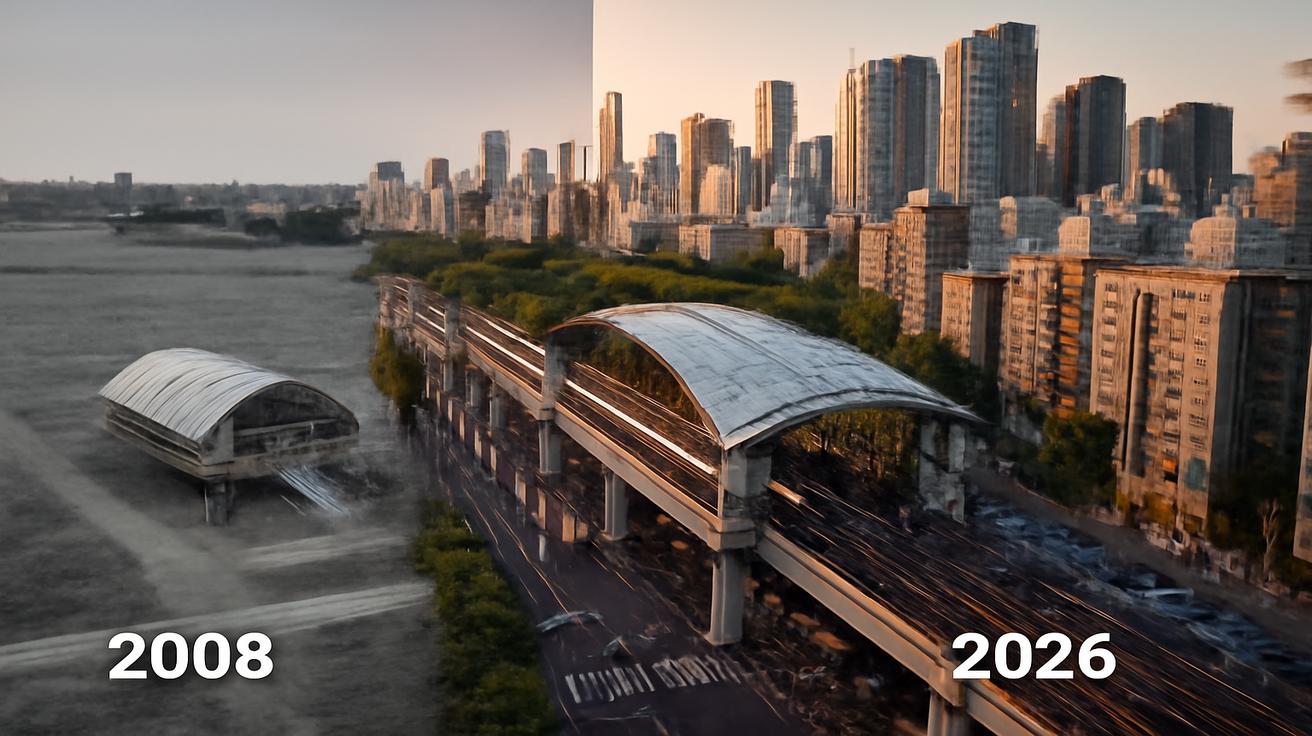
The platform was utterly silent, except for the soft electric hum of lights and the distant clatter of a maintenance cart. No crowds, no rush-hour announcements, no one running for a train. Just a row of immaculate ticket machines, a pristine tiled floor, and a security guard leaning on a railing as if he were on duty in a museum rather than a metro station. Outside the glass doors: fields, scrubby trees, an empty road stretching into a haze of dust and blue-gray distance. It was 2008, on the outskirts of a Chinese city most of the world couldn’t yet place on a map. And here, in what looked like the middle of nowhere, China had built a full-scale subway station.
The Ghost Stations That Weren’t Mistakes
Back then, the photographs made the rounds on foreign blogs and in newspapers: gleaming escalators rising from brown, empty fields; glass-and-steel entrances standing alone in half-built districts; signage pointing to exits that opened onto nothing but dirt and weeds. Critics called them “ghost stations” and “white elephants,” symbols of waste and overbuilding. Why, people wondered, would a country spend so much money putting metro stations where hardly anyone lived?
The answer, it turns out, was that China wasn’t building for 2008. It was building for 2028, 2038, and beyond.
Like seeds planted ahead of the rainy season, these isolated stations were part of a deliberate, long-range bet: that people, industry, housing, and opportunity would eventually grow up around them. At the time, it felt almost reckless. Today, standing in those same neighborhoods, the air full of horns and chatter and the chime of arriving trains, that old question—why build in the middle of nowhere?—has a very different answer.
How It Felt to Stand in a Station Without a City
Imagine descending a brand-new escalator in 2008 Beijing’s distant suburbs or the fringes of Chengdu or Shenzhen. The rubber handrail still smells faintly of manufacturing plastic. The stainless steel shines so clean it reflects your shoes. Underground, everything is in place: ticket barriers, route maps, bilingual signage. Digital displays tell you a train is coming in three minutes, even though there might be only a handful of passengers waiting.
When you ride that train, you might pop back up into a landscape that feels almost post-apocalyptic: a row of newly planted trees listing in the wind, a billboard for a residential tower that exists only as a rendering, a few migrant workers biking past a skeletal construction site. The disconnect is jarring. The city, it seems, hasn’t arrived yet. The station is ready—but for whom?
To many outside observers, those pictures became easy shorthand for “overbuilding” and looming disaster. Yet within planning bureaus and transport institutes across China, the logic was different. Rail, officials argued, is like a spinal cord: build it first, and the rest of the body can grow around it. In 2008, that sounded theoretical. In 2024, we can finally see what they meant.
China’s Long Game: Building the Tracks Before the Travelers
China’s planners were not guessing at random. They were staring at charts and projections that looked almost impossible: hundreds of millions of people expected to move to cities within a few decades; new districts to be carved out of farmland; factories and tech parks to be plugged into national supply chains. A country of bicycles and smoky buses was morphing into a nation of megacities, and the question was not whether growth would come—it was how to shape it.
Trains, unlike buses, do not pivot easily. A metro line requires tunnels or viaducts, heavy equipment, and years of planning. If you wait until the city is bursting at the seams, you are already too late. So China flipped the usual order. Instead of following development with transit, it tried something bolder: use transit to drive development.
“Transit-oriented development” became a quiet mantra in municipal planning offices. New districts would be platted around metro stops. Residential towers, office parks, universities, and shopping centers would anchor themselves to stations on lines that sometimes opened ahead of their neighbors, like stages built before the actors arrived.
The Stations That Watched Their Cities Grow
Fast-forward a decade. Stand in a once-lonely station from 2008, and the transformation can be disorienting. Where there were scrublands, now there are LED-lit shopping streets. Fields have become housing blocks with laundry fluttering from balconies. The previously empty ticket hall pulses with the afternoon turnover of schoolchildren, office workers, grandparents shepherding toddlers by the hand.
The numbers hint at the scale of this shift:
| Metro Metric | Around 2008 | By Mid‑2020s |
|---|---|---|
| Number of cities with a metro | A few dozen major hubs | Over 50, with extensive networks |
| Typical line length in big cities | A few core lines | Dozens of lines forming dense grids |
| Ridership on many “remote” stations | Sparse, often criticized | Heavy daily use, integrated into neighborhoods |
| Surrounding land use | Vacant land, early construction | Dense residential, commercial, campuses, parks |
For many of those once-empty stations, the gamble paid off. The metro didn’t follow the city; it summoned it.
Why 2008 Looked Like “Nowhere” but Wasn’t
The year 2008 is a powerful marker in China’s modern story. The Beijing Olympics dazzled global audiences, high-speed rail was at the brink of its explosive growth, and cities like Shanghai, Shenzhen, and Guangzhou were stretching outward like living organisms. But look more closely at the footprint of those expansions and you’ll notice a pattern: the outward push often marched along future rail corridors.
Where a foreign visitor might have seen “nowhere”—a place with no shops, no apartments, no obvious life—a planner saw something else entirely: approved zoning plans, incoming infrastructure, memoranda with developers, and national policies nudging people and capital into new districts. The metro stations were not decorative luxuries; they were anchor points for a story that had only just started its first chapter.
The Invisible Maps in the Planners’ Heads
Inside city planning departments, wall-sized maps showed not only where cities existed but where they were intended to grow. Lines of different colors traced future metro routes, linking proposed industrial parks, university towns, airport zones, and residential clusters not yet built. The logic was clear: put a station there early, and that land becomes more valuable, more attractive to developers, and more livable for the future residents.
By embedding transit into these blueprints from the beginning, planners hoped to avoid two all-too-familiar urban fates: endless car dependence and unmanageable congestion. If residents could rely on trains from day one, maybe fewer private cars would fill the new streets. If jobs and homes clustered around stations, maybe commutes would be shorter and cleaner. The “nowhere” of 2008 was already mapped in detail; the rest of the world just couldn’t see it yet.
From Criticism to Case Study: When the Trains Proved Their Point
At the time, not all the critics were foreign. Even within China, some economists worried about debt, underused assets, and stations serving what still looked like empty fields. There were certainly places where ridership lagged behind projections, or where development took longer than optimistic PowerPoints suggested. Yet the larger pattern, as the 2010s and 2020s unfolded, began to vindicate the long game.
Look at the ridership data. Lines that once felt deserted outside peak hours began to show the warm hum of daily life: commuters with ID badges, students with backpacks, grandparents clutching shopping bags from new supermarkets clustered near station exits. Developers, never slow to read the tea leaves, plastered advertisements with phrases like “near Line 3” and “just 500 meters from the metro,” selling the certainty that a station offered in an uncertain future.
The Environmental and Social Dividends
There was another layer to this quiet transformation: the air itself. Early, aggressive investment in metro systems meant that as new districts filled up, they did so with a mass transit backbone already in place. Every trainload of passengers represented hundreds of car trips not taken, tons of emissions not released, hours of gridlock not endured.
In a country wrestling with smog and carbon reduction, these invisible savings add up. The choice to put stations in “nowhere” wasn’t just about prestige or speed; it was also about steering an entire urban civilization toward a slightly different trajectory—one with more steel wheels and fewer exhaust pipes.
Socially, too, metros stitched new zones into the life of the city. A cleaner from an outer district could now reach her downtown job reliably. A student from a far-flung university town could attend an internship in the city core and still get home for dinner. The lonely station in the fields became a bridge between lives and opportunities that might otherwise have remained separate.
The Places Where the Bet Still Hasn’t Paid Off
Of course, the story is not uniformly triumphant. There are still stations where the platforms feel too large for the trickle of passengers. Some “new towns” never fully filled in, or did so more slowly than the engineers expected. In a few cities, lines were built faster than the local economy could reasonably support, leaving fiscal headaches and underused infrastructure.
China’s metro build-out, like any grand experiment, has its uneven patches and uncomfortable lessons. The middle of nowhere, in some cases, remains stubbornly nowhere longer than anyone planned. In others, the type of development that arrived—endless towers with little public space, or isolated office parks—raises questions about what kind of urban life is being created.
The Risk of Planning Too Far Ahead
Planning decades into the future is inherently risky. Demographics shift, industries rise and fall, pandemics scramble mobility patterns overnight. A station that made perfect sense on a 2005 projection might look less justified in the light of a 2020 census. Investing huge sums in fixed infrastructure is a bet that the future will broadly resemble the models—and it doesn’t always.
Yet even where ridership falls short, the physical presence of a station keeps a kind of quiet possibility alive. It signals: this place was meant to be connected. It’s a skeleton key that future policies or shifts in population can still turn. Urban history is full of examples where neglected infrastructure suddenly becomes vital when the city’s center of gravity moves. In that way, many of these remote stations are still loaded dice, waiting for their roll.
What We Understand Now: The “Middle of Nowhere” as a Phase, Not a Place
Looking back from today, the phrase “built in the middle of nowhere” feels less like a geographic description and more like a time-lapse snapshot: a single frame taken too early in a much longer film. In 2008, the fields were real, the emptiness was real, the quiet platforms and idle escalators were real. But they were never meant to be permanent. They were the opening scene.
Urbanization, especially on China’s scale, is a process, not a product. On that timeline, a decade is the blink of an eye. What felt like overreach in the moment often looks like foresight later, once apartments fill up, factories start running, and the daily rhythm of commuters gives meaning to those once-lonely platforms.
We also understand more clearly now how infrastructure shapes behavior, not just responds to it. When a metro arrives before the residents, it invites a different pattern of life. Families deciding where to buy a home, businesses deciding where to locate, universities deciding where to build campuses—all quietly gravitate toward the certainty of a station already humming with electricity, even if the passengers are still sparse.
The Stations as Time Machines
There’s something almost science-fictional about walking through one of those early-built stations and then reimagining what it felt like in 2008. The architecture doesn’t age much; tiles and steel and glass still look young. But the surroundings change, layers of city accreting like rings on a tree. In that sense, the stations function like time machines. They are fixed in space and design, but the world around them slides forward by years, revealing whether the planners’ vision was aligned with reality.
Today, many of those once-mocked “stations to nowhere” are so unremarkably busy that no one pauses to think about their origin story. Riders swipe in, scroll through their phones, tap out, and go home. The best evidence that the gamble worked may be that most people no longer see anything extraordinary about it at all.
Lessons for a World on the Move
As cities everywhere grapple with congestion, climate change, housing crises, and the question of how to grow without breaking themselves, the story of China’s 2008 “nowhere” stations reads like both a warning and an inspiration. It shows the power—and the peril—of building ahead of demand.
One lesson is about courage: the bravery (or audacity) required to spend billions on something that will look foolish for a few years before it looks wise for decades. Another is about humility: the recognition that even the best models can’t predict every twist, and that some stations will never fully realize their promise.
But perhaps the deepest lesson is about time itself. To most of us, a decade feels long. We measure careers, relationships, even countries’ fortunes in such spans. To a metro line, a decade is barely adolescence. Those platforms in fields were, in a sense, an attempt to align human impatience with the slower, steadier rhythms of infrastructure and urban development.
In 2008, China built metro stations in the middle of nowhere. Today, standing on those same platforms, surrounded by the heat of crowds and the smell of street food drifting through station entrances, “nowhere” has turned into somewhere very real—a place people call home, a node in an immense urban web, a reminder that the future sometimes arrives quietly, on rails laid long before we’re ready to ride.
Frequently Asked Questions
Why did China build metro stations where almost nobody lived in 2008?
China expected rapid urban growth and chose to build transit first so new districts would grow around metro lines. Instead of waiting for congestion to appear, planners used stations as anchors to shape where people, housing, and businesses would cluster.
Did those “stations in the middle of nowhere” actually become busy?
In many cases, yes. Over the 2010s and 2020s, new housing, offices, campuses, and malls were built around previously empty stations. Ridership grew steadily, and many once-lonely stops are now fully integrated into dense urban neighborhoods.
Were there failures or underused metro stations?
Some stations still see low ridership, especially in areas where development was slower or smaller than planned. Building far ahead of demand is risky, and not every line has met initial projections. However, the overall pattern has favored increasing use over time.
How did this strategy affect traffic and pollution?
By providing reliable rail options early, new districts relied less heavily on private cars. This reduced potential congestion and emissions. While it didn’t solve all air quality problems, early metro investment helped shift urban travel toward public transit.
What can other countries learn from China’s approach?
Other nations can see the value of planning transit and land use together and the importance of patience: large infrastructure may look underused at first but mature with the city. At the same time, China’s experience reminds planners to balance ambition with realistic projections and fiscal caution.








Leave a Comment