
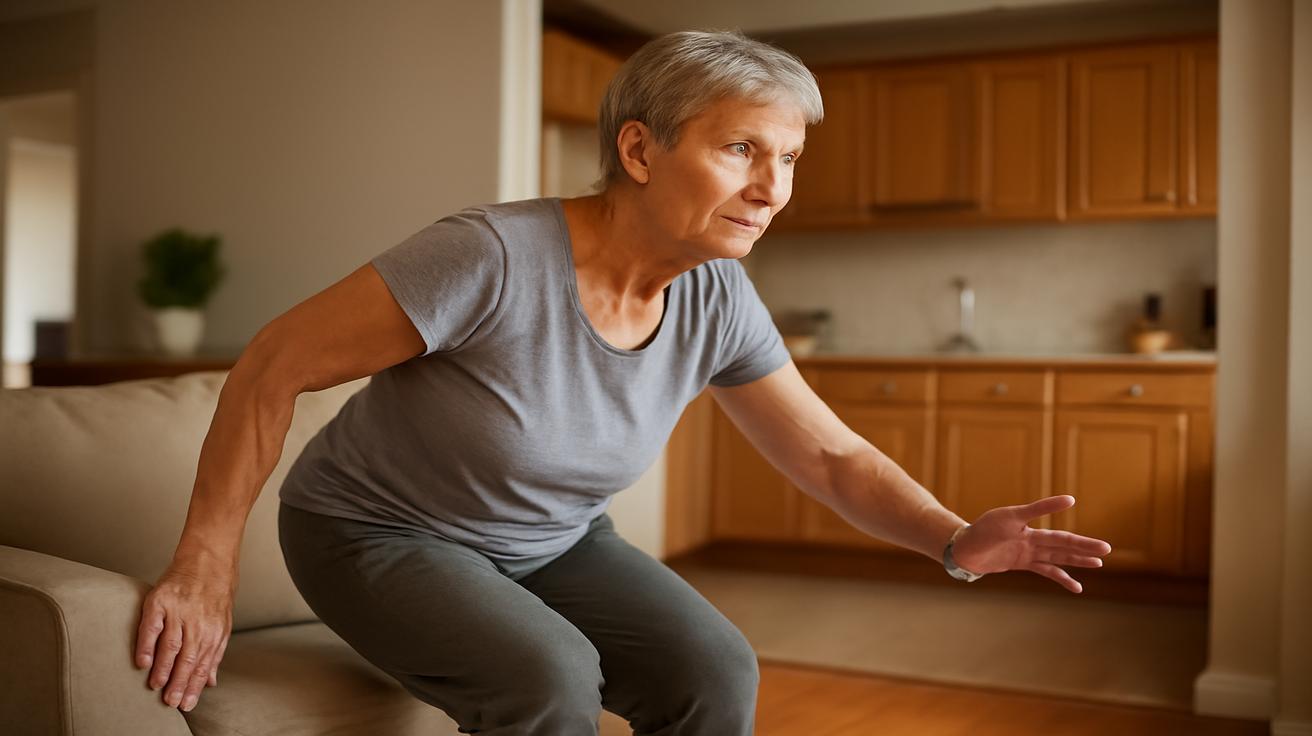
The first time you notice it, it’s not dramatic. Maybe you’re reaching for a mug in the cupboard, and your shoulder answers back with a small, surprising protest. Or you step out of the car after a long drive and your knees feel like they’ve rusted overnight. You laugh it off, because what else can you do? “Getting old,” you say, as if that explains everything. But somewhere in the back of your mind, a quiet question stirs: Is this going to get worse?
When the World Tells You to “Go Hard,” but Your Joints Say “Go Gentle”
Most health advice screams the same message: work out harder, sweat more, push through. High-intensity interval training, boot camps, spin classes—the language of fitness sounds like a military operation. But if you’re over 60, your body is likely telling a different story.
You might feel it when you stand up from a low chair, or when you twist to look over your shoulder while reversing the car. Maybe it’s the ache at the base of your spine after you’ve weeded the garden, or that slow, reluctant stiffness in your fingers when you first wake up. These are not the moments that end up in glossy gym ads. Yet, for your joints, they are the moments that matter most.
It’s easy to believe that if you’re not doing “real exercise,” you’re not doing much at all. But your joints don’t measure effort in miles run or weights lifted. They notice something else entirely: how often you move, how smoothly you move, and how you treat them during the quiet, ordinary hours of your day.
The Secret Life of Your Joints
Inside each joint—your knees, hips, shoulders, fingers—there’s a living landscape you can’t see. Bone meets bone, but not directly; they’re cushioned by cartilage as smooth as glass when it’s healthy. The surfaces glide over each other, bathed in a clear, thick fluid called synovial fluid. Think of it like nature’s own joint oil.
And here’s the detail that changes everything: that “joint oil” isn’t just sitting there. It depends on movement. Each time you bend, straighten, twist, or stretch, the joint surfaces gently press and release, pushing fluid in and out of the cartilage, feeding it, cleaning it, keeping it alive.
Stop moving regularly, and this system slows. The fluid doesn’t circulate as well. Cartilage doesn’t get nourished as effectively. Nearby muscles weaken, and ligaments stiffen. The body quietly reshapes itself around what you ask of it—and if you rarely ask it to move, it learns stillness a little too well.
This is why the small, ordinary movements of your day carry such weight, especially after 60. It’s not about heroic bursts of effort; it’s about the gentle, repeated, respectful conversation you have with your joints every time you stand, reach, turn, and walk.
Everyday Movements That Quietly Protect Your Joints
Imagine for a moment that your joints could leave you a note on the fridge. It wouldn’t say, “Sign up for a triathlon.” It would say, “Move me—softly, often, in all the directions I’m meant to go.”
Here are the kinds of everyday movements that are far more powerful for joint health than most people realize:
1. Getting Up and Down—Without Rushing
Every time you rise from a chair, sofa, or bed, you’re rehearsing a full-body movement that keeps hips, knees, and ankles honest. This action strengthens the big muscles around your joints, which act like shock absorbers.
Try turning it into a quiet practice. When you stand up, plant your feet, lean slightly forward, and press into the floor instead of pulling on the arms of the chair. When you sit down, lower yourself slowly instead of collapsing. Ten of these a day, spread out, can do more for day-to-day function than an hour of occasional punishing exercise.
2. Walking Like It Means Something
Walking is often dismissed as “just walking,” but your joints see it very differently. With every step, you load and unload the joints in your ankles, knees, and hips. Your muscles fire in a coordinated pattern. Blood circulates. Synovial fluid moves.
The magic isn’t in walking far or fast. It’s in walking often. A five-minute walk after breakfast, another around the block in the afternoon, a slow stroll after dinner—these become small rivers of motion that keep your joints from becoming stagnant ponds.
3. Reaching, Twisting, and Bending in Safe, Intentional Ways
The little turns of your spine when you reach for a plate, the stretch of your shoulder when you hang a shirt, the bend of your hip when you tie a shoe—these are how your body remembers its range of motion. When you avoid turns and bends because they feel stiff, your nervous system starts to “forget” them, tightening its map of what feels safe.
Instead, try to reclaim these movements gently. Turn your head to look over each shoulder when you’re waiting for the kettle to boil. Raise your arms overhead and stretch upward once or twice when you walk through a doorway. Slowly circle your wrists while the TV ads play. Each small movement tells your joints: “You are still needed; you are still capable.”
4. Floor-Level Life (Even Just a Little)
Getting down toward the floor and back up again—whether you’re kneeling to wipe a spill, tending a low plant, or playing with a grandchild—engages a complex dance of hips, knees, hands, and spine. If you avoid the floor completely, those joints lose an important kind of practice.
You don’t have to sit on the floor for hours. You might start with kneeling on a cushion for a moment while you sort something, or practicing a controlled half-kneel beside the bed. Even one or two supported floor-level interactions a day can keep your brain and body confident with those transitions.
The Gentle Power of “Movement Snacks”
In a world that loves big workouts, let’s talk instead about small ones—tiny, tasty, barely noticeable “movement snacks.” These are scattered, low-effort movements you slip into the spaces of your day. They ask very little of your willpower and give quite a lot back to your joints.
You might:
- Roll your shoulders in slow circles while waiting for the microwave.
- Rock gently from heel to toe when you’re brushing your teeth.
- Stand on one leg (lightly touching a counter) for a few seconds while you wait for the kettle to boil.
- Open and close your hands against light resistance—like squeezing a soft sponge—while listening to the radio.
- Gently circle your ankles while seated, especially after long periods of sitting.
Each of these takes seconds. None of them will make you break a sweat or change into gym clothes. But over a day, they add up to dozens of extra joint-nourishing moments. They keep tissues warm, ligaments elastic, synovial fluid moving, and muscles ready to respond when you truly need them—like when you trip slightly on a curb or step onto an uneven path.
Here’s a simple way to picture it: a single intense workout is like a thunderstorm. Movement snacks are like a steady, gentle rain. Joints, especially after 60, tend to prefer the rain.
Daily Movements That Matter Most After 60
The question isn’t “Should I exercise?” so much as “How do I want to move through my actual life?” Think about the tasks you’d like to keep doing comfortably in ten or twenty years: carrying groceries, climbing stairs, gardening, traveling, cooking, dressing without help. Then ask: what do those things have in common?
They all rely on a few key categories of movement. The table below organizes them in a way that’s easy to adapt to your day, without needing a gym or fancy equipment.
| Movement Type | Real-Life Example | Simple Daily Version |
|---|---|---|
| Sit-to-Stand | Getting up from a chair or toilet | Slowly stand and sit 5–10 times from a firm chair once or twice a day |
| Stepping & Balance | Climbing stairs, stepping off curbs | March in place while holding a counter for 30–60 seconds |
| Reaching Overhead | Putting items on a shelf, closing curtains | Raise both arms overhead slowly 5–8 times, once or twice per day |
| Twisting & Turning | Looking behind you, reaching into the back seat | Seated, gently turn your torso side to side 5–10 times |
| Bending from the Hips | Tying shoes, picking up something light | With hands on a table for support, hinge forward slightly from the hips a few times |
You can sprinkle these into your day like seasoning. Choose one row from the table and do that movement while waiting for the kettle. Pick another and do it between TV episodes or phone calls. No timers, no heart-rate monitors. Just you, your joints, and a little quiet care.
Listening to the Language of Your Joints
At 60 and beyond, the way you move isn’t just physical; it’s a conversation with the body you’ve lived in for decades. Your joints speak in sensations: a tug, a pinch, a warm looseness, a sharp protest, a dull ache that fades as you move. Learning that language is one of the most useful skills you can practice.
Here’s a simple way to listen:
- Gentle warmth, mild stiffness that eases as you move: This often means your joints are waking up and adapting. It’s usually safe to continue moving gently.
- Sharp, catching, or sudden pain: This is your body’s “not this way” signal. Ease off that motion and try a smaller range or a different angle.
- Pain that lingers or worsens hours after movement: This can mean you did too much, too quickly. It’s a cue to scale down the intensity or duration next time.
Intense exercise often asks you to ignore these signals—to “push through.” For older joints, that can sometimes mean pushing past the line where tissues can adapt safely. Everyday movement, approached with awareness, works differently. You can adjust in real time: making the step smaller, the reach softer, the pace slower, the support more substantial.
Instead of asking, “How hard can I go?” you begin to ask, “How can I stay curious and kind with this body?” That shift alone can transform the way your joints feel over months and years.
Why “Enough” Is Often Much Less Than You Think
One of the quiet truths about movement after 60 is that your body doesn’t need perfection; it needs consistency. You don’t have to train like an athlete to move well as you age. You just have to show up for your joints regularly.
If you walked for five or ten minutes, three times a day; if you practiced getting up and down from a chair with some intention; if you reached overhead and twisted gently a few times each morning; if you bent from the hips instead of rounding your back each time you pick something up—that would already be a powerful joint-care routine. No gym. No stopwatch. No slogans.
Think of it as tending a small, beloved garden. You don’t flood it with water once a month and hope for the best. You give it a little, often. You pull a few weeds, adjust a stake, pinch a dead leaf here, add a bit of compost there. It’s not dramatic. But over seasons, the care shows.
Your joints are that garden. They don’t ask for heroics. They ask for presence.
FAQs About Everyday Movement and Aging Joints
Do I still need any formal exercise if I move a lot during the day?
For many people over 60, a lifestyle rich in varied daily movement—walking, bending, reaching, light carrying—covers much of what joints and muscles need. Formal exercise can be helpful for specific goals (like building strength or improving balance faster), but it doesn’t have to be intense. Gentle strength work, light stretching, or a simple balance routine a few times a week can nicely complement your everyday movements.
What if my joints already hurt when I move?
Pain doesn’t always mean you should stop moving; often, it means you should move differently. Try smaller ranges of motion, slower speed, and more support (like holding the back of a chair). If pain is sharp, sudden, or worsening, or if a joint becomes very swollen or hot, that’s a sign to pause and talk with a healthcare professional. But in many cases, gentle, frequent movement actually reduces everyday joint pain over time.
Is walking really enough for my knees and hips?
Walking is one of the best things you can do for your knees and hips, especially when done regularly and at a pace that feels comfortable. It loads and unloads the joints, strengthens surrounding muscles, and keeps cartilage nourished. For even better support, combining walking with simple strength movements—like chair sit-to-stands or supported step-ups—can help make those joints more resilient.
Can I damage my joints by moving too much in everyday life?
For most people over 60, the bigger risk is moving too little, not too much. That said, sudden spikes in activity—like spending an entire day doing heavy yard work after weeks of being mostly sedentary—can irritate joints. The key is to build up gradually, pay attention to how you feel during and after, and spread your movements throughout the day instead of packing them into rare marathons of effort.
How do I start if I’ve been mostly inactive for years?
Begin smaller than you think you need to. Add one or two short walks a day, even if they’re only five minutes. Choose one movement from the table—like standing up and sitting down slowly—and do it a few times once a day. Notice how your body feels, and only add more when the current level feels manageable. Over weeks and months, these tiny steps create real, noticeable change in how easily your joints move.
What if intense exercise actually feels good to me?
If you enjoy higher-intensity exercise and your joints tolerate it well, that can be perfectly fine—with one important condition: balance. Even if you like challenging workouts, your joints still benefit most from what you do the rest of the day. Keeping up with everyday movement, changing positions often, walking, and moving in multiple directions will help your joints handle the intense sessions more comfortably and for longer into the future.
How will I know if these everyday movements are helping?
Changes can be subtle at first. You might notice you’re less stiff when you wake up, or that standing from a low seat feels easier. Perhaps you can turn to look behind you more freely, or your evening walk leaves you energized instead of drained. These small improvements are your joints quietly saying, “Thank you. More of this, please.” Over time, those tiny gains add up to something powerful: a body that feels more like a companion than a burden as you move through the years ahead.







Leave a Comment