
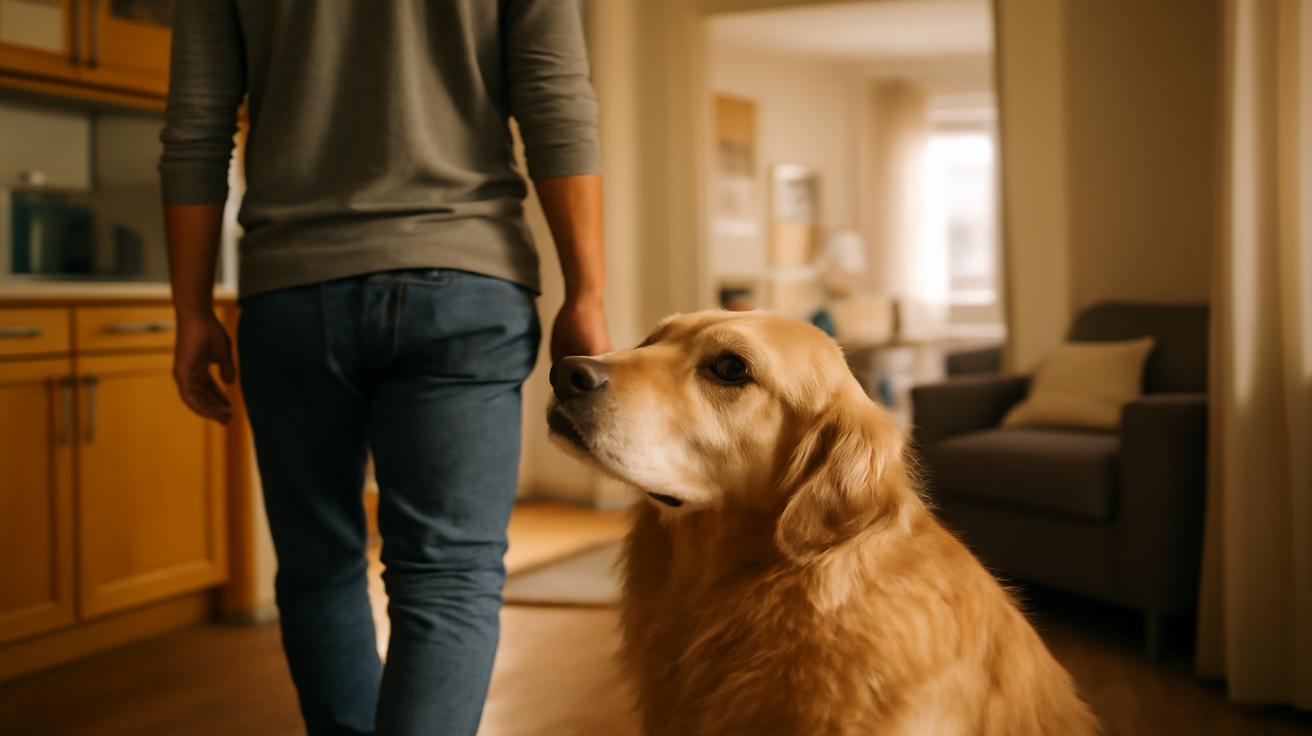
The first time you really notice it is usually something small. You stand up from the couch to refill your tea—and there they are. The soft thump of paws on hardwood. You head to the bathroom—another thump. You move to the bedroom to grab a sweater—four shadowy feet right behind you, matching your rhythm like a tiny, furry echo. You pause, hand on the doorknob, and your dog looks up at you, eyes wide and steady, as if to say, “Where to next?” And that’s when you realize: your dog follows you everywhere.
Why Your Dog Thinks You’re Worth Following
To your dog, you are not just the one who fills the bowl and holds the leash. You are gravity. You are the sun that everything else orbits around. Somewhere behind those curious eyes and wet nose, their ancient wolf ancestors are still whispering that being together is safer than being alone.
In the wild, a solitary animal is a vulnerable one. For dogs, the instinct to stay close to their group—now defined as you and your household—runs deep. When your dog shadows you from room to room, they’re doing what their DNA has been telling them for thousands of years: “Stick with the pack. Stay by the leader.”
But it’s not just old instincts at work. Over generations of living alongside humans, dogs have become experts at reading us. They study our patterns, our moods, the sound of our footsteps, the way our shoulders lift when we’re about to stand up. They know that when you head to the kitchen, magical things sometimes happen—a dropped piece of cheese, the familiar rattle of the treat jar. When you reach for your keys, they know this might be the doorway to a walk, an adventure, or, at the very least, a car ride with the windows cracked just enough to let in the scent of a hundred messages on the wind.
To your dog, following you isn’t just about watching for opportunity. It’s also about staying connected. Every move you make is a quiet conversation: when you sit, when you sigh, when you laugh, when you slam a drawer a little too hard. They are there, taking it all in, learning you, choosing you again and again.
The Many Stories Behind a Velcro Dog
Not every devoted shadow has the same story. Two dogs can trot behind their person all day, yet for completely different reasons. One may be brimming with joy and adoration, the other quietly wrestling with anxiety. The trail of paw prints behind you is a mystery worth gently unraveling.
1. Love, Bonding, and the Comfort of Your Scent
Sometimes, the meaning is simple and tender: they just love you. Your scent is their favorite smell in the world, a blend of home and safety and everything good. Your presence means warmth, soft voices, the familiar beat of your life. Many dogs follow their humans not out of insecurity, but out of genuine affection and comfort.
You’ll notice this kind of following by the softness in their body. Their tail sits at a neutral height, maybe wagging lazily from side to side. Their eyes look relaxed, not wide or intense. When you stop, they might plop down with a sigh or rest their head on your foot, content just to be near, no agenda, no urgency. Their following is like a quiet love song you can feel but not hear.
2. Curiosity and FOMO: The Fear of Missing Out
To your dog, every door you open is a portal to something potentially exciting. A new sound, a crinkling bag, the whisper of fabric as you pull on a jacket. They have no calendar, no to-do list, no emails. Their entire world is unfolding in the here and now, and you are at the center of it.
These dogs trail their humans like tiny detectives. “What are we doing now? Where are we going? Is something fun about to happen?” Their paws are fueled by curiosity. The possibility of missing out is unbearable, so they choose instead to be wherever you are, ready for whatever comes next—whether that’s a walk in the park or just you opening the fridge and staring inside like it holds life’s greatest mysteries.
3. Routine, Habit, and the Dance of Daily Life
Dogs are creatures of ritual. They remember the subtle cues that lead to the important moments of their day. When you pick up a certain bag, it might mean you’re going out. When you open that specific closet, it might mean the leash is coming out. When the sunlight hits the floor just so, that might be the time the mail is delivered and the world gets noisy.
Over time, your dog learns your choreography. They anticipate your movements like they know the next step of a dance. Following you becomes less about decision and more about rhythm: when you move, they move. It’s a form of synchronization, a life shared at the level of small motions and familiar routes from room to room.
Sometimes, your shadow-dog is just a creature of habit. They’ve followed you so many times that not following feels strange.
4. Anxiety, Insecurity, and Clinginess
Then there are the dogs who follow not just because they want to, but because they feel they have to. Their paws carry a quiet edge of worry. What if you disappear? What if they’re left alone and the house is too big and too quiet? These are the dogs whose following can slip into what people call “velcro dog” behavior—always attached, always watching, rarely able to rest unless they feel you near.
You’ll see it in the way they react when a door closes between you. They may whine, scratch, bark, or pant. When you leave the house, they might pace, howl, or destroy things, not out of spite but because fear has nowhere else to go. These dogs often struggle with separation anxiety or general insecurity. Following you is their way of stitching themselves as close as possible to the one stable thing in their world: you.
There is tenderness in this, but also a plea. They are saying, “Please don’t go too far. Please don’t disappear. I’m not quite okay without you yet.”
5. Protection, Guarding, and Quiet Watchfulness
Some dogs follow you because they’ve taken it upon themselves to be your silent bodyguard. They stand when you stand, move when you move, watching the doorway, the hallway, the window. Their following is less exuberant, more measured—a job, not a game.
Guarding breeds, especially, may feel an instinctive pull to keep you within sight. They’re not always anxious, but they’re alert. If the house creaks, if a package hits the porch, if a stranger walks past the window, they want to be right there, between you and the unknown. To them, your safety is their mission.
In their mind, sharing space with you isn’t just companionship—it’s patrol.
Is Your Dog’s Following Healthy or a Red Flag?
Most of the time, your dog trailing behind you like a small, furry satellite is not a problem. In fact, it’s one of the quiet joys of sharing a home with a companion creature who chooses your company over everything else. But sometimes, that devotion can tip into distress.
A helpful way to think about it is this: does your dog follow you out of choice or out of fear? Are they able to relax when you’re in another room, or do they panic the moment you vanish from sight?
Use the table below as a quick reference to sense where your dog might fall on the spectrum:
| Type of Following | Common Signs | What It Usually Means |
|---|---|---|
| Relaxed Companion | Soft body, loose tail, can nap away from you | Healthy bond, affection, comfort in your presence |
| Curious Shadow | Alert posture, perked ears, interest in what you’re doing | Curiosity, interest in activity, fear of missing out |
| Anxious Clinger | Whining when you leave, pacing, panting, destruction, can’t settle | Possible separation anxiety or insecurity |
| Serious Sentinel | Alert but not panicked, watching doors and windows, quick to respond to noises | Protective instinct, guarding behavior |
If your dog can stay calm when you’re out of sight, rest in another room, or entertain themselves with a toy, their habit of following you is likely harmless and sweet. But if their world falls apart the moment you’re gone—even just to take out the trash—that’s when it might be time to look deeper.
Helping Your Dog Feel Safe Without You
If you suspect your dog’s constant trailing is more about panic than preference, you’re not alone. Many dogs struggle with being left alone, especially in an age when more people work from home and routines keep changing. The good news: you can help them learn that solitude doesn’t have to be scary.
It starts small—often smaller than you might think. Close the bathroom door for thirty seconds, then open it and walk back out like nothing happened. Drop a treat or favorite toy in another room, gently encourage them to go find it, and linger behind for a moment. Practice walking from room to room without always inviting them, tossing calm praise or a soft “stay” when they manage to relax away from you.
Try to make your comings and goings unremarkable. No big goodbyes, no explosive reunions. When you leave the house, offer a special chew, puzzle feeder, or stuffed toy that only appears during alone time—an invitation for their mind to focus on something other than the closing door.
Over time, with patience and consistency, most dogs can learn that the world doesn’t end when you step outside. Your return becomes predictable, not miraculous. Your absence becomes a quiet space for them to nap, to dream, to stretch out in a sunspot and let the day move gently around them.
But if their distress is severe—if they’re harming themselves, breaking out of crates, or unable to eat when you’re gone—it’s wise to talk with a professional trainer or veterinarian. Sometimes anxiety is more than a habit; it’s a storm that may need structured support, behavior plans, or even medical help to calm.
When Following You Is a Compliment
For all the worry it can evoke, a dog that follows you everywhere is often paying you one of the highest compliments a dog can give. Out of all the scents in the world, yours is the one they choose to live inside. Out of all the options for where to nap, where to watch, where to simply be, they choose the space that includes you.
If you pause in the kitchen and notice a warm body curled at your feet, that’s a declaration: “This is where I belong.” When they shuffle out of bed to trail your early-morning footsteps down the hall, ears still floppy with sleep, they’re saying, “My day starts when yours does.”
In an age of constant distraction, your dog practices a kind of radical presence. They are not texting from the couch or half-listening while scrolling. They are in every moment with you, fully and unapologetically.
Sometimes, their following might nudge you into new awareness too. You’ll notice how often you pace without purpose, how frequently you move without needing to, how scattered your own steps can be. Meanwhile, your dog’s steps are simple: follow the person you love, then rest.
It is a humble, ordinary devotion, the kind you almost miss if you’re not paying attention.
Making Room for Healthy Space
Love doesn’t disappear in the spaces between you and your dog. In fact, a healthy relationship often includes a little distance. Moments when they’re sprawled in the other room, snoring softly, while you work, cook, or sink into a book. Moments when you walk alone to the mailbox and return to find them exactly where you left them, lifting their head just enough to say, “Oh, you’re back. Good.”
You can gently shape that balance without dimming your dog’s affection. Encourage independence with cozy resting spots that feel safe—a soft bed in a corner where the air is still, a crate draped with a blanket like a tiny den, a mat near a window where they can watch the world go by. Reward them when they choose those places. Toss a treat when they settle, offer a chew when they lie down away from your feet.
Think of it less as teaching them to be alone and more as expanding their map of comfort. You’re not removing yourself from their emotional center; you’re adding more safe islands to their world.
And still, there will be evenings when you stand up from the couch, and before you’ve taken three steps, you hear it: the soft rhythm of paws behind you. You might smile, roll your eyes, or whisper a quiet, affectionate, “You again?” But you’ll also know what’s threaded into that simple act: instinct, history, habit, concern, curiosity, and, most of all, love.
What It Really Means When Your Dog Follows You Everywhere
So what does it mean, truly, when your dog trails you from room to room, a silent, watchful, sometimes slightly clumsy shadow?
It means you matter—perhaps more than you will ever quite understand. It means you have become someone’s safe place, someone’s daily story, someone’s chosen home. It means that in a world full of unpredictability, your dog has decided that the smartest, most comforting, most interesting thing they can do is simply this: stay near you.
Sometimes that nearness will need gentle boundaries. Sometimes it will need patient training and support. But at its heart, your dog’s tendency to follow you everywhere is their way of writing one sentence, over and over again, in the language of paws and presence:
“Where you go, I’ll be there, too.”
Frequently Asked Questions
Why does my dog follow me to the bathroom?
Bathrooms are small, enclosed spaces that smell strongly like you, and your dog may see them as another cozy place to stay close. They also don’t understand the idea of “privacy”—to them, closed doors can be confusing, so they prefer to slip in and keep you company.
Is it bad if my dog follows me everywhere?
Not usually. If your dog can relax when you’re gone and doesn’t show signs of panic—like destructive behavior, nonstop barking, or heavy panting—then their following is likely a normal, affectionate behavior. It only becomes concerning when they can’t cope without you.
Does my dog follow me because I’m the “alpha”?
Modern behavior science suggests it’s less about being an “alpha” and more about being a source of safety, resources, and companionship. Your dog follows you because you’re important to them, not because they see you as a strict pack leader.
How can I help my dog be more independent?
Start small. Reward your dog for settling on a bed or mat away from you, create positive alone-time with special chews or puzzle toys, and keep departures and arrivals calm. Gradually increase the time they spend in another room, and be patient as their confidence grows.
Should I ignore my dog when they follow me?
You don’t need to ignore them, but you also don’t have to reinforce the behavior every time. Offer occasional calm praise or a gentle pat, while also encouraging them to relax on their own bed or space. The goal is balance: connection without dependence.








Leave a Comment