
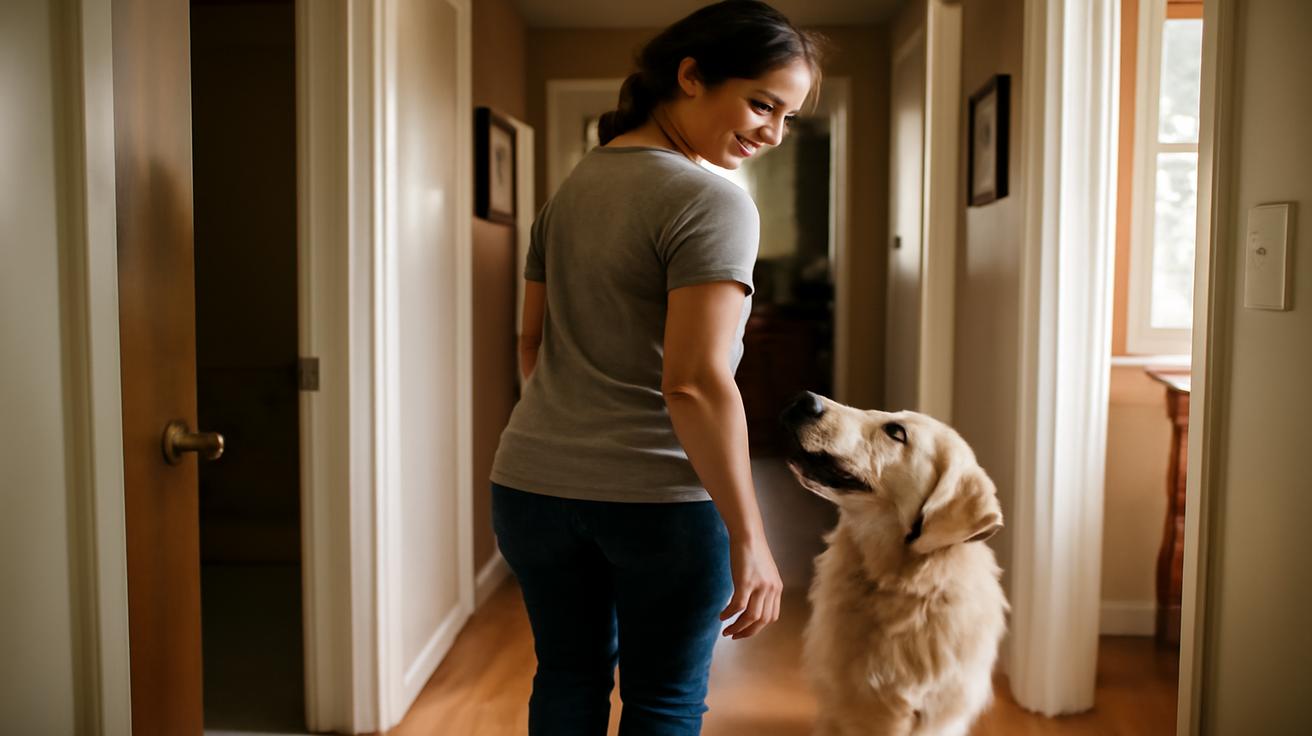
The first time you notice it, you’re halfway down the hallway, socks whispering across the floor, when you feel it—that soft, insistent presence at your heels. You glance back. There they are. Your dog. Same pace. Same direction. Same quiet determination. You stop. They stop. You turn toward the kitchen, they pivot with the smoothness of a shadow changing shape. The house is still, the clock ticking in the background, but everywhere you go, there’s the faint pad of paws, the gentle jingle of a collar, and those watchful eyes that seem to say, “Where you go, I go.”
The Shadow with a Tail: Love, Safety, and the Art of Following
There is something both comical and deeply moving about the way a dog chooses a person and then commits to that choice with unwavering loyalty. Open the bathroom door? There they are, pretending not to look embarrassed. Step out of bed? They unfurl from their sleep like a small, furry sunrise, blinking up at you and waiting for the day to begin—together.
When your dog follows you everywhere, it can feel like you’ve acquired a four-legged satellite in permanent orbit. But beneath the cuteness is a rich, instinctive story—one that starts long before dogs discovered the joys of kitchen crumbs and couch naps.
Dogs are creatures built from layers of history. Long before they were snoring on people’s pillows, their ancestors lived in packs, moving together for safety, survival, and comfort. To be alone was to be vulnerable. To be together was to be alive. That ancient logic hasn’t left them. Instead, it has been re-shaped into something softer, something more domestic: “Stay near the one who feeds you, comforts you, and makes sense of your world.”
And that “one,” more often than not, is you.
Why Your Dog Chooses You as Their Moving Home Base
Picture your daily routine as a collection of invisible paths only your dog can see. From bed to coffee maker. From desk to door. From couch to window. In your dog’s mind, you are the warm center of their map. Following you is less about clinginess and more about orientation. You are how they locate themselves in a sometimes confusing, noisy, unpredictable world.
There are a handful of powerful reasons your dog may choose to be your fuzzy shadow:
- Attachment: They see you as their primary source of safety and comfort.
- Curiosity: You’re the one who opens doors, moves objects, and makes life interesting.
- Routine tracking: Dogs quickly learn patterns. You move; something usually happens—food, walks, play, attention.
- Pack instinct: Sticking together still feels like the “right” way to live.
Sometimes, it’s as simple as this: your dog follows you because, in their eyes, you are everything that is good and important and worth watching. You are their favorite channel.
Velcro Dogs and Heartstrings: When Closeness Feels Like Love
There’s a term many dog guardians whisper with a mix of pride and exasperation: the “Velcro dog.” You know the type—the dog who believes personal space is a myth and that a bathroom door is an insult.
For many dogs, following you isn’t just a habit; it’s a physical expression of how attached they feel. Think of attachment like an invisible leash between you and your dog’s heart—loose and relaxed when you’re nearby, taut and buzzing when you’re away.
Dogs form what behaviorists call a “secure base” with their favorite humans. You are that base. Your presence gives them the courage to explore, the calm to rest, and the reassurance to handle the small oddities of daily life—like the mail carrier, or that one trash can that looks suspicious every Thursdays.
You might notice how this plays out in small, quiet moments:
- They sigh and flop down once you settle in one place, like their job is now temporarily done.
- They check in with you visually, glancing up from a toy or from across the room, as if to say, “Still here? Good.”
- They may walk just close enough that your hand “accidentally” brushes their head or back.
Your dog’s habit of following you might be, at its core, a constant, wordless love letter—one written in footsteps and wagging tails.
Security, Trust, and the Unspoken Promise
When a dog trusts you completely, your presence becomes more than familiar—it becomes grounding. Think of how you feel when you’re with someone who makes the world feel quieter and safer, just by being there. That’s what you are to your dog.
Following you can also be their way of confirming that everything is okay. The strange creak in the hallway, the unfamiliar guest at your door, even the sound of thunder outside—all of these feel less intense when they’re processed through the filter of your presence. If you’re calm, they can be calm. If you get up and move toward something, it must be worth paying attention to.
In many ways, your dog is monitoring your emotional weather as much as your physical movements. They learn when your step is light with joy, or heavy with stress. And they stay, close enough to read you, and sometimes close enough to lean into you when you need the weight of another living creature against your leg.
Neediness or Normal? When Following Becomes Clingy
Of course, there’s a difference between “sweetly devoted” and “can’t be alone for thirty seconds without panicking.” To understand what your dog’s following behavior means, it helps to look closely at the rest of their body language and daily habits.
Here’s a simple comparison to help you notice the difference between healthy attachment and something edging into anxiety:
| Behavior | Healthy Follower | Possibly Anxious |
|---|---|---|
| When you move to another room | Follows calmly, relaxed body, soft eyes | Rushes, pants, whines, seems restless |
| When you close the door | Waits nearby, maybe lies down or naps | Barks, scratches, cries, can’t settle |
| When you actually leave the house | May watch you leave, then relaxes, eats, or sleeps | Paces, howls, destroys objects, has accidents |
| General demeanor | Curious, playful, able to be independent at times | Hyper-focused on you, struggles to rest unless you’re right there |
Following, by itself, isn’t a red flag. Many confident, well-adjusted dogs simply enjoy being where their people are. They’ll follow you from room to room, then sprawl out, belly exposed, snoring peacefully while you answer emails or fold laundry.
But when following is laced with frantic energy—whining, trembling, over-the-top greetings every time you return, destructive behavior when you’re gone—it may be pointing to separation anxiety or a lack of confidence about being alone.
Context Is Everything
Think of your dog’s following behavior as one page in a larger story. Are they eating well? Sleeping deeply? Showing curiosity about the world, sniffing, exploring, playing, even if you’re not directly involved? Those are signs of a balanced emotional life.
If, instead, your dog seems unable to relax unless you’re within arm’s reach—if they follow you with a furrowed brow and a tight body, if their energy spikes the second you pick up your keys—then it’s less about devotion and more about distress. They’re not just following you; they’re clinging to you.
In those cases, their message is less “I love you” and more “I’m scared without you.” And that’s an important difference.
How Your Dog’s History Shapes Their Need to Be Near You
Every dog carries a quiet biography, one that often explains why they are the way they are. If your dog follows you like a soft shadow, part of the reason may be written in what came before you.
Dogs who have been rehomed, abandoned, or spent long stretches in shelters may arrive in your life with a heightened awareness of absence. They have known what it is to lose someone, even if they can’t name it the way humans do. When they finally bond with a person who feels safe, that bond may come with a certain intensity. “You’re mine now,” their steps seem to say. “Please don’t disappear.”
Breed tendencies can also weave into this pattern. Certain breeds were created to work closely with humans—shepherds tracking the farmer, spaniels flushing birds at a hunter’s heel, toy breeds whose job was simply to keep laps warm. For these dogs, staying close isn’t just emotional; it’s occupational. They’re doing exactly what history has asked them to do.
Then there’s the quieter influence of lifestyle. If your dog has spent most of their life constantly at your side—sleeping on your bed, lounging near your desk, riding along for errands—they may have simply never had the chance to practice solitude. You are their default environment.
None of this is wrong. But understanding the why behind their behavior can help you respond with more empathy and better support.
Reading the Body: Little Clues in Ears, Eyes, and Tails
When your dog trails behind you, look back sometimes—not just at the fact that they’re there, but at how they’re there. Their body language is a running commentary on their emotional state.
- Relaxed follower: Ears at ease, mouth slightly open, tail loose, maybe gently swaying. They’re just hanging out, interested but calm.
- Anxious follower: Ears held back, pupils dilated, tail low or tucked, body a little stiff. They track every move like a lifeline.
- Working mindset: Focused eyes, alert ears, tail neutral or raised, steps intentional. Herding or guardian breeds may shadow you like they’re on duty.
In these quiet, physical details, your dog is always telling you how they feel about being near you—and about the possibility of being away from you.
Helping Your Dog Feel Secure Without Being Your Shadow
If your dog’s following is gentle, relaxed, and doesn’t interfere with their ability to rest or be alone sometimes, you can mostly just enjoy the companionship. It’s one of the sweetest parts of sharing a home with a dog—that small shape moving with you through the rhythm of the day.
But if you sense that their devotion has tipped into dependency, you can help them find a calmer balance, without dimming the bond you share.
Teaching the Art of Comfortable Distance
Independence for a dog isn’t about pushing them away; it’s about teaching them that safety doesn’t vanish when you step aside. A few gentle practices can help:
- Create cozy “stations” away from you: Place a soft bed or mat a few steps away from where you usually sit or work. Reward your dog when they choose to lie there with a chew or a stuffed toy. Over time, gradually increase the distance.
- Practice short, calm separations: Step into another room for just a few seconds, then return as if it’s no big deal. No emotional goodbyes, no dramatic reunions. Slowly build up the time.
- Pair alone-time with good things: Reserve special chews or puzzle toys for moments when you’re not in the same room. Let absence predict something enjoyable, not stressful.
- Keep your own energy soft and steady: Dogs read us. If leaving always feels tense or guilty, they’ll notice.
In teaching your dog that being alone is survivable, even pleasant, you’re offering them something profound: the ability to feel safe inside their own skin, even when you aren’t within sight.
And as that confidence grows, their following becomes less of a desperate tether and more of a gentle choice.
What Your Dog Is Really Saying When They Follow You
Watch your dog the next time they rise to trail behind you. Notice the tiny decisions: the way they stretch first, or the sleepy squint in their eyes as they shuffle down the hallway. Listen for the soft rhythm of their paws, the whisper of their fur brushing doorframes. These are not grand gestures. They’re everyday vows.
Sometimes, your dog’s message is simple: “I like being wherever you are.” Sometimes it’s layered with old stories and hidden worries: “Please don’t leave me behind again.” Sometimes, especially in older dogs, it’s simply habit, the worn path of a life spent in step with you.
We live in a world that moves fast, that measures worth in productivity and screens and schedules. A dog who follows you everywhere is, in some small way, a rebellion against that pace. They invite you into a slower awareness: of footsteps, of shared space, of presence.
To be followed is to be witnessed. To be shadowed is to be chosen.
So the next time you turn around and nearly trip over a familiar furry body, pause for a heartbeat. Meet their eyes. Offer a quiet scratch under the chin, a soft word. There, in that tiny moment, is the whole story:
You, moving through your human life.
Your dog, choosing, again and again, to walk it with you.
FAQ: If Your Dog Follows You Everywhere
Why does my dog follow me from room to room?
Your dog likely follows you because they feel attached and safe with you. Dogs are social animals, and many see their person as the center of their world. Following you helps them stay oriented, entertained, and reassured.
Is it normal for my dog to follow me into the bathroom?
Yes, it’s very common. Dogs don’t really understand the concept of “privacy” the way humans do. To them, a closed door can feel like an unnecessary barrier between them and their favorite person. As long as they’re calm and not distressed when the door is closed, it’s harmless.
How do I know if my dog’s following is a sign of separation anxiety?
Look at what happens when you’re actually separated. If your dog panics—barks, howls, destroys things, trembles, or has accidents when left alone—it may be separation anxiety. If they simply follow you but can relax and nap when you’re gone, it’s more likely normal attachment.
Can I accidentally encourage clingy behavior?
Yes. Constantly having your dog with you, never practicing short separations, and making a big deal when you leave or return can all reinforce clinginess. Balanced routines that include rest, independent play, and calm departures can help your dog feel more secure.
Should I stop my dog from following me everywhere?
You don’t have to stop it if it’s not causing problems. Many people enjoy the companionship. But if your dog seems anxious, or if their need to be near you interferes with their ability to rest or be alone sometimes, it’s wise to gently teach them that distance can be safe and comfortable, too.
Does my dog following me mean I’m their favorite?
Often, yes. Dogs tend to follow the person they feel most bonded to, or the one who is most interesting, attentive, or consistent in their care. That said, some dogs spread their affection around evenly and may follow whoever is currently moving or doing something engaging.
Will my dog grow out of following me everywhere?
Puppies often follow more intensely and may naturally become a bit more independent with age and confidence. However, many adult dogs still enjoy trailing their humans out of habit and affection. With gentle training, you can shape that behavior into a comfortable, balanced closeness that works for both of you.




Leave a Comment